

 登录
登录
四、任务型阅读
阅读下面短文,在文章后表格中第1—8小题的空格里填入一个最恰当的单词,第9、10小题不少于5词。
体裁:说明文
主题:中华文化
难度: ★★★★★
建议用时: 8 min
正确率: /10
新素养·文化意识 A special show on “Folk(民间) Houses in China” took place in the RCF Experimental School in Beijing on September 17. Around 100 models of folk houses made by students were on show, including homes from canal towns in the area south of the Yangtze River, Xizang and other places. Students created their beautiful models by completing their own DIY jobs.
Gao Ruidi, 13, from Jiangsu
In the area south of the Yangtze River, people live beside the river. I love people's lifestyles there. So I decided to make a group of buildings to show this, including a river with a bridge, classic houses and a pavilion(亭). When I made it, the pavilion kept falling over. To fix this, I finally changed from using plasticine(橡皮泥) to wooden sticks. At last, I made it. With this experience, I saw the beauty of traditional folk houses.
Wu Maolin, 13, from Anhui
I found Ma Tou Walls in the area south of the Yangtze River interesting because they looked like staircases(楼梯). Before making my model, I looked up why they were built this way. In these areas, houses are built close together, so if one house catches fire, it could quickly spread(传播) to others. To stop this, people build Ma Tou Walls that rise(上升) above the roofs. While making the model, I used mortise and tenon joints to make the house stronger. By doing this, I knew ancient people were so clever. And it also helped me learn more about traditional Chinese culture.
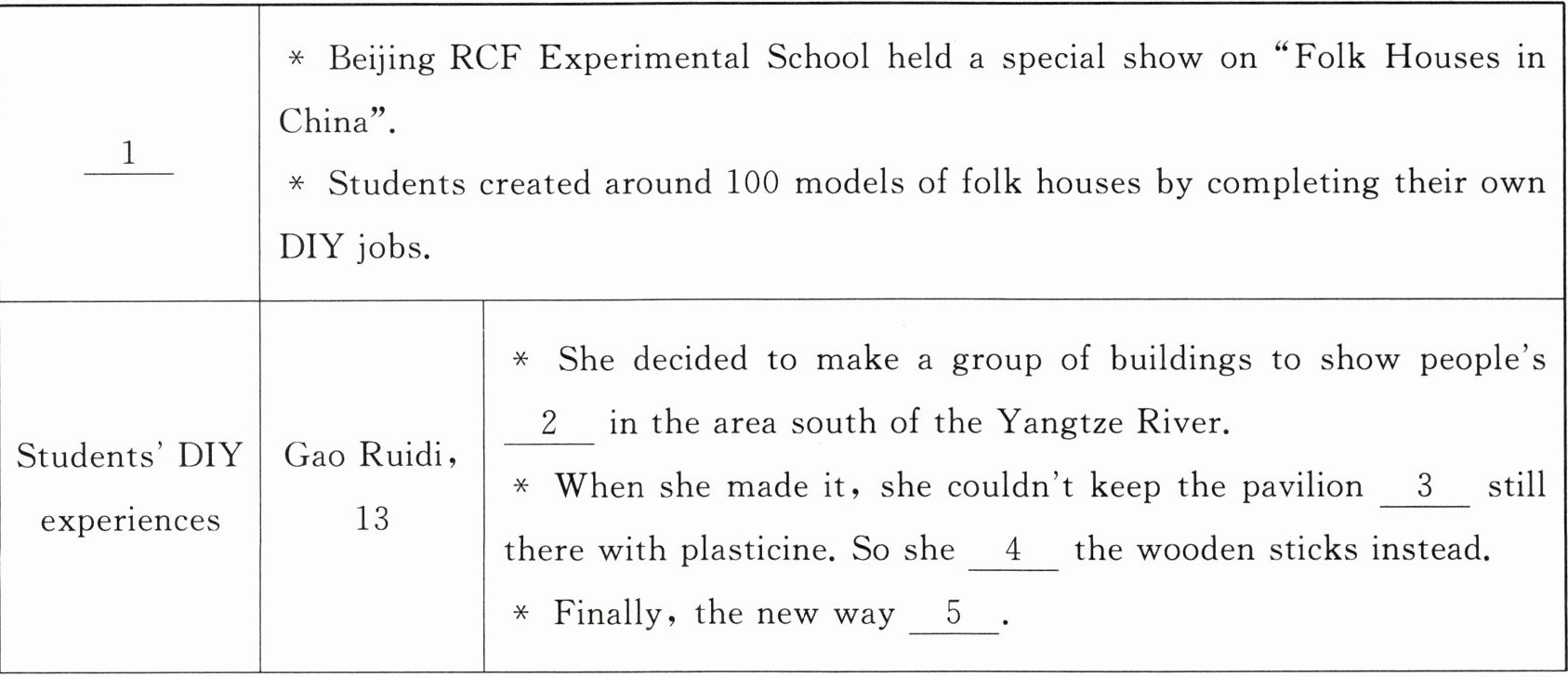

1.
2.
3.
4.
5.
6.
7.
8.
9.
10.
阅读下面短文,在文章后表格中第1—8小题的空格里填入一个最恰当的单词,第9、10小题不少于5词。
体裁:说明文
主题:中华文化
难度: ★★★★★
建议用时: 8 min
正确率: /10
新素养·文化意识 A special show on “Folk(民间) Houses in China” took place in the RCF Experimental School in Beijing on September 17. Around 100 models of folk houses made by students were on show, including homes from canal towns in the area south of the Yangtze River, Xizang and other places. Students created their beautiful models by completing their own DIY jobs.
Gao Ruidi, 13, from Jiangsu
In the area south of the Yangtze River, people live beside the river. I love people's lifestyles there. So I decided to make a group of buildings to show this, including a river with a bridge, classic houses and a pavilion(亭). When I made it, the pavilion kept falling over. To fix this, I finally changed from using plasticine(橡皮泥) to wooden sticks. At last, I made it. With this experience, I saw the beauty of traditional folk houses.
Wu Maolin, 13, from Anhui
I found Ma Tou Walls in the area south of the Yangtze River interesting because they looked like staircases(楼梯). Before making my model, I looked up why they were built this way. In these areas, houses are built close together, so if one house catches fire, it could quickly spread(传播) to others. To stop this, people build Ma Tou Walls that rise(上升) above the roofs. While making the model, I used mortise and tenon joints to make the house stronger. By doing this, I knew ancient people were so clever. And it also helped me learn more about traditional Chinese culture.
1.
Introduction
2.
lifestyles
3.
standing
4.
used
5.
worked
6.
interest
7.
after
8.
higher
9.
Ancient people were so clever./The cleverness of ancient people.
10.
The importance of traditional Chinese culture./More about traditional Chinese culture.
答案
【语篇解读】本文是一篇说明文。文章主要介绍了北京市人朝分实验学校举办的“中国民居”特别展览,学生制作了房屋模型。
1. Introduction 【解析】根据表格右侧的内容可知,此处是活动简介;根据“Students”和“Conclusion”可知此处首字母需大写。故填Introduction。
2. lifestyles 【解析】根据第二段“I love people's lifestyles there. So I decided to make a group of buildings to show this”可知她用建筑展示江南地区的生活方式。故填lifestyles。
3. standing 【解析】根据第二段“When I made it, the pavilion kept falling over.”可知她用橡皮泥做的亭子不能站立;keep sb/sth doing表示“使某人/某物保持做……”,fall over与stand still意思相反。故填standing。
4. used 【解析】根据第二段“To fix this, I finally changed from using plasticine to wooden sticks.”可知为了让亭子站立,她改用木棍而不是橡皮泥;句子时态为一般过去时。故填used。
5. worked 【解析】根据第二段“At last, I made it.”可知最后这种新的方法奏效了;句子时态为一般过去时。故填worked。
6. interest 【解析】根据第三段“I found Ma Tou Walls in the area south of the Yangtze River interesting because they looked like staircases.”可知他对马头墙很感兴趣;show a great interest in表示“对……非常感兴趣”。故填interest。
7. after 【解析】根据第三段“Before making my model, I looked up why they were built this way.”可知他查阅了马头墙独特建造方式的原因之后制作了模型。故填after。
8. higher 【解析】根据第三段“To stop this, people build Ma Tou Walls that rise above the roofs.”可知马头墙比屋顶更高。故填higher。
9. Ancient people were so clever./The cleverness of ancient people. 【解析】根据第三段“By doing this, I knew ancient people were so clever.”可知学生制作房屋模型明白了古人的智慧。故填Ancient people were so clever./The cleverness of ancient people.。
10. The importance of traditional Chinese culture./More about traditional Chinese culture. 【解析】根据第三段“And it also helped me learn more about traditional Chinese culture.”可知制作房屋模型帮助学生更多地了解了中国传统文化。故填The importance of traditional Chinese culture./More about traditional Chinese culture.。
1. Introduction 【解析】根据表格右侧的内容可知,此处是活动简介;根据“Students”和“Conclusion”可知此处首字母需大写。故填Introduction。
2. lifestyles 【解析】根据第二段“I love people's lifestyles there. So I decided to make a group of buildings to show this”可知她用建筑展示江南地区的生活方式。故填lifestyles。
3. standing 【解析】根据第二段“When I made it, the pavilion kept falling over.”可知她用橡皮泥做的亭子不能站立;keep sb/sth doing表示“使某人/某物保持做……”,fall over与stand still意思相反。故填standing。
4. used 【解析】根据第二段“To fix this, I finally changed from using plasticine to wooden sticks.”可知为了让亭子站立,她改用木棍而不是橡皮泥;句子时态为一般过去时。故填used。
5. worked 【解析】根据第二段“At last, I made it.”可知最后这种新的方法奏效了;句子时态为一般过去时。故填worked。
6. interest 【解析】根据第三段“I found Ma Tou Walls in the area south of the Yangtze River interesting because they looked like staircases.”可知他对马头墙很感兴趣;show a great interest in表示“对……非常感兴趣”。故填interest。
7. after 【解析】根据第三段“Before making my model, I looked up why they were built this way.”可知他查阅了马头墙独特建造方式的原因之后制作了模型。故填after。
8. higher 【解析】根据第三段“To stop this, people build Ma Tou Walls that rise above the roofs.”可知马头墙比屋顶更高。故填higher。
9. Ancient people were so clever./The cleverness of ancient people. 【解析】根据第三段“By doing this, I knew ancient people were so clever.”可知学生制作房屋模型明白了古人的智慧。故填Ancient people were so clever./The cleverness of ancient people.。
10. The importance of traditional Chinese culture./More about traditional Chinese culture. 【解析】根据第三段“And it also helped me learn more about traditional Chinese culture.”可知制作房屋模型帮助学生更多地了解了中国传统文化。故填The importance of traditional Chinese culture./More about traditional Chinese culture.。
解析
【分析】
本题为结合中华文化主题的任务型阅读题,解题思路如下:1. 快速通读全文,把握文章主旨(介绍北京市某实验学校举办的“中国民居”展览,学生制作相关模型的活动);2. 针对1-8小题,定位原文对应段落,结合语境、词性、时态、固定搭配等确定恰当单词;3. 针对9-10小题,结合两位学生的感悟,组织符合文意且不少于5词的语句。
【解析】
1. 根据表格结构及原文对活动的开篇介绍,此处需填活动简介,首字母大写,故填Introduction;
2. 根据第二段Gao Ruidi的表述“I love people's lifestyles there. So I decided to make a group of buildings to show this”,可知她用建筑展示江南地区的生活方式,故填lifestyles;
3. 根据第二段“When I made it, the pavilion kept falling over”,可知橡皮泥做的亭子无法站立,结合keep的用法,故填standing;
4. 根据第二段“To fix this, I finally changed from using plasticine to wooden sticks”,可知她改用木棍,时态为一般过去时,故填used;
5. 根据第二段“At last, I made it”,可知新方法奏效了,时态为一般过去时,故填worked;
6. 根据第三段Wu Maolin的表述“I found Ma Tou Walls... interesting”,结合固定搭配show a great interest in,故填interest;
7. 根据第三段“Before making my model, I looked up why they were built this way”,可知他查阅原因后制作模型,故填after;
8. 根据第三段“people build Ma Tou Walls that rise above the roofs”,可知马头墙比屋顶更高,故填higher;
9. 根据第三段“By doing this, I knew ancient people were so clever”,组织符合要求的语句,故填Ancient people were so clever;
10. 根据第三段“And it also helped me learn more about traditional Chinese culture”,组织符合要求的语句,故填The importance of traditional Chinese culture。
【答案】
1. Introduction 2. lifestyles 3. standing 4. used 5. worked 6. interest 7. after 8. higher 9. Ancient people were so clever. 10. The importance of traditional Chinese culture.
【知识点】
任务型阅读、说明文阅读、词汇运用
【点评】
本题以中国传统民居文化为主题,考查学生的信息定位、词汇运用及语句组织能力,引导学生了解传统文化,增强文化意识,难度适中。
【难度系数】
0.5
本题为结合中华文化主题的任务型阅读题,解题思路如下:1. 快速通读全文,把握文章主旨(介绍北京市某实验学校举办的“中国民居”展览,学生制作相关模型的活动);2. 针对1-8小题,定位原文对应段落,结合语境、词性、时态、固定搭配等确定恰当单词;3. 针对9-10小题,结合两位学生的感悟,组织符合文意且不少于5词的语句。
【解析】
1. 根据表格结构及原文对活动的开篇介绍,此处需填活动简介,首字母大写,故填Introduction;
2. 根据第二段Gao Ruidi的表述“I love people's lifestyles there. So I decided to make a group of buildings to show this”,可知她用建筑展示江南地区的生活方式,故填lifestyles;
3. 根据第二段“When I made it, the pavilion kept falling over”,可知橡皮泥做的亭子无法站立,结合keep的用法,故填standing;
4. 根据第二段“To fix this, I finally changed from using plasticine to wooden sticks”,可知她改用木棍,时态为一般过去时,故填used;
5. 根据第二段“At last, I made it”,可知新方法奏效了,时态为一般过去时,故填worked;
6. 根据第三段Wu Maolin的表述“I found Ma Tou Walls... interesting”,结合固定搭配show a great interest in,故填interest;
7. 根据第三段“Before making my model, I looked up why they were built this way”,可知他查阅原因后制作模型,故填after;
8. 根据第三段“people build Ma Tou Walls that rise above the roofs”,可知马头墙比屋顶更高,故填higher;
9. 根据第三段“By doing this, I knew ancient people were so clever”,组织符合要求的语句,故填Ancient people were so clever;
10. 根据第三段“And it also helped me learn more about traditional Chinese culture”,组织符合要求的语句,故填The importance of traditional Chinese culture。
【答案】
1. Introduction 2. lifestyles 3. standing 4. used 5. worked 6. interest 7. after 8. higher 9. Ancient people were so clever. 10. The importance of traditional Chinese culture.
【知识点】
任务型阅读、说明文阅读、词汇运用
【点评】
本题以中国传统民居文化为主题,考查学生的信息定位、词汇运用及语句组织能力,引导学生了解传统文化,增强文化意识,难度适中。
【难度系数】
0.5
