

 登录
登录
五、阅读下面短文,从短文后的选项中选出可以填入空白处的最佳选项。选项中有一项为多余选项。
In recent years, a growing number of Chinese books and movies have been translated into other languages. 1 They have been learning Chinese and interested in Chinese culture. Anna is one of them. Before she translated Jin Yong's novel *Legends of the Condor Heroes*(《射雕英雄传》), Jin Yong was little known to English readers. 2
But Anna managed to do it. Impressed(使……印象深刻) by the book's themes(主题) of good against evil, loyalty(忠诚) and love, as well as Chinese philosophy(哲学), Anna hoped to bring it to new readers. After five years of work, the translated book was published in 2018. 3 Many people think Anna did a good job.
Anna studied at the University of Oxford. 4 After the trip she became interested in China and began to learn Chinese. She calls herself "a clumsy(笨拙的) student", just like Guo Jing from *Legends of the Condor Heroes*, but having a loyal heart.
5 Last year, he translated the animated film *Ne Zha*. He said, "I see China's stronger cultural influences. And we have a growing number of students majoring in Chinese. More Chinese stories will appear in front of the audience."
A. Like Anna, another translator David also learnt Chinese in college.
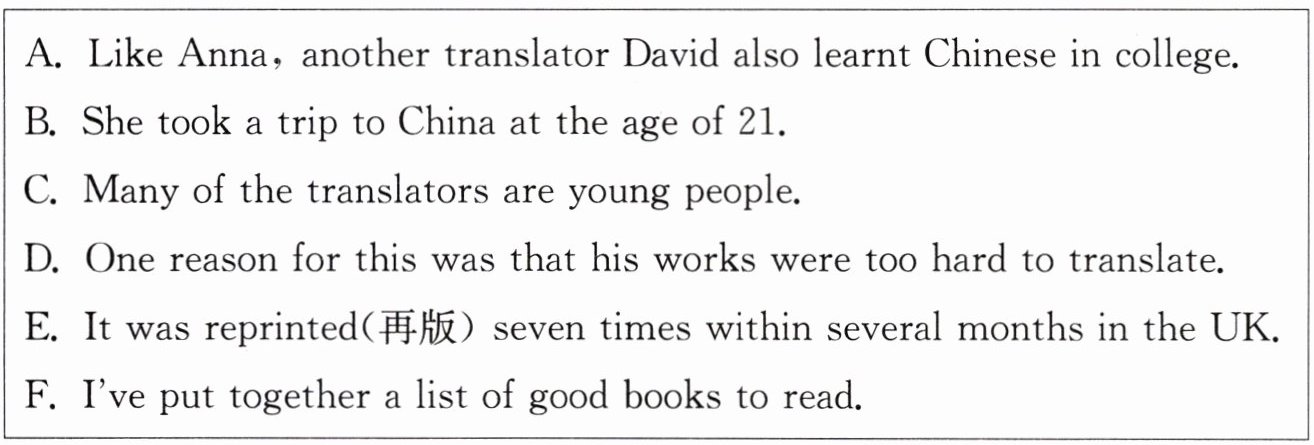
B. She took a trip to China at the age of 21.
C. Many of the translators are young people.
D. One reason for this was that his works were too hard to translate.
E. It was reprinted(再版) seven times within several months in the UK.
F. I've put together a list of good books to read.
1.
In recent years, a growing number of Chinese books and movies have been translated into other languages. 1 They have been learning Chinese and interested in Chinese culture. Anna is one of them. Before she translated Jin Yong's novel *Legends of the Condor Heroes*(《射雕英雄传》), Jin Yong was little known to English readers. 2
But Anna managed to do it. Impressed(使……印象深刻) by the book's themes(主题) of good against evil, loyalty(忠诚) and love, as well as Chinese philosophy(哲学), Anna hoped to bring it to new readers. After five years of work, the translated book was published in 2018. 3 Many people think Anna did a good job.
Anna studied at the University of Oxford. 4 After the trip she became interested in China and began to learn Chinese. She calls herself "a clumsy(笨拙的) student", just like Guo Jing from *Legends of the Condor Heroes*, but having a loyal heart.
5 Last year, he translated the animated film *Ne Zha*. He said, "I see China's stronger cultural influences. And we have a growing number of students majoring in Chinese. More Chinese stories will appear in front of the audience."
A. Like Anna, another translator David also learnt Chinese in college.
B. She took a trip to China at the age of 21.
C. Many of the translators are young people.
D. One reason for this was that his works were too hard to translate.
E. It was reprinted(再版) seven times within several months in the UK.
F. I've put together a list of good books to read.
1.
C
2. D
3. E
4. B
5. A
答案
1.C 2.D 3.E 4.B 5.A
解析
【分析】
这是一篇英语阅读补全(六选五)题型,解题时首先要通读全文,明确文章核心主题是介绍中国文化作品对外翻译的相关年轻译者的故事,再逐空定位上下文的线索:首先观察空后出现的代词、特指名词,找到和选项的呼应关系,排除和全文主题完全无关的多余选项,就能顺理成章匹配出正确答案。第一空后文出现代词They,需要找到能对应指代的群体;第二空前文提到金庸此前在海外知名度低,后文转折说Anna完成了翻译,需要补充知名度低的原因;第三空前文提到译本出版,后文提到大家认可翻译质量,需要补充译本受欢迎的表现;第四空后文出现特指的the trip,需要找到提到旅行的选项;第五空后文出现男性he,介绍另一位译者David,需要找到引出David的选项。
【解析】
1. 空1:前文提到近年越来越多中国书籍、影视作品被翻译成其他语言,后文的They指代空处引出的群体,后文说明该群体长期学习中文、喜爱中国文化,Anna是其中一员。C选项“Many of the translators are young people.” 点明译者群体的特征,后文的They正好指代句中的young people,逻辑衔接通顺。
2. 空2:前文说明在Anna翻译《射雕英雄传》之前,金庸在英语读者中几乎没有知名度,后文转折表述Anna成功完成了翻译工作。D选项“One reason for this was that his works were too hard to translate.” 解释了金庸此前在海外知名度低的核心原因,完美衔接前后文逻辑。
3. 空3:前文提到Anna耗时五年完成的译本在2018年正式出版,后文提到大众都认可Anna的翻译质量。E选项“It was reprinted seven times within several months in the UK.” 描述了译本出版后广受追捧的火爆情况,承接出版的情节,自然引出后文的好评。
4. 空4:后文出现特指表述the trip,说明空处必须提及一次中国旅行的相关内容。B选项“She took a trip to China at the age of 21.” 正好对应后文的the trip,交代了Anna对中国文化产生兴趣的契机。
5. 空5:后文出现男性代词he,开始介绍另一位译者David的翻译经历。A选项“Like Anna, another translator David also learnt Chinese in college.” 从Anna的个人故事自然过渡到另一位译者David,顺畅衔接后文对David的相关介绍。
剩余F选项和全文主题完全无关,是多余选项。
【答案】
1.C 2.D 3.E 4.B 5.A
【知识点】
阅读补全,代词指代,上下文逻辑推理
【点评】
本题属于中等难度的阅读还原题型,核心考察学生对语篇前后呼应线索的捕捉能力,通过指代关系、关键词对应就能快速锁定答案,多余选项干扰性很低,适合学生巩固梳理语篇逻辑的能力。
【难度系数】
0.7
这是一篇英语阅读补全(六选五)题型,解题时首先要通读全文,明确文章核心主题是介绍中国文化作品对外翻译的相关年轻译者的故事,再逐空定位上下文的线索:首先观察空后出现的代词、特指名词,找到和选项的呼应关系,排除和全文主题完全无关的多余选项,就能顺理成章匹配出正确答案。第一空后文出现代词They,需要找到能对应指代的群体;第二空前文提到金庸此前在海外知名度低,后文转折说Anna完成了翻译,需要补充知名度低的原因;第三空前文提到译本出版,后文提到大家认可翻译质量,需要补充译本受欢迎的表现;第四空后文出现特指的the trip,需要找到提到旅行的选项;第五空后文出现男性he,介绍另一位译者David,需要找到引出David的选项。
【解析】
1. 空1:前文提到近年越来越多中国书籍、影视作品被翻译成其他语言,后文的They指代空处引出的群体,后文说明该群体长期学习中文、喜爱中国文化,Anna是其中一员。C选项“Many of the translators are young people.” 点明译者群体的特征,后文的They正好指代句中的young people,逻辑衔接通顺。
2. 空2:前文说明在Anna翻译《射雕英雄传》之前,金庸在英语读者中几乎没有知名度,后文转折表述Anna成功完成了翻译工作。D选项“One reason for this was that his works were too hard to translate.” 解释了金庸此前在海外知名度低的核心原因,完美衔接前后文逻辑。
3. 空3:前文提到Anna耗时五年完成的译本在2018年正式出版,后文提到大众都认可Anna的翻译质量。E选项“It was reprinted seven times within several months in the UK.” 描述了译本出版后广受追捧的火爆情况,承接出版的情节,自然引出后文的好评。
4. 空4:后文出现特指表述the trip,说明空处必须提及一次中国旅行的相关内容。B选项“She took a trip to China at the age of 21.” 正好对应后文的the trip,交代了Anna对中国文化产生兴趣的契机。
5. 空5:后文出现男性代词he,开始介绍另一位译者David的翻译经历。A选项“Like Anna, another translator David also learnt Chinese in college.” 从Anna的个人故事自然过渡到另一位译者David,顺畅衔接后文对David的相关介绍。
剩余F选项和全文主题完全无关,是多余选项。
【答案】
1.C 2.D 3.E 4.B 5.A
【知识点】
阅读补全,代词指代,上下文逻辑推理
【点评】
本题属于中等难度的阅读还原题型,核心考察学生对语篇前后呼应线索的捕捉能力,通过指代关系、关键词对应就能快速锁定答案,多余选项干扰性很低,适合学生巩固梳理语篇逻辑的能力。
【难度系数】
0.7
六、阅读短文并回答问题。
Crosstalk, or *xiangsheng*, is one of China's most popular performing arts. People of all ages love it—kids, grandparents, and everyone in between find it super fun. Even many young students enjoy it after class, laughing along with performers on stage.
No one knows exactly when crosstalk started. Some say the Ming Dynasty, but most think it became a real art during the Qing Dynasty when cities were full of energy. At first, one person did *dankou*(solo acts), telling silly stories or jokes. Later, when three or more joined, it was *qunkou*(group acts). But today, the most common is *duikou*(two-person acts). In *duikou*, there's a "funny leader"(*dougen*) who makes most jokes, and a "helper"(*penggen*) who laughs, asks silly questions, or makes the jokes even funnier. They chat about daily life or silly things, making the audience laugh nonstop.
Crosstalk has four key skills: *shuo*(telling stories/jokes), *xue*(copying sounds—like how cats meow or grandpas cough), *dou*(making people laugh with silly words/faces), and *chang*(singing short folk tunes). These are taught by older actors to new students, learning by doing.
In recent years, online videos have made crosstalk even more popular. In 2008, China named it a "national intangible heritage" to help keep this funny art alive for more people.
So next time you watch, remember: every laugh comes from lots of practice and happy sharing!
1. When do people think crosstalk became an real art form?
2. What was the earliest form of *xiangsheng*?
3. How many forms of *xiangsheng* are introduced in Paragraph 2?
4. What are the key skills in *xiangsheng* according to the text?
5. Do you like *xiangsheng*? Why or why not?
Crosstalk, or *xiangsheng*, is one of China's most popular performing arts. People of all ages love it—kids, grandparents, and everyone in between find it super fun. Even many young students enjoy it after class, laughing along with performers on stage.
No one knows exactly when crosstalk started. Some say the Ming Dynasty, but most think it became a real art during the Qing Dynasty when cities were full of energy. At first, one person did *dankou*(solo acts), telling silly stories or jokes. Later, when three or more joined, it was *qunkou*(group acts). But today, the most common is *duikou*(two-person acts). In *duikou*, there's a "funny leader"(*dougen*) who makes most jokes, and a "helper"(*penggen*) who laughs, asks silly questions, or makes the jokes even funnier. They chat about daily life or silly things, making the audience laugh nonstop.
Crosstalk has four key skills: *shuo*(telling stories/jokes), *xue*(copying sounds—like how cats meow or grandpas cough), *dou*(making people laugh with silly words/faces), and *chang*(singing short folk tunes). These are taught by older actors to new students, learning by doing.
In recent years, online videos have made crosstalk even more popular. In 2008, China named it a "national intangible heritage" to help keep this funny art alive for more people.
So next time you watch, remember: every laugh comes from lots of practice and happy sharing!
1. When do people think crosstalk became an real art form?
During the Qing Dynasty. /Most of people think it became a real art during the Qing Dynasty.
2. What was the earliest form of *xiangsheng*?
Dankou (solo acts). /Dankou was the earliest form of xiangsheng.
3. How many forms of *xiangsheng* are introduced in Paragraph 2?
Three. /There are three kinds of xiangsheng introduced in Paragraph 2.
4. What are the key skills in *xiangsheng* according to the text?
Shuo, xue, dou, and chang.
5. Do you like *xiangsheng*? Why or why not?
Yes, I do. Because it is funny and can make me relax, and it also carries traditional culture. /No, I don't. Because I prefer other performing arts like music or dance. (言之有理即可)
答案
1. During the Qing Dynasty. /Most of people think it became a real art during the Qing Dynasty. 2. Dankou (solo acts). /Dankou was the earliest form of xiangsheng. 3. Three. /There are three kinds of xiangsheng introduced in Paragraph 2. 4. Shuo, xue, dou, and chang. 5. Yes, I do. Because it is funny and can make me relax, and it also carries traditional culture. /No, I don't. Because I prefer other performing arts like music or dance. (言之有理即可)
解析
【分析】
这是一篇介绍中国传统曲艺相声的阅读理解题,前4道为细节查找类题目,第5道为开放性表达题。解题时首先可以划出每道题干的核心关键词,带着关键词回到原文对应段落定位,直接提取匹配的原文信息即可得到前4道题的答案,最后一道开放题结合自身实际想法,表述逻辑通顺、言之有理即可。具体思路:1. 第一题抓关键词"became a real art form"定位到第二段相关语句提取时间;2. 第二题抓关键词"earliest form",对应原文里表示最早的"At first"后的内容;3. 第三题限定范围是第二段,数出段落里介绍的相声表演形式数量即可;4. 第四题抓关键词"key skills"直接定位第三段首句提取内容;5. 第五题按照自身喜好给出合理理由即可。
【解析】
1. 回到原文第二段第二句"Some say the Ming Dynasty, but most think it became a real art during the Qing Dynasty when cities were full of energy",可直接提取对应的时间信息作答。
2. 回到原文第二段第三句"At first, one person did dankou(solo acts), telling silly stories or jokes","At first"对应题干的"earliest",由此得到最早的相声形式。
3. 第二段先后介绍了三种相声形式:单口dankou(solo acts)、群口qunkou(group acts)、对口duikou(two-person acts),总数量为3。
4. 回到原文第三段第一句"Crosstalk has four key skills: shuo(telling stories/jokes), xue(copying sounds—like how cats meow or grandpas cough), dou(making people laugh with silly words/faces), and chang(singing short folk tunes)",直接提取四个核心技能即可。
5. 本题为开放性试题,可选择正面回答说明相声的趣味性、文化属性,也可选择反面回答说明自己的其他喜好,表述通顺合理即可。
【答案】
1. During the Qing Dynasty. /Most of people think it became a real art during the Qing Dynasty.
2. Dankou (solo acts). /Dankou was the earliest form of xiangsheng.
3. Three. /There are three kinds of xiangsheng introduced in Paragraph 2.
4. Shuo, xue, dou, and chang.
5. Yes, I do. Because it is funny and can make me relax, and it also carries traditional culture. /No, I don't. Because I prefer other performing arts like music or dance. (言之有理即可)
【知识点】
英语细节阅读
中国传统曲艺
情景问答表达
【点评】
本题选材贴合中国传统文化非遗主题,既考察学生快速定位文本信息的基础阅读能力,也能让学生在做题过程中了解相声的相关常识,最后一道开放题引导学生输出个人观点,整体没有复杂的推理要求,适合巩固基础阅读能力。
【难度系数】
0.7
这是一篇介绍中国传统曲艺相声的阅读理解题,前4道为细节查找类题目,第5道为开放性表达题。解题时首先可以划出每道题干的核心关键词,带着关键词回到原文对应段落定位,直接提取匹配的原文信息即可得到前4道题的答案,最后一道开放题结合自身实际想法,表述逻辑通顺、言之有理即可。具体思路:1. 第一题抓关键词"became a real art form"定位到第二段相关语句提取时间;2. 第二题抓关键词"earliest form",对应原文里表示最早的"At first"后的内容;3. 第三题限定范围是第二段,数出段落里介绍的相声表演形式数量即可;4. 第四题抓关键词"key skills"直接定位第三段首句提取内容;5. 第五题按照自身喜好给出合理理由即可。
【解析】
1. 回到原文第二段第二句"Some say the Ming Dynasty, but most think it became a real art during the Qing Dynasty when cities were full of energy",可直接提取对应的时间信息作答。
2. 回到原文第二段第三句"At first, one person did dankou(solo acts), telling silly stories or jokes","At first"对应题干的"earliest",由此得到最早的相声形式。
3. 第二段先后介绍了三种相声形式:单口dankou(solo acts)、群口qunkou(group acts)、对口duikou(two-person acts),总数量为3。
4. 回到原文第三段第一句"Crosstalk has four key skills: shuo(telling stories/jokes), xue(copying sounds—like how cats meow or grandpas cough), dou(making people laugh with silly words/faces), and chang(singing short folk tunes)",直接提取四个核心技能即可。
5. 本题为开放性试题,可选择正面回答说明相声的趣味性、文化属性,也可选择反面回答说明自己的其他喜好,表述通顺合理即可。
【答案】
1. During the Qing Dynasty. /Most of people think it became a real art during the Qing Dynasty.
2. Dankou (solo acts). /Dankou was the earliest form of xiangsheng.
3. Three. /There are three kinds of xiangsheng introduced in Paragraph 2.
4. Shuo, xue, dou, and chang.
5. Yes, I do. Because it is funny and can make me relax, and it also carries traditional culture. /No, I don't. Because I prefer other performing arts like music or dance. (言之有理即可)
【知识点】
英语细节阅读
中国传统曲艺
情景问答表达
【点评】
本题选材贴合中国传统文化非遗主题,既考察学生快速定位文本信息的基础阅读能力,也能让学生在做题过程中了解相声的相关常识,最后一道开放题引导学生输出个人观点,整体没有复杂的推理要求,适合巩固基础阅读能力。
【难度系数】
0.7
