

 登录
登录
探究点1 share...with...的用法
share 动词,意为"分享"。share sth with sb表示"把……与……分享"。
To enjoy and share love is the most important thing in her life.
享受和分享爱是她生活中最重要的事情。
情境应用
1. Sharing happiness others makes life more meaningful.
A. by B. with
C. of D. to
2. Helen her daily life on TV last week. (share)
3. The students are encouraged to their learning ways their classmates. (把……与……分享)
share 动词,意为"分享"。share sth with sb表示"把……与……分享"。
To enjoy and share love is the most important thing in her life.
享受和分享爱是她生活中最重要的事情。
情境应用
1. Sharing happiness others makes life more meaningful.
A. by B. with
C. of D. to
2. Helen her daily life on TV last week. (share)
3. The students are encouraged to their learning ways their classmates. (把……与……分享)
答案
1. B
2. shared
3. share; with
2. shared
3. share; with
解析
1. 本题考查固定搭配share sth. with sb.,意为“和某人分享某物”,符合“和他人分享快乐让生活更有意义”的语义,对应选介词with。
2. 本题考查动词的一般过去时,句中时间状语last week(上周)是过去时间的标志,谓语动词要使用share的过去式shared。
3. 本题考查固定搭配share sth. with sb.,不定式符号to后接动词原形,第一空填动词原形share,第二空填介词with,符合“把学习方法和同学们分享”的语义。
2. 本题考查动词的一般过去时,句中时间状语last week(上周)是过去时间的标志,谓语动词要使用share的过去式shared。
3. 本题考查固定搭配share sth. with sb.,不定式符号to后接动词原形,第一空填动词原形share,第二空填介词with,符合“把学习方法和同学们分享”的语义。
探究点2 joke 的用法
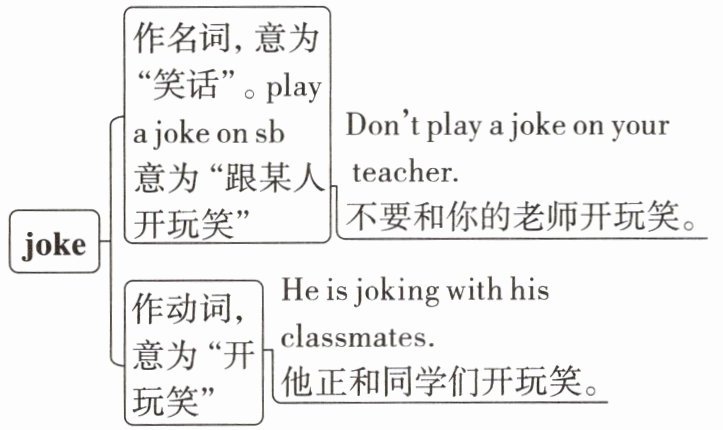
情境应用
1. She with her friends during lunchtime. (joke)
2. Tom often his brother. (开玩笑)
情境应用
1. She with her friends during lunchtime. (joke)
2. Tom often his brother. (开玩笑)
答案
1. is joking(或jokes/joked) 2. plays a joke on
解析
1. 考查joke作动词的用法,joke with sb是固定搭配,意为“和某人开玩笑”,句子描述午餐时段的相关行为,主语she是第三人称单数,可使用现在进行时is joking、一般现在时jokes或一般过去时joked,均符合语境和语法要求。
2. 考查joke作名词对应的固定搭配play a joke on sb,意为“跟某人开玩笑”,句中often表示经常性的动作,时态用一般现在时,主语Tom是第三人称单数,谓语动词play要变为第三人称单数形式plays。
2. 考查joke作名词对应的固定搭配play a joke on sb,意为“跟某人开玩笑”,句中often表示经常性的动作,时态用一般现在时,主语Tom是第三人称单数,谓语动词play要变为第三人称单数形式plays。
探究点3 matter 的用法
1. matter 作动词,意为“要紧”;作名词,意为“问题”。
It doesn’t matter.
不要紧。
I have some important matters to ask you.
我有几件重要的事情要问你。
2. no matter 意为“不论;不要紧”,通常与what、which、who、how、when、where等特殊疑问词连用,引导让步状语从句,“no matter+特殊疑问词”相当于“特殊疑问词+-ever”。
Whatever/No matter what happens to the children, their parents will always be there.
无论孩子们发生什么事,他们的父母总会在他们身边。
情境应用
1. —You don’t look well. What’s the matter?
—
A. It doesn’t matter. B. I think so.
C. Sounds great. D. I have a fever.
2. —Tom, I lost the pen you lent me yesterday. I’m so sorry.
—
A. You are kind. B. It is true.
C. It doesn’t matter. D. I am sorry too.
3. you are, you have to follow the rules of your school as a student.
(不论谁)
1. matter 作动词,意为“要紧”;作名词,意为“问题”。
It doesn’t matter.
不要紧。
I have some important matters to ask you.
我有几件重要的事情要问你。
2. no matter 意为“不论;不要紧”,通常与what、which、who、how、when、where等特殊疑问词连用,引导让步状语从句,“no matter+特殊疑问词”相当于“特殊疑问词+-ever”。
Whatever/No matter what happens to the children, their parents will always be there.
无论孩子们发生什么事,他们的父母总会在他们身边。
情境应用
1. —You don’t look well. What’s the matter?
—
A. It doesn’t matter. B. I think so.
C. Sounds great. D. I have a fever.
2. —Tom, I lost the pen you lent me yesterday. I’m so sorry.
—
A. You are kind. B. It is true.
C. It doesn’t matter. D. I am sorry too.
3. you are, you have to follow the rules of your school as a student.
(不论谁)
答案
1. D
2. C
3. No matter who
2. C
3. No matter who
解析
1. 问句"What's the matter?"用于询问对方身体或状态出现了什么问题,A选项意为“没关系”,B选项意为“我也这么认为”,C选项意为“听起来很棒”,D选项意为“我发烧了”,只有D符合回应身体不适的语境。
2. 上句是对方弄丢了借来的钢笔,向Tom表达歉意,回应他人的道歉常用"It doesn't matter."表示“没关系”,其余选项都不符合该交际场景的逻辑。
3. 根据提示“不论谁”,结合本课时所学no matter的用法,此处用"No matter who",符合"no matter+特殊疑问词"引导让步状语从句的结构。
2. 上句是对方弄丢了借来的钢笔,向Tom表达歉意,回应他人的道歉常用"It doesn't matter."表示“没关系”,其余选项都不符合该交际场景的逻辑。
3. 根据提示“不论谁”,结合本课时所学no matter的用法,此处用"No matter who",符合"no matter+特殊疑问词"引导让步状语从句的结构。
