

 登录
登录
Ⅲ. 用适当的介词填空。
1. He keeps on writing stories and succeeds
2. We are trying to search
3.
4. Fred is friendly because he never laughs
5. We see beautiful swans
6. The ugly duckling was different from the other ducklings
7.
1. He keeps on writing stories and succeeds
in
becoming a writer.2. We are trying to search
for
a new place.3.
To
our surprise, we met Mr Smith on the street.4. Fred is friendly because he never laughs
at
his classmates.5. We see beautiful swans
with
long necks in the zoo today.6. The ugly duckling was different from the other ducklings
in
size and colour.7.
In
the end, he becomes rich and powerful.答案
1. in 2. for 3. To 4. at 5. with 6. in 7. In
解析
【解析】
1. 固定搭配succeed in doing sth表示“成功做某事”,故填in。
2. 固定短语search for表示“寻找”,故填for。
3. 固定表达to one's surprise表示“令某人惊讶的是”,句首单词首字母大写,故填To。
4. 固定短语laugh at表示“嘲笑”,故填at。
5. 介词with表示“带有”,用来描述天鹅的特征,故填with。
6. 介词in表示“在……方面”,此处指在尺寸和颜色方面不同,故填in。
7. 固定短语in the end表示“最后,最终”,句首单词首字母大写,故填In。
【答案】
1. in 2. for 3. To 4. at 5. with 6. in 7. In
【知识点】
固定介词搭配、介词语境运用、固定介词表达
【点评】
本题考查常见介词的固定搭配与语境用法,涵盖多个高频介词短语,能有效检验学生对基础介词知识的掌握程度,帮助学生巩固介词的常用搭配及场景运用能力。
【难度系数】
0.8
1. 固定搭配succeed in doing sth表示“成功做某事”,故填in。
2. 固定短语search for表示“寻找”,故填for。
3. 固定表达to one's surprise表示“令某人惊讶的是”,句首单词首字母大写,故填To。
4. 固定短语laugh at表示“嘲笑”,故填at。
5. 介词with表示“带有”,用来描述天鹅的特征,故填with。
6. 介词in表示“在……方面”,此处指在尺寸和颜色方面不同,故填in。
7. 固定短语in the end表示“最后,最终”,句首单词首字母大写,故填In。
【答案】
1. in 2. for 3. To 4. at 5. with 6. in 7. In
【知识点】
固定介词搭配、介词语境运用、固定介词表达
【点评】
本题考查常见介词的固定搭配与语境用法,涵盖多个高频介词短语,能有效检验学生对基础介词知识的掌握程度,帮助学生巩固介词的常用搭配及场景运用能力。
【难度系数】
0.8
Ⅳ. 综合填空。
hopeful, he, instead of, succeed in, believe, in the end, laugh at, search
In a forest, there was a small rabbit. Winter was coming soon. He had no food for cold days. Some big birds (1)
hopeful, he, instead of, succeed in, believe, in the end, laugh at, search
In a forest, there was a small rabbit. Winter was coming soon. He had no food for cold days. Some big birds (1)
laughed at
him, saying he was too small to find food. But the rabbit didn't (2) believe in
their words. (3) Instead of
sitting and worrying, he (4) searched
for food everywhere every day. He told (5) himself
, “I can do it!” Day by day, he tried his best to (6) succeed in
getting enough food. (7) In the end
, snow fell and winter came. The rabbit had a lot of food to eat. To everyone's surprise, he didn't keep all the food. He gave some to a little bird with nothing to eat. (8) Hopefully
, everyone can keep trying and help others in need.答案
1. laughed at 2. believe in 3. Instead of 4. searched 5. himself 6. succeed in 7. In the end 8. Hopefully
解析
【解析】
1. 根据“saying he was too small to find food”可知大鸟嘲笑兔子,结合全文一般过去时态,故填laughed at。
2. 结合语境,兔子不相信他们的话,“believe in”表示“相信”,didn't后接动词原形,故填believe in。
3. 根据后文兔子积极找食物的行为,可知他没有坐着担心,“Instead of”表示“而不是”,首字母大写,故填Instead of。
4. “search for”是固定短语“寻找”,全文为一般过去时,故填searched。
5. 兔子告诉自己“我能做到”,反身代词himself指代兔子本人,故填himself。
6. “succeed in doing sth.”是固定搭配“成功做某事”,try one's best to后接动词原形,故填succeed in。
7. 根据语境,此处表示最终冬天来临,“In the end”表示“最后,最终”,首字母大写,故填In the end。
8. 此处用副词Hopefully修饰整个句子,表达“满怀希望地”,首字母大写,故填Hopefully。
【答案】
1. laughed at 2. believe in 3. Instead of 4. searched 5. himself 6. succeed in 7. In the end 8. Hopefully
【知识点】
固定短语搭配、反身代词用法、副词作状语
【点评】
本题通过兔子的励志故事考查词汇在语境中的运用,需结合上下文语义和固定搭配解题,同时传递了坚持努力、乐于助人的正能量,对学生的词汇运用和语境理解能力有一定要求。
【难度系数】
0.6
1. 根据“saying he was too small to find food”可知大鸟嘲笑兔子,结合全文一般过去时态,故填laughed at。
2. 结合语境,兔子不相信他们的话,“believe in”表示“相信”,didn't后接动词原形,故填believe in。
3. 根据后文兔子积极找食物的行为,可知他没有坐着担心,“Instead of”表示“而不是”,首字母大写,故填Instead of。
4. “search for”是固定短语“寻找”,全文为一般过去时,故填searched。
5. 兔子告诉自己“我能做到”,反身代词himself指代兔子本人,故填himself。
6. “succeed in doing sth.”是固定搭配“成功做某事”,try one's best to后接动词原形,故填succeed in。
7. 根据语境,此处表示最终冬天来临,“In the end”表示“最后,最终”,首字母大写,故填In the end。
8. 此处用副词Hopefully修饰整个句子,表达“满怀希望地”,首字母大写,故填Hopefully。
【答案】
1. laughed at 2. believe in 3. Instead of 4. searched 5. himself 6. succeed in 7. In the end 8. Hopefully
【知识点】
固定短语搭配、反身代词用法、副词作状语
【点评】
本题通过兔子的励志故事考查词汇在语境中的运用,需结合上下文语义和固定搭配解题,同时传递了坚持努力、乐于助人的正能量,对学生的词汇运用和语境理解能力有一定要求。
【难度系数】
0.6
Ⅴ. 补全对话。
A: (1)
B: I think it's really interesting. (2)
A: I agree with you. (3)
B: When the emperor was wearing nothing in the street, only a child tell the truth.
A: (4)
B: Yes, you're right.
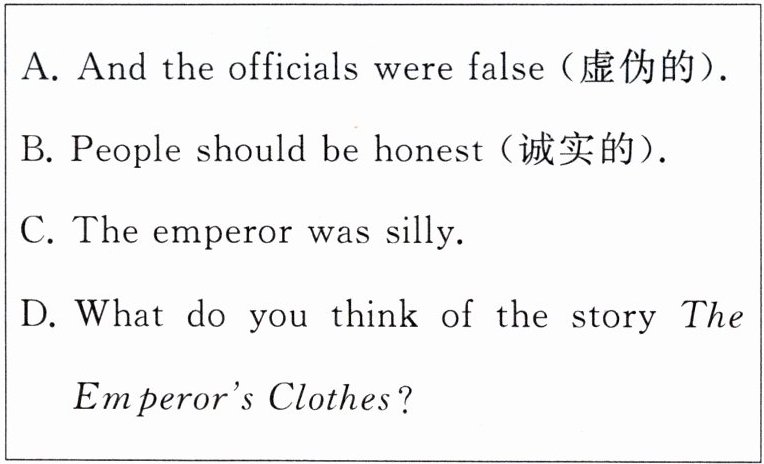
A: (1)
D
B: I think it's really interesting. (2)
C
A: I agree with you. (3)
A
B: When the emperor was wearing nothing in the street, only a child tell the truth.
A: (4)
B
B: Yes, you're right.
答案
DCAB
解析
【解析】
(1) 根据B的回答“I think it's really interesting.”,可知A是在询问对方对《皇帝的新装》的看法,故选D。
(2) B表达对故事的有趣感后,结合故事内容,评价皇帝的愚蠢符合语境,故选C。
(3) A同意B的观点后,接着评价故事里虚伪的官员,A选项契合语境,故选A。
(4) 结合前文“only a child tell the truth”以及B的回应“Yes, you're right.”,此处提出“人们应该诚实”的观点符合逻辑,故选B。综上,答案为DCAB。
【答案】
DCAB
【知识点】
情景交际、补全对话、语篇逻辑
【点评】
本题结合经典故事《皇帝的新装》考查情景对话补全,需结合故事内容与对话逻辑选择合适语句,考查学生对交际语境的把握能力。
【难度系数】
0.7
(1) 根据B的回答“I think it's really interesting.”,可知A是在询问对方对《皇帝的新装》的看法,故选D。
(2) B表达对故事的有趣感后,结合故事内容,评价皇帝的愚蠢符合语境,故选C。
(3) A同意B的观点后,接着评价故事里虚伪的官员,A选项契合语境,故选A。
(4) 结合前文“only a child tell the truth”以及B的回应“Yes, you're right.”,此处提出“人们应该诚实”的观点符合逻辑,故选B。综上,答案为DCAB。
【答案】
DCAB
【知识点】
情景交际、补全对话、语篇逻辑
【点评】
本题结合经典故事《皇帝的新装》考查情景对话补全,需结合故事内容与对话逻辑选择合适语句,考查学生对交际语境的把握能力。
【难度系数】
0.7
