

 登录
登录
6. 如图1-12,在 $ △ A B C $中, $ A B=A C $ $ ∠ B A C=1 2 0° $ ,AD是BC边上的中线,分别以点 C,D为圆心,以大于 $ \frac{1}{2} $ CD长为半径画弧,两弧相交于点M,N。作直线MN分别交 AC,BC于点F,E,连接DF。
(1) $ △ A D F $是等边三角形吗?为什么?
(2) 若 EF的长为2,求 AB的长。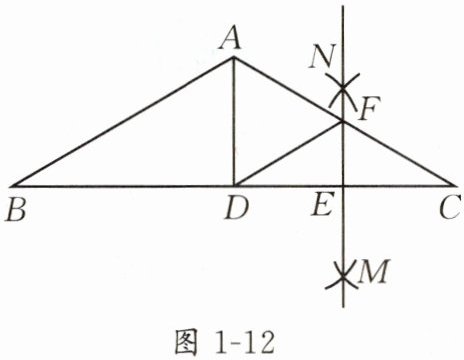
(1) $ △ A D F $是等边三角形吗?为什么?
(2) 若 EF的长为2,求 AB的长。
答案
6. 解:(1)$△ ADF$是等边三角形。
理由:$\because AB=AC$,$∠ BAC=120°$,
$\therefore ∠ B=∠ C=\frac{1}{2}×(180°-∠ BAC)=\frac{1}{2}×(180°-120°)=\frac{1}{2}×60°=30°$。
由作图可知$MN$是$CD$的垂直平分线。
$\therefore DF=CF$。
$\therefore ∠ FDC=∠ C=30°$。
$\therefore ∠ AFD=∠ C+∠ FDC=60°$。
$\because AB=AC$,$AD$是$BC$边上的中线,
$\therefore ∠ DAF=\frac{1}{2}∠ BAC=60°$。
$\therefore ∠ ADF=∠ DAF=∠ AFD=60°$。
$\therefore △ ADF$是等边三角形。
(2)由(1)知$MN$是$CD$的垂直平分线,
$\therefore ∠ FEC=90°$。
$\because ∠ C=30°$,$EF=2$,$\therefore FC=2EF=4$。
$\because DF=FC$,$\therefore DF=4$。
$\because △ ADF$是等边三角形,$\therefore AF=DF=4$。
$\therefore AC=AF+FC=4 + 4=8$。
$\because AB=AC$,$\therefore AB=8$。
理由:$\because AB=AC$,$∠ BAC=120°$,
$\therefore ∠ B=∠ C=\frac{1}{2}×(180°-∠ BAC)=\frac{1}{2}×(180°-120°)=\frac{1}{2}×60°=30°$。
由作图可知$MN$是$CD$的垂直平分线。
$\therefore DF=CF$。
$\therefore ∠ FDC=∠ C=30°$。
$\therefore ∠ AFD=∠ C+∠ FDC=60°$。
$\because AB=AC$,$AD$是$BC$边上的中线,
$\therefore ∠ DAF=\frac{1}{2}∠ BAC=60°$。
$\therefore ∠ ADF=∠ DAF=∠ AFD=60°$。
$\therefore △ ADF$是等边三角形。
(2)由(1)知$MN$是$CD$的垂直平分线,
$\therefore ∠ FEC=90°$。
$\because ∠ C=30°$,$EF=2$,$\therefore FC=2EF=4$。
$\because DF=FC$,$\therefore DF=4$。
$\because △ ADF$是等边三角形,$\therefore AF=DF=4$。
$\therefore AC=AF+FC=4 + 4=8$。
$\because AB=AC$,$\therefore AB=8$。
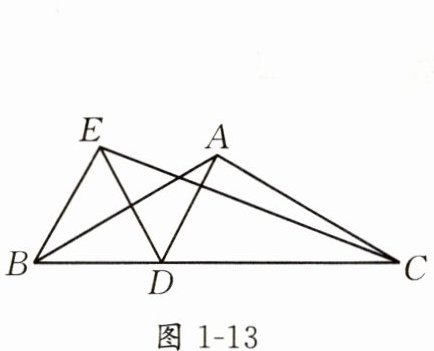
1. 如图1-13,在 $ △ A B C $中, $ A B=A C=2 \sqrt{3} $ $ ∠ B A C=1 2 0° $ ,D为BC边上的动点,以BD为边向上作等边三角形BED,连接CE,AD,则 $ A D+C E $的最小值为_______。
答案
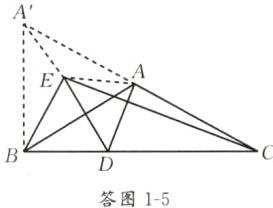
1. $4\sqrt{3}$ 解析:如答图1 - 5,连接$AE$。
$\because △ BDE$是等边三角形,
$\therefore BD=BE$,$∠ EBD=60°$。
$\therefore$当$D$在$BC$边上运动时,点$E$在射线$BE$上运动,且$∠ EBD=60°$。
$\because AB=AC$,$∠ BAC=120°$,$\therefore ∠ ABD=30°$。
$\therefore ∠ ABE=∠ ABD=30°$。
$\therefore AB$是$DE$的垂直平分线,
$\therefore AE=AD$。
$\therefore AD+CE=AE+CE$。
如答图1 - 5,作点$A$关于$BE$的对称点$A'$,连接$BA'$,$CA'$,$A'E$,
则$BA'=BA$,$A'E=AE$,$∠ CBA'=90°$,
$\therefore CA'=2BA'=4\sqrt{3}$。
$\because EA=EA'$,
$\therefore AE+EC=EA'+EC≥ CA'$,
$\therefore AE+EC≥ 4\sqrt{3}$。
$AD+CE$的最小值为$4\sqrt{3}$。
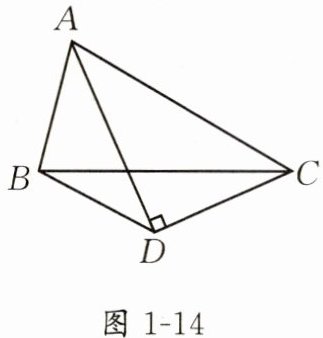
2. 如图 1-14,在 $ △ A B C $中, $ BC=1 0 $ $ AC-AB=4 $ ,AD是 $ ∠ B A C $的平分线, $ CD\bot AD $则 $ S_{△ B D C} $的最大值为_______。
答案
2. 10
