

 登录
登录
2. 你的家乡以制作风筝而闻名吗?
Is your hometown ______________________________?
Is your hometown ______________________________?
答案
famous for making kites
3. 通过大量的辛勤劳动和练习,她成了一位剪纸大师。
Through ______________________________, she becomes a master of paper - cutting.
Through ______________________________, she becomes a master of paper - cutting.
答案
a lot of hard work and practice
4. 这些是我的礼物。你的在哪里呢?
These are my presents. ______________________________?
These are my presents. ______________________________?
答案
Where are/is yours
5. 你真有创造力,能做出这样一个绝妙的手工艺品。
It’s so ______________________________.
It’s so ______________________________.
答案
creative of you to make such a wonderful handicraft
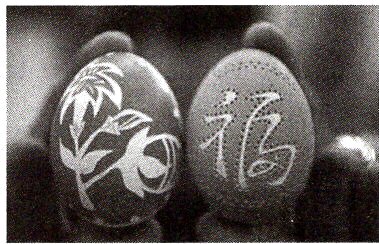
Egg carving(蛋雕)is often called the most fragile(易碎的)art, because it needs great care before, during and even after the carving. Yu Wen, the granddaughter of a famous local painter in Dandong, Liaoning Province, has been practising egg carving for about 25 years.
Yu has used more than 10 000 eggs, and years of hard work leaves many thick calluses(茧)on her hands. Sometimes she can’t even hold chopsticks(筷子)after a long day of holding the carving knife. But in Yu’s opinion, the difficult process(过程)makes egg carving twice as exciting. “If you carve off too much, the work is broken and there is no way to deal with it. That makes the sense of achievement(成就感)even greater when you finish a piece,” said Yu.
Yu’s love for egg carving started with a local tradition. In North - east China, when a baby is born, friends and relatives often give eggs coloured red as gifts, and some may carve auspicious(吉利的)words on them. The character fu is a popular one to be carved onto eggs. Yu carves with not only popular characters or traditional patterns(图案), but also Beijing opera masks and wall paintings. Her egg carving is just as much about eggs as it is about Chinese culture.
Now Yu teaches egg carving at a local college. In recent years, she has seen more people coming from across the country learn the art. “I hope I can better combine(结合) the art with traditional culture in the future,” Yu said.
( )1. What is most needed during the process of carving an egg?
A. Much money. B. Coloured eggs. C. Much care. D. Carving knives.
( )2. What does the underlined word “it” in Paragraph 2 refer to?
A. The broken work. B. The process.
C. The culture. D. The knife.
( )3. According to the passage, what does Yu Wen carve onto eggs?
① Babies’ pictures. ② Traditional patterns.
③ Beijing opera masks. ④ Wall paintings.
A. ①②③ B. ①②④ C. ①③④ D. ②③④
( )4. What can we learn from the passage?
A. Yu Wen loves egg carving very much.
B. Yu Wen works at a primary school now.
C. Yu Wen started to carve eggs at the age of 25.
D. There is something wrong with Yu Wen’s eyes.
Yu has used more than 10 000 eggs, and years of hard work leaves many thick calluses(茧)on her hands. Sometimes she can’t even hold chopsticks(筷子)after a long day of holding the carving knife. But in Yu’s opinion, the difficult process(过程)makes egg carving twice as exciting. “If you carve off too much, the work is broken and there is no way to deal with it. That makes the sense of achievement(成就感)even greater when you finish a piece,” said Yu.
Yu’s love for egg carving started with a local tradition. In North - east China, when a baby is born, friends and relatives often give eggs coloured red as gifts, and some may carve auspicious(吉利的)words on them. The character fu is a popular one to be carved onto eggs. Yu carves with not only popular characters or traditional patterns(图案), but also Beijing opera masks and wall paintings. Her egg carving is just as much about eggs as it is about Chinese culture.
Now Yu teaches egg carving at a local college. In recent years, she has seen more people coming from across the country learn the art. “I hope I can better combine(结合) the art with traditional culture in the future,” Yu said.
( )1. What is most needed during the process of carving an egg?
A. Much money. B. Coloured eggs. C. Much care. D. Carving knives.
( )2. What does the underlined word “it” in Paragraph 2 refer to?
A. The broken work. B. The process.
C. The culture. D. The knife.
( )3. According to the passage, what does Yu Wen carve onto eggs?
① Babies’ pictures. ② Traditional patterns.
③ Beijing opera masks. ④ Wall paintings.
A. ①②③ B. ①②④ C. ①③④ D. ②③④
( )4. What can we learn from the passage?
A. Yu Wen loves egg carving very much.
B. Yu Wen works at a primary school now.
C. Yu Wen started to carve eggs at the age of 25.
D. There is something wrong with Yu Wen’s eyes.
答案
1 - 4 CADA
