

 登录
登录
2. 你知道until的用法吗?
He stayed with his grandparents until the end of summer. 他和祖父母待到夏末。
The kids played outside until the sun went down. 孩子们在外面玩到太阳落山。
I didn't realize my mistake until he pointed it out. 直到他指出来,我才意识到自己的错误。
They won't leave until you arrive. 他们要等到你到了才会走。
总结:
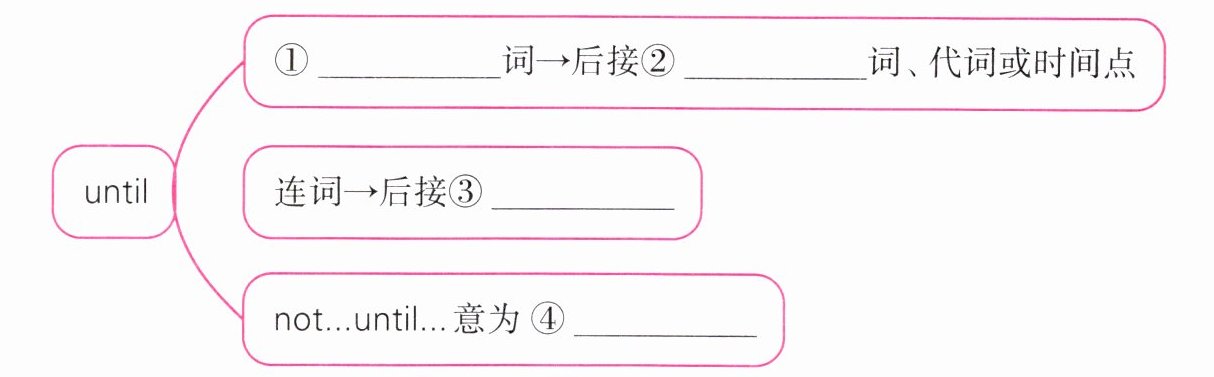
①词→后接②词、代词或时间点
until 连词→后接③
not...until...意为④
【即学即练】根据括号中的提示填空。
Yesterday, Lily had a lot of homework. She didn't start watching TV until (1)
(她完成作业). Her brother waited for her until(2)(中午)because they
planned to play chess together. They (3) their parents prepared some snacks for
them(直到他们的父母为他们准备了零食才开始玩游戏).
He stayed with his grandparents until the end of summer. 他和祖父母待到夏末。
The kids played outside until the sun went down. 孩子们在外面玩到太阳落山。
I didn't realize my mistake until he pointed it out. 直到他指出来,我才意识到自己的错误。
They won't leave until you arrive. 他们要等到你到了才会走。
总结:
①词→后接②词、代词或时间点
until 连词→后接③
not...until...意为④
【即学即练】根据括号中的提示填空。
Yesterday, Lily had a lot of homework. She didn't start watching TV until (1)
(她完成作业). Her brother waited for her until(2)(中午)because they
planned to play chess together. They (3) their parents prepared some snacks for
them(直到他们的父母为他们准备了零食才开始玩游戏).
答案
总结部分:
①介;②名;③从句;④直到……才……
即学即练:
(1) she finished her homework
(2) noon
(3) didn't start playing games until
①介;②名;③从句;④直到……才……
即学即练:
(1) she finished her homework
(2) noon
(3) didn't start playing games until
解析
1. until有两种词性,作介词时,后接名词、代词或时间点;作连词时,后接从句。not...until...是固定搭配,意为“直到……才……”。
2. 即学即练部分:(1)“她完成作业”是完整句子,在until后作时间状语从句,结合语境用一般过去时;(2)“中午”是名词,作介词until的宾语;(3)需用not...until...结构,结合语境用一般过去时表达“直到……才开始玩游戏”。
2. 即学即练部分:(1)“她完成作业”是完整句子,在until后作时间状语从句,结合语境用一般过去时;(2)“中午”是名词,作介词until的宾语;(3)需用not...until...结构,结合语境用一般过去时表达“直到……才开始玩游戏”。
3. 你能"打败我","赢得比赛"吗?
She practised every day and finally won the piano competition last week.
她每天都练习,上周终于赢得了钢琴比赛。
Our class won first prize in the school's art show.
我们班在学校艺术节上获得了一等奖。
The red team played very well and beat the blue team by 2 goals.
红队表现出色,以2球优势击败了蓝队。
I tried my best, but Tom still beat me in the chess game.
我已经尽力了,但汤姆还是在象棋比赛中赢了我。
总结:
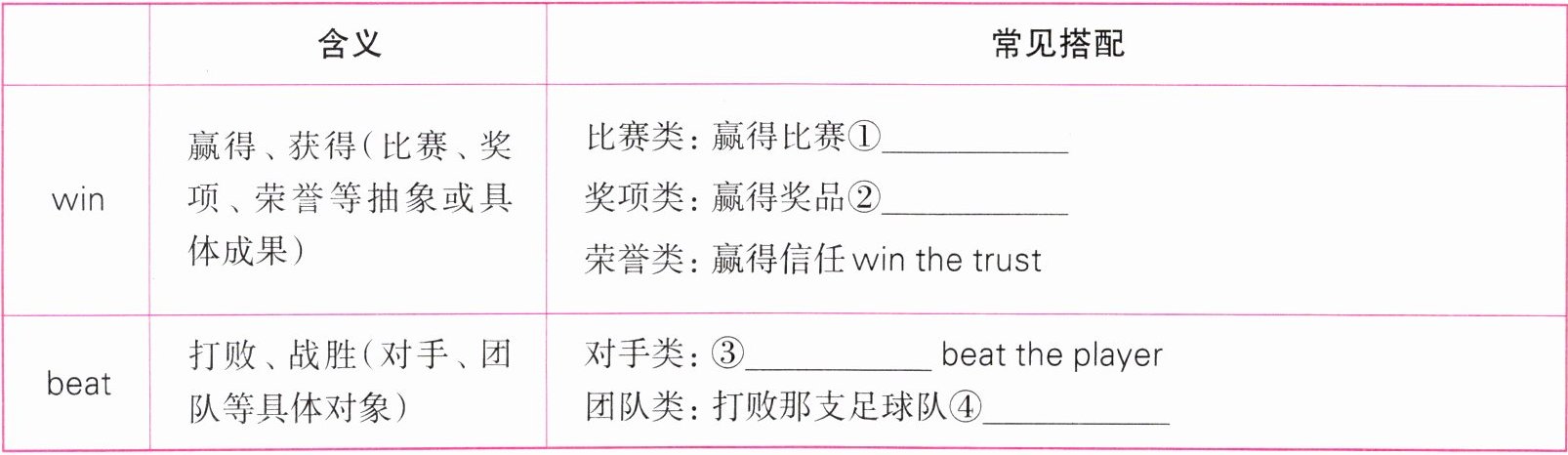
奖项类:赢得奖品②
荣誉类:赢得信任win the trust|
|beat|打败、战胜(对手、团队等具体对象)|对手类:③ beat the player
团队类:打败那支足球队④|
【即学即练】用win或beat的适当形式填空。
Last week, our school held a sports meeting. John took part in the 100-metre race. He
first (1) the runner from Class 2, and finally (2) the first place. Many
students cheered for him because he worked hard (3) this honour. Everyone
believed he would (4) more games in the future.
She practised every day and finally won the piano competition last week.
她每天都练习,上周终于赢得了钢琴比赛。
Our class won first prize in the school's art show.
我们班在学校艺术节上获得了一等奖。
The red team played very well and beat the blue team by 2 goals.
红队表现出色,以2球优势击败了蓝队。
I tried my best, but Tom still beat me in the chess game.
我已经尽力了,但汤姆还是在象棋比赛中赢了我。
总结:
奖项类:赢得奖品②
荣誉类:赢得信任win the trust|
|beat|打败、战胜(对手、团队等具体对象)|对手类:③ beat the player
团队类:打败那支足球队④|
【即学即练】用win或beat的适当形式填空。
Last week, our school held a sports meeting. John took part in the 100-metre race. He
first (1) the runner from Class 2, and finally (2) the first place. Many
students cheered for him because he worked hard (3) this honour. Everyone
believed he would (4) more games in the future.
答案
总结部分:
①win the match/competition
②win the prize
③打败选手
④beat that football team
即学即练:
(1) beat
(2) won
(3) to win
(4) win
①win the match/competition
②win the prize
③打败选手
④beat that football team
即学即练:
(1) beat
(2) won
(3) to win
(4) win
解析
本题考查win和beat的用法区别:win后接比赛、奖项、荣誉等抽象或具体成果;beat后接对手、团队等具体对象。
1. 总结搭配:
①win后接比赛,对应英文表达为win the match/competition;②“赢得奖品”的英文表达为win the prize;③beat后接选手,对应中文表达为“打败选手”;④“打败那支足球队”的英文表达为beat that football team。
2. 即学即练:
(1) 空格后是对手the runner,需用beat,结合last week可知用过去式beat;(2) 空格后是the first place(名次),需用win,结合语境用过去式won;(3) 此处表目的,用不定式to win;(4) would后接动词原形,空格后是games,用win。
1. 总结搭配:
①win后接比赛,对应英文表达为win the match/competition;②“赢得奖品”的英文表达为win the prize;③beat后接选手,对应中文表达为“打败选手”;④“打败那支足球队”的英文表达为beat that football team。
2. 即学即练:
(1) 空格后是对手the runner,需用beat,结合last week可知用过去式beat;(2) 空格后是the first place(名次),需用win,结合语境用过去式won;(3) 此处表目的,用不定式to win;(4) would后接动词原形,空格后是games,用win。
