

 登录
登录
一、选出最佳选项补全对话,其中有1项多余。
A. What are you doing?
B. How’s it going?
C. How’s the weather?
D. Is your sister at home?
E. Sure, no problem.
F. Can I take a message for her?
Tom: Hello, Tom speaking.
Bob: Hi, Tom. It’s Bob. 1.
Tom: Pretty good, thanks. 2.
Bob: I’m playing games with some friends at home.
Tom: Sounds like you’re having a good time.
Bob: Yeah. 3.
Tom: No, she’s not here. She’s shopping. 4.
Bob: Yes, thanks. Could you tell her to bring the book to me tomorrow?
Tom: 5.
A. What are you doing?
B. How’s it going?
C. How’s the weather?
D. Is your sister at home?
E. Sure, no problem.
F. Can I take a message for her?
Tom: Hello, Tom speaking.
Bob: Hi, Tom. It’s Bob. 1.
Tom: Pretty good, thanks. 2.
Bob: I’m playing games with some friends at home.
Tom: Sounds like you’re having a good time.
Bob: Yeah. 3.
Tom: No, she’s not here. She’s shopping. 4.
Bob: Yes, thanks. Could you tell her to bring the book to me tomorrow?
Tom: 5.
答案
1. B 2. A 3. D 4. F 5. E
解析
我们可以结合上下文逻辑逐空匹配选项:
1. 根据下文Tom的回答“Pretty good, thanks.(相当不错,谢谢)”,可知此处Bob是问候Tom的近况,B选项“How's it going?(最近过得怎么样?)”符合语境。
2. 根据下文Bob的回答“I'm playing games with some friends at home.(我正在家和朋友们玩游戏)”,可知此处Tom是询问Bob正在做什么,A选项“What are you doing?(你正在做什么?)”符合语境。
3. 根据下文Tom的回答“No, she's not here. She's shopping.(不,她不在这儿,她正在购物)”,可知此处是询问Tom的妹妹是否在家的一般疑问句,D选项“Is your sister at home?(你妹妹在家吗?)”符合语境。
4. 得知Tom的妹妹不在家后,结合下文Bob提出要Tom帮忙传话的内容,可知此处Tom主动询问是否需要捎口信,F选项“Can I take a message for her?(我可以给她捎个口信吗?)”符合语境。
5. 上文Bob提出帮忙传话的请求,此处Tom回应答应帮忙,E选项“Sure, no problem.(当然,没问题)”符合语境。
剩余的C选项“How's the weather?(天气怎么样?)”和整段对话内容无关,是多余选项。
1. 根据下文Tom的回答“Pretty good, thanks.(相当不错,谢谢)”,可知此处Bob是问候Tom的近况,B选项“How's it going?(最近过得怎么样?)”符合语境。
2. 根据下文Bob的回答“I'm playing games with some friends at home.(我正在家和朋友们玩游戏)”,可知此处Tom是询问Bob正在做什么,A选项“What are you doing?(你正在做什么?)”符合语境。
3. 根据下文Tom的回答“No, she's not here. She's shopping.(不,她不在这儿,她正在购物)”,可知此处是询问Tom的妹妹是否在家的一般疑问句,D选项“Is your sister at home?(你妹妹在家吗?)”符合语境。
4. 得知Tom的妹妹不在家后,结合下文Bob提出要Tom帮忙传话的内容,可知此处Tom主动询问是否需要捎口信,F选项“Can I take a message for her?(我可以给她捎个口信吗?)”符合语境。
5. 上文Bob提出帮忙传话的请求,此处Tom回应答应帮忙,E选项“Sure, no problem.(当然,没问题)”符合语境。
剩余的C选项“How's the weather?(天气怎么样?)”和整段对话内容无关,是多余选项。
二、在空白处填入一个适当的单词使对话内容完整。
Cara: Hi, Amy, 1. was your vacation?
Amy: It was great!
Cara: Where did you go?
Amy: I 2. to Tokyo 3. my family.
Cara: Really? Wow! 4. did you do there?
Amy: Well, we went to a lot of museums and did some 5. .
Cara: Oh, how 6. they?
Amy: The museums are really interesting, but the things in the stores are very expensive.
Cara: What do you 7. of the people there?
Amy: They are friendly. My parents have some 8. friends, and we 9. dinner at their house.
Cara: How is the 10. ?
Amy: It is delicious.
Cara: Hi, Amy, 1. was your vacation?
Amy: It was great!
Cara: Where did you go?
Amy: I 2. to Tokyo 3. my family.
Cara: Really? Wow! 4. did you do there?
Amy: Well, we went to a lot of museums and did some 5. .
Cara: Oh, how 6. they?
Amy: The museums are really interesting, but the things in the stores are very expensive.
Cara: What do you 7. of the people there?
Amy: They are friendly. My parents have some 8. friends, and we 9. dinner at their house.
Cara: How is the 10. ?
Amy: It is delicious.
答案
1. How 2. went 3. with 4. What 5. shopping 6. were 7. think 8. Japanese 9. had 10. food
解析
我们结合对话上下文、七年级所学的词汇语法和固定搭配逐一分析:
1. 根据答语“It was great!”是对假期的评价,可知此处询问假期的整体情况,用疑问词How,意为“怎么样”。
2. 上文问句使用一般过去时,描述过去去东京的动作,go的过去式为went。
3. 此处表达“和我的家人一起”,用介词with表伴随。
4. 根据答语介绍在东京开展的活动,可知此处询问“你在那里做了什么”,用疑问词What。
5. 后文提到商店里的商品价格很高,对应固定搭配do some shopping,意为“购物”,填shopping。
6. 后文回答了博物馆和商店商品的特点,此处询问它们的情况,对话描述假期是过去发生的事,主语是they,be动词用were。
7. 固定句型What do you think of...? 用于询问对方对人/事物的看法,填think。
8. 对话的地点是东京,此处指我的父母有一些日本朋友,填Japanese符合语境。
9. 描述过去在家吃晚餐的动作,用have dinner的过去式had dinner,填had。
10. 根据答语“It is delicious.”(很美味),可知此处询问食物的情况,填food。
1. 根据答语“It was great!”是对假期的评价,可知此处询问假期的整体情况,用疑问词How,意为“怎么样”。
2. 上文问句使用一般过去时,描述过去去东京的动作,go的过去式为went。
3. 此处表达“和我的家人一起”,用介词with表伴随。
4. 根据答语介绍在东京开展的活动,可知此处询问“你在那里做了什么”,用疑问词What。
5. 后文提到商店里的商品价格很高,对应固定搭配do some shopping,意为“购物”,填shopping。
6. 后文回答了博物馆和商店商品的特点,此处询问它们的情况,对话描述假期是过去发生的事,主语是they,be动词用were。
7. 固定句型What do you think of...? 用于询问对方对人/事物的看法,填think。
8. 对话的地点是东京,此处指我的父母有一些日本朋友,填Japanese符合语境。
9. 描述过去在家吃晚餐的动作,用have dinner的过去式had dinner,填had。
10. 根据答语“It is delicious.”(很美味),可知此处询问食物的情况,填food。
三、短文六选五。
In Canada you can find dogs, cats, horses, etc. in almost every family. These are their pets. 1. Before they keep them at their houses, they take them to animal hospitals to give them needles so that they won't carry disease(疾病). They have special animal food stores, though they can get animal food in almost every store. 2. When you visit people's homes, they would be very glad to show you their pets and they are very proud of them. You will also find almost every family has a bird feeder in their garden.
All kinds of birds are welcomed to come and have a good meal. 3. Nobody is allowed to kill any animals in Canada. 4. If you killed an animal, you would be punished(处罚). If an animal happened to get run over by a car, people would be very sad about it.
5. One of them might be: Their family tie is not as close as ours. When children grow up, they leave their parents and start their own career(职业). Then the seniors(老人) will feel lonely. But pets can solve this problem. They can be good friends and never leave them alone.
根据短文内容,从下列选项中选出能填入文中空白处的最佳选项,选项中有一项多余。
A. They have a law against killing wild animals.
B. They are free to come and go.
C. People in Canada have many reasons to like animals.
D. People love t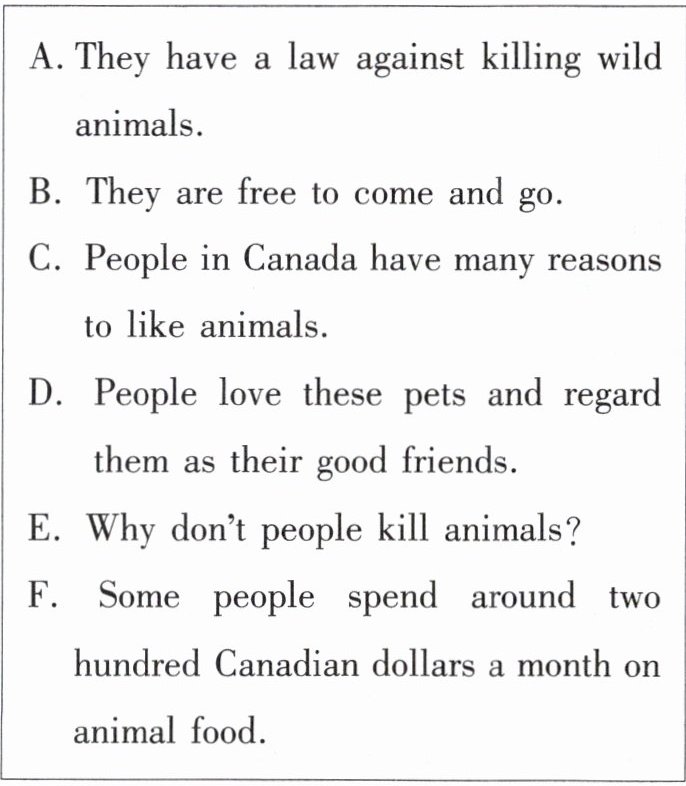 se pets and regard them as their good friends.
E. Why don't people kill animals?
F. Some people spend around two hundred Canadian dollars a month on animal food.
In Canada you can find dogs, cats, horses, etc. in almost every family. These are their pets. 1. Before they keep them at their houses, they take them to animal hospitals to give them needles so that they won't carry disease(疾病). They have special animal food stores, though they can get animal food in almost every store. 2. When you visit people's homes, they would be very glad to show you their pets and they are very proud of them. You will also find almost every family has a bird feeder in their garden.
All kinds of birds are welcomed to come and have a good meal. 3. Nobody is allowed to kill any animals in Canada. 4. If you killed an animal, you would be punished(处罚). If an animal happened to get run over by a car, people would be very sad about it.
5. One of them might be: Their family tie is not as close as ours. When children grow up, they leave their parents and start their own career(职业). Then the seniors(老人) will feel lonely. But pets can solve this problem. They can be good friends and never leave them alone.
根据短文内容,从下列选项中选出能填入文中空白处的最佳选项,选项中有一项多余。
A. They have a law against killing wild animals.
B. They are free to come and go.
C. People in Canada have many reasons to like animals.
D. People love t
se pets and regard them as their good friends.E. Why don't people kill animals?
F. Some people spend around two hundred Canadian dollars a month on animal food.
答案
1.D 2.F 3.B 4.A 5.C
解析
我们可以根据上下文逻辑逐一匹配选项:
1. 空前文介绍加拿大家庭大多饲养宠物,空后文介绍人们饲养宠物前会带宠物去医院打针预防疾病,D选项“人们喜爱这些宠物,把它们当作自己的好朋友”可以自然衔接,引出后文人们对宠物的悉心照料,符合语境。
2. 空前文提到加拿大有专门的宠物食品店,几乎所有商店都能买到宠物粮,F选项“有些人每个月会在宠物食品上花费大约200加元”承接宠物食品的相关话题,逻辑连贯。
3. 空前文提到几乎每个家庭的花园里都有喂鸟器,欢迎各类鸟类来享用食物,B选项“它们来去自由”中的they指代前文的各类鸟类,说明鸟类可以自由前来进食、自由离开,符合语境。
4. 空前文说明加拿大不允许任何人猎杀动物,空后文提到杀害动物会受到处罚,A选项“他们有反对猎杀野生动物的法律”衔接上下文,解释了禁止猎杀动物、违者受罚的依据,逻辑通顺。
5. 空后文开始列举加拿大人喜爱动物的其中一个原因,C选项“加拿大人有很多喜欢动物的理由”引出下文的原因说明,完全匹配。
多余选项为E。
1. 空前文介绍加拿大家庭大多饲养宠物,空后文介绍人们饲养宠物前会带宠物去医院打针预防疾病,D选项“人们喜爱这些宠物,把它们当作自己的好朋友”可以自然衔接,引出后文人们对宠物的悉心照料,符合语境。
2. 空前文提到加拿大有专门的宠物食品店,几乎所有商店都能买到宠物粮,F选项“有些人每个月会在宠物食品上花费大约200加元”承接宠物食品的相关话题,逻辑连贯。
3. 空前文提到几乎每个家庭的花园里都有喂鸟器,欢迎各类鸟类来享用食物,B选项“它们来去自由”中的they指代前文的各类鸟类,说明鸟类可以自由前来进食、自由离开,符合语境。
4. 空前文说明加拿大不允许任何人猎杀动物,空后文提到杀害动物会受到处罚,A选项“他们有反对猎杀野生动物的法律”衔接上下文,解释了禁止猎杀动物、违者受罚的依据,逻辑通顺。
5. 空后文开始列举加拿大人喜爱动物的其中一个原因,C选项“加拿大人有很多喜欢动物的理由”引出下文的原因说明,完全匹配。
多余选项为E。
