

 登录
登录
A. 根据首字母填写单词。
1. In Japan, people usually b to show respect when they meet for the first time.
2. Our school tour guide greeted the guests in a warm and welcoming m.
3. We should g our teachers politely when we see them at school.
4. Parents always v honesty and kindness when educating their children.
5. I wonder which city is the c of France, the romantic city with many famous museums.
1. In Japan, people usually b to show respect when they meet for the first time.
2. Our school tour guide greeted the guests in a warm and welcoming m.
3. We should g our teachers politely when we see them at school.
4. Parents always v honesty and kindness when educating their children.
5. I wonder which city is the c of France, the romantic city with many famous museums.
答案
1. bow 2. manner 3. greet 4. value 5. capital
解析
1. 结合日本初次见面的礼仪常识、首字母提示以及句子时态,此处表达“鞠躬”的含义,主语是people,时态为一般现在时,填动词原形bow。
2. 考查固定搭配in a ... manner,意为“以……的方式”,结合句意“我们学校的导游以热情好客的方式迎接来宾”和首字母m提示,填名词manner。
3. 结合语境“在学校见到老师”、首字母g提示,此处表达“问候”的含义,情态动词should后接动词原形,填greet。
4. 结合句意“父母教育孩子时总是看重诚实和善良”、首字母v提示,此处表达“重视、珍视”的含义,主语为parents,时态为一般现在时,填动词原形value。
5. 考查固定表达the capital of ...,意为“……的首都”,结合常识法国首都巴黎是拥有众多著名博物馆的浪漫城市,符合语境,首字母c提示,填capital。
2. 考查固定搭配in a ... manner,意为“以……的方式”,结合句意“我们学校的导游以热情好客的方式迎接来宾”和首字母m提示,填名词manner。
3. 结合语境“在学校见到老师”、首字母g提示,此处表达“问候”的含义,情态动词should后接动词原形,填greet。
4. 结合句意“父母教育孩子时总是看重诚实和善良”、首字母v提示,此处表达“重视、珍视”的含义,主语为parents,时态为一般现在时,填动词原形value。
5. 考查固定表达the capital of ...,意为“……的首都”,结合常识法国首都巴黎是拥有众多著名博物馆的浪漫城市,符合语境,首字母c提示,填capital。
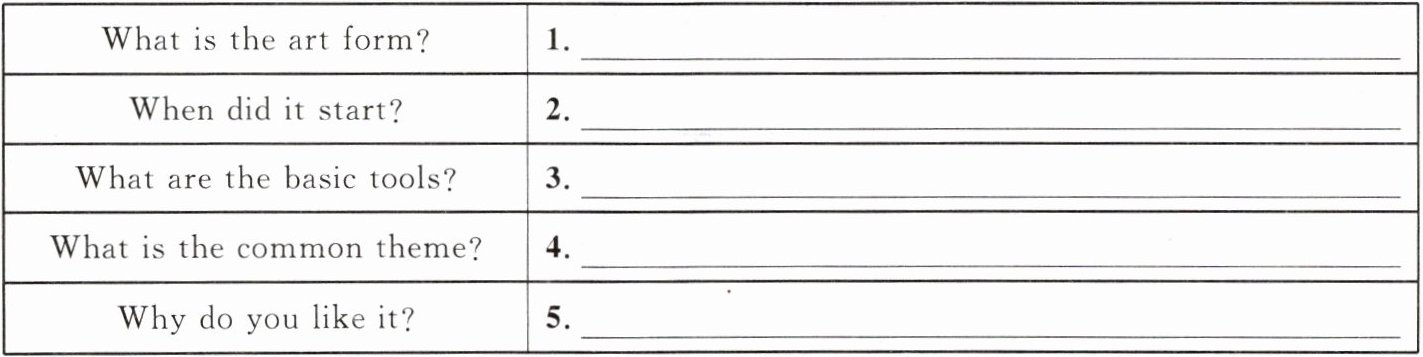
B. 请选择你喜欢的传统艺术形式,查找资料并完成表格。
答案
1. It is Chinese paper cutting, a famous traditional Chinese folk art.
2. It started over 2,000 years ago during the Han Dynasty.
3. The basic tools are a pair of scissors and some red paper.
4. The common themes are usually flowers, cute animals, and Chinese characters that stand for happiness and good luck.
5. It shows people's love for a peaceful happy life, and the delicate creative works are really amazing to me.
2. It started over 2,000 years ago during the Han Dynasty.
3. The basic tools are a pair of scissors and some red paper.
4. The common themes are usually flowers, cute animals, and Chinese characters that stand for happiness and good luck.
5. It shows people's love for a peaceful happy life, and the delicate creative works are really amazing to me.
解析
这是一道开放性的传统文化主题实践题,选取极具代表性的中国传统剪纸作为介绍对象,给出符合九年级英语词汇难度的参考作答,内容贴合各个问题的要求。
A. 词汇与语法。
When planning a trip to Europe, understanding the local customs is truly
necessary to avoid embarrassing moments. Let’s take France as an example.
First, greeting manners here are quite 1. (difference) from those in China. Instead of smiling 2. (nod) a greeting, friends often greet each other with a cheek kiss, usually 2 to 4 kisses, depending on the region(地区). For formal situations, a short handshake is 3. (accept).
Table manners in France are strict too. At a formal dinner, you must keep your knife in your right hand and fork in your left while eating. It’s 4. (polite) to put your elbows on the table or speak with a full mouth. Also, finishing all the food on your plate 5. (show) you enjoy the meal, which is a praise to the cook.
Gift-giving is another important part. Small gifts like Chinese tea are welcome, but never give white flowers. They 6. (connect) with sadness. When receiving a gift, you should open it right away 7. (show) your thanks, while in China we often open gifts later.
What’s more, privacy(隐私) is highly valued here. It’s rude 8. (ask) about someone’s age, salary or marital status. And you must arrive on time for parties; being late even by 5 minutes needs an 9. (apologize).
These customs may seem complicated(复杂的), but learning them helps you get along well with the 10. (local). As the saying goes, “When in Rome, do as the Romans do.” Respecting the local cultures will make your trip enjoyable and meaningful.
任务一:根据短文内容,用所给单词的正确形式填空。
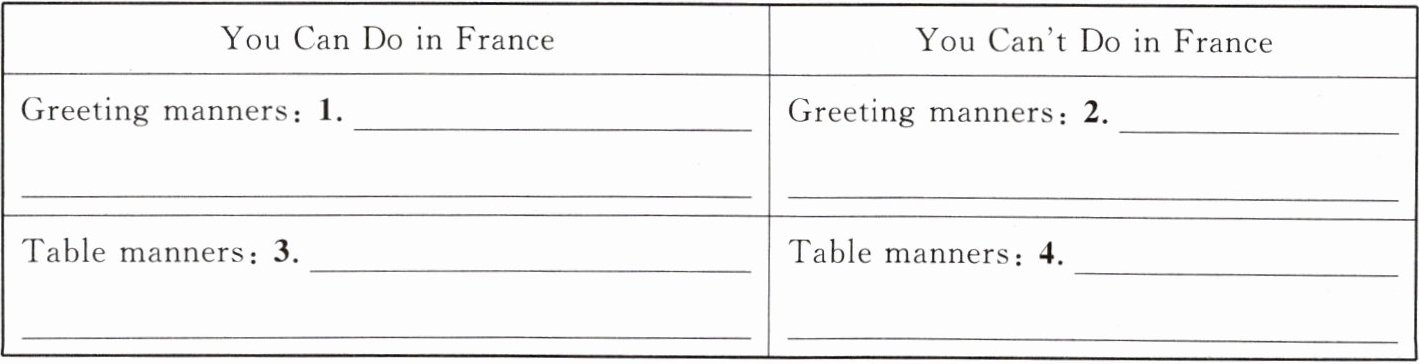
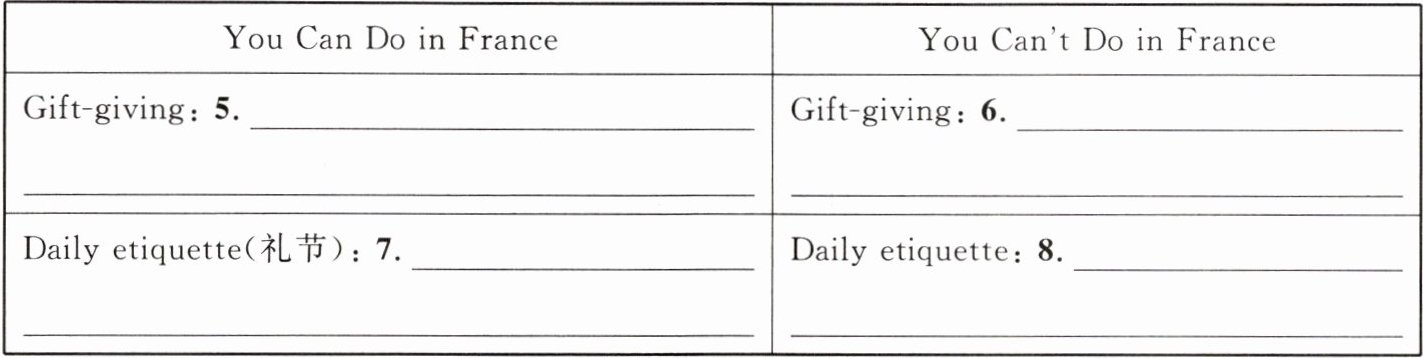
任务二:根据短文内容,完成表格。
续表
任务三:根据短文内容,回答下列问题。
1. How should the friends greet each other when they meet in France?
2. At a formal dinner in France, how to use a knife and fork?
3. What do you need to do if you are 5 minutes late for a party in France?
4. Why should people never give white flowers as gifts in France?
5. What other customs do you know in France?
When planning a trip to Europe, understanding the local customs is truly
necessary to avoid embarrassing moments. Let’s take France as an example.
First, greeting manners here are quite 1. (difference) from those in China. Instead of smiling 2. (nod) a greeting, friends often greet each other with a cheek kiss, usually 2 to 4 kisses, depending on the region(地区). For formal situations, a short handshake is 3. (accept).
Table manners in France are strict too. At a formal dinner, you must keep your knife in your right hand and fork in your left while eating. It’s 4. (polite) to put your elbows on the table or speak with a full mouth. Also, finishing all the food on your plate 5. (show) you enjoy the meal, which is a praise to the cook.
Gift-giving is another important part. Small gifts like Chinese tea are welcome, but never give white flowers. They 6. (connect) with sadness. When receiving a gift, you should open it right away 7. (show) your thanks, while in China we often open gifts later.
What’s more, privacy(隐私) is highly valued here. It’s rude 8. (ask) about someone’s age, salary or marital status. And you must arrive on time for parties; being late even by 5 minutes needs an 9. (apologize).
These customs may seem complicated(复杂的), but learning them helps you get along well with the 10. (local). As the saying goes, “When in Rome, do as the Romans do.” Respecting the local cultures will make your trip enjoyable and meaningful.
任务一:根据短文内容,用所给单词的正确形式填空。
任务二:根据短文内容,完成表格。
续表
任务三:根据短文内容,回答下列问题。
1. How should the friends greet each other when they meet in France?
2. At a formal dinner in France, how to use a knife and fork?
3. What do you need to do if you are 5 minutes late for a party in France?
4. Why should people never give white flowers as gifts in France?
5. What other customs do you know in France?
答案
任务一:
1. different
2. nodding
3. acceptable
4. impolite
5. shows
6. are connected
7. to show
8. to ask
9. apology
10. locals
任务二:
1. Friends greet each other with a cheek kiss (usually 2 to 4 kisses, depending on the region); use a short handshake in formal situations.
2. Greet others only by smiling or nodding.
3. Keep your knife in your right hand and fork in your left while eating; finish all the food on your plate to show you enjoy the meal.
4. Put your elbows on the table or speak with a full mouth at dinner.
5. Give small gifts like Chinese tea to others; open the gift right away when receiving it to show thanks.
6. Give white flowers as gifts to others.
7. Arrive on time for parties.
8. Ask about someone's age, salary or marital status; be late for parties even for a few minutes.
任务三:
1. They often greet each other with a cheek kiss, usually 2 to 4 kisses, depending on the region.
2. They must keep the knife in the right hand and the fork in the left while eating.
3. You need to make an apology.
4. Because white flowers are connected with sadness in France.
5. 示例:People in France usually eat bread with every meal, and they don't cut the bread with a knife but break it with hands.(答案合理即可)
1. different
2. nodding
3. acceptable
4. impolite
5. shows
6. are connected
7. to show
8. to ask
9. apology
10. locals
任务二:
1. Friends greet each other with a cheek kiss (usually 2 to 4 kisses, depending on the region); use a short handshake in formal situations.
2. Greet others only by smiling or nodding.
3. Keep your knife in your right hand and fork in your left while eating; finish all the food on your plate to show you enjoy the meal.
4. Put your elbows on the table or speak with a full mouth at dinner.
5. Give small gifts like Chinese tea to others; open the gift right away when receiving it to show thanks.
6. Give white flowers as gifts to others.
7. Arrive on time for parties.
8. Ask about someone's age, salary or marital status; be late for parties even for a few minutes.
任务三:
1. They often greet each other with a cheek kiss, usually 2 to 4 kisses, depending on the region.
2. They must keep the knife in the right hand and the fork in the left while eating.
3. You need to make an apology.
4. Because white flowers are connected with sadness in France.
5. 示例:People in France usually eat bread with every meal, and they don't cut the bread with a knife but break it with hands.(答案合理即可)
解析
任务一:本题考查九年级词形转换相关知识点,结合固定搭配、句子语法规则逐一变形:
1. 考查固定搭配be different from(与……不同),需将名词difference转换为形容词different。
2. 考查固定结构instead of doing sth.,and并列两个动名词作of的宾语,因此将nod变为动名词nodding。
3. 考查主系表结构,be动词后需接形容词作表语,将动词accept转换为形容词acceptable(可接受的)。
4. 结合句意可知把胳膊肘放在桌上、嘴里塞满食物说话是不礼貌的,需将polite变为带否定前缀的反义词impolite。
5. 动名词作主语时谓语动词用第三人称单数形式,句子为一般现在时,因此show变为shows。
6. 考查固定搭配be connected with(与……相关),主语为复数they,时态为一般现在时,因此填are connected。
7. 考查不定式作目的状语,此处表示立刻打开礼物的目的是表达感谢,因此填to show。
8. 考查固定句型It's + 形容词 + to do sth.(做某事是……的),因此填to ask。
9. 冠词an后需接名词,将动词apologize转换为名词apology。
10. 此处表示“当地人”,用可数名词复数形式locals。
任务二:本题需要从原文中定位对应场景下允许和禁止的行为,分类梳理后填入表格即可。
任务三:1-4题可直接从原文定位找到对应答案,第5题为开放性问题,结合法国文化常识给出符合逻辑的答案即可。
1. 考查固定搭配be different from(与……不同),需将名词difference转换为形容词different。
2. 考查固定结构instead of doing sth.,and并列两个动名词作of的宾语,因此将nod变为动名词nodding。
3. 考查主系表结构,be动词后需接形容词作表语,将动词accept转换为形容词acceptable(可接受的)。
4. 结合句意可知把胳膊肘放在桌上、嘴里塞满食物说话是不礼貌的,需将polite变为带否定前缀的反义词impolite。
5. 动名词作主语时谓语动词用第三人称单数形式,句子为一般现在时,因此show变为shows。
6. 考查固定搭配be connected with(与……相关),主语为复数they,时态为一般现在时,因此填are connected。
7. 考查不定式作目的状语,此处表示立刻打开礼物的目的是表达感谢,因此填to show。
8. 考查固定句型It's + 形容词 + to do sth.(做某事是……的),因此填to ask。
9. 冠词an后需接名词,将动词apologize转换为名词apology。
10. 此处表示“当地人”,用可数名词复数形式locals。
任务二:本题需要从原文中定位对应场景下允许和禁止的行为,分类梳理后填入表格即可。
任务三:1-4题可直接从原文定位找到对应答案,第5题为开放性问题,结合法国文化常识给出符合逻辑的答案即可。
