

 登录
登录
中考趋势 Ⅳ. 阅读还原(每小题2分,共10分)
从方框中选出能填入空白处的最佳选项。选项中有两项多余。
Recess(课间休息) for Kids
Ask a group of kids about their favourite part of the school day and many will talk about something that happened at recess. Maybe they finally made it across the monkey bars (单杠). Maybe somebody kicked the ball over the fence. Maybe a fruit tree in a neighbouring yard started to drop apples on the playground. 1
It's true not just according to kids, but also to adults who study recess for kids. Whether they're inventing a new game or sitting under a tree, kids need a break—or several of them—during the school day.
Why Kids Need Recess.
There's no debate that recess, or mainly referred to as physical activity, is good for kids.
You can't have your brains working for hours at a time and retain and store information in working memory. 2
How Much Recess Should Kids Get.
"Ideally, children should get four 15-minute breaks every day," says Debbie Rhea, a professor from Texas Christian University, who advocates for outdoor play in schools. 3
4
In addition to simply providing enough time for recess, schools should teach skills that will make recess more successful. For example, letting kids run fast will help them develop coordination. 5
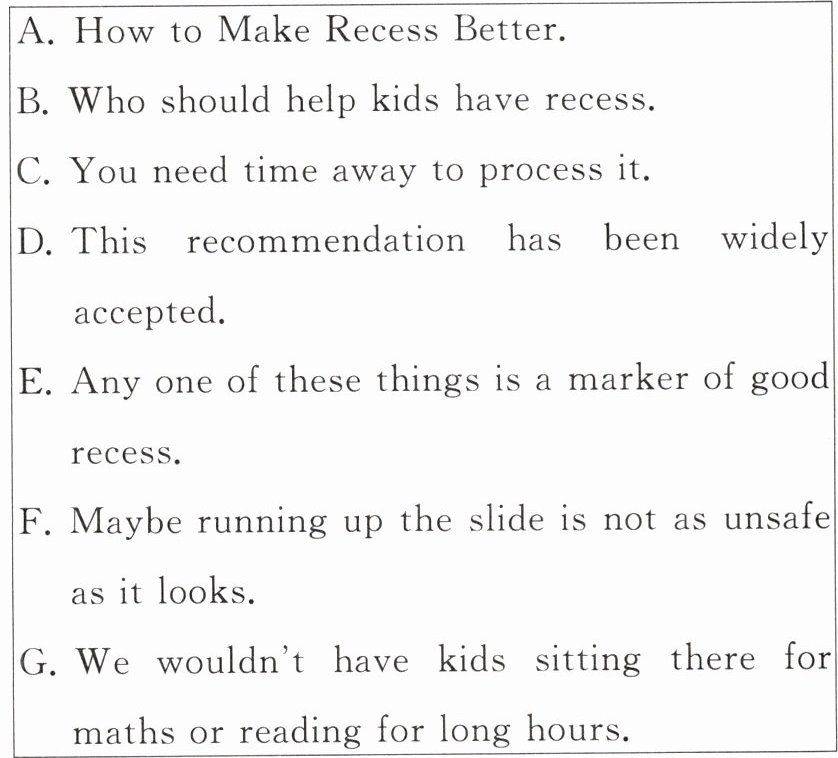
A. How to Make Recess Better.
B. Who should help kids have recess.
C. You need time away to process it.
D. This recommendation has been widely accepted.
E. Any one of these ings is a marker of good recess.
F. Maybe running up the slide is not as unsafe as it looks.
G. We wouldn't have kids sitting there for maths or reading for long hours.
1.
从方框中选出能填入空白处的最佳选项。选项中有两项多余。
Recess(课间休息) for Kids
Ask a group of kids about their favourite part of the school day and many will talk about something that happened at recess. Maybe they finally made it across the monkey bars (单杠). Maybe somebody kicked the ball over the fence. Maybe a fruit tree in a neighbouring yard started to drop apples on the playground. 1
E
It's true not just according to kids, but also to adults who study recess for kids. Whether they're inventing a new game or sitting under a tree, kids need a break—or several of them—during the school day.
Why Kids Need Recess.
There's no debate that recess, or mainly referred to as physical activity, is good for kids.
You can't have your brains working for hours at a time and retain and store information in working memory. 2
C
Besides, activity that involves arms and legs—running, climbing, crawling—builds new neural connections, which helps kids regulate their emotions. Studies show that after recess, children are more attentive in class, perform better and have fewer emotional problems.How Much Recess Should Kids Get.
"Ideally, children should get four 15-minute breaks every day," says Debbie Rhea, a professor from Texas Christian University, who advocates for outdoor play in schools. 3
D
It is noted that Centres for Disease Control and Prevention have recently expanded the idea to encourage recess for all students, including those in middle and high schools.4
A
In addition to simply providing enough time for recess, schools should teach skills that will make recess more successful. For example, letting kids run fast will help them develop coordination. 5
F
And even falling is something kids need to practise to avoid getting badly hurt. To allow children to take reasonable risks with their bodies is also a wise move.A. How to Make Recess Better.
B. Who should help kids have recess.
C. You need time away to process it.
D. This recommendation has been widely accepted.
E. Any one of these ings is a marker of good recess.
F. Maybe running up the slide is not as unsafe as it looks.
G. We wouldn't have kids sitting there for maths or reading for long hours.
1.
E
2. C
3. D
4. A
5. F
答案
Ⅳ.1.E 2.C 3.D 4.A 5.F
【语篇解读】本文是一篇说明文,主要介绍了孩子们需要课间休息的原因,课间休息时间的长短,以及如何让休息时间更好。
1. E 解析:根据“Maybe they finally made it across the monkey bars. Maybe somebody kicked the ball over the fence. Maybe a fruit tree in a neighbouring yard started to drop apples on the playground.”可知,本段列举了课间休息的活动,且该句位于段尾,起到总结的作用。选项 E“以上任何一件事都是良好休息的标志。”符合语境。故选 E。
2. C 解析:根据“You can't have your brains working for hours at a time and retain and store information in working memory.”可知,大脑不能连续工作太长时间,此处应该是说需要时间处理信息。选项 C“你需要时间来处理它。”中的 it 指代前面的 information,符合语境。故选 C。
3. D 解析:根据“Ideally, children should get four 15-minute breaks every day,”和“Centres for Disease Control and Prevention have recently expanded the idea to encourage recess for all students”可知,此处应该表示建议被接受了。选项 D“这一建议已被广泛接受。”符合语境。故选 D。
4. A 解析:此处作为第三个小标题,根据后面提到的“schools should teach skills that will make recess more successful”可知,该小标题应该说的是如何让课间休息更成功,更好。选项 A“如何让休息时间变得更好。”符合语境。故选 A。
5. F 解析:根据“letting kids run fast will help them develop coordination”和“And even falling is something kids need to practise to avoid getting badly hurt.”可知,此处应该说的是某种跑着的有风险的活动。选项 F“也许跑上滑梯并不像看上去那么不安全。”符合语境。故选 F。
【语篇解读】本文是一篇说明文,主要介绍了孩子们需要课间休息的原因,课间休息时间的长短,以及如何让休息时间更好。
1. E 解析:根据“Maybe they finally made it across the monkey bars. Maybe somebody kicked the ball over the fence. Maybe a fruit tree in a neighbouring yard started to drop apples on the playground.”可知,本段列举了课间休息的活动,且该句位于段尾,起到总结的作用。选项 E“以上任何一件事都是良好休息的标志。”符合语境。故选 E。
2. C 解析:根据“You can't have your brains working for hours at a time and retain and store information in working memory.”可知,大脑不能连续工作太长时间,此处应该是说需要时间处理信息。选项 C“你需要时间来处理它。”中的 it 指代前面的 information,符合语境。故选 C。
3. D 解析:根据“Ideally, children should get four 15-minute breaks every day,”和“Centres for Disease Control and Prevention have recently expanded the idea to encourage recess for all students”可知,此处应该表示建议被接受了。选项 D“这一建议已被广泛接受。”符合语境。故选 D。
4. A 解析:此处作为第三个小标题,根据后面提到的“schools should teach skills that will make recess more successful”可知,该小标题应该说的是如何让课间休息更成功,更好。选项 A“如何让休息时间变得更好。”符合语境。故选 A。
5. F 解析:根据“letting kids run fast will help them develop coordination”和“And even falling is something kids need to practise to avoid getting badly hurt.”可知,此处应该说的是某种跑着的有风险的活动。选项 F“也许跑上滑梯并不像看上去那么不安全。”符合语境。故选 F。
解析
【分析】
做阅读还原题时,需先通读全文把握语篇主旨,再逐个分析空白处的上下文语境,寻找句子间的逻辑关系(如总结、指代、过渡、举例等),结合选项匹配最佳答案。本题中,1空前文列举课间活动需选总结句;2空承接大脑工作需选与处理信息相关的句子;3空衔接教授建议与官方认可需选建议被接受的语句;4空为小标题需匹配优化课间的主旨;5空围绕合理风险活动需选相关例子。
【解析】
1. 第1空:前文列举孩子们在课间的多种活动(过单杠、踢球、苹果掉落等),空白处需总结这些活动,选项E“以上任何一件事都是良好休息的标志”符合总结语境,故选E。
2. 第2空:前文提到大脑不能连续长时间工作以保留和存储信息,空白处需承接“处理信息”的内容,选项C“你需要时间来处理它”中“it”指代前文的“information”,符合语境,故选C。
3. 第3空:前文是教授提出的“每天四次15分钟课间”的建议,后文提到疾控中心扩展该想法,说明建议被广泛接受,选项D“这一建议已被广泛接受”符合逻辑,故选D。
4. 第4空:此处为段落小标题,后文内容是学校应教技能让课间更成功,即如何优化课间,选项A“如何让休息时间变得更好”匹配该段主旨,故选A。
5. 第5空:前文提到让孩子快跑发展协调能力,后文提到摔倒也是需要练习的,围绕合理风险的活动,选项F“也许跑上滑梯并不像看上去那么不安全”是相关例子,符合语境,故选F。
【答案】
1.E 2.C 3.D 4.A 5.F
【知识点】
英语语篇衔接、阅读还原技巧、小标题匹配
【点评】
本题为中考常见的阅读还原题型,考查学生对语篇逻辑、上下文指代及主旨概括的能力,需学生理清段落结构和句子间的逻辑关系,整体难度适中,是学生应掌握的基础题型。
【难度系数】
0.6
做阅读还原题时,需先通读全文把握语篇主旨,再逐个分析空白处的上下文语境,寻找句子间的逻辑关系(如总结、指代、过渡、举例等),结合选项匹配最佳答案。本题中,1空前文列举课间活动需选总结句;2空承接大脑工作需选与处理信息相关的句子;3空衔接教授建议与官方认可需选建议被接受的语句;4空为小标题需匹配优化课间的主旨;5空围绕合理风险活动需选相关例子。
【解析】
1. 第1空:前文列举孩子们在课间的多种活动(过单杠、踢球、苹果掉落等),空白处需总结这些活动,选项E“以上任何一件事都是良好休息的标志”符合总结语境,故选E。
2. 第2空:前文提到大脑不能连续长时间工作以保留和存储信息,空白处需承接“处理信息”的内容,选项C“你需要时间来处理它”中“it”指代前文的“information”,符合语境,故选C。
3. 第3空:前文是教授提出的“每天四次15分钟课间”的建议,后文提到疾控中心扩展该想法,说明建议被广泛接受,选项D“这一建议已被广泛接受”符合逻辑,故选D。
4. 第4空:此处为段落小标题,后文内容是学校应教技能让课间更成功,即如何优化课间,选项A“如何让休息时间变得更好”匹配该段主旨,故选A。
5. 第5空:前文提到让孩子快跑发展协调能力,后文提到摔倒也是需要练习的,围绕合理风险的活动,选项F“也许跑上滑梯并不像看上去那么不安全”是相关例子,符合语境,故选F。
【答案】
1.E 2.C 3.D 4.A 5.F
【知识点】
英语语篇衔接、阅读还原技巧、小标题匹配
【点评】
本题为中考常见的阅读还原题型,考查学生对语篇逻辑、上下文指代及主旨概括的能力,需学生理清段落结构和句子间的逻辑关系,整体难度适中,是学生应掌握的基础题型。
【难度系数】
0.6
