

 登录
登录
三、任务型阅读
阅读下面短文,并根据所读内容在文章后的表格里填入最恰当的单词,每个空格只填一个单词。
The zisha teapots made in Yixing City in east China's Jiangsu Province are considered to be the best tool for making tea. It was created during the Song Dynasty in the 10th century.
Different types of clay used for making Yixing teapots, mainly purple clay, red clay, green clay and mixed clay, are totally called Yixing clay. Yixing clay stands for “zisha (purple sand)” in Chinese because purple clay is most commonly (普遍地) used. To make a zisha teapot, the material should be carefully chosen and processed before it can be used. The most important step to make Yixing teapots is to keep pounding (拍打) the clay with a special wooden stick. They are produced in factories, but they are hand - made.
The zisha teapot is considered the best teapot and the tea made in it tastes especially nice. And the tea can be stored (储存) overnight in it without going bad in spring, autumn, winter and even in summer. The clay is highly porous (多孔的), but water cannot go out of it. This is the most special about zisha clay.
Another famous characteristic of Yixing teapots is that they can absorb (吸收) tea flavours (茶香). Over time, Yixing teapots can smell good even there is no tea in them.
The production (生产) skills of Yixing China's zisha teapots were listed among Intangible Cultural Heritages in 2006. Many people collect zisha teapots, since it is not only a daily necessity, but has become a work of art.
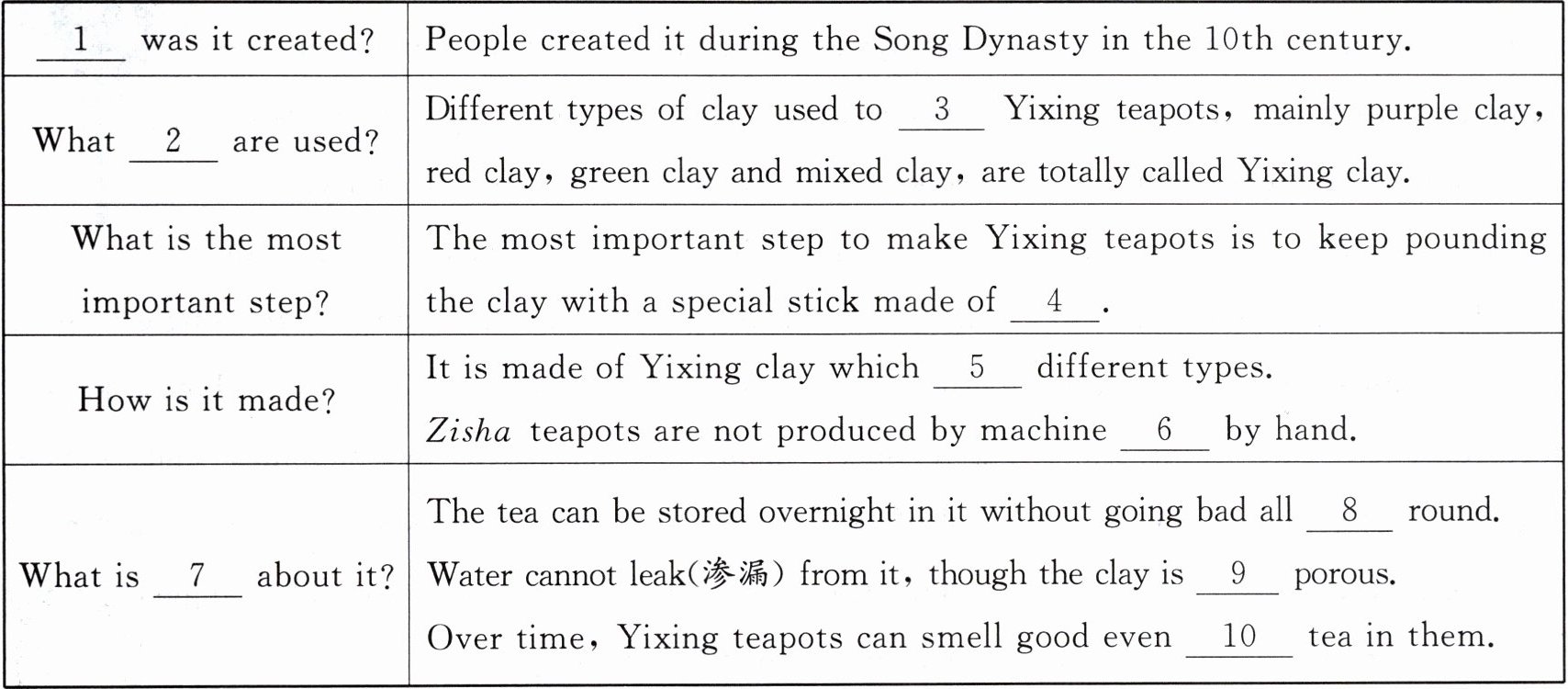
阅读下面短文,并根据所读内容在文章后的表格里填入最恰当的单词,每个空格只填一个单词。
The zisha teapots made in Yixing City in east China's Jiangsu Province are considered to be the best tool for making tea. It was created during the Song Dynasty in the 10th century.
Different types of clay used for making Yixing teapots, mainly purple clay, red clay, green clay and mixed clay, are totally called Yixing clay. Yixing clay stands for “zisha (purple sand)” in Chinese because purple clay is most commonly (普遍地) used. To make a zisha teapot, the material should be carefully chosen and processed before it can be used. The most important step to make Yixing teapots is to keep pounding (拍打) the clay with a special wooden stick. They are produced in factories, but they are hand - made.
The zisha teapot is considered the best teapot and the tea made in it tastes especially nice. And the tea can be stored (储存) overnight in it without going bad in spring, autumn, winter and even in summer. The clay is highly porous (多孔的), but water cannot go out of it. This is the most special about zisha clay.
Another famous characteristic of Yixing teapots is that they can absorb (吸收) tea flavours (茶香). Over time, Yixing teapots can smell good even there is no tea in them.
The production (生产) skills of Yixing China's zisha teapots were listed among Intangible Cultural Heritages in 2006. Many people collect zisha teapots, since it is not only a daily necessity, but has become a work of art.
答案
【文章大意】本文是一篇说明文。文章介绍了中国传统工艺——宜兴紫砂壶。
1. When 2. materials 3. make 4. wood 5. has/includes 6. but 7. special 8. year 9. highly 10. without
1. When 2. materials 3. make 4. wood 5. has/includes 6. but 7. special 8. year 9. highly 10. without
解析
【分析】
这道题是说明文类任务型阅读,要求每空仅填一个单词,解题思路如下:
1. 先观察表格的问答逻辑,明确每个问题对应的提问方向,再回到原文精准定位和答句匹配的原句;
2. 结合空格前后的语法结构、固定搭配要求,对原文的表达进行适配调整,比如动名词转动词原形、从句结构转介词结构等;
3. 最后检查所有单词的词性、单复数、大小写是否符合要求,确保每空仅填一个词。
逐个空推导:
空1:答句回答的是紫砂壶的创造时间,对应特殊疑问词询问时间,句首首字母大写,填When。
空2:答句介绍的是制作紫砂壶用到的各类黏土,也就是所用的材料,句中be动词是are,说明主语是复数,填materials。
空3:原句对应“Different types of clay used for making Yixing teapots”,空格前是used to,used to后接动词原形,因此把making转换为make。
空4:原句对应“keep pounding the clay with a special wooden stick”,即木棍是用木头做的,介词of后接名词,填wood。
空5:句意是“它由包含不同种类的宜兴黏土制成”,先行词Yixing clay是不可数名词,定语从句的谓语可以表示“包含/有”的含义,填has/includes。
空6:这里是固定搭配not...but...,含义为“不是……而是……”,表示紫砂壶不是机器生产而是手工制作,填but。
空7:后面的三点内容都是介绍紫砂壶的独特特性,对应原文“This is the most special about zisha clay”,填special。
空8:固定搭配all year round,含义为“全年、一年四季”,对应原文提到的春、秋、冬、夏四季,填year。
空9:原句直接给出“the clay is highly porous”,直接提取副词highly修饰形容词porous,填highly。
空10:原句对应“even there is no tea in them”,空格后是名词tea,需要用介词表示“没有”的含义,填without。
【解析】
我们逐空结合原文和语法规则推导:
1. 根据答句“People created it during the Song Dynasty in the 10th century.”可知提问的是创造的时间,用疑问词When,句首首字母大写。
2. 根据答句介绍各类制作黏土,可知提问使用的材料,后文be动词为are,用复数名词materials。
3. 原文对应“Different types of clay used for making Yixing teapots”,空格前为used to,后接动词原形,故填make。
4. 原文提到“a special wooden stick”,即特殊的木棍,由木头制成,介词of后接名词wood。
5. 先行词Yixing clay为不可数名词,定语从句谓语表示“包含/有不同种类”,可填has/includes。
6. 固定结构not...but...意为“不是…而是…”,符合“非机器生产而是手工制作”的语义,填but。
7. 后文介绍紫砂壶的独有特性,对应提问“它的特别之处是什么”,填形容词special。
8. 固定短语all year round意为“一年四季”,对应原文提到的四季都可隔夜存茶,填year。
9. 原文直接给出“the clay is highly porous”,填副词highly修饰porous。
10. 原句“even there is no tea in them”转换为介词结构,后接名词tea,填without表示“没有”。
【答案】
1. When 2. materials 3. make 4. wood 5. has/includes 6. but 7. special 8. year 9. highly 10. without
【知识点】
任务型阅读;固定短语;词性转换
【点评】
本题选取介绍中国非物质文化遗产宜兴紫砂壶的说明文作为载体,既考查学生快速定位原文信息的基础阅读能力,也兼顾了句式转换、固定搭配应用的语法考点,同时渗透了中国传统工艺的文化常识,难度梯度设置合理。
【难度系数】
0.6
这道题是说明文类任务型阅读,要求每空仅填一个单词,解题思路如下:
1. 先观察表格的问答逻辑,明确每个问题对应的提问方向,再回到原文精准定位和答句匹配的原句;
2. 结合空格前后的语法结构、固定搭配要求,对原文的表达进行适配调整,比如动名词转动词原形、从句结构转介词结构等;
3. 最后检查所有单词的词性、单复数、大小写是否符合要求,确保每空仅填一个词。
逐个空推导:
空1:答句回答的是紫砂壶的创造时间,对应特殊疑问词询问时间,句首首字母大写,填When。
空2:答句介绍的是制作紫砂壶用到的各类黏土,也就是所用的材料,句中be动词是are,说明主语是复数,填materials。
空3:原句对应“Different types of clay used for making Yixing teapots”,空格前是used to,used to后接动词原形,因此把making转换为make。
空4:原句对应“keep pounding the clay with a special wooden stick”,即木棍是用木头做的,介词of后接名词,填wood。
空5:句意是“它由包含不同种类的宜兴黏土制成”,先行词Yixing clay是不可数名词,定语从句的谓语可以表示“包含/有”的含义,填has/includes。
空6:这里是固定搭配not...but...,含义为“不是……而是……”,表示紫砂壶不是机器生产而是手工制作,填but。
空7:后面的三点内容都是介绍紫砂壶的独特特性,对应原文“This is the most special about zisha clay”,填special。
空8:固定搭配all year round,含义为“全年、一年四季”,对应原文提到的春、秋、冬、夏四季,填year。
空9:原句直接给出“the clay is highly porous”,直接提取副词highly修饰形容词porous,填highly。
空10:原句对应“even there is no tea in them”,空格后是名词tea,需要用介词表示“没有”的含义,填without。
【解析】
我们逐空结合原文和语法规则推导:
1. 根据答句“People created it during the Song Dynasty in the 10th century.”可知提问的是创造的时间,用疑问词When,句首首字母大写。
2. 根据答句介绍各类制作黏土,可知提问使用的材料,后文be动词为are,用复数名词materials。
3. 原文对应“Different types of clay used for making Yixing teapots”,空格前为used to,后接动词原形,故填make。
4. 原文提到“a special wooden stick”,即特殊的木棍,由木头制成,介词of后接名词wood。
5. 先行词Yixing clay为不可数名词,定语从句谓语表示“包含/有不同种类”,可填has/includes。
6. 固定结构not...but...意为“不是…而是…”,符合“非机器生产而是手工制作”的语义,填but。
7. 后文介绍紫砂壶的独有特性,对应提问“它的特别之处是什么”,填形容词special。
8. 固定短语all year round意为“一年四季”,对应原文提到的四季都可隔夜存茶,填year。
9. 原文直接给出“the clay is highly porous”,填副词highly修饰porous。
10. 原句“even there is no tea in them”转换为介词结构,后接名词tea,填without表示“没有”。
【答案】
1. When 2. materials 3. make 4. wood 5. has/includes 6. but 7. special 8. year 9. highly 10. without
【知识点】
任务型阅读;固定短语;词性转换
【点评】
本题选取介绍中国非物质文化遗产宜兴紫砂壶的说明文作为载体,既考查学生快速定位原文信息的基础阅读能力,也兼顾了句式转换、固定搭配应用的语法考点,同时渗透了中国传统工艺的文化常识,难度梯度设置合理。
【难度系数】
0.6
