

 登录
登录
六、新考法 连词成句并编写对话。
(一)连词成句。
1. keeps, Mike, room, clean, every, his, day (.)
2. gets, girl, late, up, the (.)
(一)连词成句。
1. keeps, Mike, room, clean, every, his, day (.)
Mike keeps his room clean every day.
2. gets, girl, late, up, the (.)
The girl gets up late.
答案
(一)1. Mike keeps his room clean every day. 2. The girl gets up late.
解析
【分析】首先观察每个小题的单词,先确定句子的主语(名词或代词),再匹配对应的谓语动词,接着搭配宾语、定语等成分,最后调整时间状语等的位置,确保符合英语表达习惯。第1题先找主语Mike,谓语keeps,宾语his room,补语clean,时间状语every day放句末;第2题先找主语the girl,谓语短语gets up,状语late。
【解析】1. 确定主语为Mike,谓语是keeps,his room作宾语,clean补充说明room的状态,时间状语every day放句末,组合成正确句子:Mike keeps his room clean every day. 2. 主语是the girl,谓语短语是gets up,late作状语,组合成正确句子:The girl gets up late.
【答案】1. Mike keeps his room clean every day. 2. The girl gets up late.
【知识点】英语连词成句、英语基本句式
【点评】本题考查英语简单句的构成,需掌握主谓宾/主谓结构,注意物主代词、定冠词的正确使用,属于基础题型,能帮助学生巩固英语句子的基本表达。
【难度系数】0.6
【解析】1. 确定主语为Mike,谓语是keeps,his room作宾语,clean补充说明room的状态,时间状语every day放句末,组合成正确句子:Mike keeps his room clean every day. 2. 主语是the girl,谓语短语是gets up,late作状语,组合成正确句子:The girl gets up late.
【答案】1. Mike keeps his room clean every day. 2. The girl gets up late.
【知识点】英语连词成句、英语基本句式
【点评】本题考查英语简单句的构成,需掌握主谓宾/主谓结构,注意物主代词、定冠词的正确使用,属于基础题型,能帮助学生巩固英语句子的基本表达。
【难度系数】0.6
(二)编写对话。
根据上面两个句子,编写一组对话(至少4句话),其中一人描述句中提到的习惯,另一人判断习惯好坏并说明理由。
根据上面两个句子,编写一组对话(至少4句话),其中一人描述句中提到的习惯,另一人判断习惯好坏并说明理由。
A: Mike keeps his room tidy every day.
B: That's a good habit.
A: The girl gets up late.
B: That's a bad habit. She may be late.
答案
(二)A: Mike keeps his room tidy every day. B: That's a good habit. A: The girl gets up late. B: That's a bad habit. She may be late.
解析
【分析】本题要求编写至少4句的英语对话,核心是一人描述习惯,另一人判断习惯好坏并说明理由。解题思路:先确定两个不同的习惯(一个好、一个坏),分别让对话双方完成“描述习惯→判断好坏→说明理由”的环节,确保对话句数达标且符合日常交流逻辑。
【解析】选取两个典型习惯:好的习惯(每天整理房间)和坏的习惯(起床晚)。安排对话流程:A先描述好的习惯,B判断为好习惯;接着A描述坏的习惯,B判断为坏习惯并说明理由,既满足句数要求,又符合题目要求。
【答案】A: Mike keeps his room tidy every day. B: That's a good habit. A: The girl gets up late. B: That's a bad habit. She may be late.
【知识点】英语对话编写、日常习惯表达
【点评】本题考查英语日常交流对话的编写能力,需结合习惯描述与评价,符合日常交际逻辑,是基础的英语应用类题目。
【难度系数】0.5
【解析】选取两个典型习惯:好的习惯(每天整理房间)和坏的习惯(起床晚)。安排对话流程:A先描述好的习惯,B判断为好习惯;接着A描述坏的习惯,B判断为坏习惯并说明理由,既满足句数要求,又符合题目要求。
【答案】A: Mike keeps his room tidy every day. B: That's a good habit. A: The girl gets up late. B: That's a bad habit. She may be late.
【知识点】英语对话编写、日常习惯表达
【点评】本题考查英语日常交流对话的编写能力,需结合习惯描述与评价,符合日常交际逻辑,是基础的英语应用类题目。
【难度系数】0.5
七、新考法 五(一)班正在评选“好习惯之星”,班长正在对Amy进行采访。Amy分享了自己和好朋友Lily的习惯。请阅读对话,完成任务。
Monitor: Hello, Amy. Welcome to the “Good Habit Star” interview. What 1.
Amy: I 2.
Monitor: Great. Do you 4.
Amy: Yes, I wash dishes and sweep the floor every day.
Monitor: What about your room? Do you 5.
Amy: Yes, I make my bed and put my things in order. I never 7.
Monitor: Wonderful. Does your friend Lily have good habits too?
Amy: Yes. She 8.
Monitor: I see. Thank you, Amy!
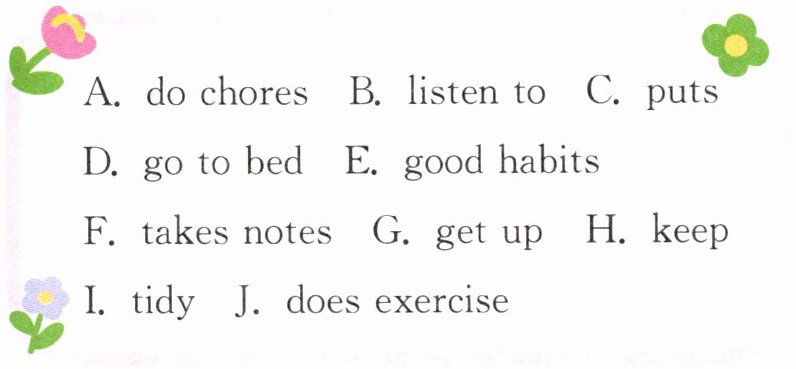
任务一:从方框中选择合适的单词或短语补全对话。(有一项多余)
任务二:根据对话内容,回答问题。
1. What time does Amy get up every morning?
2. What good habits does Lily have?(举两个例子)
3. Do you think Amy can be the “Good Habit Star”? Why?
Monitor: Hello, Amy. Welcome to the “Good Habit Star” interview. What 1.
E
do you have?Amy: I 2.
B
my teachers carefully in class. I also 3. G
at 6:30 every morning.Monitor: Great. Do you 4.
A
at home?Amy: Yes, I wash dishes and sweep the floor every day.
Monitor: What about your room? Do you 5.
H
your room 6. I
?Amy: Yes, I make my bed and put my things in order. I never 7.
D
late, either. I sleep at 9:30 p.m.Monitor: Wonderful. Does your friend Lily have good habits too?
Amy: Yes. She 8.
F
in class and 9. C
her school things in order. But she often reads in bed.Monitor: I see. Thank you, Amy!
任务一:从方框中选择合适的单词或短语补全对话。(有一项多余)
任务二:根据对话内容,回答问题。
1. What time does Amy get up every morning?
She gets up at 6:30 every morning.
2. What good habits does Lily have?(举两个例子)
She takes notes in class and puts her school things in order.
3. Do you think Amy can be the “Good Habit Star”? Why?
Yes, I think so. Because she has many good habits: listening carefully, getting up early, doing chores, keeping her room tidy, and going to bed early.
答案
任务一:1. E 2. B 3. G 4. A 5. H 6. I 7. D 8. F 9. C
任务二:1. She gets up at 6:30 every morning. 2. She takes notes in class and puts her school things in order. 3. Yes, I think so. Because she has many good habits: listening carefully, getting up early, doing chores, keeping her room tidy, and going to bed early.
任务二:1. She gets up at 6:30 every morning. 2. She takes notes in class and puts her school things in order. 3. Yes, I think so. Because she has many good habits: listening carefully, getting up early, doing chores, keeping her room tidy, and going to bed early.
解析
【分析】
本题分为任务一选词填空和任务二阅读理解答题两部分。任务一需结合句子语境、短语搭配及语法(如动词形式)选择合适的短语:先通读对话理解每句语义,再匹配方框内的短语,注意第三人称单数的动词形式变化;任务二需从对话中提取关键信息,准确回答问题,答案要符合原文内容。
【解析】
任务一:
1. 句意为“你有什么好习惯?”,“good habits”符合语义,选E。
2. 句意为“我在课堂上认真听老师”,“listen to”是固定搭配,选B。
3. 句意为“我每天早上6:30起床”,“get up”符合语义,选G。
4. 句意为“你在家做家务吗?”,“do chores”符合语境,选A。
5. 句意为“你保持你的房间……吗?”,“keep”符合语义,选H。
6. 句意为“你整理你的房间吗?”,“tidy”作动词表示整理,选I。
7. 句意为“我也从不晚睡”,“go to bed”符合语义,选D。
8. 句意为“她在课堂上做笔记”,主语是第三人称单数,“takes notes”匹配,选F。
9. 句意为“把她的学习用品放整齐”,主语是第三人称单数,“puts”匹配,选C。
任务二:
1. 从Amy的话“I also get up at 6:30 every morning.”提取信息,得出答案。
2. 从Amy的话“She takes notes in class and puts her school things in order.”提取信息,得出答案。
3. 从Amy分享的诸多好习惯,判断她能当选,理由是有很多良好习惯。
【答案】
任务一:1. E 2. B 3. G 4. A 5. H 6. I 7. D 8. F 9. C
任务二:1. She gets up at 6:30 every morning. 2. She takes notes in class and puts her school things in order. 3. Yes, I think so. Because she has many good habits: listening carefully, getting up early, doing chores, keeping her room tidy, and going to bed early.
【知识点】
动词短语、名词短语、阅读理解
【点评】
本题结合日常话题考查短语运用和细节理解,贴近学生生活,需仔细分析语境和原文信息,难度适中。
【难度系数】
0.6
本题分为任务一选词填空和任务二阅读理解答题两部分。任务一需结合句子语境、短语搭配及语法(如动词形式)选择合适的短语:先通读对话理解每句语义,再匹配方框内的短语,注意第三人称单数的动词形式变化;任务二需从对话中提取关键信息,准确回答问题,答案要符合原文内容。
【解析】
任务一:
1. 句意为“你有什么好习惯?”,“good habits”符合语义,选E。
2. 句意为“我在课堂上认真听老师”,“listen to”是固定搭配,选B。
3. 句意为“我每天早上6:30起床”,“get up”符合语义,选G。
4. 句意为“你在家做家务吗?”,“do chores”符合语境,选A。
5. 句意为“你保持你的房间……吗?”,“keep”符合语义,选H。
6. 句意为“你整理你的房间吗?”,“tidy”作动词表示整理,选I。
7. 句意为“我也从不晚睡”,“go to bed”符合语义,选D。
8. 句意为“她在课堂上做笔记”,主语是第三人称单数,“takes notes”匹配,选F。
9. 句意为“把她的学习用品放整齐”,主语是第三人称单数,“puts”匹配,选C。
任务二:
1. 从Amy的话“I also get up at 6:30 every morning.”提取信息,得出答案。
2. 从Amy的话“She takes notes in class and puts her school things in order.”提取信息,得出答案。
3. 从Amy分享的诸多好习惯,判断她能当选,理由是有很多良好习惯。
【答案】
任务一:1. E 2. B 3. G 4. A 5. H 6. I 7. D 8. F 9. C
任务二:1. She gets up at 6:30 every morning. 2. She takes notes in class and puts her school things in order. 3. Yes, I think so. Because she has many good habits: listening carefully, getting up early, doing chores, keeping her room tidy, and going to bed early.
【知识点】
动词短语、名词短语、阅读理解
【点评】
本题结合日常话题考查短语运用和细节理解,贴近学生生活,需仔细分析语境和原文信息,难度适中。
【难度系数】
0.6
八、书面表达。
周六早晨,Lucy和弟弟Andrew在各自的房间做着不同的事。请观察图片,以Lucy的口吻介绍自己和弟弟的习惯。不少于6句话。

周六早晨,Lucy和弟弟Andrew在各自的房间做着不同的事。请观察图片,以Lucy的口吻介绍自己和弟弟的习惯。不少于6句话。
I'm Lucy. I am doing exercise. It makes me healthy.
My brother Andrew is playing computer games.
That's a bad habit.
It's bad for his eyes.
He should go out and play.
答案
One possible version:
I'm Lucy. I am doing exercise. It makes me healthy. My brother Andrew is playing computer games. That's a bad habit. It's bad for his eyes. He should go out and play.
I'm Lucy. I am doing exercise. It makes me healthy. My brother Andrew is playing computer games. That's a bad habit. It's bad for his eyes. He should go out and play.
解析
【分析】
首先明确写作要求:以Lucy的第一人称口吻,介绍周六早晨自己和弟弟Andrew的不同活动,句子数量不少于6句。接着观察图片:Lucy在做运动,弟弟Andrew在玩电脑游戏。然后确定写作思路:先自我介绍,再描述自己的活动及好处,接着介绍弟弟的活动,评价弟弟的行为并说明坏处,最后给出合理建议,注意使用现在进行时描述正在做的事,确保内容贴合图片、符合要求。
【解析】
1. 开篇点明身份:I'm Lucy.
2. 描述自己的活动及好处(用现在进行时):I am doing exercise. It makes me healthy.
3. 介绍弟弟的身份和活动(用现在进行时):My brother Andrew is playing computer games.
4. 评价弟弟的行为并说明坏处:That's a bad habit. It's bad for his eyes.
5. 给出合理建议:He should go out and play.
以上内容共6句,符合要求,时态正确,内容贴合图片。
【答案】
One possible version:
I'm Lucy. I am doing exercise. It makes me healthy. My brother Andrew is playing computer games. That's a bad habit. It's bad for his eyes. He should go out and play.
【知识点】
英语书面表达、现在进行时、日常话题写作
【点评】
本题结合图片信息考查英语基础书面表达能力,要求学生根据图片内容组织语言,介绍人物活动并进行简单评价,贴近学生生活实际,注重对基础表达和观察能力的考查,是常见的书面表达题型。
【难度系数】
0.5
首先明确写作要求:以Lucy的第一人称口吻,介绍周六早晨自己和弟弟Andrew的不同活动,句子数量不少于6句。接着观察图片:Lucy在做运动,弟弟Andrew在玩电脑游戏。然后确定写作思路:先自我介绍,再描述自己的活动及好处,接着介绍弟弟的活动,评价弟弟的行为并说明坏处,最后给出合理建议,注意使用现在进行时描述正在做的事,确保内容贴合图片、符合要求。
【解析】
1. 开篇点明身份:I'm Lucy.
2. 描述自己的活动及好处(用现在进行时):I am doing exercise. It makes me healthy.
3. 介绍弟弟的身份和活动(用现在进行时):My brother Andrew is playing computer games.
4. 评价弟弟的行为并说明坏处:That's a bad habit. It's bad for his eyes.
5. 给出合理建议:He should go out and play.
以上内容共6句,符合要求,时态正确,内容贴合图片。
【答案】
One possible version:
I'm Lucy. I am doing exercise. It makes me healthy. My brother Andrew is playing computer games. That's a bad habit. It's bad for his eyes. He should go out and play.
【知识点】
英语书面表达、现在进行时、日常话题写作
【点评】
本题结合图片信息考查英语基础书面表达能力,要求学生根据图片内容组织语言,介绍人物活动并进行简单评价,贴近学生生活实际,注重对基础表达和观察能力的考查,是常见的书面表达题型。
【难度系数】
0.5
