

 登录
登录
8. During the next few days, I decide to have a good
A.meal
B.sleep
C.rest
D.friend
rest
by taking a walk or seeing a film. I really need to relax.A.meal
B.sleep
C.rest
D.friend
答案
8.C 解析:考查名词词义。have a good rest“好好休息”,与后文relax呼应。故选C。
解析
【分析】
本题考查名词词义辨析及固定搭配,解题时需先理解句子语境,后文提到“need to relax(需要放松)”,结合语境分析各选项含义,再匹配对应的固定短语。
【解析】
本题考查名词词义辨析及固定搭配。根据后文“I really need to relax(我真的需要放松)”可知,此处应表达“好好休息”的含义。A选项meal意为“一餐;饭”,B选项sleep意为“睡眠”,C选项rest意为“休息”,have a good rest是固定短语,意为“好好休息”,与后文的relax呼应,符合语境;D选项friend意为“朋友”,不符合语境。因此选C。
【答案】
C
【知识点】
名词词义辨析;固定搭配
【点评】
本题结合语境考查名词的固定搭配,属于基础题型,需准确理解句意及常见短语的用法。
【难度系数】
0.8
本题考查名词词义辨析及固定搭配,解题时需先理解句子语境,后文提到“need to relax(需要放松)”,结合语境分析各选项含义,再匹配对应的固定短语。
【解析】
本题考查名词词义辨析及固定搭配。根据后文“I really need to relax(我真的需要放松)”可知,此处应表达“好好休息”的含义。A选项meal意为“一餐;饭”,B选项sleep意为“睡眠”,C选项rest意为“休息”,have a good rest是固定短语,意为“好好休息”,与后文的relax呼应,符合语境;D选项friend意为“朋友”,不符合语境。因此选C。
【答案】
C
【知识点】
名词词义辨析;固定搭配
【点评】
本题结合语境考查名词的固定搭配,属于基础题型,需准确理解句意及常见短语的用法。
【难度系数】
0.8
9. 新语篇 调查问卷 The class teacher asks everyone in class to finish a questionnaire.
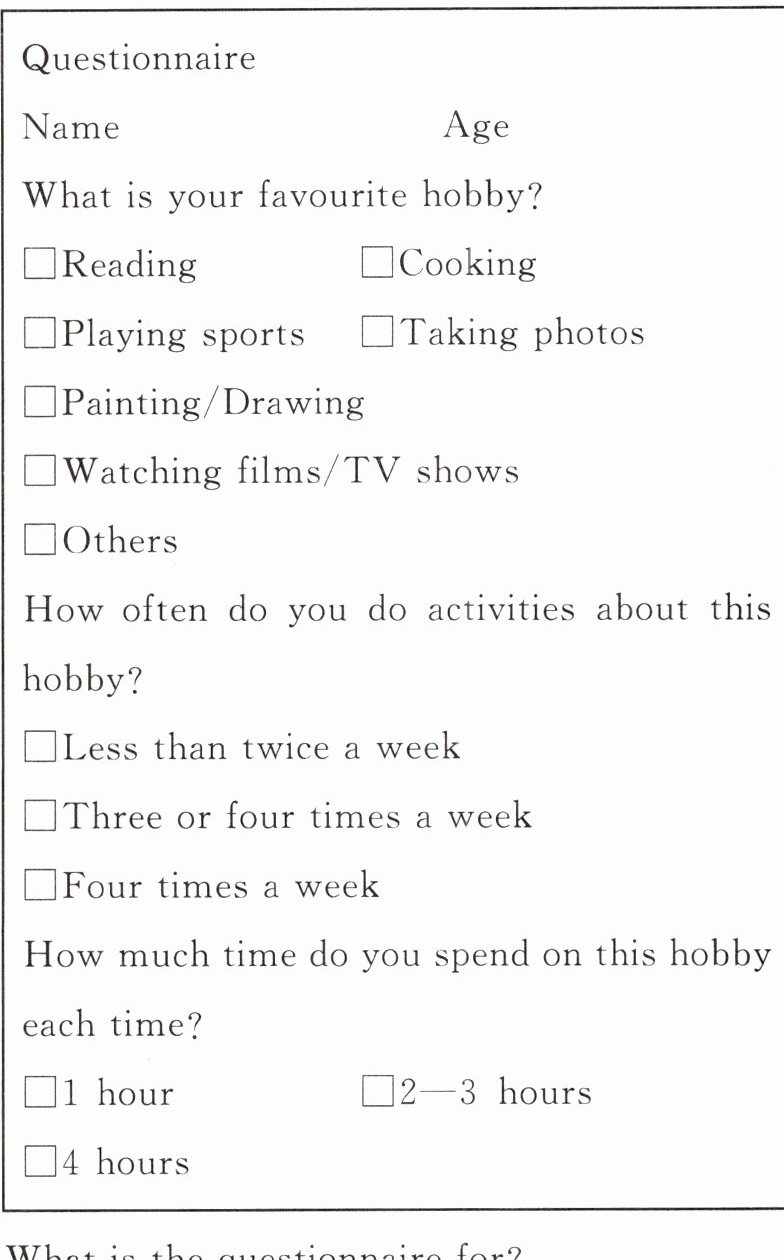
What is the questionnaire for?
A.Learning about the students' hobbies.
B.Helping the students know each other.
C.Telling the students to keep their hobbies.
D.Asking the students to introduce themselves.
What is the questionnaire for?
A.Learning about the students' hobbies.
B.Helping the students know each other.
C.Telling the students to keep their hobbies.
D.Asking the students to introduce themselves.
答案
9.A 解析:考查信息提取。问卷内容询问兴趣爱好及活动频率、时长,目的是了解学生爱好。故选A。
解析
【分析】
首先观察调查问卷的内容:依次询问学生“最喜欢的爱好”“做该爱好活动的频率”“每次在该爱好上花费的时间”,核心围绕学生的爱好展开,需据此判断问卷的目的,再结合选项选出正确答案。
【解析】
该题考查对调查问卷内容的理解与信息提取。问卷的所有问题均围绕学生的爱好设置,目的是了解学生的爱好。选项A“Learning about the students' hobbies”符合问卷的核心目的;选项B“帮助学生互相了解”、选项C“告诉学生保持爱好”、选项D“让学生自我介绍”均与问卷内容无关,因此选A。
【答案】
A
【知识点】
信息提取、阅读理解
【点评】
本题以调查问卷为载体考查学生对文本内容的理解,需准确把握问卷的核心问题,难度适中。
【难度系数】
0.7
首先观察调查问卷的内容:依次询问学生“最喜欢的爱好”“做该爱好活动的频率”“每次在该爱好上花费的时间”,核心围绕学生的爱好展开,需据此判断问卷的目的,再结合选项选出正确答案。
【解析】
该题考查对调查问卷内容的理解与信息提取。问卷的所有问题均围绕学生的爱好设置,目的是了解学生的爱好。选项A“Learning about the students' hobbies”符合问卷的核心目的;选项B“帮助学生互相了解”、选项C“告诉学生保持爱好”、选项D“让学生自我介绍”均与问卷内容无关,因此选A。
【答案】
A
【知识点】
信息提取、阅读理解
【点评】
本题以调查问卷为载体考查学生对文本内容的理解,需准确把握问卷的核心问题,难度适中。
【难度系数】
0.7
Ⅳ.句子翻译
1. 她每天做多少运动?
2. 你需要对你的生活方式做出一些改变。
3. 晚上睡个好觉能给你一整天的能量。
4. 他每天花一个半小时时间在英语上。
5. 保持健康就是要有足够的锻炼和休息。
1. 她每天做多少运动?
How much exercise does she do/take every day?
2. 你需要对你的生活方式做出一些改变。
You need to make some changes to your lifestyle.
3. 晚上睡个好觉能给你一整天的能量。
A good night's sleep can give you energy for the whole day.
4. 他每天花一个半小时时间在英语上。
He spends one and a half hours on English every day.
5. 保持健康就是要有足够的锻炼和休息。
Keeping/Staying fit/healthy is all about enough exercise and rest.
答案
Ⅳ. 1. How much exercise does she do/take every day?
2. You need to make some changes to your lifestyle.
3. A good night's sleep can give you energy for the whole day.
4. He spends one and a half hours on English every day.
5. Keeping/Staying fit/healthy is all about enough exercise and rest.
2. You need to make some changes to your lifestyle.
3. A good night's sleep can give you energy for the whole day.
4. He spends one and a half hours on English every day.
5. Keeping/Staying fit/healthy is all about enough exercise and rest.
解析
【分析】
本题为英语句子翻译题,解题思路为:1. 先判断每个句子的句式(特殊疑问句/陈述句);2. 提取句子核心语义及关键短语;3. 匹配英语中对应的常用表达、固定搭配;4. 结合时态(均为一般现在时,描述日常动作)调整语序,确保翻译符合英语表达习惯,准确传达原句含义。
【解析】
1. 原句是特殊疑问句,核心为“她每天做多少运动”,“多少运动”用how much exercise,“做运动”常用do/take exercise,时间状语“每天”对应every day,因此翻译为How much exercise does she do/take every day?
2. 原句是陈述句,核心为“需要对生活方式做改变”,“需要做某事”是need to do sth,“做出改变”是make changes,“生活方式”是lifestyle,因此翻译为You need to make some changes to your lifestyle.
3. 原句是陈述句,核心为“晚上睡好觉给一整天能量”,“晚上睡个好觉”译为A good night's sleep,“给某人能量”是give sb energy,“一整天”是the whole day,因此翻译为A good night's sleep can give you energy for the whole day.
4. 原句是陈述句,核心为“每天花一个半小时在英语上”,“花费时间在某事上”是spend time on sth,“一个半小时”是one and a half hours,因此翻译为He spends one and a half hours on English every day.
5. 原句是陈述句,核心为“保持健康需要足够锻炼和休息”,“保持健康”用动名词短语Keeping/Staying fit/healthy作主语,“足够的锻炼和休息”是enough exercise and rest,因此翻译为Keeping/Staying fit/healthy is all about enough exercise and rest.
【答案】
Ⅳ. 1. How much exercise does she do/take every day?
2. You need to make some changes to your lifestyle.
3. A good night's sleep can give you energy for the whole day.
4. He spends one and a half hours on English every day.
5. Keeping/Staying fit/healthy is all about enough exercise and rest.
【知识点】
英语句子翻译、常用固定搭配、一般现在时
【点评】
本题围绕日常健康与生活习惯话题,考察基础英语翻译能力,涉及常用固定短语和句式,属于基础题型,适合巩固英语基础表达,难度适中。
【难度系数】
0.7
本题为英语句子翻译题,解题思路为:1. 先判断每个句子的句式(特殊疑问句/陈述句);2. 提取句子核心语义及关键短语;3. 匹配英语中对应的常用表达、固定搭配;4. 结合时态(均为一般现在时,描述日常动作)调整语序,确保翻译符合英语表达习惯,准确传达原句含义。
【解析】
1. 原句是特殊疑问句,核心为“她每天做多少运动”,“多少运动”用how much exercise,“做运动”常用do/take exercise,时间状语“每天”对应every day,因此翻译为How much exercise does she do/take every day?
2. 原句是陈述句,核心为“需要对生活方式做改变”,“需要做某事”是need to do sth,“做出改变”是make changes,“生活方式”是lifestyle,因此翻译为You need to make some changes to your lifestyle.
3. 原句是陈述句,核心为“晚上睡好觉给一整天能量”,“晚上睡个好觉”译为A good night's sleep,“给某人能量”是give sb energy,“一整天”是the whole day,因此翻译为A good night's sleep can give you energy for the whole day.
4. 原句是陈述句,核心为“每天花一个半小时在英语上”,“花费时间在某事上”是spend time on sth,“一个半小时”是one and a half hours,因此翻译为He spends one and a half hours on English every day.
5. 原句是陈述句,核心为“保持健康需要足够锻炼和休息”,“保持健康”用动名词短语Keeping/Staying fit/healthy作主语,“足够的锻炼和休息”是enough exercise and rest,因此翻译为Keeping/Staying fit/healthy is all about enough exercise and rest.
【答案】
Ⅳ. 1. How much exercise does she do/take every day?
2. You need to make some changes to your lifestyle.
3. A good night's sleep can give you energy for the whole day.
4. He spends one and a half hours on English every day.
5. Keeping/Staying fit/healthy is all about enough exercise and rest.
【知识点】
英语句子翻译、常用固定搭配、一般现在时
【点评】
本题围绕日常健康与生活习惯话题,考察基础英语翻译能力,涉及常用固定短语和句式,属于基础题型,适合巩固英语基础表达,难度适中。
【难度系数】
0.7
Ⅴ. 阅读理解
Moving your body is good not only for your health, but also for your mind. Studies show that children who move their bodies a lot often do better in school. While kids get some exercise in PE class and at breaks, this is often not enough (足够的).
To help with children's learning, teachers are using movement integration(运动整合) in their classes. In these lessons, kids don't sit still all day but move their bodies while learning.
Movement integration can be part of a lesson or a fun break from learning. You can jump as far as you can in a maths lesson. Write down how far you go—this turns boring number practice into something interesting. After a reading lesson, you can rest your mind with a 5-minute dance party to exciting music. You can also do warm-up moves like walking by your desk. Some teachers even use special ball chairs so kids can move while they listen.
Kids like talking and working with other classmates in the movement integration. They often feel happy and energetic(有活力的) after it. When kids feel good about themselves and with others, they are more prepared to learn and do better in the classroom. It is important that teachers make use of activities in class so that they can help kids do well in all classes.
1. What does the first paragraph talk about?
A. What activities kids like to do.
B. Why moving the body is important.
C. When kids usually have PE class.
D. How teachers learn to teach kids.
2. What does the underlined word "still" in Paragraph 2 mean?
A. Quietly.
B. Back.
C. Closely.
D. Around.
3. 新考法 图示理解 Which picture shows turning maths number practice into a fun activity?
A.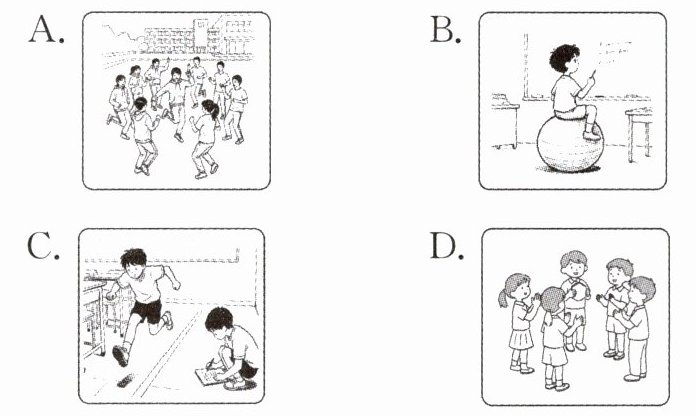
4. What can we learn from the last paragraph?
A. Kids need longer breaks to play freely.
B. It's bad for kids to talk with others in class.
C. Teachers find it difficult to make kids move.
D. Movement helps kids feel good and learn better.
5. What would be the best title for the passage?
A. Fun Class Games in PE Class
B. How to Have Dance Parties in Class
C. Give More Free Time to the School Kids
D. Classroom Movement: Good for Health and Study
Moving your body is good not only for your health, but also for your mind. Studies show that children who move their bodies a lot often do better in school. While kids get some exercise in PE class and at breaks, this is often not enough (足够的).
To help with children's learning, teachers are using movement integration(运动整合) in their classes. In these lessons, kids don't sit still all day but move their bodies while learning.
Movement integration can be part of a lesson or a fun break from learning. You can jump as far as you can in a maths lesson. Write down how far you go—this turns boring number practice into something interesting. After a reading lesson, you can rest your mind with a 5-minute dance party to exciting music. You can also do warm-up moves like walking by your desk. Some teachers even use special ball chairs so kids can move while they listen.
Kids like talking and working with other classmates in the movement integration. They often feel happy and energetic(有活力的) after it. When kids feel good about themselves and with others, they are more prepared to learn and do better in the classroom. It is important that teachers make use of activities in class so that they can help kids do well in all classes.
1. What does the first paragraph talk about?
A. What activities kids like to do.
B. Why moving the body is important.
C. When kids usually have PE class.
D. How teachers learn to teach kids.
2. What does the underlined word "still" in Paragraph 2 mean?
A. Quietly.
B. Back.
C. Closely.
D. Around.
3. 新考法 图示理解 Which picture shows turning maths number practice into a fun activity?
A.
4. What can we learn from the last paragraph?
A. Kids need longer breaks to play freely.
B. It's bad for kids to talk with others in class.
C. Teachers find it difficult to make kids move.
D. Movement helps kids feel good and learn better.
5. What would be the best title for the passage?
A. Fun Class Games in PE Class
B. How to Have Dance Parties in Class
C. Give More Free Time to the School Kids
D. Classroom Movement: Good for Health and Study
答案
Ⅴ. 1.B 2.A 3.C 4.D 5.D
【语篇解读】本文主要介绍了课堂运动整合的作用与实践。
1. B 解析:段落大意题。根据第一段先提出“运动对身心都有益”的核心观点,再用研究结果支撑“常运动的孩子成绩更好”,最后指出“现有运动时间不足”的问题可知,整体是在解释为什么活动身体很重要,而非描述孩子喜欢的活动或体育课时间。故选B。
2. A 解析:词义猜测题。根据原文“kids don't sit still all day”可知孩子们不会一整天坐着不动。“still”在这里表示静止的、不动的,与“Quietly”(安静地)含义最贴合。故选A。
3. C 解析:图示理解题。根据原文“Write down how far you go—this turns boring number practice into something interesting.”可知,图片C展示的正是“跳远+记录距离”的场景。故选C。
4. D 解析:推理判断题。根据原文“They often feel happy and energetic”和“they are more prepared to learn and do better in the classroom”可知运动整合让孩子感到开心且有活力,并且更乐于学习、课堂表现更好。故选D。
5. D 解析:标题归纳题。全文围绕“movement integration”展开,既讲了它对健康的好处,也讲了它对学习的提升,故选D。
【语篇解读】本文主要介绍了课堂运动整合的作用与实践。
1. B 解析:段落大意题。根据第一段先提出“运动对身心都有益”的核心观点,再用研究结果支撑“常运动的孩子成绩更好”,最后指出“现有运动时间不足”的问题可知,整体是在解释为什么活动身体很重要,而非描述孩子喜欢的活动或体育课时间。故选B。
2. A 解析:词义猜测题。根据原文“kids don't sit still all day”可知孩子们不会一整天坐着不动。“still”在这里表示静止的、不动的,与“Quietly”(安静地)含义最贴合。故选A。
3. C 解析:图示理解题。根据原文“Write down how far you go—this turns boring number practice into something interesting.”可知,图片C展示的正是“跳远+记录距离”的场景。故选C。
4. D 解析:推理判断题。根据原文“They often feel happy and energetic”和“they are more prepared to learn and do better in the classroom”可知运动整合让孩子感到开心且有活力,并且更乐于学习、课堂表现更好。故选D。
5. D 解析:标题归纳题。全文围绕“movement integration”展开,既讲了它对健康的好处,也讲了它对学习的提升,故选D。
解析
【分析】
本题为英语阅读理解题,包含5道小题,分别考查段落大意、词义猜测、图示理解、细节推理和标题归纳能力。解题思路如下:
1. 第1题:通读第一段,明确其核心是阐述运动对健康和学习的重要性,排除不符合的选项,得出答案。
2. 第2题:结合原句语境“kids don't sit still all day”,推断“still”的含义,匹配选项。
3. 第3题:定位原文中“把数学数字练习变成有趣活动”的描述,对应图示场景,选出正确图片。
4. 第4题:细读最后一段,提取关于运动对孩子情绪和学习影响的信息,推理得出答案。
5. 第5题:梳理全文主旨,围绕“课堂运动整合对健康和学习有益”归纳标题。
【解析】
1. 第1题:第一段开篇提出“运动对健康和思维都有益”,用研究说明常运动的孩子学业更好,最后指出现有运动不足,整体是解释运动的重要性,故选B。
2. 第2题:原句“kids don't sit still all day”意为孩子们不会一整天坐着不动,“still”在此表示“静止地、不动地”,与“Quietly”含义贴合,故选A。
3. 第3题:原文提到“跳远并记录距离,把枯燥的数字练习变成有趣的事”,图片C展示了跳远和记录的场景,故选C。
4. 第4题:最后一段指出运动后孩子会开心有活力,更乐于学习、课堂表现更好,对应选项D,故选D。
5. 第5题:全文围绕“课堂运动整合”展开,既讲对健康的好处,也讲对学习的提升,故选D。
【答案】
Ⅴ. 1.B 2.A 3.C 4.D 5.D
【知识点】
阅读理解、段落大意、词义猜测
【点评】
本题是一篇关于课堂运动整合的英语阅读理解题,涵盖多种核心阅读题型,注重考查学生对文本细节、主旨的理解与应用能力,结合原文信息即可完成解答,难度适中。
【难度系数】
0.6
本题为英语阅读理解题,包含5道小题,分别考查段落大意、词义猜测、图示理解、细节推理和标题归纳能力。解题思路如下:
1. 第1题:通读第一段,明确其核心是阐述运动对健康和学习的重要性,排除不符合的选项,得出答案。
2. 第2题:结合原句语境“kids don't sit still all day”,推断“still”的含义,匹配选项。
3. 第3题:定位原文中“把数学数字练习变成有趣活动”的描述,对应图示场景,选出正确图片。
4. 第4题:细读最后一段,提取关于运动对孩子情绪和学习影响的信息,推理得出答案。
5. 第5题:梳理全文主旨,围绕“课堂运动整合对健康和学习有益”归纳标题。
【解析】
1. 第1题:第一段开篇提出“运动对健康和思维都有益”,用研究说明常运动的孩子学业更好,最后指出现有运动不足,整体是解释运动的重要性,故选B。
2. 第2题:原句“kids don't sit still all day”意为孩子们不会一整天坐着不动,“still”在此表示“静止地、不动地”,与“Quietly”含义贴合,故选A。
3. 第3题:原文提到“跳远并记录距离,把枯燥的数字练习变成有趣的事”,图片C展示了跳远和记录的场景,故选C。
4. 第4题:最后一段指出运动后孩子会开心有活力,更乐于学习、课堂表现更好,对应选项D,故选D。
5. 第5题:全文围绕“课堂运动整合”展开,既讲对健康的好处,也讲对学习的提升,故选D。
【答案】
Ⅴ. 1.B 2.A 3.C 4.D 5.D
【知识点】
阅读理解、段落大意、词义猜测
【点评】
本题是一篇关于课堂运动整合的英语阅读理解题,涵盖多种核心阅读题型,注重考查学生对文本细节、主旨的理解与应用能力,结合原文信息即可完成解答,难度适中。
【难度系数】
0.6
