

 登录
登录
语篇研读
阅读教材1b的语篇并完成以下题目。
Activity 1 学习理解
Ⅰ. 回答问题
1. What are the two main kinds of memory mentioned in the passage?
2. Why is taking notes helpful in remembering information?
3. Which healthy habit helps the brain organize memories?
阅读教材1b的语篇并完成以下题目。
Activity 1 学习理解
Ⅰ. 回答问题
1. What are the two main kinds of memory mentioned in the passage?
Short-term memory and long-term memory.
2. Why is taking notes helpful in remembering information?
Because it is easier to remember a summary than every word in a passage.
3. Which healthy habit helps the brain organize memories?
Sleeping well helps the brain organize memories.
答案
1. Short-term memory and long-term memory.
2. Because it is easier to remember a summary than every word in a passage.
3. Sleeping well helps the brain organize memories.
2. Because it is easier to remember a summary than every word in a passage.
3. Sleeping well helps the brain organize memories.
解析
【分析】本题是语篇研读的信息提取类题目,解题思路为:先仔细研读1b的语篇,针对每个问题的核心关键词(如“two main kinds of memory”“taking notes helpful”“healthy habit organize memories”)在语篇中定位对应内容,准确提取所需信息即可完成作答。
【解析】1. 从语篇中定位关于记忆类型的表述,明确提到两种主要记忆为短期记忆和长期记忆;2. 定位语篇中阐述记笔记作用的内容,可知记笔记时总结信息比逐字记忆更容易,因此有助于记忆;3. 定位语篇中提到的帮助大脑组织记忆的健康习惯,可知是良好睡眠。
【答案】1. Short-term memory and long-term memory.
2. Because it is easier to remember a summary than every word in a passage.
3. Sleeping well helps the brain organize memories.
【知识点】英语语篇阅读理解,信息提取
【点评】本题属于学习理解层面的基础语篇题目,主要考查学生从语篇中定位并提取关键信息的能力,难度较低,只要认真研读语篇即可正确作答。
【难度系数】0.8
【解析】1. 从语篇中定位关于记忆类型的表述,明确提到两种主要记忆为短期记忆和长期记忆;2. 定位语篇中阐述记笔记作用的内容,可知记笔记时总结信息比逐字记忆更容易,因此有助于记忆;3. 定位语篇中提到的帮助大脑组织记忆的健康习惯,可知是良好睡眠。
【答案】1. Short-term memory and long-term memory.
2. Because it is easier to remember a summary than every word in a passage.
3. Sleeping well helps the brain organize memories.
【知识点】英语语篇阅读理解,信息提取
【点评】本题属于学习理解层面的基础语篇题目,主要考查学生从语篇中定位并提取关键信息的能力,难度较低,只要认真研读语篇即可正确作答。
【难度系数】0.8
Ⅱ. 根据1b课文完成导图
How to Boost Your Memory
Two types of memory
Short-term memory
1.
Ways to improve memory
Pay attention.
Try 2.
Use it or lose it.
You should review what you learn, but not 3.
Create images by 4.
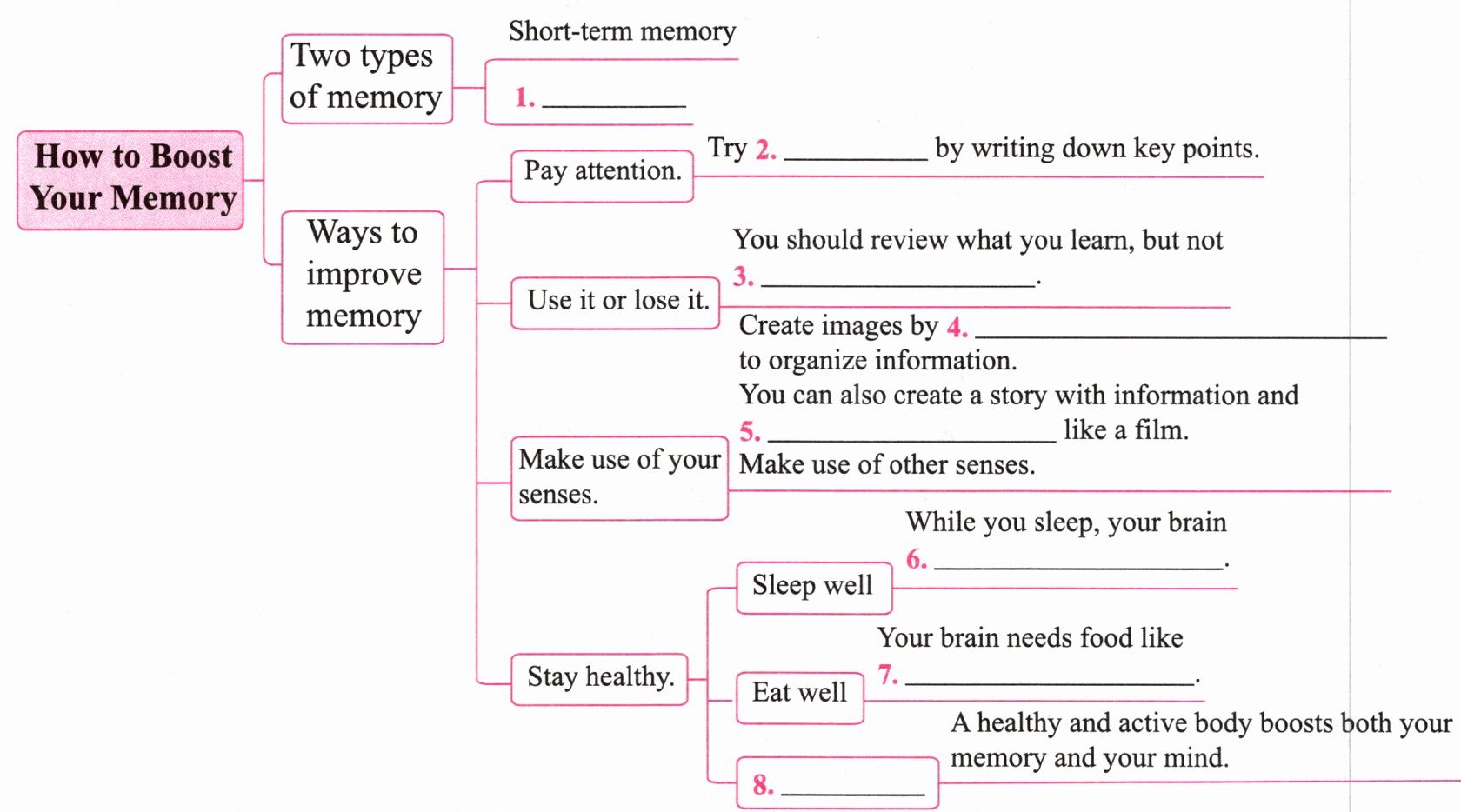 You can also create a story with information and 5.
Make use of your senses.
Make use of other senses.
Stay healthy.
Sleep well
While you sleep, your brain 6.
Eat well
Your brain needs food like 7.
8.
A healthy and active body boosts both your memory and your mind.
How to Boost Your Memory
Two types of memory
Short-term memory
1.
Long-term memory
Ways to improve memory
Pay attention.
Try 2.
taking notes
by writing down key points.Use it or lose it.
You should review what you learn, but not 3.
wear out your brain
.Create images by 4.
using tables, graphs, and mind maps
to organize information. You can also create a story with information and 5. view it in your mind
like a film.Make use of your senses.
Make use of other senses.
Stay healthy.
Sleep well
While you sleep, your brain 6.
organizes your memories
.Eat well
Your brain needs food like 7.
an engine needs fuel
.8.
Exercise
A healthy and active body boosts both your memory and your mind.
答案
1. Long-term memory
2. taking notes
3. wear out your brain
4. using tables, graphs, and mind maps
5. view it in your mind
6. organizes your memories
7. an engine needs fuel
8. Exercise
2. taking notes
3. wear out your brain
4. using tables, graphs, and mind maps
5. view it in your mind
6. organizes your memories
7. an engine needs fuel
8. Exercise
解析
【分析】
这道题是根据课文内容完成提升记忆力的思维导图填空,解题思路为:先明确思维导图的两大分支(记忆类型、提升记忆的方法),再结合课文对应知识点,逐个分析每个空的逻辑:1空对应短期记忆的另一种记忆类型,需填长期记忆;2空对应“写下关键点”的具体做法,是做笔记;3空对应“复习但不要”的禁忌,是过度用脑;4空对应组织信息的方式,需填相关工具;5空对应像电影一样的动作,是脑海中的行为;6空对应睡眠时大脑的功能;7空对应大脑所需营养的类比;8空对应保持健康的第三个要点。
【解析】
1. 两种记忆类型包含短期记忆和长期记忆,因此1空填Long-term memory;
2. “写下关键点”对应的做法是做笔记,即taking notes,故2空填taking notes;
3. “复习所学但不要”的内容是过度用脑,即wear out your brain,故3空填wear out your brain;
4. 组织信息可通过使用表格、图表、思维导图,即using tables, graphs, and mind maps,故4空填using tables, graphs, and mind maps;
5. 像电影一样在脑海中呈现信息的动作是view it in your mind,故5空填view it in your mind;
6. 睡眠时大脑会整理记忆,即organizes your memories,故6空填organizes your memories;
7. 大脑需要的食物类比引擎需要燃料,即an engine needs fuel,故7空填an engine needs fuel;
8. 保持健康的第三个要点是锻炼,对应“健康活跃的身体提升记忆和思维”,故8空填Exercise。
【答案】
1. Long-term memory;2. taking notes;3. wear out your brain;4. using tables, graphs, and mind maps;5. view it in your mind;6. organizes your memories;7. an engine needs fuel;8. Exercise
【知识点】
英语课文理解、信息提取
【点评】
本题考查对课文内容的理解与信息匹配能力,以思维导图形式梳理提升记忆力的方法,需结合课文原文准确作答,难度适中。
【难度系数】
0.5
这道题是根据课文内容完成提升记忆力的思维导图填空,解题思路为:先明确思维导图的两大分支(记忆类型、提升记忆的方法),再结合课文对应知识点,逐个分析每个空的逻辑:1空对应短期记忆的另一种记忆类型,需填长期记忆;2空对应“写下关键点”的具体做法,是做笔记;3空对应“复习但不要”的禁忌,是过度用脑;4空对应组织信息的方式,需填相关工具;5空对应像电影一样的动作,是脑海中的行为;6空对应睡眠时大脑的功能;7空对应大脑所需营养的类比;8空对应保持健康的第三个要点。
【解析】
1. 两种记忆类型包含短期记忆和长期记忆,因此1空填Long-term memory;
2. “写下关键点”对应的做法是做笔记,即taking notes,故2空填taking notes;
3. “复习所学但不要”的内容是过度用脑,即wear out your brain,故3空填wear out your brain;
4. 组织信息可通过使用表格、图表、思维导图,即using tables, graphs, and mind maps,故4空填using tables, graphs, and mind maps;
5. 像电影一样在脑海中呈现信息的动作是view it in your mind,故5空填view it in your mind;
6. 睡眠时大脑会整理记忆,即organizes your memories,故6空填organizes your memories;
7. 大脑需要的食物类比引擎需要燃料,即an engine needs fuel,故7空填an engine needs fuel;
8. 保持健康的第三个要点是锻炼,对应“健康活跃的身体提升记忆和思维”,故8空填Exercise。
【答案】
1. Long-term memory;2. taking notes;3. wear out your brain;4. using tables, graphs, and mind maps;5. view it in your mind;6. organizes your memories;7. an engine needs fuel;8. Exercise
【知识点】
英语课文理解、信息提取
【点评】
本题考查对课文内容的理解与信息匹配能力,以思维导图形式梳理提升记忆力的方法,需结合课文原文准确作答,难度适中。
【难度系数】
0.5
Activity 2 应用实践
If you need to remember a new list of English words, choose one memory technique from the passage and describe how you would use it in this situation.
If you need to remember a new list of English words, choose one memory technique from the passage and describe how you would use it in this situation.
I'd use the "make use of senses" technique: I'll create a story that includes all the new words (e.g., "The 'brave' rabbit carried a 'soft' blanket to the 'quiet' forest.") and imagine the story as a film in my mind.
This makes the words more memorable and helps them enter long-term memory.
答案
I'd use the "make use of senses" technique: I'll create a story that includes all the new words (e.g., "The 'brave' rabbit carried a 'soft' blanket to the 'quiet' forest.") and imagine the story as a film in my mind. This makes the words more memorable and helps them enter long-term memory.
解析
【分析】首先明确题目要求:从文章中的记忆技巧选取一种,描述如何用该技巧记住新英语单词。解题思路为:先挑选适合记单词的记忆技巧,再结合记新单词的场景,具体说明该技巧的操作步骤,最后点明该操作对记忆单词的作用。
【解析】我会选择“利用感官”的记忆技巧:我将创作一个包含所有新单词的故事(例如“勇敢的兔子带着柔软的毯子去了安静的森林”),同时在脑海中把这个故事想象成一部电影,通过视觉化的画面强化对单词的记忆,帮助这些单词进入长期记忆。
【答案】I'd use the "make use of senses" technique: I'll create a story that includes all the new words (e.g., "The 'brave' rabbit carried a 'soft' blanket to the 'quiet' forest.") and imagine the story as a film in my mind. This makes the words more memorable and helps them enter long-term memory.
【知识点】英语学习方法;记忆技巧应用
【点评】本题考查学生对英语记忆技巧的理解与实际运用能力,要求学生结合具体任务选择合适方法并清晰表述,注重知识的学以致用。
【难度系数】0.5
【解析】我会选择“利用感官”的记忆技巧:我将创作一个包含所有新单词的故事(例如“勇敢的兔子带着柔软的毯子去了安静的森林”),同时在脑海中把这个故事想象成一部电影,通过视觉化的画面强化对单词的记忆,帮助这些单词进入长期记忆。
【答案】I'd use the "make use of senses" technique: I'll create a story that includes all the new words (e.g., "The 'brave' rabbit carried a 'soft' blanket to the 'quiet' forest.") and imagine the story as a film in my mind. This makes the words more memorable and helps them enter long-term memory.
【知识点】英语学习方法;记忆技巧应用
【点评】本题考查学生对英语记忆技巧的理解与实际运用能力,要求学生结合具体任务选择合适方法并清晰表述,注重知识的学以致用。
【难度系数】0.5
1. discuss
【感知】
» You can also review information by
Activity 3 迁移创新
Design a one-week memory plan to help
yourself improve, and explain why each part
of the plan works.
discussing it with others or by teaching others.(教材第36页)
你也可以通过和别人讨论或教别人来复习知识。
» We had a heated discussion about the English story with our teacher in class.
我们就这篇英语故事在课堂上和老师进行了热烈的讨论。
» The new rule about school uniforms is under discussion now.
关于校服的新规定现在正在讨论中。
【探究】
(1)discuss 及物动词,意为“讨论;谈论;商量”。
(2)discussion 名词,意为“讨论;谈论;商量”。
①have a discussion about sth 就某事进行讨论
②have a discussion with sb 和某人讨论
③
【应用】
①用所给单词的适当形式填空:The parking problem is a hot topic under
②完成句子:我父母正在和我讨论家庭旅行的事。
My parents are
【感知】
» You can also review information by
Activity 3 迁移创新
Design a one-week memory plan to help
yourself improve, and explain why each part
of the plan works.
Daily: Spend 30 minutes reviewing notes (from the "use it or lose it" tip—repetition strengthens long-term memory) and create a mind map for new knowledge (use senses to make information vivid).
Every 2 days: Discuss what I've learnt with a classmate (review the knowledge by discussing it or teaching others, which deepens understanding).
Weekly: Check sleep / eating habits (staying healthy ensures the brain works well for memory storage).
discussing it with others or by teaching others.(教材第36页)
你也可以通过和别人讨论或教别人来复习知识。
» We had a heated discussion about the English story with our teacher in class.
我们就这篇英语故事在课堂上和老师进行了热烈的讨论。
» The new rule about school uniforms is under discussion now.
关于校服的新规定现在正在讨论中。
【探究】
(1)discuss 及物动词,意为“讨论;谈论;商量”。
discuss sth with sb
和某人讨论某事(2)discussion 名词,意为“讨论;谈论;商量”。
①have a discussion about sth 就某事进行讨论
②have a discussion with sb 和某人讨论
③
under discussion
在讨论中【应用】
①用所给单词的适当形式填空:The parking problem is a hot topic under
discussion
(discuss).②完成句子:我父母正在和我讨论家庭旅行的事。
My parents are
discussing
family trips with
me.答案
【探究】
(1)discuss sth with sb
(2)③under discussion
【应用】
①discussion
②discussing; with
Activity 3:
Daily: Spend 30 minutes reviewing notes (from the "use it or lose it" tip—repetition strengthens long-term memory) and create a mind map for new knowledge (use senses to make information vivid).
Every 2 days: Discuss what I've learnt with a classmate (review the knowledge by discussing it or teaching others, which deepens understanding).
Weekly: Check sleep / eating habits (staying healthy ensures the brain works well for memory storage).
(1)discuss sth with sb
(2)③under discussion
【应用】
①discussion
②discussing; with
Activity 3:
Daily: Spend 30 minutes reviewing notes (from the "use it or lose it" tip—repetition strengthens long-term memory) and create a mind map for new knowledge (use senses to make information vivid).
Every 2 days: Discuss what I've learnt with a classmate (review the knowledge by discussing it or teaching others, which deepens understanding).
Weekly: Check sleep / eating habits (staying healthy ensures the brain works well for memory storage).
解析
【分析】
本题围绕动词discuss和名词discussion的用法展开,分为探究搭配、应用填空及迁移创新三部分。解题时需先明确discuss的动词搭配、discussion的名词固定短语;应用部分根据介词后接名词、现在进行时结构判断单词形式;迁移部分需结合题干提到的复习方法及记忆技巧设计一周计划。
【解析】
1. 探究部分:
(1) discuss为及物动词,表“和某人讨论某事”的搭配是discuss sth with sb;
(2) discussion为名词,表“在讨论中”的固定短语是under discussion;
2. 应用部分:
① 介词under后需接名词,故将动词discuss变为名词discussion;
② 现在进行时结构为“be + 动词ing”,“和某人讨论某事”用discuss sth with sb,故填discussing; with;
3. 迁移创新部分:需结合题干给出的复习建议(重复复习、思维导图、讨论交流、健康习惯)设计一周计划,如每日复习笔记、画思维导图,每两天和同学讨论所学,每周检查健康习惯。
【答案】
【探究】
(1)discuss sth with sb
(2)③under discussion
【应用】
①discussion
②discussing; with
Activity 3:
Daily: Spend 30 minutes reviewing notes (from the "use it or lose it" tip—repetition strengthens long-term memory) and create a mind map for new knowledge (use senses to make information vivid).
Every 2 days: Discuss what I've learnt with a classmate (review the knowledge by discussing it or teaching others, which deepens understanding).
Weekly: Check sleep / eating habits (staying healthy ensures the brain works well for memory storage).
【知识点】
动词短语搭配、名词辨析、固定搭配
【点评】
本题考查discuss与discussion的词性转换及固定短语,同时要求结合记忆方法设计计划,既需掌握基础语法搭配,又要具备知识迁移应用能力,是基础考点与实践应用结合的题型。
【难度系数】
0.3
本题围绕动词discuss和名词discussion的用法展开,分为探究搭配、应用填空及迁移创新三部分。解题时需先明确discuss的动词搭配、discussion的名词固定短语;应用部分根据介词后接名词、现在进行时结构判断单词形式;迁移部分需结合题干提到的复习方法及记忆技巧设计一周计划。
【解析】
1. 探究部分:
(1) discuss为及物动词,表“和某人讨论某事”的搭配是discuss sth with sb;
(2) discussion为名词,表“在讨论中”的固定短语是under discussion;
2. 应用部分:
① 介词under后需接名词,故将动词discuss变为名词discussion;
② 现在进行时结构为“be + 动词ing”,“和某人讨论某事”用discuss sth with sb,故填discussing; with;
3. 迁移创新部分:需结合题干给出的复习建议(重复复习、思维导图、讨论交流、健康习惯)设计一周计划,如每日复习笔记、画思维导图,每两天和同学讨论所学,每周检查健康习惯。
【答案】
【探究】
(1)discuss sth with sb
(2)③under discussion
【应用】
①discussion
②discussing; with
Activity 3:
Daily: Spend 30 minutes reviewing notes (from the "use it or lose it" tip—repetition strengthens long-term memory) and create a mind map for new knowledge (use senses to make information vivid).
Every 2 days: Discuss what I've learnt with a classmate (review the knowledge by discussing it or teaching others, which deepens understanding).
Weekly: Check sleep / eating habits (staying healthy ensures the brain works well for memory storage).
【知识点】
动词短语搭配、名词辨析、固定搭配
【点评】
本题考查discuss与discussion的词性转换及固定短语,同时要求结合记忆方法设计计划,既需掌握基础语法搭配,又要具备知识迁移应用能力,是基础考点与实践应用结合的题型。
【难度系数】
0.3
