

 登录
登录
一 同学们正在讨论理性消费好习惯。在属于理性消费的句子前的括号内打“√”。
(
()2. I buy all things I want, even if(即使) I don't need them.
(
()4. I can spend all my pocket money on food and toys.
(
√
)1. I write a spending plan before I buy things.()2. I buy all things I want, even if(即使) I don't need them.
(
√
)3. I wait for a sale when I want to buy expensive things.()4. I can spend all my pocket money on food and toys.
答案
在1、3括号里打“√”。
解析
【分析】首先明确理性消费的核心是合理规划支出、按需购买、不盲目消费。接着逐个分析句子:1句是买东西前制定支出计划,属于合理规划,符合理性消费;2句是购买所有想要的物品(即使不需要),属于盲目消费,不符合;3句是购买昂贵物品时等待促销,属于合理安排支出,符合理性消费;4句是将所有零花钱花在食物和玩具上,无规划,不符合。因此需在1、3的括号内打“√”。
【解析】判断理性消费的依据是是否合理规划、按需购买,不盲目。1. 买东西前做支出计划,符合理性消费,打“√”;2. 买不需要的物品,盲目消费,不打;3. 买昂贵物品等促销,合理安排,打“√”;4. 无规划花零花钱,不打。
【答案】在1、3的括号内打“√”。
【知识点】理性消费观念、英语句子理解
【点评】本题结合英语句子考查对理性消费的理解,需先明确理性消费的含义,再结合句子内容判断,贴近生活实际,难度适中。
【难度系数】0.6
【解析】判断理性消费的依据是是否合理规划、按需购买,不盲目。1. 买东西前做支出计划,符合理性消费,打“√”;2. 买不需要的物品,盲目消费,不打;3. 买昂贵物品等促销,合理安排,打“√”;4. 无规划花零花钱,不打。
【答案】在1、3的括号内打“√”。
【知识点】理性消费观念、英语句子理解
【点评】本题结合英语句子考查对理性消费的理解,需先明确理性消费的含义,再结合句子内容判断,贴近生活实际,难度适中。
【难度系数】0.6
二 同学们展示了自己的消费计划。阅读对话,填写单词。
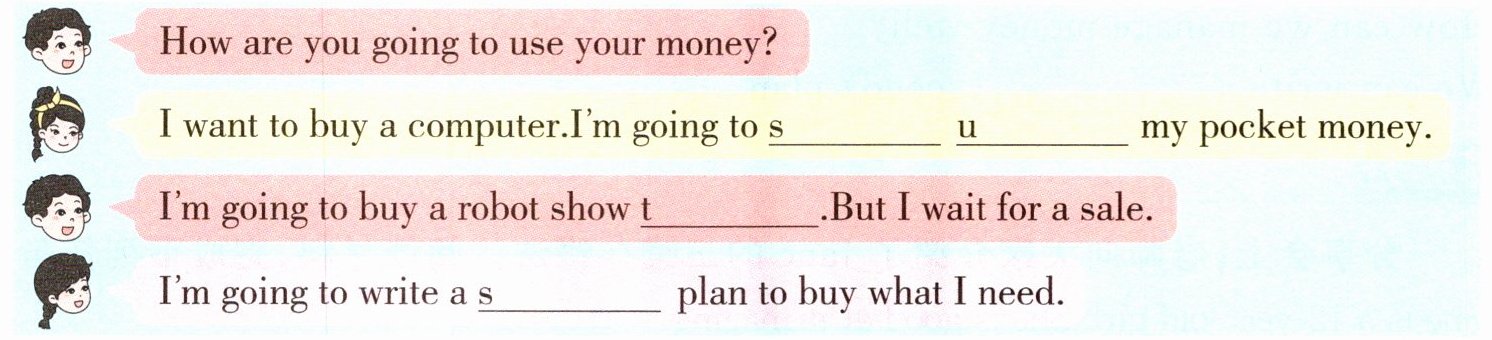
How are you going to use your money?
I want to buy a computer.I'm going to s
I'm going to buy a robot show t
I'm going to write a s
How are you going to use your money?
I want to buy a computer.I'm going to s
ave
up
my pocket money.I'm going to buy a robot show t
icket
.But I wait for a sale.I'm going to write a s
pending
plan to buy what I need.答案
save up;ticket;spending
解析
【分析】
本题需结合对话语境和固定搭配填写单词。第一处表达用零花钱攒钱买电脑,要用到固定短语;第二处对应买机器人展的票,需填写合适名词;第三处对应写消费计划,要用到固定名词短语。
【解析】
1. 第一处:根据语境“用零花钱买电脑”,固定短语save up表示“积攒”,故填save;
2. 第二处:“买机器人展的票”,ticket意为“票”,符合语境,故填ticket;
3. 第三处:“写消费计划”,固定短语spending plan表示“消费计划”,故填spending。
【答案】
save up;ticket;spending
【知识点】
固定搭配、名词、形容词
【点评】
本题考查词汇及固定短语的运用,需结合对话语境分析空格含义,难度适中,学生掌握基础词汇和常用短语即可解答。
【难度系数】
0.3
本题需结合对话语境和固定搭配填写单词。第一处表达用零花钱攒钱买电脑,要用到固定短语;第二处对应买机器人展的票,需填写合适名词;第三处对应写消费计划,要用到固定名词短语。
【解析】
1. 第一处:根据语境“用零花钱买电脑”,固定短语save up表示“积攒”,故填save;
2. 第二处:“买机器人展的票”,ticket意为“票”,符合语境,故填ticket;
3. 第三处:“写消费计划”,固定短语spending plan表示“消费计划”,故填spending。
【答案】
save up;ticket;spending
【知识点】
固定搭配、名词、形容词
【点评】
本题考查词汇及固定短语的运用,需结合对话语境分析空格含义,难度适中,学生掌握基础词汇和常用短语即可解答。
【难度系数】
0.3
三 素养题·理财管理 Alex 投稿分享了自己使用压岁钱的习惯。阅读短文,完成下列任务。
What I do with my lucky money
Every year,I get some lucky money in the Spring Festival. I usually spend most of my lucky money on pens,books,food and music. I also use some money to help children in need every year. I save the rest in my bank account. My mum always tells me,“It is important to save for a rainy day.” I try to manage my money well. At the beginning of each year,I make a budget(预算)for my lucky money. It helps me plan what to do with it and have good spending habits.
任务一:根据短文内容,完成思维导图。

任务二:根据短文内容,回答问题。
5. What does the underlined sentence mean in Chinese?
6. How can you use your money wisely?(根据实际情况回答)
What I do with my lucky money
Every year,I get some lucky money in the Spring Festival. I usually spend most of my lucky money on pens,books,food and music. I also use some money to help children in need every year. I save the rest in my bank account. My mum always tells me,“It is important to save for a rainy day.” I try to manage my money well. At the beginning of each year,I make a budget(预算)for my lucky money. It helps me plan what to do with it and have good spending habits.
任务一:根据短文内容,完成思维导图。
任务二:根据短文内容,回答问题。
5. What does the underlined sentence mean in Chinese?
未雨绸缪。/存钱以备不时之需。
6. How can you use your money wisely?(根据实际情况回答)
示例:I can write a spending plan before I buy things. I can also save some money in my piggy bank and wait for a sale.
答案
任务一:
1. pens 2. books 3. children in need 4. bank account
任务二:
5. 未雨绸缪。/存钱以备不时之需。
6. 示例:I can write a spending plan before I buy things. I can also save some money in my piggy bank and wait for a sale.
1. pens 2. books 3. children in need 4. bank account
任务二:
5. 未雨绸缪。/存钱以备不时之需。
6. 示例:I can write a spending plan before I buy things. I can also save some money in my piggy bank and wait for a sale.
解析
【分析】
首先看任务一,思维导图将Alex的压岁钱计划分为spend(花费)、help(帮助)、save(储蓄)三类,需从短文中提取对应信息填空:1. 找spend的具体内容,短文提到“spend... on pens,books,food and music”,所以1、2填pens和books;2. help的内容是“children in need”,对应3;3. save的内容是“bank account”,对应4。任务二的5题是翻译谚语“save for a rainy day”,属于固定短语翻译;6题是开放性问题,结合实际回答合理即可。
【解析】
任务一:1. 从短文“I usually spend most of my lucky money on pens,books,food and music.”可知,spend类的两项为pens、books,故1填pens,2填books;2. 从“I also use some money to help children in need every year.”可知,help类为children in need,故3填children in need;3. 从“I save the rest in my bank account.”可知,save类为bank account,故4填bank account。
任务二:5. “save for a rainy day”是固定谚语,意为“未雨绸缪”或“存钱以备不时之需”;6. 此题为开放性问题,结合实际情况给出合理做法即可,示例符合要求。
【答案】
任务一:1. pens 2. books 3. children in need 4. bank account
任务二:5. 未雨绸缪。/存钱以备不时之需。6. 示例:I can write a spending plan before I buy things. I can also save some money in my piggy bank and wait for a sale.
【知识点】
阅读理解、短语翻译、开放性表达
【点评】
本题结合理财管理素养,考查学生对短文细节信息的提取能力、固定短语的翻译能力,以及结合实际解决问题的能力,题型全面,难度适中。
【难度系数】
0.6
首先看任务一,思维导图将Alex的压岁钱计划分为spend(花费)、help(帮助)、save(储蓄)三类,需从短文中提取对应信息填空:1. 找spend的具体内容,短文提到“spend... on pens,books,food and music”,所以1、2填pens和books;2. help的内容是“children in need”,对应3;3. save的内容是“bank account”,对应4。任务二的5题是翻译谚语“save for a rainy day”,属于固定短语翻译;6题是开放性问题,结合实际回答合理即可。
【解析】
任务一:1. 从短文“I usually spend most of my lucky money on pens,books,food and music.”可知,spend类的两项为pens、books,故1填pens,2填books;2. 从“I also use some money to help children in need every year.”可知,help类为children in need,故3填children in need;3. 从“I save the rest in my bank account.”可知,save类为bank account,故4填bank account。
任务二:5. “save for a rainy day”是固定谚语,意为“未雨绸缪”或“存钱以备不时之需”;6. 此题为开放性问题,结合实际情况给出合理做法即可,示例符合要求。
【答案】
任务一:1. pens 2. books 3. children in need 4. bank account
任务二:5. 未雨绸缪。/存钱以备不时之需。6. 示例:I can write a spending plan before I buy things. I can also save some money in my piggy bank and wait for a sale.
【知识点】
阅读理解、短语翻译、开放性表达
【点评】
本题结合理财管理素养,考查学生对短文细节信息的提取能力、固定短语的翻译能力,以及结合实际解决问题的能力,题型全面,难度适中。
【难度系数】
0.6
