

 登录
登录
例 在$△ ABC$中,已知$AB=AC$,$D$,$A$,$E$三点都在直线$m$上,且$DE=9\ \mathrm{cm}$.
(1)若$∠ BDA=∠ AEC=∠ BAC$.
①如图1,若$AB⊥ AC$,试判断线段$BD$与$AE$的数量关系,并证明.
②如图2,判断线段$BD$,$CE$与$DE$的数量关系,并证明.
(2)如图3,若$∠ BDA=∠ AEC$,$BD=EF=7\ \mathrm{cm}$,点$A$在线段$DE$上以$2\ \mathrm{cm/s}$的速度由点$D$向点$E$运动,同时,点$C$在线段$EF$上以$x\ \mathrm{cm/s}$的速度由点$E$向点$F$运动,它们运动的时间为$t\ \mathrm{s}$.是否存在$x$,使得$△ ABD$与$△ EAC$全等?若存在,求出相应的$t$的值和$x$的值;若不存在,请说明理由.
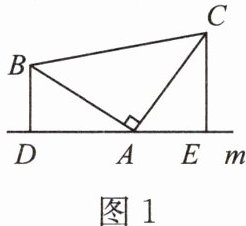
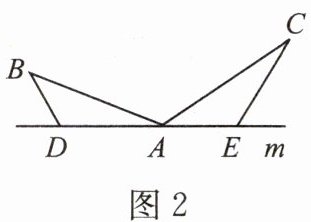
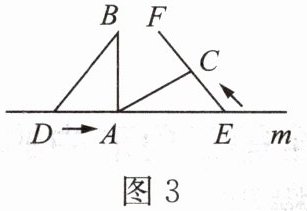
解:(1)①$BD=AE$.
证明:$\because AB⊥ AC$,
$\therefore ∠ BAC=90°$,
$\therefore ∠ BDA=∠ AEC=∠ BAC=90°$,
$\therefore ∠ DBA + ∠ BAD = ∠ BAD + ∠ CAE=90°$,
$\therefore ∠ DBA=∠ CAE$.
$\because AB=AC$,
$\therefore △ BAD≌△ ACE(\mathrm{AAS})$,
$\therefore BD=AE$.
②$BD+CE=DE$.
证明:$\because ∠ BDA=∠ AEC=∠ BAC$,
$\therefore ∠ DBA+∠ BAD=∠ BAD+∠ CAE$,
$\therefore ∠ DBA=∠ CAE$.
又$\because AB=AC$,
$\therefore △ BAD≌△ ACE(\mathrm{AAS})$,
$\therefore BD=AE$,$AD=CE$,
$\therefore BD+CE=AE+AD=DE$.
(2)存在.
$\because$点$A$在线段$DE$上以$2\ \mathrm{cm/s}$的速度由点$D$向点$E$运动,点$C$在线段$EF$上以$x\ \mathrm{cm/s}$的速度由点$E$向点$F$运动,$DE=9\ \mathrm{cm}$,
$\therefore DA=2t\ \mathrm{cm}$,$EC=xt\ \mathrm{cm}$,$AE=(9-2t)\mathrm{cm}$,
①当$△ BDA≌△ AEC$时,$DA=CE$,$BD=AE=7\ \mathrm{cm}$,
$\therefore 2t=xt$,$9-2t=7$,$\therefore x=2$,$t=1$.
②当$△ BDA≌△ CEA$时,$DA=EA$,$BD=CE=7\ \mathrm{cm}$,
$\therefore 2t=9-2t$,$xt=7$,
$\therefore t=\frac{9}{4}$,$x=\frac{28}{9}$.
综上,$x=2$,$t=1$或$t=\frac{9}{4}$,$x=\frac{28}{9}$.
(1)若$∠ BDA=∠ AEC=∠ BAC$.
①如图1,若$AB⊥ AC$,试判断线段$BD$与$AE$的数量关系,并证明.
②如图2,判断线段$BD$,$CE$与$DE$的数量关系,并证明.
(2)如图3,若$∠ BDA=∠ AEC$,$BD=EF=7\ \mathrm{cm}$,点$A$在线段$DE$上以$2\ \mathrm{cm/s}$的速度由点$D$向点$E$运动,同时,点$C$在线段$EF$上以$x\ \mathrm{cm/s}$的速度由点$E$向点$F$运动,它们运动的时间为$t\ \mathrm{s}$.是否存在$x$,使得$△ ABD$与$△ EAC$全等?若存在,求出相应的$t$的值和$x$的值;若不存在,请说明理由.
解:(1)①$BD=AE$.
证明:$\because AB⊥ AC$,
$\therefore ∠ BAC=90°$,
$\therefore ∠ BDA=∠ AEC=∠ BAC=90°$,
$\therefore ∠ DBA + ∠ BAD = ∠ BAD + ∠ CAE=90°$,
$\therefore ∠ DBA=∠ CAE$.
$\because AB=AC$,
$\therefore △ BAD≌△ ACE(\mathrm{AAS})$,
$\therefore BD=AE$.
②$BD+CE=DE$.
证明:$\because ∠ BDA=∠ AEC=∠ BAC$,
$\therefore ∠ DBA+∠ BAD=∠ BAD+∠ CAE$,
$\therefore ∠ DBA=∠ CAE$.
又$\because AB=AC$,
$\therefore △ BAD≌△ ACE(\mathrm{AAS})$,
$\therefore BD=AE$,$AD=CE$,
$\therefore BD+CE=AE+AD=DE$.
(2)存在.
$\because$点$A$在线段$DE$上以$2\ \mathrm{cm/s}$的速度由点$D$向点$E$运动,点$C$在线段$EF$上以$x\ \mathrm{cm/s}$的速度由点$E$向点$F$运动,$DE=9\ \mathrm{cm}$,
$\therefore DA=2t\ \mathrm{cm}$,$EC=xt\ \mathrm{cm}$,$AE=(9-2t)\mathrm{cm}$,
①当$△ BDA≌△ AEC$时,$DA=CE$,$BD=AE=7\ \mathrm{cm}$,
$\therefore 2t=xt$,$9-2t=7$,$\therefore x=2$,$t=1$.
②当$△ BDA≌△ CEA$时,$DA=EA$,$BD=CE=7\ \mathrm{cm}$,
$\therefore 2t=9-2t$,$xt=7$,
$\therefore t=\frac{9}{4}$,$x=\frac{28}{9}$.
综上,$x=2$,$t=1$或$t=\frac{9}{4}$,$x=\frac{28}{9}$.
答案
解:(1)① $BD=AE$.
证明:$\because AB⊥ AC$,
$\therefore ∠ BAC=90°$,
$\therefore ∠ BDA=∠ AEC=∠ BAC=90°$,
$\therefore ∠ DBA + ∠ BAD = ∠ BAD + ∠ CAE=90°$,
$\therefore ∠ DBA=∠ CAE$.
$\because AB=AC$,
$\therefore △ BAD≌△ ACE(\mathrm{AAS})$,
$\therefore BD=AE$.
② $BD+CE=DE$.
证明:$\because ∠ BDA=∠ AEC=∠ BAC$,
$\therefore ∠ DBA+∠ BAD=∠ BAD+∠ CAE$,
$\therefore ∠ DBA=∠ CAE$.
又$\because AB=AC$,
$\therefore △ BAD≌△ ACE(\mathrm{AAS})$,
$\therefore BD=AE$,$AD=CE$,
$\therefore BD+CE=AE+AD=DE$.
(2) 存在.
由题意得:$DA=2t\ \mathrm{cm}$,$EC=xt\ \mathrm{cm}$,$AE=(9-2t)\mathrm{cm}$,
① 当$△ BDA≌△ AEC$时,$DA=CE$,$BD=AE=7\ \mathrm{cm}$,
$\therefore 9-2t=7$,解得$t=1$,
将$t=1$代入$2t=xt$,得$x=2$.
② 当$△ BDA≌△ CEA$时,$DA=EA$,$BD=CE=7\ \mathrm{cm}$,
$\therefore 2t=9-2t$,解得$t=\frac{9}{4}$,
将$t=\frac{9}{4}$代入$xt=7$,得$x=\frac{28}{9}$.
综上,存在满足条件的$x$,当$t=1$时,$x=2$;当$t=\frac{9}{4}$时,$x=\frac{28}{9}$.
证明:$\because AB⊥ AC$,
$\therefore ∠ BAC=90°$,
$\therefore ∠ BDA=∠ AEC=∠ BAC=90°$,
$\therefore ∠ DBA + ∠ BAD = ∠ BAD + ∠ CAE=90°$,
$\therefore ∠ DBA=∠ CAE$.
$\because AB=AC$,
$\therefore △ BAD≌△ ACE(\mathrm{AAS})$,
$\therefore BD=AE$.
② $BD+CE=DE$.
证明:$\because ∠ BDA=∠ AEC=∠ BAC$,
$\therefore ∠ DBA+∠ BAD=∠ BAD+∠ CAE$,
$\therefore ∠ DBA=∠ CAE$.
又$\because AB=AC$,
$\therefore △ BAD≌△ ACE(\mathrm{AAS})$,
$\therefore BD=AE$,$AD=CE$,
$\therefore BD+CE=AE+AD=DE$.
(2) 存在.
由题意得:$DA=2t\ \mathrm{cm}$,$EC=xt\ \mathrm{cm}$,$AE=(9-2t)\mathrm{cm}$,
① 当$△ BDA≌△ AEC$时,$DA=CE$,$BD=AE=7\ \mathrm{cm}$,
$\therefore 9-2t=7$,解得$t=1$,
将$t=1$代入$2t=xt$,得$x=2$.
② 当$△ BDA≌△ CEA$时,$DA=EA$,$BD=CE=7\ \mathrm{cm}$,
$\therefore 2t=9-2t$,解得$t=\frac{9}{4}$,
将$t=\frac{9}{4}$代入$xt=7$,得$x=\frac{28}{9}$.
综上,存在满足条件的$x$,当$t=1$时,$x=2$;当$t=\frac{9}{4}$时,$x=\frac{28}{9}$.
解析
【分析】
(1)①要判断BD与AE的数量关系,可通过证明两条线段所在的三角形全等来推导:已知AB=AC,AB⊥AC可得∠BAC=90°,结合∠BDA=∠AEC=90°,利用同角的余角相等可证∠DBA=∠CAE,进而用AAS证明△BAD≌△ACE,即可得到对应边BD=AE。
(1)②要推导BD、CE、DE的数量关系,同样先证△BAD≌△ACE:由∠BDA=∠AEC=∠BAC,利用角的和差关系可得∠DBA=∠CAE,结合AB=AC用AAS证全等,得到BD=AE、AD=CE,再根据DE=AD+AE,等量代换即可得到三条线段的数量关系。
(2)属于动态全等的存在性问题,首先用含t和x的式子表示出各边长度:DA=2t,AE=9-2t,EC=xt。由于△ABD与△EAC全等时对应顶点不唯一,需分两种情况讨论:第一种是△BDA≌△AEC,对应边为DA=CE、BD=AE;第二种是△BDA≌△CEA,对应边为DA=EA、BD=CE,分别列方程求解t和x即可。
【解析】
(1)① $BD=AE$。
证明:$\because AB⊥ AC$,
$\therefore ∠ BAC=90°$,
$\therefore ∠ BDA=∠ AEC=∠ BAC=90°$,
$\therefore ∠ DBA + ∠ BAD = ∠ BAD + ∠ CAE=90°$,
$\therefore ∠ DBA=∠ CAE$.
$\because AB=AC$,
$\therefore △ BAD≌△ ACE(\mathrm{AAS})$,
$\therefore BD=AE$.
② $BD+CE=DE$.
证明:$\because ∠ BDA=∠ AEC=∠ BAC$,
$\therefore ∠ DBA+∠ BAD=∠ BAD+∠ CAE$,
$\therefore ∠ DBA=∠ CAE$.
又$\because AB=AC$,
$\therefore △ BAD≌△ ACE(\mathrm{AAS})$,
$\therefore BD=AE$,$AD=CE$,
$\therefore BD+CE=AE+AD=DE$.
(2) 存在.
由题意得:$DA=2t\ \mathrm{cm}$,$EC=xt\ \mathrm{cm}$,$AE=(9-2t)\mathrm{cm}$,
① 当$△ BDA≌△ AEC$时,$DA=CE$,$BD=AE=7\ \mathrm{cm}$,
$\therefore 9-2t=7$,解得$t=1$,
将$t=1$代入$2t=xt$,得$x=2$.
② 当$△ BDA≌△ CEA$时,$DA=EA$,$BD=CE=7\ \mathrm{cm}$,
$\therefore 2t=9-2t$,解得$t=\frac{9}{4}$,
将$t=\frac{9}{4}$代入$xt=7$,得$x=\frac{28}{9}$.
综上,存在满足条件的$x$,当$t=1$时,$x=2$;当$t=\frac{9}{4}$时,$x=\frac{28}{9}$.
【答案】
(1)①$BD=AE$;②$BD+CE=DE$;(2)存在,对应值为$\begin{cases} t=1 \\x=2 \end{cases}$或$\begin{cases} t=\frac{9}{4} \\x=\frac{28}{9} \end{cases}$
【知识点】
全等三角形的判定与性质,分类讨论思想,动态几何计算
【点评】
本题是三角形全等的经典综合题型,由浅入深设置问题,既考查了全等三角形判定和性质的基础应用,又通过动点问题考查了分类讨论的数学思维,解题时要注意动态全等中对应关系不明确时需分情况讨论,避免漏解。
【难度系数】
0.6
(1)①要判断BD与AE的数量关系,可通过证明两条线段所在的三角形全等来推导:已知AB=AC,AB⊥AC可得∠BAC=90°,结合∠BDA=∠AEC=90°,利用同角的余角相等可证∠DBA=∠CAE,进而用AAS证明△BAD≌△ACE,即可得到对应边BD=AE。
(1)②要推导BD、CE、DE的数量关系,同样先证△BAD≌△ACE:由∠BDA=∠AEC=∠BAC,利用角的和差关系可得∠DBA=∠CAE,结合AB=AC用AAS证全等,得到BD=AE、AD=CE,再根据DE=AD+AE,等量代换即可得到三条线段的数量关系。
(2)属于动态全等的存在性问题,首先用含t和x的式子表示出各边长度:DA=2t,AE=9-2t,EC=xt。由于△ABD与△EAC全等时对应顶点不唯一,需分两种情况讨论:第一种是△BDA≌△AEC,对应边为DA=CE、BD=AE;第二种是△BDA≌△CEA,对应边为DA=EA、BD=CE,分别列方程求解t和x即可。
【解析】
(1)① $BD=AE$。
证明:$\because AB⊥ AC$,
$\therefore ∠ BAC=90°$,
$\therefore ∠ BDA=∠ AEC=∠ BAC=90°$,
$\therefore ∠ DBA + ∠ BAD = ∠ BAD + ∠ CAE=90°$,
$\therefore ∠ DBA=∠ CAE$.
$\because AB=AC$,
$\therefore △ BAD≌△ ACE(\mathrm{AAS})$,
$\therefore BD=AE$.
② $BD+CE=DE$.
证明:$\because ∠ BDA=∠ AEC=∠ BAC$,
$\therefore ∠ DBA+∠ BAD=∠ BAD+∠ CAE$,
$\therefore ∠ DBA=∠ CAE$.
又$\because AB=AC$,
$\therefore △ BAD≌△ ACE(\mathrm{AAS})$,
$\therefore BD=AE$,$AD=CE$,
$\therefore BD+CE=AE+AD=DE$.
(2) 存在.
由题意得:$DA=2t\ \mathrm{cm}$,$EC=xt\ \mathrm{cm}$,$AE=(9-2t)\mathrm{cm}$,
① 当$△ BDA≌△ AEC$时,$DA=CE$,$BD=AE=7\ \mathrm{cm}$,
$\therefore 9-2t=7$,解得$t=1$,
将$t=1$代入$2t=xt$,得$x=2$.
② 当$△ BDA≌△ CEA$时,$DA=EA$,$BD=CE=7\ \mathrm{cm}$,
$\therefore 2t=9-2t$,解得$t=\frac{9}{4}$,
将$t=\frac{9}{4}$代入$xt=7$,得$x=\frac{28}{9}$.
综上,存在满足条件的$x$,当$t=1$时,$x=2$;当$t=\frac{9}{4}$时,$x=\frac{28}{9}$.
【答案】
(1)①$BD=AE$;②$BD+CE=DE$;(2)存在,对应值为$\begin{cases} t=1 \\x=2 \end{cases}$或$\begin{cases} t=\frac{9}{4} \\x=\frac{28}{9} \end{cases}$
【知识点】
全等三角形的判定与性质,分类讨论思想,动态几何计算
【点评】
本题是三角形全等的经典综合题型,由浅入深设置问题,既考查了全等三角形判定和性质的基础应用,又通过动点问题考查了分类讨论的数学思维,解题时要注意动态全等中对应关系不明确时需分情况讨论,避免漏解。
【难度系数】
0.6
练习二
1. 如图,$CA ⊥ AB$,垂足为A,射线$BM ⊥ AB$,垂足为B,$AB=15\ \mathrm{cm}$,$AC=6\ \mathrm{cm}$。动点E从A点出发以$3\ \mathrm{cm/s}$的速度沿射线AN运动,动点D在射线BM上,随着E点的运动而运动,始终保持$ED=CB$。若点E的运动时间为$t\ \mathrm{s}(t>0)$,则当以B,E,D为顶点的三角形与$△ ACB$全等时,$t=$。
1. 如图,$CA ⊥ AB$,垂足为A,射线$BM ⊥ AB$,垂足为B,$AB=15\ \mathrm{cm}$,$AC=6\ \mathrm{cm}$。动点E从A点出发以$3\ \mathrm{cm/s}$的速度沿射线AN运动,动点D在射线BM上,随着E点的运动而运动,始终保持$ED=CB$。若点E的运动时间为$t\ \mathrm{s}(t>0)$,则当以B,E,D为顶点的三角形与$△ ACB$全等时,$t=$。
答案
$\boldsymbol{3}$或$\boldsymbol{7}$或$\boldsymbol{10}$
解析
【分析】
首先由题意可知△ACB和△BED都是直角三角形,已知斜边ED=CB,根据直角三角形全等的HL判定定理,只需一组直角边对应相等即可判定两三角形全等。因为动点E沿射线AN运动,位置不唯一,需分情况讨论E的位置:①E在线段AB上;②E在点B右侧的射线上,再结合全等的两种直角边对应关系列方程求解,注意排除不符合t>0的解。
【解析】
解:由题意得$∠ A=∠ EBD=90°$,$AE=3t\ \mathrm{cm}$,$ED=CB$。
Rt△ACB和Rt△BED全等分以下三种情况:
1. 当E在线段AB上,且$BE=AC=6\ \mathrm{cm}$时:
$BE=AB-AE=15-3t=6$
解得$3t=9$,即$t=3$。
2. 当E运动到点B右侧,且$BE=AC=6\ \mathrm{cm}$时:
$BE=AE-AB=3t-15=6$
解得$3t=21$,即$t=7$。
3. 当E运动到点B右侧,且$BE=AB=15\ \mathrm{cm}$时:
$BE=AE-AB=3t-15=15$
解得$3t=30$,即$t=10$。
综上,满足条件的$t$的值为3或7或10。
【答案】
$\boldsymbol{3}$或$\boldsymbol{7}$或$\boldsymbol{10}$
【知识点】
直角三角形全等判定,动点问题,分类讨论
【点评】
本题是动点与全等三角形结合的典型题型,解题核心是根据动点的不同位置分类讨论,明确全等三角形的对应边关系,避免出现漏解的情况。
【难度系数】
0.5
首先由题意可知△ACB和△BED都是直角三角形,已知斜边ED=CB,根据直角三角形全等的HL判定定理,只需一组直角边对应相等即可判定两三角形全等。因为动点E沿射线AN运动,位置不唯一,需分情况讨论E的位置:①E在线段AB上;②E在点B右侧的射线上,再结合全等的两种直角边对应关系列方程求解,注意排除不符合t>0的解。
【解析】
解:由题意得$∠ A=∠ EBD=90°$,$AE=3t\ \mathrm{cm}$,$ED=CB$。
Rt△ACB和Rt△BED全等分以下三种情况:
1. 当E在线段AB上,且$BE=AC=6\ \mathrm{cm}$时:
$BE=AB-AE=15-3t=6$
解得$3t=9$,即$t=3$。
2. 当E运动到点B右侧,且$BE=AC=6\ \mathrm{cm}$时:
$BE=AE-AB=3t-15=6$
解得$3t=21$,即$t=7$。
3. 当E运动到点B右侧,且$BE=AB=15\ \mathrm{cm}$时:
$BE=AE-AB=3t-15=15$
解得$3t=30$,即$t=10$。
综上,满足条件的$t$的值为3或7或10。
【答案】
$\boldsymbol{3}$或$\boldsymbol{7}$或$\boldsymbol{10}$
【知识点】
直角三角形全等判定,动点问题,分类讨论
【点评】
本题是动点与全等三角形结合的典型题型,解题核心是根据动点的不同位置分类讨论,明确全等三角形的对应边关系,避免出现漏解的情况。
【难度系数】
0.5
