

 登录
登录
一、航天员刘叔叔正在向同学们介绍他在空间站的工作。听短文,判断下列句子的正误,正确的写“T”,错误的写“F”。
(
(
(
(
(
(
T
)1. Uncle Liu sleeps in a special sleeping bag on the space station.(
F
)2. Uncle Liu can't listen to music on the space station.(
T
)3. Earth looks like a big blue marble.(
T
)4. The Moon looks much bigger and more beautiful in space.(
F
)5. From space, Uncle Liu can't see mountains or oceans on Earth.答案
1. T
2. F
3. T
4. T
5. F
2. F
3. T
4. T
5. F
二、Amy 需要完成一份地球观察日记。请根据首字母提示,补全单词。
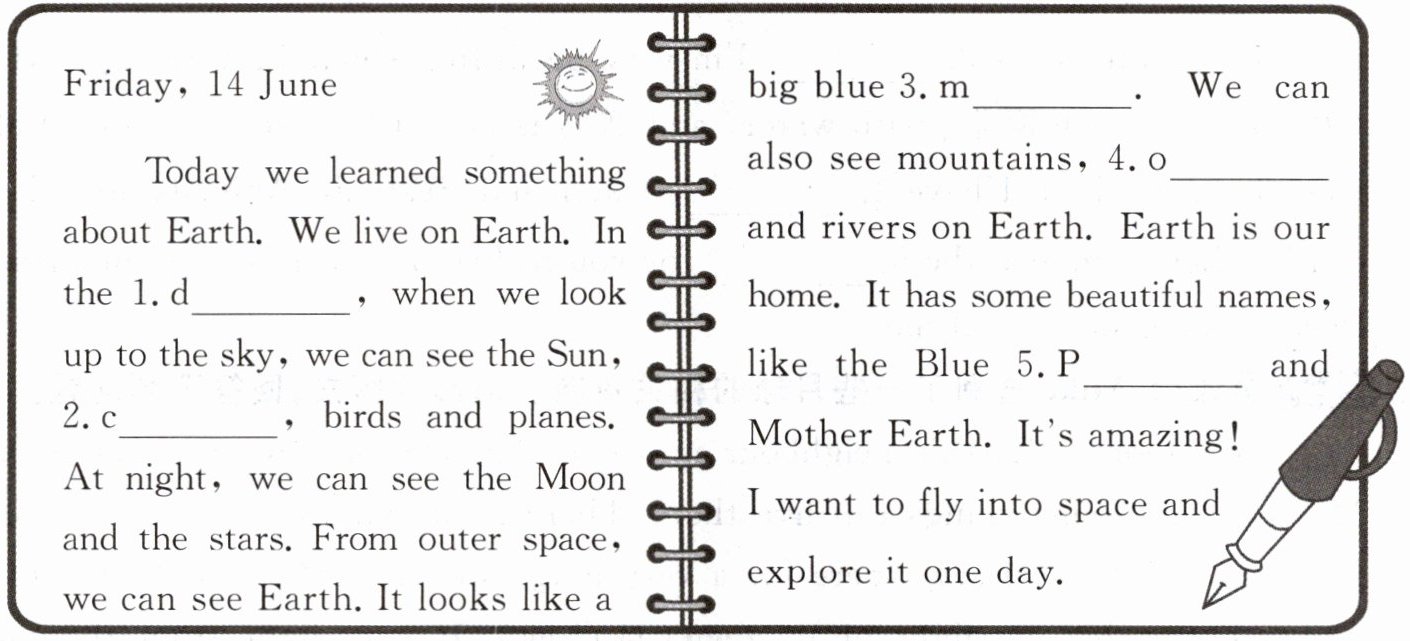
答案
1. daytime
2. clouds
3. marble
4. oceans
5. Planet
2. clouds
3. marble
4. oceans
5. Planet
解析
【分析】
先通读日记内容,理解每句的语境,结合首字母提示,联系相关词汇和生活常识,逐一确定每个空应填的单词。
【解析】
1. 句意为“在白天,当我们抬头看天空时,能看到太阳……”,结合首字母d,填daytime;
2. 天空中的事物,与太阳、鸟、飞机并列,结合首字母c,填clouds;
3. 从外太空看地球的样子,像大蓝大理石,结合首字母m,填marble;
4. 地球上的地理事物,与山脉、河流并列,结合首字母o,填oceans;
5. 地球的别名“蓝色星球”,结合首字母P,填Planet。
【答案】
1. daytime 2. clouds 3. marble 4. oceans 5. Planet
【知识点】
英语单词拼写;语境词汇运用
【点评】
本题是结合日记语境的首字母填空题,考查基础词汇掌握与语境运用能力,贴近生活,难度适中。
【难度系数】
0.6
先通读日记内容,理解每句的语境,结合首字母提示,联系相关词汇和生活常识,逐一确定每个空应填的单词。
【解析】
1. 句意为“在白天,当我们抬头看天空时,能看到太阳……”,结合首字母d,填daytime;
2. 天空中的事物,与太阳、鸟、飞机并列,结合首字母c,填clouds;
3. 从外太空看地球的样子,像大蓝大理石,结合首字母m,填marble;
4. 地球上的地理事物,与山脉、河流并列,结合首字母o,填oceans;
5. 地球的别名“蓝色星球”,结合首字母P,填Planet。
【答案】
1. daytime 2. clouds 3. marble 4. oceans 5. Planet
【知识点】
英语单词拼写;语境词汇运用
【点评】
本题是结合日记语境的首字母填空题,考查基础词汇掌握与语境运用能力,贴近生活,难度适中。
【难度系数】
0.6
三、Amy 和 Mike 正在讨论今天的太空主题课。请将下列句子重新排序,使其组成一段通顺、合理的对话。(首句已给出)
(
( 1 )What can you see in the sky during the day?
(
(
(
(
and also Mother Earth.
(
5
)Yes! Earth looks like a big blue marble from space.( 1 )What can you see in the sky during the day?
(
6
)That's amazing! I want to know more about our Mother Earth.(
2
)I can see the Sun and the clouds. What about at night?(
3
)At night, I can see the Moon and the stars.(
4
)Do you know Earth has some beautiful names? We call it the Blue Planet,and also Mother Earth.
答案
1. 5
2. 1
3. 6
4. 2
5. 3
6. 4
2. 1
3. 6
4. 2
5. 3
6. 4
解析
【分析】首先明确首句已给出,是标注为(1)的句子“What can you see in the sky during the day?”。解题时需结合对话的问答逻辑和话题连贯性:第一步,找首句的答句,对应“I can see the Sun and the clouds. What about at night?”,这是对白天所见的回答;第二步,接着回答晚上的所见,对应“At night, I can see the Moon and the stars.”;第三步,话题从天空所见过渡到地球的别称,对应“Do you know Earth has some beautiful names? We call it the Blue Planet, and also Mother Earth.”;第四步,回应地球别称的话题,对应“Yes! Earth looks like a big blue marble from space.”;第五步,最后用感叹句收尾,对应“That's amazing! I want to know more about our Mother Earth.”,由此确定每个括号的序号。
【解析】1. 首句为第2个括号,序号固定为1;2. 第4个括号是首句的答句,内容为回答白天所见并询问晚上的情况,序号为2;3. 第5个括号回答晚上的所见,序号为3;4. 第6个括号将话题过渡到地球的别称,序号为4;5. 第1个括号回应地球别称的话题,序号为5;6. 第3个括号用感叹句收尾,序号为6。
【答案】1.5;2.1;3.6;4.2;5.3;6.4
【知识点】英语对话排序;日常交际用语
【点评】本题考查英语日常对话的逻辑排序,需依据问答逻辑和话题连贯性梳理句子顺序,是基础的英语交际类题型。
【难度系数】0.5
【解析】1. 首句为第2个括号,序号固定为1;2. 第4个括号是首句的答句,内容为回答白天所见并询问晚上的情况,序号为2;3. 第5个括号回答晚上的所见,序号为3;4. 第6个括号将话题过渡到地球的别称,序号为4;5. 第1个括号回应地球别称的话题,序号为5;6. 第3个括号用感叹句收尾,序号为6。
【答案】1.5;2.1;3.6;4.2;5.3;6.4
【知识点】英语对话排序;日常交际用语
【点评】本题考查英语日常对话的逻辑排序,需依据问答逻辑和话题连贯性梳理句子顺序,是基础的英语交际类题型。
【难度系数】0.5
