

 登录
登录
B
An old farmer felt sad as he saw his destroyed crops(被破坏的庄稼). A terrible storm had come the night before, and his fields were now in a big mess. His beans(大豆) were all in the water. His neighbor Thomas came by to give a hand.
“This is a disaster,” the farmer said. “My family has always been able to live on the food we grow. I don’t know what to do now.”
Thomas thought for a while. “I think this is not a disaster but a chance,” he said softly.
“How can this be a chance?” the farmer asked.
Thomas smiled. “Now you have a chance to try something new. You’ve always grown beans. Why not try planting different crops?” he said.
The farmer thought about this. Thomas was right—he had become set in his ways. This disaster could make him run his farm in new ways.
“You have given me hope again,” the farmer said. “Thank you for showing me the chance in this difficulty. My farm will be better for it.”
So the farmer planted new crops and introduced more plants to his farm. Although the storm destroyed one harvest, it ended up saving more, for in every difficulty lies a chance, if we are brave enough to see it.
根据短文内容,用完整句子回答下列问题。
6. What crops did the old farmer use to grow?
7. What happened to the farmer's crops during the storm?
8. What advice did his neighbour Thomas give?
9. What did the old farmer do then?
10. What does the story want to tell us?
An old farmer felt sad as he saw his destroyed crops(被破坏的庄稼). A terrible storm had come the night before, and his fields were now in a big mess. His beans(大豆) were all in the water. His neighbor Thomas came by to give a hand.
“This is a disaster,” the farmer said. “My family has always been able to live on the food we grow. I don’t know what to do now.”
Thomas thought for a while. “I think this is not a disaster but a chance,” he said softly.
“How can this be a chance?” the farmer asked.
Thomas smiled. “Now you have a chance to try something new. You’ve always grown beans. Why not try planting different crops?” he said.
The farmer thought about this. Thomas was right—he had become set in his ways. This disaster could make him run his farm in new ways.
“You have given me hope again,” the farmer said. “Thank you for showing me the chance in this difficulty. My farm will be better for it.”
So the farmer planted new crops and introduced more plants to his farm. Although the storm destroyed one harvest, it ended up saving more, for in every difficulty lies a chance, if we are brave enough to see it.
根据短文内容,用完整句子回答下列问题。
6. What crops did the old farmer use to grow?
He used to grow beans.
7. What happened to the farmer's crops during the storm?
His crops were destroyed./His crops were all in the water.
8. What advice did his neighbour Thomas give?
He advised the farmer to grow different crops.
9. What did the old farmer do then?
He planted new crops and introduced more plants to his farm.
10. What does the story want to tell us?
A chance lies in every difficulty if we are brave enough to change.
答案
1. He used to grow beans
2. His crops were destroyed./His crops were all in the water.
3. He advised the farmer to grow different crops.
4. He planted new crops and introduced more plants to his farm.
5. A chance lies in every difficulty if we are brave enough to change.
2. His crops were destroyed./His crops were all in the water.
3. He advised the farmer to grow different crops.
4. He planted new crops and introduced more plants to his farm.
5. A chance lies in every difficulty if we are brave enough to change.
解析
【分析】
这是一篇记叙文阅读理解的问答题目,解题时需先通读全文,针对每个问题在文中定位对应关键语句,提取有效信息后用完整句子作答。具体需分别定位农民过去种植的作物、风暴对庄稼的影响、邻居的建议、农民后续的行动及文章主旨,精准匹配原文内容即可。
【解析】
6. 定位原文关键句“You’ve always grown beans.”,可知农民过去种植大豆,用完整句子回答为“He used to grow beans.”。
7. 定位原文第一段“A terrible storm had come the night before, and his fields were now in a big mess. His beans were all in the water.”,可知庄稼被风暴破坏且泡在水里,用完整句子回答为“His crops were destroyed./His crops were all in the water.”。
8. 定位原文中Thomas的建议句“Why not try planting different crops?”,可知他建议农民种植不同的作物,用完整句子回答为“He advised the farmer to grow different crops.”。
9. 定位原文最后一段“So the farmer planted new crops and introduced more plants to his farm.”,可知农民后续的行动是种植新作物并引进更多植物,用完整句子回答为“He planted new crops and introduced more plants to his farm.”。
10. 定位原文最后一句“in every difficulty lies a chance, if we are brave enough to see it.”,提炼主旨后用完整句子回答为“A chance lies in every difficulty if we are brave enough to change.”。
【答案】
1. He used to grow beans
2. His crops were destroyed./His crops were all in the water.
3. He advised the farmer to grow different crops.
4. He planted new crops and introduced more plants to his farm.
5. A chance lies in every difficulty if we are brave enough to change.
【知识点】
阅读理解、细节理解、主旨大意
【点评】
本题为记叙文阅读理解的问答题型,侧重考查学生提取文中细节信息和把握文章主旨的能力,要求结合原文内容用完整句子作答,整体难度不大,适合基础阶段学生练习。
【难度系数】
0.3
这是一篇记叙文阅读理解的问答题目,解题时需先通读全文,针对每个问题在文中定位对应关键语句,提取有效信息后用完整句子作答。具体需分别定位农民过去种植的作物、风暴对庄稼的影响、邻居的建议、农民后续的行动及文章主旨,精准匹配原文内容即可。
【解析】
6. 定位原文关键句“You’ve always grown beans.”,可知农民过去种植大豆,用完整句子回答为“He used to grow beans.”。
7. 定位原文第一段“A terrible storm had come the night before, and his fields were now in a big mess. His beans were all in the water.”,可知庄稼被风暴破坏且泡在水里,用完整句子回答为“His crops were destroyed./His crops were all in the water.”。
8. 定位原文中Thomas的建议句“Why not try planting different crops?”,可知他建议农民种植不同的作物,用完整句子回答为“He advised the farmer to grow different crops.”。
9. 定位原文最后一段“So the farmer planted new crops and introduced more plants to his farm.”,可知农民后续的行动是种植新作物并引进更多植物,用完整句子回答为“He planted new crops and introduced more plants to his farm.”。
10. 定位原文最后一句“in every difficulty lies a chance, if we are brave enough to see it.”,提炼主旨后用完整句子回答为“A chance lies in every difficulty if we are brave enough to change.”。
【答案】
1. He used to grow beans
2. His crops were destroyed./His crops were all in the water.
3. He advised the farmer to grow different crops.
4. He planted new crops and introduced more plants to his farm.
5. A chance lies in every difficulty if we are brave enough to change.
【知识点】
阅读理解、细节理解、主旨大意
【点评】
本题为记叙文阅读理解的问答题型,侧重考查学生提取文中细节信息和把握文章主旨的能力,要求结合原文内容用完整句子作答,整体难度不大,适合基础阶段学生练习。
【难度系数】
0.3
Ⅲ. 根据短文内容,从短文后的选项中选出能填入空白处的最佳选项。其中有一项为多余选项。
There is a lot of rain in summer. The rain causes floods in many areas. Many people are hurt or lose their lives in the floods. Then how can we protect ourselves when there is a flood?
When you are inside
When you are at home, keep windows and doors closed and turn off the gas.
When you are outside
If you are outside, do not stay under trees or large boards that are close to power lines(电线). The area above the second floor is much safer. And never stand on the bridges, especially on rivers.
When you drive on rainy days, slow down your car and drive more carefully. Get out of your car quickly and wait for help if it breaks down.
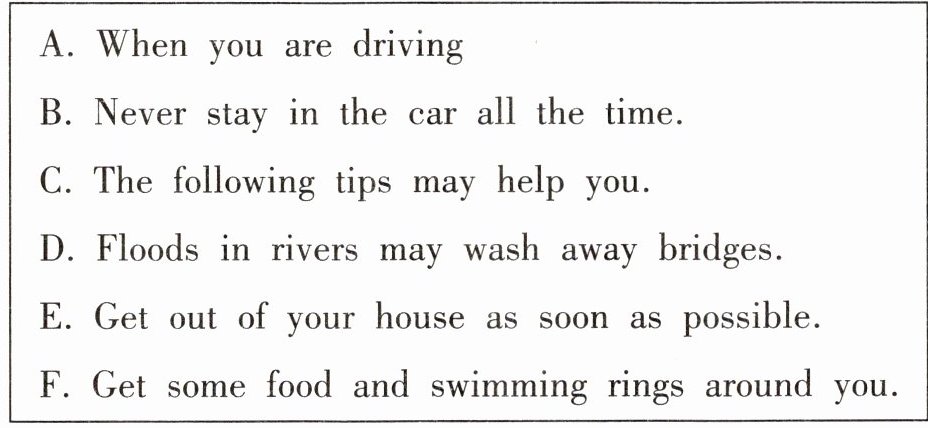
1.
There is a lot of rain in summer. The rain causes floods in many areas. Many people are hurt or lose their lives in the floods. Then how can we protect ourselves when there is a flood?
C
1When you are inside
When you are at home, keep windows and doors closed and turn off the gas.
F
2 If the rain enters the room, immediately cut off the power supply(电源).When you are outside
If you are outside, do not stay under trees or large boards that are close to power lines(电线). The area above the second floor is much safer. And never stand on the bridges, especially on rivers.
D
3 During a thunderstorm(雷电), it is better not to answer or use mobile phones outdoors. Lighting may hit you through the phone.A
4When you drive on rainy days, slow down your car and drive more carefully. Get out of your car quickly and wait for help if it breaks down.
B
51.
C
2. F
3. D
4. A
5. B
答案
1.C 2.F 3.D 4.A 5.B
解析
【分析】
本题为七选五题型,需结合上下文语境、逻辑关系选择合适的句子。第1空前文提出“遇到洪水如何保护自己”,后文是具体建议,需选承上启下引出建议的句子;第2空前文讲在家的应对,后文提到雨水进房间断电,需选洪水时在家准备物资的句子;第3空前文说不要站在桥上,需选解释不能站桥的原因的句子;第4空后文讲雨天开车的注意事项,需选引出开车场景的句子;第5空前文说车坏了要出来等帮助,需选补充车坏后正确做法的句子。
【解析】
1. 第1空:前文提出问题“遇到洪水如何保护自己”,后文是具体应对建议,C选项“The following tips may help you.”(以下建议可能会帮到你)起到承上启下的作用,故选C。
2. 第2空:前文讲在家的防护做法,后文提到雨水进入房间要断电,F选项“Get some food and swimming rings around you.”(准备一些食物和游泳圈)是洪水时在家需准备的物资,符合语境,故选F。
3. 第3空:前文说“不要站在桥上,尤其是靠近河流的桥”,D选项“Floods in rivers may wash away bridges.”(河水的洪水可能会冲垮桥梁)解释了不能站在桥上的原因,故选D。
4. 第4空:后文围绕雨天开车的注意事项展开,A选项“When you are driving”(当你开车时)引出开车场景的内容,故选A。
5. 第5空:前文说车坏了要出来等待帮助,B选项“Never stay in the car all the time.”(不要一直待在车里)补充了车坏后的正确做法,符合语境,故选B。
【答案】
1.C 2.F 3.D 4.A 5.B
【知识点】
阅读理解之七选五,上下文语境理解
【点评】
本题考查学生对语篇逻辑和上下文语境的理解能力,需结合前后文内容关联选择合适句子,难度适中。
【难度系数】
0.6
本题为七选五题型,需结合上下文语境、逻辑关系选择合适的句子。第1空前文提出“遇到洪水如何保护自己”,后文是具体建议,需选承上启下引出建议的句子;第2空前文讲在家的应对,后文提到雨水进房间断电,需选洪水时在家准备物资的句子;第3空前文说不要站在桥上,需选解释不能站桥的原因的句子;第4空后文讲雨天开车的注意事项,需选引出开车场景的句子;第5空前文说车坏了要出来等帮助,需选补充车坏后正确做法的句子。
【解析】
1. 第1空:前文提出问题“遇到洪水如何保护自己”,后文是具体应对建议,C选项“The following tips may help you.”(以下建议可能会帮到你)起到承上启下的作用,故选C。
2. 第2空:前文讲在家的防护做法,后文提到雨水进入房间要断电,F选项“Get some food and swimming rings around you.”(准备一些食物和游泳圈)是洪水时在家需准备的物资,符合语境,故选F。
3. 第3空:前文说“不要站在桥上,尤其是靠近河流的桥”,D选项“Floods in rivers may wash away bridges.”(河水的洪水可能会冲垮桥梁)解释了不能站在桥上的原因,故选D。
4. 第4空:后文围绕雨天开车的注意事项展开,A选项“When you are driving”(当你开车时)引出开车场景的内容,故选A。
5. 第5空:前文说车坏了要出来等待帮助,B选项“Never stay in the car all the time.”(不要一直待在车里)补充了车坏后的正确做法,符合语境,故选B。
【答案】
1.C 2.F 3.D 4.A 5.B
【知识点】
阅读理解之七选五,上下文语境理解
【点评】
本题考查学生对语篇逻辑和上下文语境的理解能力,需结合前后文内容关联选择合适句子,难度适中。
【难度系数】
0.6
