

 登录
登录
训练5
体裁:说明文 主题:科普知识 难度:★★★★★ 建议用时:9 min 正确率: /10
阅读下面短文,在文章后表格的空格里填入最恰当的内容,第1—8小题每个空格只填1个单词,第9—10小题词数不限。
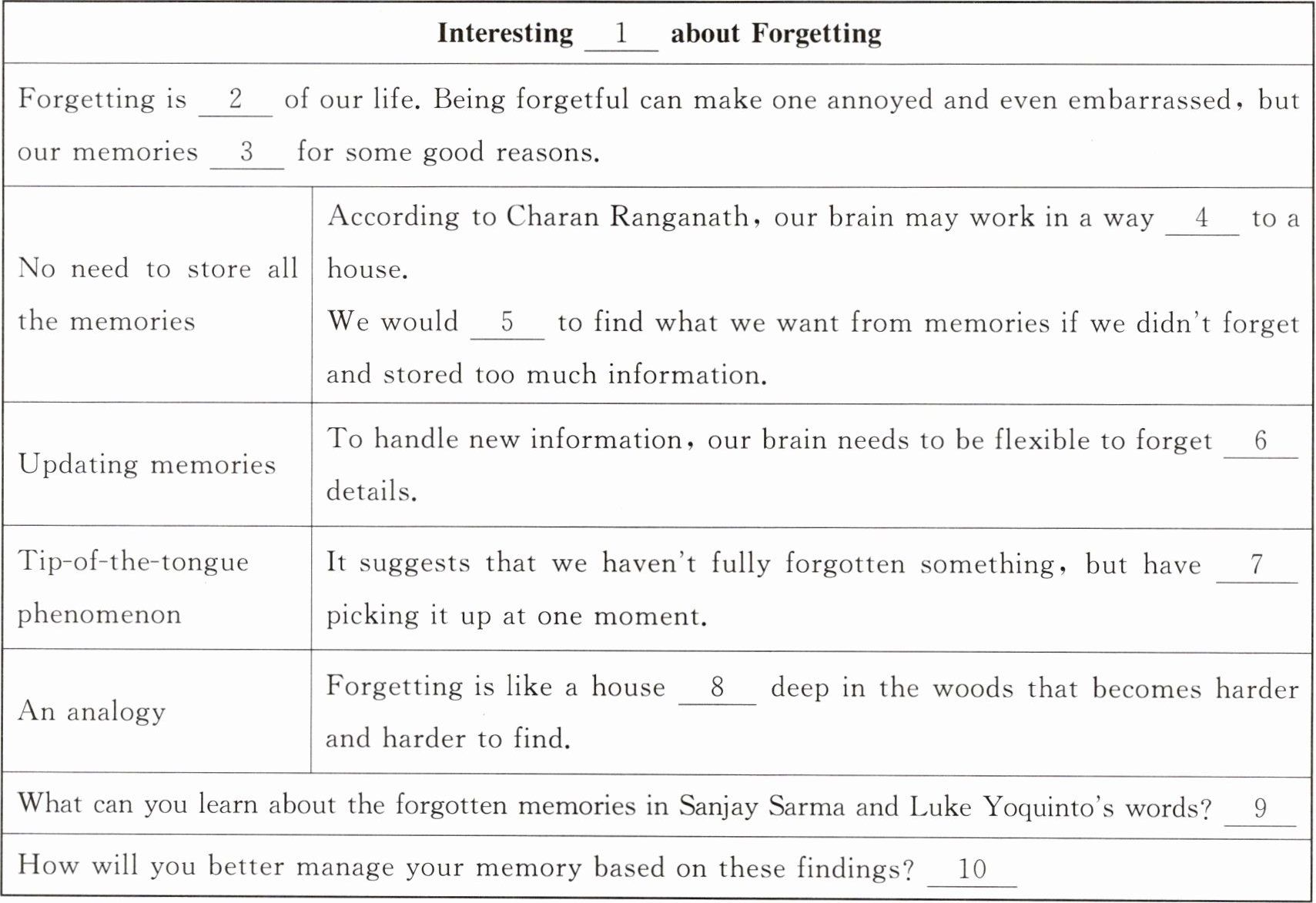
Have you ever bumped into someone and their name just doesn't come to you? Or,you walk into a room and suddenly can't recall why you're there? We can't live without forgetting! Being forgetful can be really annoying,sometimes even embarrassing. But what if I told you that there are actually good reasons for our memories fading away(消失)?
In a BBC interview,scientist Charan Ranganath uses an analogy(类比). We don't want to store everything we've ever owned in our house. Then,we don't need to store all our memories either. He says,“If we didn't forget anything,we'd be storing memories,and you'd never be able to find what you want,when you want it.” For example,you don't need to memorize all the faces you pass on the street.
We also need to be able to forget things in order to update our memories with new information. Imagine you get used to the same school timetable or work schedule for a whole year,but the next year,these all change. Your brain needs to be flexible(灵活的) and forget the details that are of no or little importance in order to handle the new information.
And,if you've ever believed that you know a word,but it just doesn't pop into your head,you're not alone. This tip-of-the-tongue phenomenon(现象) may suggest that some things are not fully forgotten,just can't be easily picked up at one moment. Those with a higher level of knowledge are more affected by this because their brains have to sort through more information to find the word.
While memories are often compared to a cliff(悬崖)—once fell apart,they're lost—Sanjay Sarma and Luke Yoquinto argue in their article “Forgetfulness: Why Your Mind Going Blank Can Be a Benefit” that forgetting is “less like a cliff and more like a house we hide deep in the woods that becomes harder and harder to find”.

体裁:说明文 主题:科普知识 难度:★★★★★ 建议用时:9 min 正确率: /10
阅读下面短文,在文章后表格的空格里填入最恰当的内容,第1—8小题每个空格只填1个单词,第9—10小题词数不限。
Have you ever bumped into someone and their name just doesn't come to you? Or,you walk into a room and suddenly can't recall why you're there? We can't live without forgetting! Being forgetful can be really annoying,sometimes even embarrassing. But what if I told you that there are actually good reasons for our memories fading away(消失)?
In a BBC interview,scientist Charan Ranganath uses an analogy(类比). We don't want to store everything we've ever owned in our house. Then,we don't need to store all our memories either. He says,“If we didn't forget anything,we'd be storing memories,and you'd never be able to find what you want,when you want it.” For example,you don't need to memorize all the faces you pass on the street.
We also need to be able to forget things in order to update our memories with new information. Imagine you get used to the same school timetable or work schedule for a whole year,but the next year,these all change. Your brain needs to be flexible(灵活的) and forget the details that are of no or little importance in order to handle the new information.
And,if you've ever believed that you know a word,but it just doesn't pop into your head,you're not alone. This tip-of-the-tongue phenomenon(现象) may suggest that some things are not fully forgotten,just can't be easily picked up at one moment. Those with a higher level of knowledge are more affected by this because their brains have to sort through more information to find the word.
While memories are often compared to a cliff(悬崖)—once fell apart,they're lost—Sanjay Sarma and Luke Yoquinto argue in their article “Forgetfulness: Why Your Mind Going Blank Can Be a Benefit” that forgetting is “less like a cliff and more like a house we hide deep in the woods that becomes harder and harder to find”.
答案
训练 5 【语篇解读】本文是一篇说明文。文章主要介绍了人们遗忘的原因和益处。
1. Facts/Information 结合文章内容可知,本文主要介绍了关于遗忘的有趣事实/信息;不止一条事实/信息,应用复数形式,作为标题首字母需大写。故填 Facts/Information。
2. part 根据第一段“We can't live without forgetting!”可知遗忘是我们是生活中的一部分。故填 part。
3. disappear 根据第一段“But what if I told you that there are actually good reasons for our memories fading away?”可知记忆消失有充分理由;fade away = disappear。故填 disappear。
4. similar 根据第二段“In a BBC interview, scientist Charan Ranganath uses an analogy...we don't need to store all our memories either.”可知兰迦纳特做了类比,大脑就像房子一样工作;similar to 表示“类似”。故填 similar。
5. fail 根据第二段“If we didn't forget anything, we'd be storing memories, and you'd never be able to find what you want, when you want it.”可知如果没有忘记任何事情,就会一直储存记忆,不能从记忆中找到想要的东西;fail to do sth.表示“未能做某事”,would 后接动词原形。故填 fail。
6. unimportant 根据第三段“Your brain needs to be flexible and forget the details that are of no or little importance in order to handle the new information.”可知大脑要灵活,忘记不重要的细节。故填 unimportant。
7. trouble/problem(s)/difficulty/difficulties 根据第四段“This tip-of-the-tongue phenomenon may suggest that some things are not fully forgotten, just can't be easily picked up at one moment.”可知舌尖现象可能表明某些记忆并非完全忘记,只是暂时不容易提取,即在提取上有困难或问题。故填 trouble/problem(s)/difficulty/difficulties。
8. hidden 根据最后一段“forgetting is ‘less like a cliff and more like a house we hide deep in the woods that becomes harder and harder to find’”可知遗忘像藏在树林深处的房子;此处应用过去分词作定语。故填 hidden。
9. They may not be lost but hard to find. 根据最后一段“While memories are often compared to a cliff—once fell apart, they're lost”和“forgetting is ‘less like a cliff and more like a house we hide deep in the woods that becomes harder and harder to find’”可知遗忘不像悬崖,一旦崩塌就会消失,更像树林深处的房子,只是越来越难找到,由此可知被遗忘的记忆可能没有消失,只是难以发现。
10. I will focus on remembering what's important.(答案不唯一,言之有理即可)
1. Facts/Information 结合文章内容可知,本文主要介绍了关于遗忘的有趣事实/信息;不止一条事实/信息,应用复数形式,作为标题首字母需大写。故填 Facts/Information。
2. part 根据第一段“We can't live without forgetting!”可知遗忘是我们是生活中的一部分。故填 part。
3. disappear 根据第一段“But what if I told you that there are actually good reasons for our memories fading away?”可知记忆消失有充分理由;fade away = disappear。故填 disappear。
4. similar 根据第二段“In a BBC interview, scientist Charan Ranganath uses an analogy...we don't need to store all our memories either.”可知兰迦纳特做了类比,大脑就像房子一样工作;similar to 表示“类似”。故填 similar。
5. fail 根据第二段“If we didn't forget anything, we'd be storing memories, and you'd never be able to find what you want, when you want it.”可知如果没有忘记任何事情,就会一直储存记忆,不能从记忆中找到想要的东西;fail to do sth.表示“未能做某事”,would 后接动词原形。故填 fail。
6. unimportant 根据第三段“Your brain needs to be flexible and forget the details that are of no or little importance in order to handle the new information.”可知大脑要灵活,忘记不重要的细节。故填 unimportant。
7. trouble/problem(s)/difficulty/difficulties 根据第四段“This tip-of-the-tongue phenomenon may suggest that some things are not fully forgotten, just can't be easily picked up at one moment.”可知舌尖现象可能表明某些记忆并非完全忘记,只是暂时不容易提取,即在提取上有困难或问题。故填 trouble/problem(s)/difficulty/difficulties。
8. hidden 根据最后一段“forgetting is ‘less like a cliff and more like a house we hide deep in the woods that becomes harder and harder to find’”可知遗忘像藏在树林深处的房子;此处应用过去分词作定语。故填 hidden。
9. They may not be lost but hard to find. 根据最后一段“While memories are often compared to a cliff—once fell apart, they're lost”和“forgetting is ‘less like a cliff and more like a house we hide deep in the woods that becomes harder and harder to find’”可知遗忘不像悬崖,一旦崩塌就会消失,更像树林深处的房子,只是越来越难找到,由此可知被遗忘的记忆可能没有消失,只是难以发现。
10. I will focus on remembering what's important.(答案不唯一,言之有理即可)
解析
【分析】
首先通读全文,明确文章主旨是介绍遗忘的原因与益处。针对1-8小题,需结合空格所在句的上下文语境、同义词替换、固定搭配及词性要求确定答案;第9小题需对比最后一段的两个比喻(悬崖与藏在树林的房子)推导结论;第10小题需围绕文章主旨给出合理建议。
1. 第1题:结合文章主题,介绍遗忘的相关事实,需用复数名词且首字母大写;
2. 第2题:根据第一段“We can't live without forgetting”,判断遗忘是生活的一部分;
3. 第3题:第一段“fading away”意为“消失”,对应动词disappear;
4. 第4题:根据第二段的类比,大脑存储记忆的方式与存储物品的房子类似,用similar;
5. 第5题:第二段“never be able to find”对应fail to do sth(未能做某事);
6. 第6题:第三段“of no or little importance”意为“不重要的”,对应unimportant;
7. 第7题:第四段“舌尖现象”指记忆提取困难,对应表示“困难/问题”的词汇;
8. 第8题:最后一段“藏在树林深处的房子”,用过去分词hidden作定语;
9. 第9题:对比悬崖(一旦崩塌就消失)和房子(难找到)的比喻推导结论;
10. 第10题:结合文章主旨,给出合理建议即可。
【解析】
1. 第1题:文章围绕遗忘的相关事实展开,不止一条,故填Facts/Information;
2. 第2题:根据第一段“我们的生活离不开遗忘”,可知遗忘是生活的一部分,故填part;
3. 第3题:第一段“memories fading away”意为“记忆消失”,fade away与disappear同义,故填disappear;
4. 第4题:根据第二段的类比,大脑存储记忆的方式和存储物品的房子类似,similar to表示“与……类似”,故填similar;
5. 第5题:第二段“never be able to find what you want”即“未能找到想要的内容”,fail to do sth表示“未能做某事”,would后接动词原形,故填fail;
6. 第6题:第三段“forget the details that are of no or little importance”意为“忘记不重要的细节”,对应形容词unimportant,故填unimportant;
7. 第7题:第四段“舌尖现象”指记忆并非完全遗忘,只是暂时难以提取,即提取有困难,故填trouble/problem(s)/difficulty/difficulties;
8. 第8题:最后一段“藏在树林深处的房子”,此处用过去分词hidden作定语修饰house,故填hidden;
9. 第9题:根据最后一段,记忆不像悬崖(一旦崩塌就消失),更像藏在树林深处的房子,只是越来越难找到,故填They may not be lost but hard to find;
10. 第10题:结合文章主旨(遗忘有好处),可给出合理建议,如I will focus on remembering what's important.(答案不唯一)
【答案】
1. Facts/Information
2. part
3. disappear
4. similar
5. fail
6. unimportant
7. trouble/problem(s)/difficulty/difficulties
8. hidden
9. They may not be lost but hard to find.
10. I will focus on remembering what's important.
【知识点】
阅读理解(说明文);词汇辨析;同义词替换
【点评】
本文为科普类说明文,围绕遗忘的原因与益处展开,考查学生对文章细节的理解、同义词转换及主旨把握能力。题目兼顾基础词汇和语境逻辑分析,整体难度适中。
【难度系数】
0.5
首先通读全文,明确文章主旨是介绍遗忘的原因与益处。针对1-8小题,需结合空格所在句的上下文语境、同义词替换、固定搭配及词性要求确定答案;第9小题需对比最后一段的两个比喻(悬崖与藏在树林的房子)推导结论;第10小题需围绕文章主旨给出合理建议。
1. 第1题:结合文章主题,介绍遗忘的相关事实,需用复数名词且首字母大写;
2. 第2题:根据第一段“We can't live without forgetting”,判断遗忘是生活的一部分;
3. 第3题:第一段“fading away”意为“消失”,对应动词disappear;
4. 第4题:根据第二段的类比,大脑存储记忆的方式与存储物品的房子类似,用similar;
5. 第5题:第二段“never be able to find”对应fail to do sth(未能做某事);
6. 第6题:第三段“of no or little importance”意为“不重要的”,对应unimportant;
7. 第7题:第四段“舌尖现象”指记忆提取困难,对应表示“困难/问题”的词汇;
8. 第8题:最后一段“藏在树林深处的房子”,用过去分词hidden作定语;
9. 第9题:对比悬崖(一旦崩塌就消失)和房子(难找到)的比喻推导结论;
10. 第10题:结合文章主旨,给出合理建议即可。
【解析】
1. 第1题:文章围绕遗忘的相关事实展开,不止一条,故填Facts/Information;
2. 第2题:根据第一段“我们的生活离不开遗忘”,可知遗忘是生活的一部分,故填part;
3. 第3题:第一段“memories fading away”意为“记忆消失”,fade away与disappear同义,故填disappear;
4. 第4题:根据第二段的类比,大脑存储记忆的方式和存储物品的房子类似,similar to表示“与……类似”,故填similar;
5. 第5题:第二段“never be able to find what you want”即“未能找到想要的内容”,fail to do sth表示“未能做某事”,would后接动词原形,故填fail;
6. 第6题:第三段“forget the details that are of no or little importance”意为“忘记不重要的细节”,对应形容词unimportant,故填unimportant;
7. 第7题:第四段“舌尖现象”指记忆并非完全遗忘,只是暂时难以提取,即提取有困难,故填trouble/problem(s)/difficulty/difficulties;
8. 第8题:最后一段“藏在树林深处的房子”,此处用过去分词hidden作定语修饰house,故填hidden;
9. 第9题:根据最后一段,记忆不像悬崖(一旦崩塌就消失),更像藏在树林深处的房子,只是越来越难找到,故填They may not be lost but hard to find;
10. 第10题:结合文章主旨(遗忘有好处),可给出合理建议,如I will focus on remembering what's important.(答案不唯一)
【答案】
1. Facts/Information
2. part
3. disappear
4. similar
5. fail
6. unimportant
7. trouble/problem(s)/difficulty/difficulties
8. hidden
9. They may not be lost but hard to find.
10. I will focus on remembering what's important.
【知识点】
阅读理解(说明文);词汇辨析;同义词替换
【点评】
本文为科普类说明文,围绕遗忘的原因与益处展开,考查学生对文章细节的理解、同义词转换及主旨把握能力。题目兼顾基础词汇和语境逻辑分析,整体难度适中。
【难度系数】
0.5
