

 登录
登录
听第二段对话,回答第8—10小题。
()8. Where are the two speakers talking?
A. In a museum. B. In a library. C. In a shop.
()9. What does the sign say according to the boy?
A. Do not touch anything. B. Do not take photos. C. Do not talk loudly.
()10. What do they decide to do finally?
A. Move the glass box quickly. B. Draw a picture of the vase.
C. Ask someone for help.
()8. Where are the two speakers talking?
A. In a museum. B. In a library. C. In a shop.
()9. What does the sign say according to the boy?
A. Do not touch anything. B. Do not take photos. C. Do not talk loudly.
()10. What do they decide to do finally?
A. Move the glass box quickly. B. Draw a picture of the vase.
C. Ask someone for help.
答案
8.A 9.A 10.B
第三节 听短文,根据所听内容选择能回答所提问题的最佳选项。短文读两遍。
()11. What happened to Tom on the rainy day?
A. He lost his book. B. He hurt his foot. C. He broke his glasses.
()12. How did Tom change after learning the rule?
A. He walked carefully. B. He ran faster. C. He stayed home.
()13. Why did Tom shout at the boy later?
A. To invite him to play. B. To warn him about the wet floor. C. To ask for help.
()14. What is the main purpose of the teacher's talk?
A. To give more homework. B. To announce a sports day. C. To explain how rules help keep us safe.
()15. What is the story mainly about?
A. Winning a running race. B. How to fix a hurt foot. C. The importance of following rules for safety and happiness.
()11. What happened to Tom on the rainy day?
A. He lost his book. B. He hurt his foot. C. He broke his glasses.
()12. How did Tom change after learning the rule?
A. He walked carefully. B. He ran faster. C. He stayed home.
()13. Why did Tom shout at the boy later?
A. To invite him to play. B. To warn him about the wet floor. C. To ask for help.
()14. What is the main purpose of the teacher's talk?
A. To give more homework. B. To announce a sports day. C. To explain how rules help keep us safe.
()15. What is the story mainly about?
A. Winning a running race. B. How to fix a hurt foot. C. The importance of following rules for safety and happiness.
答案
11.B 12.A 13.B 14.C 15.C
Ⅱ. 根据文本内容,从下列选项中选出能填入空白处的最佳选项,其中有一项是多余选项。
Follow Public Rules to Build a Better Society
Public rules are important guides to help people live peacefully together in a society.
Firstly, following public rules shows that you are a good person.
Another reason for public rules is to keep people safe. Traffic rules clearly show this importance. Drivers stop at red lights and people use crosswalks to stay safe. Recent studies show that over 60% of road accidents happen because people break rules.
Finally, public rules keep our world in order. Imagine a park where everyone walks on the grass, or a museum where visitors touch things freely.
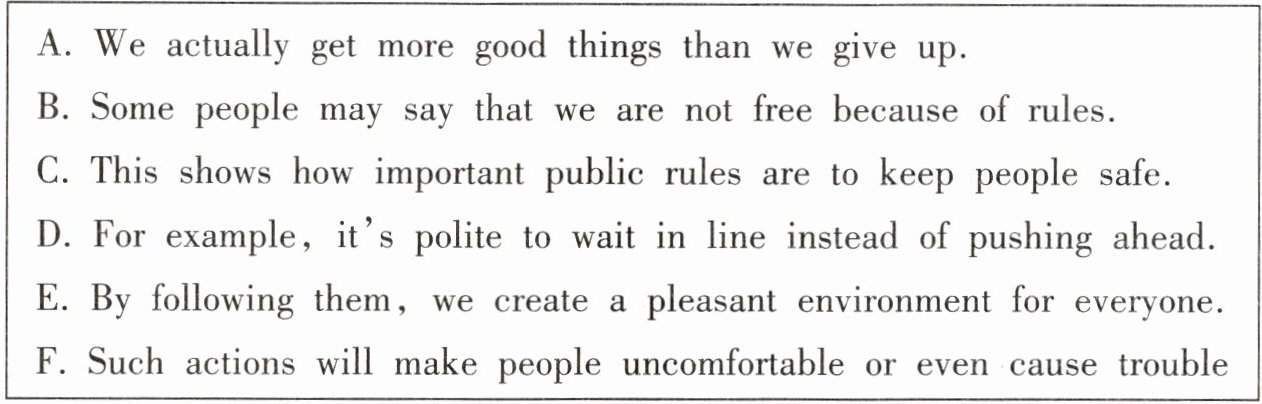
1.
2.
3.
4.
5.
Follow Public Rules to Build a Better Society
Public rules are important guides to help people live peacefully together in a society.
E
1 Here are the reasons why we must follow public rules.Firstly, following public rules shows that you are a good person.
D
2 Keeping quiet in a library is polite as well. These small actions can show your politeness and kindness.Another reason for public rules is to keep people safe. Traffic rules clearly show this importance. Drivers stop at red lights and people use crosswalks to stay safe. Recent studies show that over 60% of road accidents happen because people break rules.
C
3Finally, public rules keep our world in order. Imagine a park where everyone walks on the grass, or a museum where visitors touch things freely.
F
4 By following the rules, we protect shared spaces and valuable things for the future.B
5 This idea is wrong about how society should work. We can only be free when everyone is safe through rules followed by all. Let's work together to build a better society by being responsible rule-followers.1.
E
2.
D
3.
C
4.
F
5.
B
答案
1.E 2.D 3.C 4.F 5.B
解析
【分析】
本题为语篇填空,需结合上下文语义、逻辑关系(举例、因果、转折等)选择合适选项。首先通读全文,明确主题是“遵守公共规则建设美好社会”,再逐个分析每个空的前后语境:
1. 第1空:前句讲公共规则是和平共处的重要指南,后句引出遵守规则的原因,需填承接规则好处的句子,对应E。
2. 第2空:前句讲遵守规则体现良好品德,后句举图书馆保持安静的例子,需填举例说明礼貌行为的句子,对应D。
3. 第3空:前句讲规则保障安全,提到60%事故因违反规则,需填强调规则安全重要性的句子,对应C。
4. 第4空:前句想象不遵守规则的混乱场景,需填描述该场景后果的句子,对应F。
5. 第5空:后句说“这个想法是错的”,需填引出错误观点的句子,对应B。
【解析】
1. 第1空:前文指出公共规则是人们和平共处的重要指南,E选项“By following them, we create a pleasant environment for everyone”承接上文,说明遵守规则的益处,故1选E。
2. 第2空:前文提到遵守规则体现良好品德,后文举图书馆保持安静的礼貌行为例子,D选项“For example, it's polite to wait in line instead of pushing ahead”是对前文“良好品德”的举例说明,故2选D。
3. 第3空:前文说明公共规则的作用是保障安全,且提到超60%的交通事故因违反规则导致,C选项“This shows how important public rules are to keep people safe”承接上文的事故案例,强调规则的安全重要性,故3选C。
4. 第4空:前文想象公园踩草、博物馆乱碰的不遵守规则的场景,F选项“Such actions will make people uncomfortable or even cause trouble”描述了该场景的后果,故4选F。
5. 第5空:后文提到“This idea is wrong about how society should work”,B选项“Some people may say that we are not free because of rules”是后文要反驳的错误观点,故5选B。
【答案】
1.E 2.D 3.C 4.F 5.B
【知识点】
英语语篇衔接、七选五阅读、逻辑推理
【点评】
本题考查学生对语篇逻辑关系的理解能力,需结合段落主题、前后句的举例、因果、转折等关系选择合适选项,是初中英语常见的语篇类题目,难度适中,能有效考查学生的语篇分析能力。
【难度系数】
0.5
本题为语篇填空,需结合上下文语义、逻辑关系(举例、因果、转折等)选择合适选项。首先通读全文,明确主题是“遵守公共规则建设美好社会”,再逐个分析每个空的前后语境:
1. 第1空:前句讲公共规则是和平共处的重要指南,后句引出遵守规则的原因,需填承接规则好处的句子,对应E。
2. 第2空:前句讲遵守规则体现良好品德,后句举图书馆保持安静的例子,需填举例说明礼貌行为的句子,对应D。
3. 第3空:前句讲规则保障安全,提到60%事故因违反规则,需填强调规则安全重要性的句子,对应C。
4. 第4空:前句想象不遵守规则的混乱场景,需填描述该场景后果的句子,对应F。
5. 第5空:后句说“这个想法是错的”,需填引出错误观点的句子,对应B。
【解析】
1. 第1空:前文指出公共规则是人们和平共处的重要指南,E选项“By following them, we create a pleasant environment for everyone”承接上文,说明遵守规则的益处,故1选E。
2. 第2空:前文提到遵守规则体现良好品德,后文举图书馆保持安静的礼貌行为例子,D选项“For example, it's polite to wait in line instead of pushing ahead”是对前文“良好品德”的举例说明,故2选D。
3. 第3空:前文说明公共规则的作用是保障安全,且提到超60%的交通事故因违反规则导致,C选项“This shows how important public rules are to keep people safe”承接上文的事故案例,强调规则的安全重要性,故3选C。
4. 第4空:前文想象公园踩草、博物馆乱碰的不遵守规则的场景,F选项“Such actions will make people uncomfortable or even cause trouble”描述了该场景的后果,故4选F。
5. 第5空:后文提到“This idea is wrong about how society should work”,B选项“Some people may say that we are not free because of rules”是后文要反驳的错误观点,故5选B。
【答案】
1.E 2.D 3.C 4.F 5.B
【知识点】
英语语篇衔接、七选五阅读、逻辑推理
【点评】
本题考查学生对语篇逻辑关系的理解能力,需结合段落主题、前后句的举例、因果、转折等关系选择合适选项,是初中英语常见的语篇类题目,难度适中,能有效考查学生的语篇分析能力。
【难度系数】
0.5
