

 登录
登录
C
KEY→P35
范畴:人与自然 主题:环境保护 体裁:说明文 难度:★★★★ 建议用时:6分钟 评价:/5
Have you wondered what happens to all the hot water that you use in your homes for showers or washing dishes? The water goes into our city's sewage system.
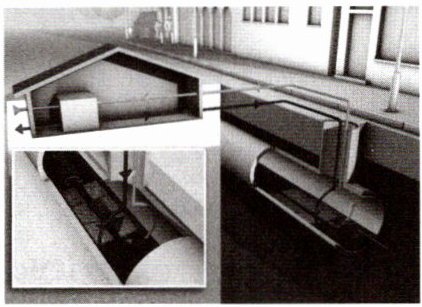
Now imagine using the waste heat and recovered energy to heat and cool buildings. Known as sewer(下水道) energy, this unconventional source of energy may be at the forefront of the future clean energy change.
Cities are realizing that wastewater is a valuable source of heat energy. It can be used and processed in treatment plants to power homes up. One report has said that American cities lose about 350 billion kilowatt-hours of waste energy—enough to power about 30 million homes up!
As the city of Denver in Colorado begins to take the lead in the project of using sewer energy, many cities are following and employing this eco-friendly source of energy.
Using sewer energy may be a simpler process than you thought. In Denver, work has already started on the construction of a wastewater energy retrieval plant.
A large pit in the new facility contains the main sewer line, through which the wastewater flows at constant temperatures from about $55\ °\mathrm{F}$ to $75\ °\mathrm{F}$. A large heat pump will transfer the heat from the wastewater to a clean-water loop that is pumped to buildings around the city. This recovered energy can be used to heat water and indoor spaces in buildings.
Since the sewage is always kept at a fairly constant temperature, much like the energy from the earth used by geothermal(地热的) systems, it takes much less energy to heat the water than cold water. This eco-friendly method also makes use of wastewater that would otherwise do harm to local wildlife if it were released directly into river systems.
However, there are also some problems. Such a system functions best when used in districts that have central heating and cooling systems. Experts say careful planning is necessary when deciding how to implement the sewer recovery system.
Using energy from wastewater is certainly a special method of powering homes up, but in just a few years, it may just prove to be one of the key players in the energy industry.
(
A. Factories.
B. The sea.
C. Our homes.
D. Hot weather.
英语嗨吧
(
A. Powering homes up for free.
B. Offering homes hot water.
C. Trying to clean wastewater.
D. Using wastewater to power homes up.
(
A. Paragraph 5.
B. Paragraph 6.
C. Paragraph 7.
D. Paragraph 8.
(
A. It's not easy to use energy from wastewater.
B. Energy from wastewater will be widely used.
C. Most homes are using energy from wastewater.
D. Few homes would like energy from wastewater.
(
A. Future life.
B. Sewer energy.
C. The heating system.
D. The city of Denver.
D
KEY→P35
KEY→P35
范畴:人与自然 主题:环境保护 体裁:说明文 难度:★★★★ 建议用时:6分钟 评价:/5
Have you wondered what happens to all the hot water that you use in your homes for showers or washing dishes? The water goes into our city's sewage system.
Now imagine using the waste heat and recovered energy to heat and cool buildings. Known as sewer(下水道) energy, this unconventional source of energy may be at the forefront of the future clean energy change.
Cities are realizing that wastewater is a valuable source of heat energy. It can be used and processed in treatment plants to power homes up. One report has said that American cities lose about 350 billion kilowatt-hours of waste energy—enough to power about 30 million homes up!
As the city of Denver in Colorado begins to take the lead in the project of using sewer energy, many cities are following and employing this eco-friendly source of energy.
Using sewer energy may be a simpler process than you thought. In Denver, work has already started on the construction of a wastewater energy retrieval plant.
A large pit in the new facility contains the main sewer line, through which the wastewater flows at constant temperatures from about $55\ °\mathrm{F}$ to $75\ °\mathrm{F}$. A large heat pump will transfer the heat from the wastewater to a clean-water loop that is pumped to buildings around the city. This recovered energy can be used to heat water and indoor spaces in buildings.
Since the sewage is always kept at a fairly constant temperature, much like the energy from the earth used by geothermal(地热的) systems, it takes much less energy to heat the water than cold water. This eco-friendly method also makes use of wastewater that would otherwise do harm to local wildlife if it were released directly into river systems.
However, there are also some problems. Such a system functions best when used in districts that have central heating and cooling systems. Experts say careful planning is necessary when deciding how to implement the sewer recovery system.
Using energy from wastewater is certainly a special method of powering homes up, but in just a few years, it may just prove to be one of the key players in the energy industry.
(
C
)1. Where does the wastewater come from according to the passage?A. Factories.
B. The sea.
C. Our homes.
D. Hot weather.
英语嗨吧
(
D
)2. What does Denver in Colorado take the lead in?A. Powering homes up for free.
B. Offering homes hot water.
C. Trying to clean wastewater.
D. Using wastewater to power homes up.
(
C
)3. Which paragraph mainly talks about the advantage of using wastewater?A. Paragraph 5.
B. Paragraph 6.
C. Paragraph 7.
D. Paragraph 8.
(
B
)4. What can we guess from the last paragraph?A. It's not easy to use energy from wastewater.
B. Energy from wastewater will be widely used.
C. Most homes are using energy from wastewater.
D. Few homes would like energy from wastewater.
(
B
)5. What is the passage mainly about?A. Future life.
B. Sewer energy.
C. The heating system.
D. The city of Denver.
D
KEY→P35
答案
1.C 2.D 3.C 4.B 5.B
你是否知道家中用于淋浴或洗碗的所有热水都去哪里了?这些废水会进入城市污水系统,待处理后为家庭供电。随着美国科罗拉多州丹佛市在下水道能源项目中起带头作用,许多城市都在效仿并应用这种环保能源。
1. C 细节理解题。由第一段中“Have you wondered what happens to all the hot water that you use in your homes for showers or washing dishes?”可知,本文提及的废水来自人们的家庭。
2. D 细节理解题。由第四段“As the city of Denver in Colorado begins to take the lead in the project of using sewer energy ...”可知,丹佛市在使用下水道能源方面领先。
3. C 推理判断题。第七段提及加热这些废水需要的能量比冷水少得多,这种环保方法还利用了废水,保护了环境。由此可知,第七段主要谈论了利用废水的好处。
4. B 推理判断题。由最后一段中“but in just a few years, it may just prove to be one of the key players in the energy industry”可推知,废水转换的能源将被广泛应用。
5. B 主旨大意题。通读全文可知,本文主要介绍的是下水道能源。
你是否知道家中用于淋浴或洗碗的所有热水都去哪里了?这些废水会进入城市污水系统,待处理后为家庭供电。随着美国科罗拉多州丹佛市在下水道能源项目中起带头作用,许多城市都在效仿并应用这种环保能源。
1. C 细节理解题。由第一段中“Have you wondered what happens to all the hot water that you use in your homes for showers or washing dishes?”可知,本文提及的废水来自人们的家庭。
2. D 细节理解题。由第四段“As the city of Denver in Colorado begins to take the lead in the project of using sewer energy ...”可知,丹佛市在使用下水道能源方面领先。
3. C 推理判断题。第七段提及加热这些废水需要的能量比冷水少得多,这种环保方法还利用了废水,保护了环境。由此可知,第七段主要谈论了利用废水的好处。
4. B 推理判断题。由最后一段中“but in just a few years, it may just prove to be one of the key players in the energy industry”可推知,废水转换的能源将被广泛应用。
5. B 主旨大意题。通读全文可知,本文主要介绍的是下水道能源。
