

 登录
登录
1. 你知道“现在完成时(1)”的用法吗?
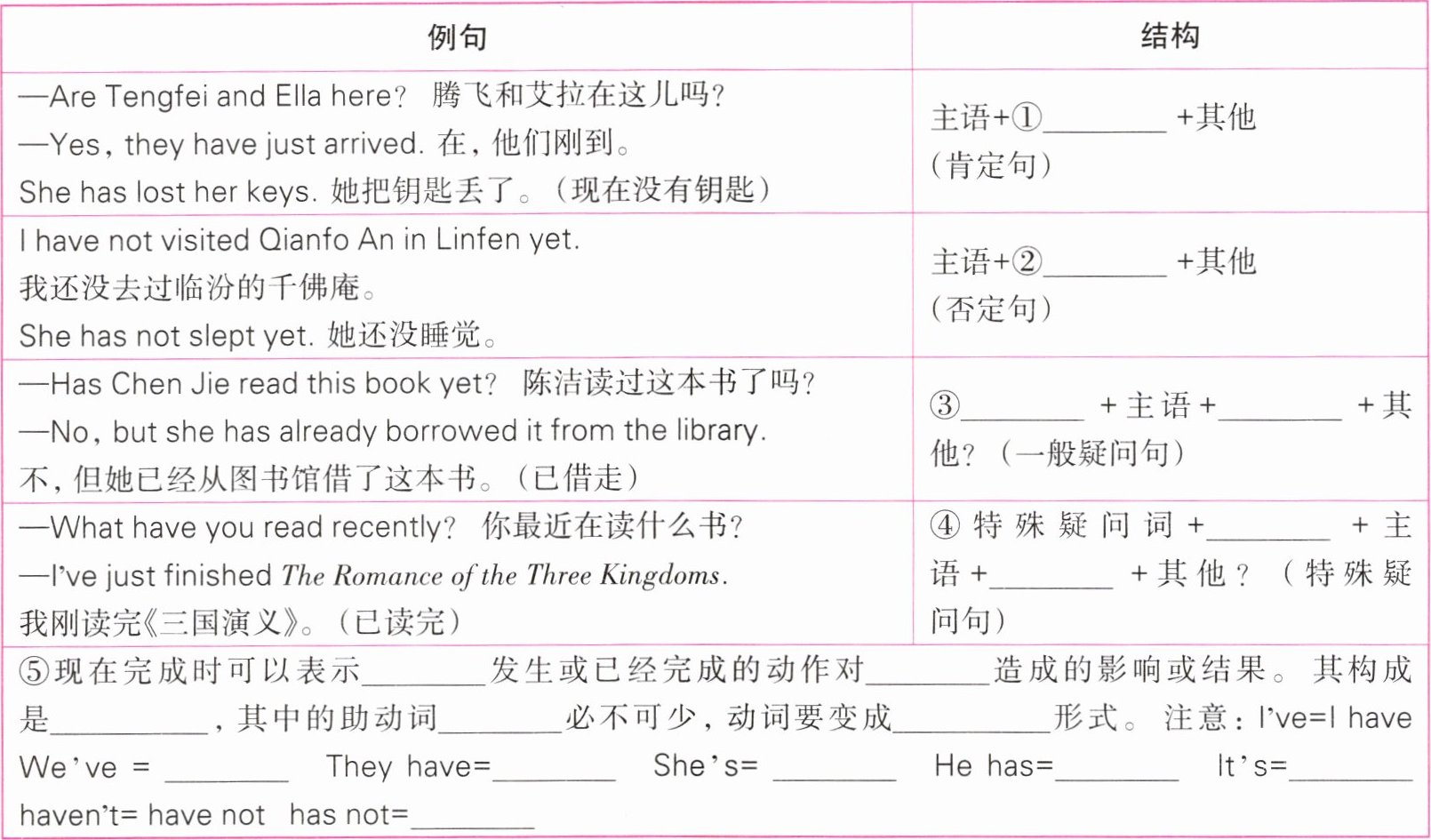
—Yes, they have just arrived. 在,他们刚到。
She has lost her keys. 她把钥匙丢了。|主语+① +其他
|
|I have not visited Qianfo An in Linfen yet.
我还没去过临汾的千佛庵。
She has not slept yet. 她还没睡觉。|主语+② +其他
|
|—Has Chen Jie read this book yet? 陈洁读过这本书了吗?
—No, but she has already borrowed it from the library.
不,但她已经从图书馆借了这本书。|③ +主语+ +其他?|
|—What have you read recently? 你最近在读什么书?
—I've just finished *The Romance of the Three Kingdoms*.
我刚读完《三国演义》。|④特殊疑问词+ +主语+ +其他?|
|⑤现在完成时可以表示发生或已经完成的动作对造成的影响或结果。其构成是,其中的助动词必不可少,动词要变成形式。注意:I've=I have
We've = They have= She's= He has= It's=
haven't= have not has not=| |
【即学即练】用括号内动词的现在完成时态的肯定式、否定式或疑问式填空。
(1) my homework. Now I can play computer games. (I/ finish)
(2) her passport, so she can't travel. (she/ lose)
(3)—Where is the newspaper? —I don't know. it yet. (I/ not read)
(4) Datong? I hear it's full of historical sights. (you/ visit)
(5)—*The Romance of the Three Kingdoms* is your favourite literary classic. it?
—I have already read it more than three times. (how many times/ read)
—Yes, they have just arrived. 在,他们刚到。
She has lost her keys. 她把钥匙丢了。|主语+① +其他
|
|I have not visited Qianfo An in Linfen yet.
我还没去过临汾的千佛庵。
She has not slept yet. 她还没睡觉。|主语+② +其他
|
|—Has Chen Jie read this book yet? 陈洁读过这本书了吗?
—No, but she has already borrowed it from the library.
不,但她已经从图书馆借了这本书。|③ +主语+ +其他?|
|—What have you read recently? 你最近在读什么书?
—I've just finished *The Romance of the Three Kingdoms*.
我刚读完《三国演义》。|④特殊疑问词+ +主语+ +其他?|
|⑤现在完成时可以表示发生或已经完成的动作对造成的影响或结果。其构成是,其中的助动词必不可少,动词要变成形式。注意:I've=I have
We've = They have= She's= He has= It's=
haven't= have not has not=| |
【即学即练】用括号内动词的现在完成时态的肯定式、否定式或疑问式填空。
(1) my homework. Now I can play computer games. (I/ finish)
(2) her passport, so she can't travel. (she/ lose)
(3)—Where is the newspaper? —I don't know. it yet. (I/ not read)
(4) Datong? I hear it's full of historical sights. (you/ visit)
(5)—*The Romance of the Three Kingdoms* is your favourite literary classic. it?
—I have already read it more than three times. (how many times/ read)
答案
表格填空
① have/has+过去分词
② have/has+not+过去分词
③ Have/Has;过去分词
④ have/has;过去分词
⑤ 过去;现在;主语+have/has+动词过去分词;have/has;过去分词;We have;They've;She has;He's;It has;hasn't
即学即练
(1) I have finished
(2) She has lost
(3) I haven't read
(4) Have you visited
(5) How many times have you read
① have/has+过去分词
② have/has+not+过去分词
③ Have/Has;过去分词
④ have/has;过去分词
⑤ 过去;现在;主语+have/has+动词过去分词;have/has;过去分词;We have;They've;She has;He's;It has;hasn't
即学即练
(1) I have finished
(2) She has lost
(3) I haven't read
(4) Have you visited
(5) How many times have you read
解析
本题考查现在完成时的结构、用法、缩写形式以及在不同句式中的应用。现在完成时核心构成为“主语+have/has+动词过去分词”,可表示过去发生的动作对现在造成的影响或结果,需根据主语人称和数选择have或has,同时掌握其肯定句、否定句、一般疑问句、特殊疑问句的句式变化,以及相关缩写形式。
2. 同学们,观察以下例句,你知道现在完成时中just、already、yet和ever的用法吗?
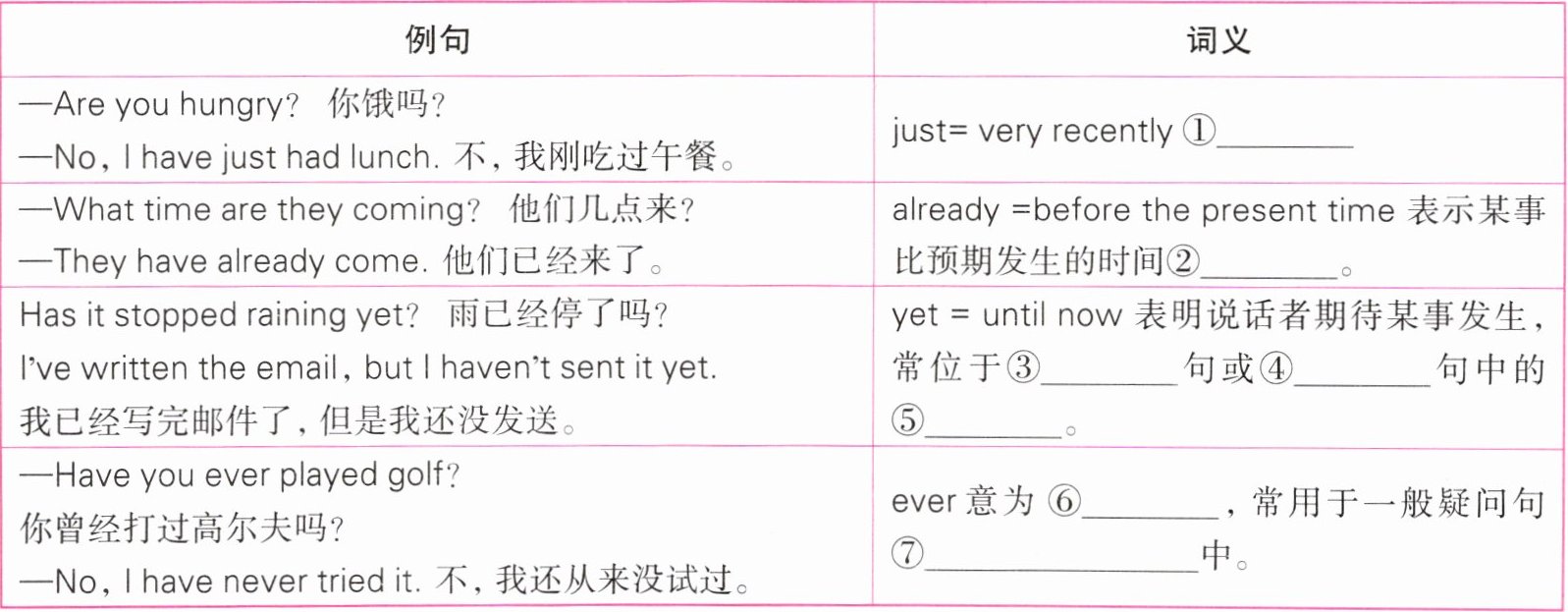
I've written the email, but I haven't sent it yet.
我已经写完邮件了,但是我还没发送。|yet = until now 表明说话者期待某事发生,常位于③句或④句中的⑤。|
|—Have you ever played golf?
你曾经打过高尔夫吗?
—No, I have never tried it. 不,我还从来没试过。|ever 意为 ⑥,常用于一般疑问句⑦中。|
【即学即练】用ever、never、just、already或yet填空,完成语篇。
We have (1) finished our community clean-up and have (2) collected lots of rubbish. Have you joined the green group (3)? Have you (4) felt the joy of making a difference? I have (5) been happier to help our planet! Join us and let's go hand in hand to make our home clean and beautiful.
I've written the email, but I haven't sent it yet.
我已经写完邮件了,但是我还没发送。|yet = until now 表明说话者期待某事发生,常位于③句或④句中的⑤。|
|—Have you ever played golf?
你曾经打过高尔夫吗?
—No, I have never tried it. 不,我还从来没试过。|ever 意为 ⑥,常用于一般疑问句⑦中。|
【即学即练】用ever、never、just、already或yet填空,完成语篇。
We have (1) finished our community clean-up and have (2) collected lots of rubbish. Have you joined the green group (3)? Have you (4) felt the joy of making a difference? I have (5) been happier to help our planet! Join us and let's go hand in hand to make our home clean and beautiful.
答案
知识点填空:
①刚刚,刚才
②早
③否定
④疑问
⑤句末
⑥曾经
⑦现在完成时
即学即练:
(1) just
(2) already
(3) yet
(4) ever
(5) never
①刚刚,刚才
②早
③否定
④疑问
⑤句末
⑥曾经
⑦现在完成时
即学即练:
(1) just
(2) already
(3) yet
(4) ever
(5) never
解析
本题考查现在完成时中just、already、yet、ever、never的用法:
1. just意为“刚刚,刚才”,用于现在完成时,强调动作刚发生;
2. already意为“已经”,通常用于肯定句,说明动作比预期早发生;
3. yet意为“还,仍”,常用于否定句或疑问句的句末;
4. ever意为“曾经”,常用于现在完成时的一般疑问句中;
5. never意为“从未”,用于现在完成时,表否定含义。
即学即练需结合语境判断:(1)强调刚完成清洁,用just;(2)表示已经收集很多垃圾,用already;(3)疑问句询问是否加入,用yet;(4)疑问句询问是否感受过这种快乐,用ever;(5)表示从未这么开心,用never。
1. just意为“刚刚,刚才”,用于现在完成时,强调动作刚发生;
2. already意为“已经”,通常用于肯定句,说明动作比预期早发生;
3. yet意为“还,仍”,常用于否定句或疑问句的句末;
4. ever意为“曾经”,常用于现在完成时的一般疑问句中;
5. never意为“从未”,用于现在完成时,表否定含义。
即学即练需结合语境判断:(1)强调刚完成清洁,用just;(2)表示已经收集很多垃圾,用already;(3)疑问句询问是否加入,用yet;(4)疑问句询问是否感受过这种快乐,用ever;(5)表示从未这么开心,用never。
