

 登录
登录
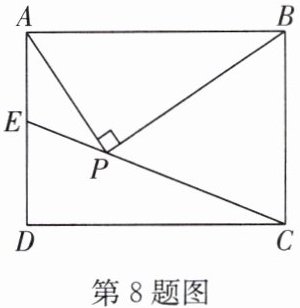
8. (2024·无锡宜兴)如图,在长方形ABCD中,AB=8,AD=6,长方形内有一点P,连接AP,BP,CP,已知∠APB=90°,CP=CB,延长CP交AD于点E,则AE=
$\frac{8}{3}$
.答案
$\frac{8}{3}$
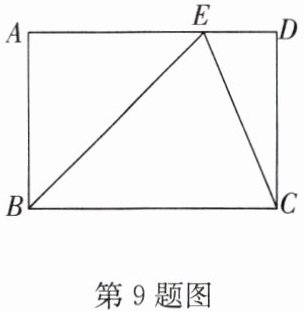
9. (2024·海淀区期末)如图,在矩形ABCD中,BE平分∠ABC交AD于点E,∠BED的平分线恰好经过点C,则∠BCE=
67.5
°.答案
67.5
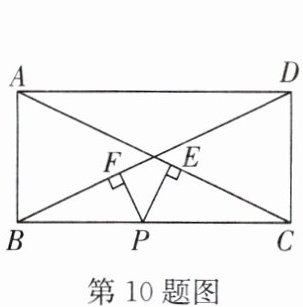
10. 如图,在矩形ABCD中,P为矩形ABCD的边BC上任意一点,PE⊥AC于点E,PF⊥BD于点F.若AB=5,BC=12,则PE+PF=
$\frac{60}{13}$
.答案
$\frac{60}{13}$
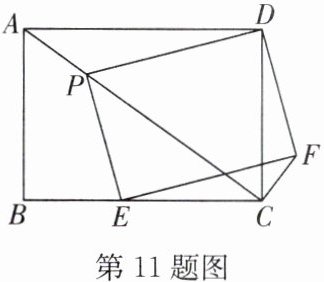
11. 如图,在矩形ABCD中,AB=6,AD=8,P,E分别是线段AC,BC上的点,且四边形PEFD为矩形,连接CF.
(1)若△PCD是等腰三角形,求AP的长;
(2)判断CF与AC有怎样的位置关系,并说明理由.
(1)若△PCD是等腰三角形,求AP的长;
(2)判断CF与AC有怎样的位置关系,并说明理由.
答案
解:
$ (1)\because $在矩形ABCD中,AB=6,AD=8,
∠ ADC=90°,$\therefore DC=AB=6$,
$ AC=\sqrt{AD^2+DC^2}=10.$
若△ PCD是等腰三角形,则分以下3种情况:
①当CP=CD时,AP=AC-CP=10-6=4.
②当PD=PC时,∠ PDC=∠ PCD,
$ \because ∠ PCD+∠ PAD=∠ PDC+∠ PDA=90°$,
$ \therefore ∠ PAD=∠ PDA$,
$ \therefore PD=PA$,$\therefore PA=PC$,$\therefore AP=\frac{1}{2}AC=5.$
③当DP=DC时,如答图①,过点D作DQ⊥ AC于点Q,则PQ=CQ.
$ \because S_{△ ADC}=\frac{1}{2}AD· DC=\frac{1}{2}AC· DQ$,
$ \therefore DQ=\frac{AD· DC}{AC}=\frac{24}{5}$,$\therefore CQ=\sqrt{DC^2-DQ^2}=\frac{18}{5}$,
$ \therefore PC=2CQ=\frac{36}{5}$,
$ \therefore AP=AC-PC=10-\frac{36}{5}=\frac{14}{5}.$
综上所述,AP的长为4或5或$\frac{14}{5}.$
(2)CF⊥ AC.理由如下:
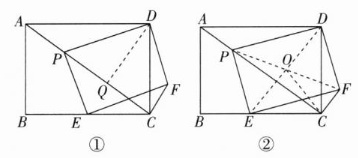
如答图②,连接PF,DE,交于点O,连接OC.
$ \because $四边形ABCD是矩形,$\therefore ∠ BCD=90°.$
$ \because $四边形PEFD是矩形,$\therefore OE=OD$,$\therefore OC=\frac{1}{2}ED.$
$ \because $在矩形PEFD中,PF=DE,$\therefore OC=\frac{1}{2}PF.$
$ \because OP=OF=\frac{1}{2}PF$,$\therefore OC=OP=OF$,
$ \therefore ∠ OCF=∠ OFC$,∠ OCP=∠ OPC.
$ \because ∠ OPC+∠ OFC+∠ OCP+∠ OCF=180°$,
$ \therefore 2∠ OCP+2∠ OCF=180°$,
$ \therefore ∠ OCP+∠ OCF=90°$,
$ \therefore ∠ PCF=90°$,$\therefore CF⊥ AC.$
12. 如图,在矩形ABCD中,AB=5,P为BC上一个动点,BP=m,点B关于直线AP的对称点是E.
(1)当m=2时,若直线PE恰好经过点D,求此时AD的长;
(2)若AD足够长,当点E到直线AD的距离不超过3时,求m的取值范围.
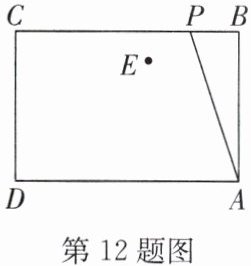
(1)当m=2时,若直线PE恰好经过点D,求此时AD的长;
(2)若AD足够长,当点E到直线AD的距离不超过3时,求m的取值范围.
答案
解:
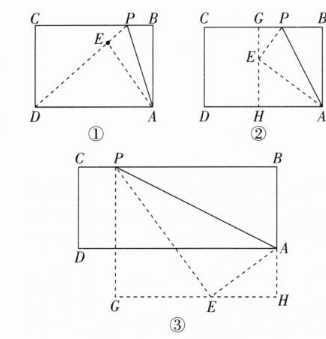 (1)如答图①,$\because $点B关于直线AP的对称点是E,
$ \therefore AE=AB=5$,PE=PB=2,∠ AEP=∠ B,∠ APE=∠ APB.
$ \because $四边形ABCD是矩形,
$ \therefore ∠ B=90°$,AD// BC,
$ \therefore ∠ AEP=90°$,∠ BPA=∠ DAP,
$ \therefore ∠ AED=90°$,∠ DAP=∠ DPA,$\therefore DA=DP.$
在$\mathrm{Rt}△ ADE$中,设AD=PD=x,
$ \therefore DE=x-2$,AE=5,$\therefore (x-2)^2+5^2=x^2$,
解得$x=\frac{29}{4}$,即AD的长为$\frac{29}{4}.$
(2)当点E位于直线AD上方且到AD距离为3时,如答图②,过点E作GH⊥ AD,交BC于点G,交AD于点H.
在$\mathrm{Rt}△ AEH$中,AE=5,EH=3,$\therefore AH=4.$
在$\mathrm{Rt}△ EPG$中,PE=m,PG=4-m,EG=2,
$ \therefore (4-m)^2+2^2=m^2$,解得$m=\frac{5}{2}$;
当点E位于直线AD下方且到AD的距离为3时,如答图③,过点E作GH⊥ AB,交BA的延长线于点H,过点P作PG⊥ EH于点G.
在$\mathrm{Rt}△ AEH$中,AE=5,AH=3,$\therefore EH=4.$
在$\mathrm{Rt}△ EPG$中,PE=m,PG=8,EG=m-4,
$ \therefore (m-4)^2+8^2=m^2$,解得m=10,
$ \therefore $当点E到直线AD的距离不超过3时,m的取值范围为$\frac{5}{2}≤ m≤10.$
