

 登录
登录
Ⅴ. 仿写句子。
【例】He visits the Nanli Lake every year.
He is going to visit the Nanli Lake next year.
1. Sue reads some books in the library every weekend.
2. The children have a party every month.
3. Yang Li goes to the park at ten o’clock every day.
4. The boys play basketball in the park every Saturday.
5. My sister flies kites with her family on Sundays.
【例】He visits the Nanli Lake every year.
He is going to visit the Nanli Lake next year.
1. Sue reads some books in the library every weekend.
Sue is going to read some books in the library next weekend.
2. The children have a party every month.
The children are going to have a party next month.
3. Yang Li goes to the park at ten o’clock every day.
Yang Li is going to go to the park at ten o'clock tomorrow.
4. The boys play basketball in the park every Saturday.
The boys are going to play basketball in the park next Saturday.
5. My sister flies kites with her family on Sundays.
My sister is going to fly kites with her family next Sunday.
答案
Ⅴ. 1. Sue is going to read some books in the library next weekend.
2. The children are going to have a party next month.
3. Yang Li is going to go to the park at ten o'clock tomorrow.
4. The boys are going to play basketball in the park next Saturday.
5. My sister is going to fly kites with her family next Sunday.
2. The children are going to have a party next month.
3. Yang Li is going to go to the park at ten o'clock tomorrow.
4. The boys are going to play basketball in the park next Saturday.
5. My sister is going to fly kites with her family next Sunday.
解析
【解析】
本题要求将一般现在时的句子改写为be going to结构的一般将来时句子。解题步骤:1. 根据主语的人称和数确定be动词的形式(第三人称单数主语用is,复数主语用are);2. 将原句中一般现在时的实义动词(单三形式需还原为原形)置于be going to之后;3. 把原句表经常性的时间状语替换为对应的将来时时间状语(如every weekend改为next weekend等)。
【答案】
1. Sue is going to read some books in the library next weekend.
2. The children are going to have a party next month.
3. Yang Li is going to go to the park at ten o'clock tomorrow.
4. The boys are going to play basketball in the park next Saturday.
5. My sister is going to fly kites with her family next Sunday.
【知识点】
一般现在时转一般将来时、be going to结构、时间状语替换
【点评】
本题聚焦一般现在时与be going to结构的一般将来时的转换,考查学生对be动词匹配、实义动词形式变化及时间状语替换的掌握,帮助学生明晰不同时态的表达场景,巩固时态基础。
【难度系数】
0.8
本题要求将一般现在时的句子改写为be going to结构的一般将来时句子。解题步骤:1. 根据主语的人称和数确定be动词的形式(第三人称单数主语用is,复数主语用are);2. 将原句中一般现在时的实义动词(单三形式需还原为原形)置于be going to之后;3. 把原句表经常性的时间状语替换为对应的将来时时间状语(如every weekend改为next weekend等)。
【答案】
1. Sue is going to read some books in the library next weekend.
2. The children are going to have a party next month.
3. Yang Li is going to go to the park at ten o'clock tomorrow.
4. The boys are going to play basketball in the park next Saturday.
5. My sister is going to fly kites with her family next Sunday.
【知识点】
一般现在时转一般将来时、be going to结构、时间状语替换
【点评】
本题聚焦一般现在时与be going to结构的一般将来时的转换,考查学生对be动词匹配、实义动词形式变化及时间状语替换的掌握,帮助学生明晰不同时态的表达场景,巩固时态基础。
【难度系数】
0.8
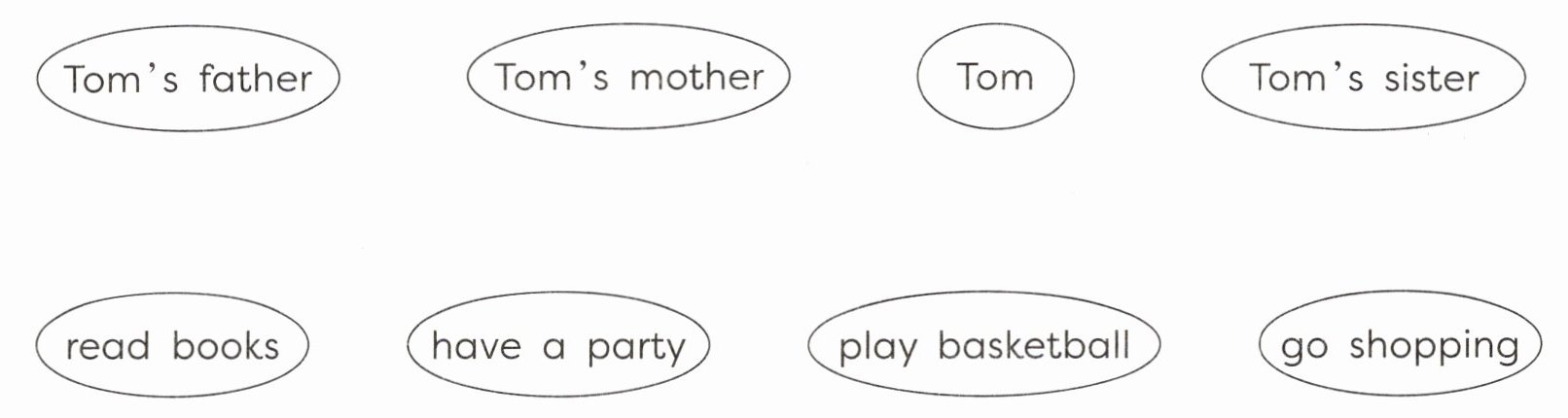
Ⅰ. 听录音,连线。
答案
Tom's father—play basketball
Tom's mother—go shopping
Tom—read books
Tom's sister—have a party
Tom's mother—go shopping
Tom—read books
Tom's sister—have a party
解析
【解析】
本题为听力连线题,需要根据听力音频中对应的内容,将Tom一家的家庭成员和他们的活动进行匹配连线。
【答案】
Tom's father—play basketball
Tom's mother—go shopping
Tom—read books
Tom's sister—have a party
【知识点】
家庭成员词汇,日常活动表达,听力信息匹配
【点评】
本题考查学生对家庭成员及日常活动类词汇的听力辨识能力,要求学生精准捕捉听力关键信息完成匹配,能有效锻炼学生的听力理解与信息对应能力。
【难度系数】
0.7
本题为听力连线题,需要根据听力音频中对应的内容,将Tom一家的家庭成员和他们的活动进行匹配连线。
【答案】
Tom's father—play basketball
Tom's mother—go shopping
Tom—read books
Tom's sister—have a party
【知识点】
家庭成员词汇,日常活动表达,听力信息匹配
【点评】
本题考查学生对家庭成员及日常活动类词汇的听力辨识能力,要求学生精准捕捉听力关键信息完成匹配,能有效锻炼学生的听力理解与信息对应能力。
【难度系数】
0.7
