

 登录
登录
D
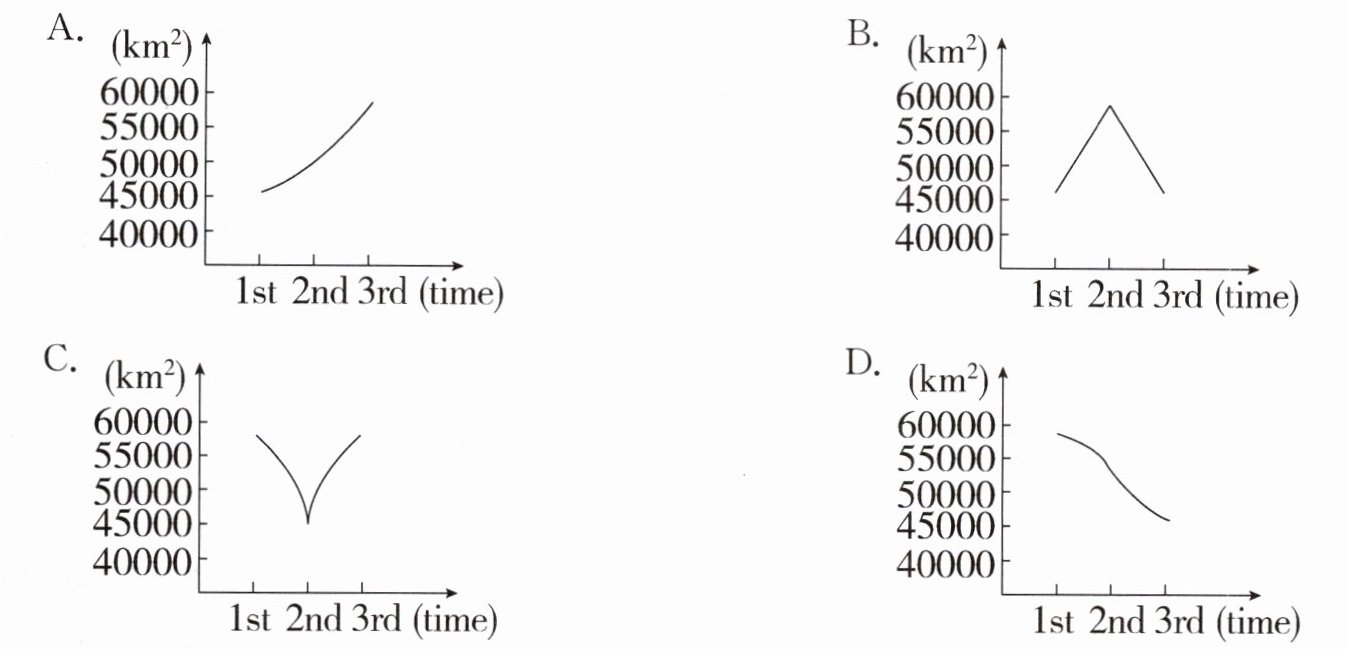
According to the latest inventory(编目), China's total glacier(冰川) area around 2020 was about 46,000 square kilometres, with around 69,000 glaciers. Compared to the results of the first inventory from the 1960s to 2020, China's glacier area has shrunk by 26 percent, with nearly 7,000 small glaciers disappearing. Compared to the second inventory, from 2008 to 2020, the glacier area reduced by about 6 percent, showing a rapid retreat(消融).
The findings were shared on Friday in March 2025, the first World Day for Glaciers, as researchers presented China's third glacier inventory at the third Chinese Conference of Cryospheric Science in Lingshui, Hainan Province.
Global glacier inventory efforts began in 1978, studying the distribution(分布) and volume(体积) of mountain glaciers. China's first and second glacier inventories were published in 2002 and 2014, with research detailing changes in the country's glaciers from the late 20th century to the early 21st century.
"Glaciers are among the most sensitive and direct signs of climate(气候) change, and glacier inventories are surveys of glacier resources," researchers from the Northwest Institute of Eco-Environment and Resources explained.
China began its first glacier inventory in 1978, led by scientist Shi Yafeng, as countries with glacier distributions worldwide began compiling(编制) their own inventories. The process took 24 years and was completed in 2002.
The first inventory recorded about 46,000 glaciers in China, covering around 59,000 square kilometres. With global temperatures rising, China's glaciers have continued to shrink, according to the Northwest Institute of Eco-Environment and Resources.
To better understand glacier distribution after 2000, the Cold and Arid Regions Environmental and Engineering Research Institute of the Chinese Academy of Sciences began the second inventory in 2007, publishing the data set in 2014. The results showed that by 2008, China had around 48,000 glaciers covering about 52,000 square kilometres.
China is the only major country to have completed three full glacier inventories, according to the institute.
The United Nations has designated March 21st as World Glacier Day starting from 2025. Glaciers are of great importance to the earth's climate and water resources, but their rapid melting(融化) has brought many problems. Although glaciers are still shrinking, the good news is that scientists all over the world are working hard to find ways to save them.
▲
(
A. By telling stories.
B. By asking questions.
C. By comparing facts.
D. By describing opinions.
(
(
A. Travel Guide
B. Science Report
C. Cultural Exchange
D. Technology News
(
A. How people help slow glaciers' melting.
B. How climate change influences glaciers.
C. Why glaciers worldwide are melting rapidly.
D. Why scientists pay attention to glaciers melting.
According to the latest inventory(编目), China's total glacier(冰川) area around 2020 was about 46,000 square kilometres, with around 69,000 glaciers. Compared to the results of the first inventory from the 1960s to 2020, China's glacier area has shrunk by 26 percent, with nearly 7,000 small glaciers disappearing. Compared to the second inventory, from 2008 to 2020, the glacier area reduced by about 6 percent, showing a rapid retreat(消融).
The findings were shared on Friday in March 2025, the first World Day for Glaciers, as researchers presented China's third glacier inventory at the third Chinese Conference of Cryospheric Science in Lingshui, Hainan Province.
Global glacier inventory efforts began in 1978, studying the distribution(分布) and volume(体积) of mountain glaciers. China's first and second glacier inventories were published in 2002 and 2014, with research detailing changes in the country's glaciers from the late 20th century to the early 21st century.
"Glaciers are among the most sensitive and direct signs of climate(气候) change, and glacier inventories are surveys of glacier resources," researchers from the Northwest Institute of Eco-Environment and Resources explained.
China began its first glacier inventory in 1978, led by scientist Shi Yafeng, as countries with glacier distributions worldwide began compiling(编制) their own inventories. The process took 24 years and was completed in 2002.
The first inventory recorded about 46,000 glaciers in China, covering around 59,000 square kilometres. With global temperatures rising, China's glaciers have continued to shrink, according to the Northwest Institute of Eco-Environment and Resources.
To better understand glacier distribution after 2000, the Cold and Arid Regions Environmental and Engineering Research Institute of the Chinese Academy of Sciences began the second inventory in 2007, publishing the data set in 2014. The results showed that by 2008, China had around 48,000 glaciers covering about 52,000 square kilometres.
China is the only major country to have completed three full glacier inventories, according to the institute.
The United Nations has designated March 21st as World Glacier Day starting from 2025. Glaciers are of great importance to the earth's climate and water resources, but their rapid melting(融化) has brought many problems. Although glaciers are still shrinking, the good news is that scientists all over the world are working hard to find ways to save them.
▲
(
C
)42. How does the writer start this passage?A. By telling stories.
B. By asking questions.
C. By comparing facts.
D. By describing opinions.
(
D
)43. Which of the following can show the results of the three inventories?(
B
)44. In which part of the website may you find this passage?A. Travel Guide
B. Science Report
C. Cultural Exchange
D. Technology News
(
A
)45. What will the writer probably continue to write in "▲"?A. How people help slow glaciers' melting.
B. How climate change influences glaciers.
C. Why glaciers worldwide are melting rapidly.
D. Why scientists pay attention to glaciers melting.
答案
D
【语篇解读】本文是一篇说明文,介绍了中国冰川最新编目的结果,其对气候变化的敏感性,以及中国冰川的变化及其对环境的影响。
42. C 写作手法题。根据“China's total glacier area around 2020 was about 46,000 square kilometres, with around 69,000 glaciers”以及后续提到的不同编目的对比,文章通过比较不同编目的事实来开头。故选 C。
43. D 图示理解题。根据“The first inventory recorded about 46,000 glaciers in China, covering around 59,000 square kilometres.”和第二次结果“The results showed that by 2008, China had around 48,000 glaciers covering about 52,000 square kilometres.”的数据,结合“According to the latest inventory, China's total glacier area around 2020 was about 46,000 square kilometres, with around 69,000 glaciers.”中最新的数据可知冰川的面积在逐年减少,图 D 符合。故选 D。
44. B 文章出处题。文章介绍了中国冰川变化的情况,属于对科学研究的报道,因此最可能出现在“Science Report”类别。故选 B。
45. A 推理判断题。根据文章最后提到“scientists all over the world are working hard to find ways to save them”,推测接下来可能讨论科学家如何努力减缓冰川融化的措施。故选 A。
【语篇解读】本文是一篇说明文,介绍了中国冰川最新编目的结果,其对气候变化的敏感性,以及中国冰川的变化及其对环境的影响。
42. C 写作手法题。根据“China's total glacier area around 2020 was about 46,000 square kilometres, with around 69,000 glaciers”以及后续提到的不同编目的对比,文章通过比较不同编目的事实来开头。故选 C。
43. D 图示理解题。根据“The first inventory recorded about 46,000 glaciers in China, covering around 59,000 square kilometres.”和第二次结果“The results showed that by 2008, China had around 48,000 glaciers covering about 52,000 square kilometres.”的数据,结合“According to the latest inventory, China's total glacier area around 2020 was about 46,000 square kilometres, with around 69,000 glaciers.”中最新的数据可知冰川的面积在逐年减少,图 D 符合。故选 D。
44. B 文章出处题。文章介绍了中国冰川变化的情况,属于对科学研究的报道,因此最可能出现在“Science Report”类别。故选 B。
45. A 推理判断题。根据文章最后提到“scientists all over the world are working hard to find ways to save them”,推测接下来可能讨论科学家如何努力减缓冰川融化的措施。故选 A。
解析
【分析】
这是一篇科普类说明文阅读理解,解题时可以按题目顺序逐个对应考点思考:
1. 第42题判断开篇方式:先定位文章首段内容,观察开篇的呈现形式,对比四个选项的特征,排除不符合的选项即可。
2. 第43题匹配对应图表:先从文中提取三次冰川编目的面积数据,梳理面积随时间的变化趋势,再对比四个选项的曲线走向,选出完全匹配的图。
3. 第44题判断文章出处:结合全文的主题属性,区分四个不同板块的内容特征,选出最适配的栏目。
4. 第45题推断后续续写内容:定位文章末尾的收尾句,结合行文逻辑,判断接下来最顺承的内容,排除前文已经涉及的选项。
【解析】
42. 细节理解+写作手法题:文章首段先给出2020年第三次冰川编目的面积数据,紧接着将该数据和第一次、第二次冰川编目的统计结果做对比,全文开篇没有讲述故事、提出问题,也没有先抛出主观观点,是通过对比不同阶段的统计事实引入主题,因此选C。
43. 图表匹配题:从文中提取三次冰川编目的面积数据:①第一次编目冰川面积约为59000km²;②第二次编目冰川面积约为52000km²;③第三次编目冰川面积约为46000km²,整体呈现持续递减的趋势。选项A曲线持续上升、选项B先升后降、选项C先降后升,均不符合趋势,只有选项D的曲线持续下降,完全匹配三次数据的变化规律,因此选D。
44. 文章出处推断题:本文围绕中国三次冰川科考编目的成果展开,属于自然领域的科研成果介绍类内容,不属于旅游指南、文化交流板块,也不属于新技术研发相关的科技新闻,最可能出现在网站的科学报告栏目,因此选B。
45. 语篇逻辑推理题:文章末尾最后一句提到“全世界的科学家都在努力寻找拯救冰川的方法”,按照行文逻辑,接下来最顺承的内容就是介绍人们为减缓冰川融化所采取的相关举措,而气候变化对冰川的影响、冰川快速融化的原因、科学家关注冰川融化的原因在前文中已经有相关涉及,不会放在收尾部分后续展开,因此选A。
【答案】
42.C 43.D 44.B 45.A
【知识点】
阅读理解细节定位,图表信息匹配,语篇逻辑推断
【点评】
本题属于典型的科普类阅读考题,考点设置全面,既考查学生快速从长文本中定位关键数据的能力,也要求学生结合行文逻辑、内容属性做合理推导,兼顾基础能力和逻辑思维的考查,难度适中。
【难度系数】
0.7
这是一篇科普类说明文阅读理解,解题时可以按题目顺序逐个对应考点思考:
1. 第42题判断开篇方式:先定位文章首段内容,观察开篇的呈现形式,对比四个选项的特征,排除不符合的选项即可。
2. 第43题匹配对应图表:先从文中提取三次冰川编目的面积数据,梳理面积随时间的变化趋势,再对比四个选项的曲线走向,选出完全匹配的图。
3. 第44题判断文章出处:结合全文的主题属性,区分四个不同板块的内容特征,选出最适配的栏目。
4. 第45题推断后续续写内容:定位文章末尾的收尾句,结合行文逻辑,判断接下来最顺承的内容,排除前文已经涉及的选项。
【解析】
42. 细节理解+写作手法题:文章首段先给出2020年第三次冰川编目的面积数据,紧接着将该数据和第一次、第二次冰川编目的统计结果做对比,全文开篇没有讲述故事、提出问题,也没有先抛出主观观点,是通过对比不同阶段的统计事实引入主题,因此选C。
43. 图表匹配题:从文中提取三次冰川编目的面积数据:①第一次编目冰川面积约为59000km²;②第二次编目冰川面积约为52000km²;③第三次编目冰川面积约为46000km²,整体呈现持续递减的趋势。选项A曲线持续上升、选项B先升后降、选项C先降后升,均不符合趋势,只有选项D的曲线持续下降,完全匹配三次数据的变化规律,因此选D。
44. 文章出处推断题:本文围绕中国三次冰川科考编目的成果展开,属于自然领域的科研成果介绍类内容,不属于旅游指南、文化交流板块,也不属于新技术研发相关的科技新闻,最可能出现在网站的科学报告栏目,因此选B。
45. 语篇逻辑推理题:文章末尾最后一句提到“全世界的科学家都在努力寻找拯救冰川的方法”,按照行文逻辑,接下来最顺承的内容就是介绍人们为减缓冰川融化所采取的相关举措,而气候变化对冰川的影响、冰川快速融化的原因、科学家关注冰川融化的原因在前文中已经有相关涉及,不会放在收尾部分后续展开,因此选A。
【答案】
42.C 43.D 44.B 45.A
【知识点】
阅读理解细节定位,图表信息匹配,语篇逻辑推断
【点评】
本题属于典型的科普类阅读考题,考点设置全面,既考查学生快速从长文本中定位关键数据的能力,也要求学生结合行文逻辑、内容属性做合理推导,兼顾基础能力和逻辑思维的考查,难度适中。
【难度系数】
0.7
