

 登录
登录
五、V. 根据短文内容,从短文后的方框中选出能填入空白处的最佳选项。其中有一项为多余选项。
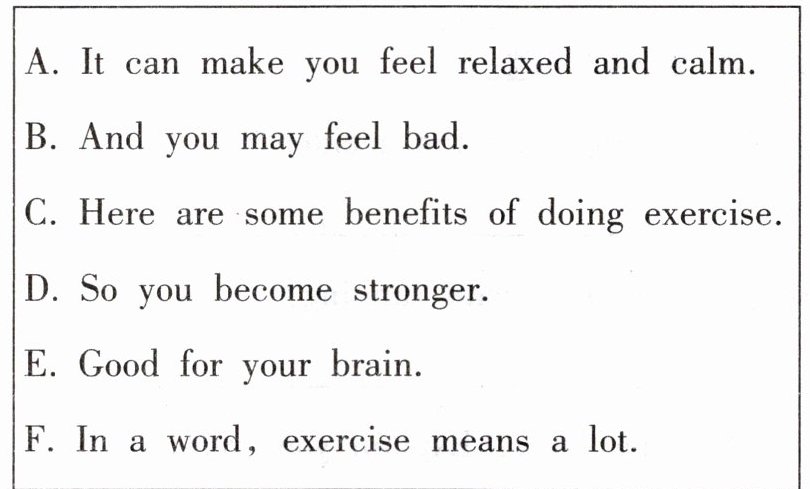
Everyone knows exercise is good for our health. But many teenagers don't seem to know much. 1
Good for your body. When you exercise, your muscles(肌肉)grow. 2 You will have fewer diseases(疾病)now and in the future.
3 When you do exercise, your heart beats faster and you breathe in more air. So your brain gets more oxygen(氧气). That helps your brain work better. So, next time you have trouble with your homework, do some exercise!
Good for your mood(心情). When you exercise, your brain will give out something. 4 You will feel better and confident. By the way, you can also make many friends. This will also make you happy.
5 Just do some exercise every day.
1. ___ 2. ___ 3. ___ 4. ___ 5. ___
Everyone knows exercise is good for our health. But many teenagers don't seem to know much. 1
Good for your body. When you exercise, your muscles(肌肉)grow. 2 You will have fewer diseases(疾病)now and in the future.
3 When you do exercise, your heart beats faster and you breathe in more air. So your brain gets more oxygen(氧气). That helps your brain work better. So, next time you have trouble with your homework, do some exercise!
Good for your mood(心情). When you exercise, your brain will give out something. 4 You will feel better and confident. By the way, you can also make many friends. This will also make you happy.
5 Just do some exercise every day.
1. ___ 2. ___ 3. ___ 4. ___ 5. ___
答案
Ⅴ. 1.C 2.D 3.E 4.A 5.F
解析
【分析】
这是一篇介绍运动益处的说明文选句填空,解题时首先先通读全文,梳理出文章“总起-分点介绍好处-总结”的总分总结构:第一步先判断首空的作用,首段末尾后文开始分点讲运动的各类好处,需要找总起引出下文的句子;第二步顺着分点段落的逻辑,第一点讲对身体的好处,前文提到运动让肌肉生长,顺着因果逻辑找对应的结果句;第三步下一段整段围绕大脑展开,直接匹配对应的主题小标题;第四点讲对心情的好处,前后文都在描述运动给人带来的情绪感受,匹配对应描述情绪的句子;最后一空在全文结尾,是总结句,匹配收尾的总结类表达,排除多余的B选项即可完成作答。
【解析】
1. 空1位于首段末尾,前文提到很多青少年对运动的好处了解不多,后文开始分点罗列运动的各类益处,C选项“Here are some benefits of doing exercise.”起到总起下文的作用,符合语境。
2. 空2前文说明运动时肌肉会生长,后文提到你现在和未来患病的概率更低,D选项“So you become stronger.”承接肌肉生长带来的变化,顺承引出后续少生病的逻辑,衔接通顺。
3. 空3是本段的主题句,本段全部内容围绕运动给大脑带来的益处展开,E选项“Good for your brain.”作为本段小标题,精准概括段落核心内容。
4. 空4前文提到运动时大脑会释放特定物质,后文提到你会感觉更好、更自信,A选项“It can make you feel relaxed and calm.”描述该物质带来的情绪感受,和上下文关于心情的描述完全匹配。
5. 空5位于全文末尾,属于总结段落,后文呼吁大家每天坚持运动,F选项“In a word, exercise means a lot.”对全文介绍的运动的诸多好处进行归纳总结,符合文章收尾逻辑。
【答案】
1.C 2.D 3.E 4.A 5.F
【知识点】
说明文阅读,语篇逻辑衔接
【点评】
本题选取和学生生活关联度很高的运动主题,文章结构清晰,解题时可以优先通过段落主题快速锁定小标题类选项,再通过上下文的因果、顺承逻辑匹配剩余句子,能够有效锻炼学生梳理语篇行文逻辑的能力。
【难度系数】
0.7
这是一篇介绍运动益处的说明文选句填空,解题时首先先通读全文,梳理出文章“总起-分点介绍好处-总结”的总分总结构:第一步先判断首空的作用,首段末尾后文开始分点讲运动的各类好处,需要找总起引出下文的句子;第二步顺着分点段落的逻辑,第一点讲对身体的好处,前文提到运动让肌肉生长,顺着因果逻辑找对应的结果句;第三步下一段整段围绕大脑展开,直接匹配对应的主题小标题;第四点讲对心情的好处,前后文都在描述运动给人带来的情绪感受,匹配对应描述情绪的句子;最后一空在全文结尾,是总结句,匹配收尾的总结类表达,排除多余的B选项即可完成作答。
【解析】
1. 空1位于首段末尾,前文提到很多青少年对运动的好处了解不多,后文开始分点罗列运动的各类益处,C选项“Here are some benefits of doing exercise.”起到总起下文的作用,符合语境。
2. 空2前文说明运动时肌肉会生长,后文提到你现在和未来患病的概率更低,D选项“So you become stronger.”承接肌肉生长带来的变化,顺承引出后续少生病的逻辑,衔接通顺。
3. 空3是本段的主题句,本段全部内容围绕运动给大脑带来的益处展开,E选项“Good for your brain.”作为本段小标题,精准概括段落核心内容。
4. 空4前文提到运动时大脑会释放特定物质,后文提到你会感觉更好、更自信,A选项“It can make you feel relaxed and calm.”描述该物质带来的情绪感受,和上下文关于心情的描述完全匹配。
5. 空5位于全文末尾,属于总结段落,后文呼吁大家每天坚持运动,F选项“In a word, exercise means a lot.”对全文介绍的运动的诸多好处进行归纳总结,符合文章收尾逻辑。
【答案】
1.C 2.D 3.E 4.A 5.F
【知识点】
说明文阅读,语篇逻辑衔接
【点评】
本题选取和学生生活关联度很高的运动主题,文章结构清晰,解题时可以优先通过段落主题快速锁定小标题类选项,再通过上下文的因果、顺承逻辑匹配剩余句子,能够有效锻炼学生梳理语篇行文逻辑的能力。
【难度系数】
0.7
Ⅵ. 阅读下面短文,根据短文内容按要求完成任务。
Wang Ming is 64 years old. He lives in Shanghai, China. He moves(感动)a lot of people.
In 2001, after an accident(事故)in Hangzhou, he couldn't walk and had to stay in bed for the rest of his life. He felt sad but he told himself not to give up. He wanted to walk, so he started to train(训练)himself to walk with his family's help. He fell down over and over again, but he didn't give up.
After a few months, he could walk slowly. Then he started to walk more. After a year, he could walk like other people. He felt very happy.
In 2012, a friend asked him to take part in a running race of 10 kilometers. He said yes. So he ran every day. And he got a medal(奖牌). He was happy and proud.
Wang fell in love with running because it made him happy and he thought it was good for his health and mind. He took part in all kinds of races and made many friends. They shared their stories and fun together. He even has over 90 marathon medals. His record for it is three hours forty-eight minutes and ten seconds.
He always says running is part of his life. He will run till 80 and even older.
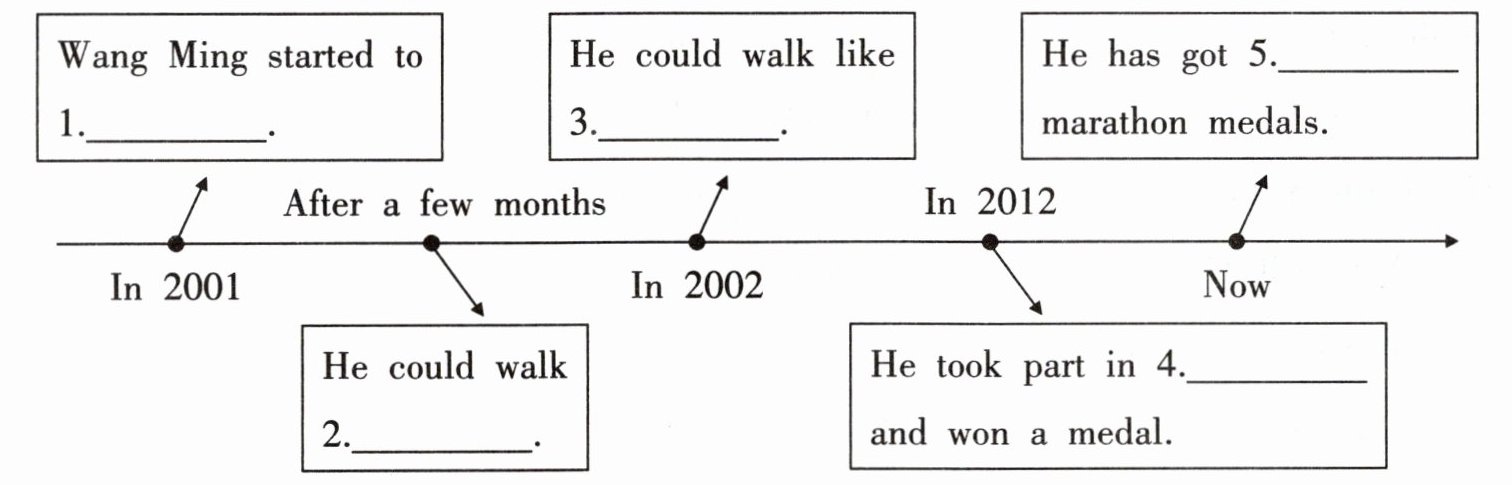
任务一:根据短文内容,完成图表。每个空格不超过3个单词。
任务二:根据短文内容,回答下列问题。
6. What happened to Wang Ming after the accident ______ ?
7. Why did Wang Ming fall in love with running ______ ?
8. What do you think of Wang Ming? Explain your reason(s) in about 20 words ______ .
Wang Ming is 64 years old. He lives in Shanghai, China. He moves(感动)a lot of people.
In 2001, after an accident(事故)in Hangzhou, he couldn't walk and had to stay in bed for the rest of his life. He felt sad but he told himself not to give up. He wanted to walk, so he started to train(训练)himself to walk with his family's help. He fell down over and over again, but he didn't give up.
After a few months, he could walk slowly. Then he started to walk more. After a year, he could walk like other people. He felt very happy.
In 2012, a friend asked him to take part in a running race of 10 kilometers. He said yes. So he ran every day. And he got a medal(奖牌). He was happy and proud.
Wang fell in love with running because it made him happy and he thought it was good for his health and mind. He took part in all kinds of races and made many friends. They shared their stories and fun together. He even has over 90 marathon medals. His record for it is three hours forty-eight minutes and ten seconds.
He always says running is part of his life. He will run till 80 and even older.
任务一:根据短文内容,完成图表。每个空格不超过3个单词。
任务二:根据短文内容,回答下列问题。
6. What happened to Wang Ming after the accident ______ ?
7. Why did Wang Ming fall in love with running ______ ?
8. What do you think of Wang Ming? Explain your reason(s) in about 20 words ______ .
答案
Ⅵ. 1. train himself 2. slowly 3. other people 4. a running race 5. over 90
6. He couldn't walk and had to stay on the bed for the rest of his life.
7. Because it made him happy and he thought it was good for his health and mind.
8. I think he is strong-minded. Because when he couldn't walk after an accident, he didn't give up. Instead, he kept trying until he made it.(仅供参考)
6. He couldn't walk and had to stay on the bed for the rest of his life.
7. Because it made him happy and he thought it was good for his health and mind.
8. I think he is strong-minded. Because when he couldn't walk after an accident, he didn't give up. Instead, he kept trying until he made it.(仅供参考)
解析
【分析】
这是一篇人物故事类任务型阅读,解题思路是先顺着题干给出的时间线,回到原文对应位置精准定位信息:首先按照2001、几个月后、2002、2012、现在的时间顺序,逐一在原文找到对应描述,提取符合字数要求的内容填空;后面的问答题同样先根据题干关键词定位原文,直接提取原句作答即可,最后一道开放题结合人物事迹给出合理评价和对应理由就行。
【解析】
1. 定位原文第二段:2001年事故后王明想要重新走路,于是开始在家人帮助下训练自己走路,空格要求不超过3个单词,提取核心内容train himself。
2. 定位原文第三段:几个月之后,王明已经可以慢慢走路了,直接提取副词slowly。
3. 定位原文第三段:事故一年后也就是2002年,王明可以像其他人一样正常走路了,提取other people。
4. 定位原文第四段:2012年王明受邀参加了10公里跑步比赛,还拿到了奖牌,提取a running race。
5. 定位原文第五段:现在王明已经拥有超过90枚马拉松奖牌,提取over 90。
6. 题干询问事故后王明的遭遇,直接定位原文第二段事故后的描述,整理得到对应答案。
7. 题干询问王明爱上跑步的原因,直接定位原文第五段开头的原因描述,提取原句即可。
8. 本题为开放性作答,结合王明遭遇事故后不放弃、坚持康复训练、参与多项赛事的事迹,给出符合人物特点的评价,搭配合理理由,字数符合要求即可。
【答案】
1. train himself
2. slowly
3. other people
4. a running race
5. over 90
6. He couldn't walk and had to stay in bed for the rest of his life.
7. Because it made him happy and he thought it was good for his health and mind.
8. I think he is strong-minded. Because when he couldn't walk after an accident, he didn't give up. Instead, he kept trying until he made it.(合理即可)
【知识点】
任务型阅读,细节信息定位,文本信息提取
【点评】
本题整体难度不高,绝大多数填空类题目都可以直接从原文找到对应答案,重点考察学生快速定位文本细节的能力,最后一道开放题引导学生结合文本内容进行独立思考和语言输出,兼顾基础能力考察和思维拓展。
【难度系数】
0.7
这是一篇人物故事类任务型阅读,解题思路是先顺着题干给出的时间线,回到原文对应位置精准定位信息:首先按照2001、几个月后、2002、2012、现在的时间顺序,逐一在原文找到对应描述,提取符合字数要求的内容填空;后面的问答题同样先根据题干关键词定位原文,直接提取原句作答即可,最后一道开放题结合人物事迹给出合理评价和对应理由就行。
【解析】
1. 定位原文第二段:2001年事故后王明想要重新走路,于是开始在家人帮助下训练自己走路,空格要求不超过3个单词,提取核心内容train himself。
2. 定位原文第三段:几个月之后,王明已经可以慢慢走路了,直接提取副词slowly。
3. 定位原文第三段:事故一年后也就是2002年,王明可以像其他人一样正常走路了,提取other people。
4. 定位原文第四段:2012年王明受邀参加了10公里跑步比赛,还拿到了奖牌,提取a running race。
5. 定位原文第五段:现在王明已经拥有超过90枚马拉松奖牌,提取over 90。
6. 题干询问事故后王明的遭遇,直接定位原文第二段事故后的描述,整理得到对应答案。
7. 题干询问王明爱上跑步的原因,直接定位原文第五段开头的原因描述,提取原句即可。
8. 本题为开放性作答,结合王明遭遇事故后不放弃、坚持康复训练、参与多项赛事的事迹,给出符合人物特点的评价,搭配合理理由,字数符合要求即可。
【答案】
1. train himself
2. slowly
3. other people
4. a running race
5. over 90
6. He couldn't walk and had to stay in bed for the rest of his life.
7. Because it made him happy and he thought it was good for his health and mind.
8. I think he is strong-minded. Because when he couldn't walk after an accident, he didn't give up. Instead, he kept trying until he made it.(合理即可)
【知识点】
任务型阅读,细节信息定位,文本信息提取
【点评】
本题整体难度不高,绝大多数填空类题目都可以直接从原文找到对应答案,重点考察学生快速定位文本细节的能力,最后一道开放题引导学生结合文本内容进行独立思考和语言输出,兼顾基础能力考察和思维拓展。
【难度系数】
0.7
