

 登录
登录
一、根据提示写单词
1. Tina f
2. 安徽人文题 Mr Green goes to Huizhou Ancient City(徽州古城)every summer and s
3. It's our d
4. My mother often p
5. The r
1. Tina f
finishes
(完成)her homework before 6 o'clock every day.2. 安徽人文题 Mr Green goes to Huizhou Ancient City(徽州古城)every summer and s
stays
(停留)there on holiday.3. It's our d
duty
(职责)to keep our classroom clean.4. My mother often p
prepares
(准备)lots of delicious food before a picnic.5. The r
reporter
(记者)wants to interview the famous writer about his new book.答案
1. finishes 2. stays 3. duty 4. prepares 5. reporter
解析
【分析】
这类题需结合句子时态、主语单复数及中文提示、首字母确定单词的正确形式:先判断句子时态(如一般现在时的标志词every day、often等),再根据主语的单复数确定动词的形式,最后匹配对应的中文词义和首字母,同时注意固定句型的用法。
【解析】
1. 时间状语every day提示用一般现在时,主语Tina是第三人称单数,中文“完成”对应动词finish,需变为第三人称单数形式finishes,故填finishes;
2. 时间状语every summer提示用一般现在时,主语Mr Green是第三人称单数,中文“停留”对应动词stay,需变为第三人称单数形式stays,故填stays;
3. 固定句型It's one's duty to do sth.表示“做某事是某人的职责”,中文“职责”对应名词duty,符合语境,故填duty;
4. 频率副词often提示用一般现在时,主语My mother是第三人称单数,中文“准备”对应动词prepare,需变为第三人称单数形式prepares,故填prepares;
5. 中文“记者”对应名词reporter,结合语境“采访著名作家”,此处填reporter,故填reporter。
【答案】
1. finishes 2. stays 3. duty 4. prepares 5. reporter
【知识点】
一般现在时、动词第三人称单数、名词词义
【点评】
本题考查基础词汇运用及一般现在时的用法,属于英语基础题型,侧重考查学生对核心词汇的掌握和时态的正确运用,难度较低。
【难度系数】
0.8
这类题需结合句子时态、主语单复数及中文提示、首字母确定单词的正确形式:先判断句子时态(如一般现在时的标志词every day、often等),再根据主语的单复数确定动词的形式,最后匹配对应的中文词义和首字母,同时注意固定句型的用法。
【解析】
1. 时间状语every day提示用一般现在时,主语Tina是第三人称单数,中文“完成”对应动词finish,需变为第三人称单数形式finishes,故填finishes;
2. 时间状语every summer提示用一般现在时,主语Mr Green是第三人称单数,中文“停留”对应动词stay,需变为第三人称单数形式stays,故填stays;
3. 固定句型It's one's duty to do sth.表示“做某事是某人的职责”,中文“职责”对应名词duty,符合语境,故填duty;
4. 频率副词often提示用一般现在时,主语My mother是第三人称单数,中文“准备”对应动词prepare,需变为第三人称单数形式prepares,故填prepares;
5. 中文“记者”对应名词reporter,结合语境“采访著名作家”,此处填reporter,故填reporter。
【答案】
1. finishes 2. stays 3. duty 4. prepares 5. reporter
【知识点】
一般现在时、动词第三人称单数、名词词义
【点评】
本题考查基础词汇运用及一般现在时的用法,属于英语基础题型,侧重考查学生对核心词汇的掌握和时态的正确运用,难度较低。
【难度系数】
0.8
二、根据汉语意思完成句子,每空一词
6. 你是怎样度过学校的一天的?
How do you
7. 我通常在早上6:45起床,然后快速穿好衣服。
I usually
8. 我在学校待大约七个小时,上七节课。
I
9. 每节课是45分钟。
10. 上课前,我喜欢读点书。
11. 我们应该尽量好好利用时间。
We should try to
12. 那么,你的日常生活是怎样的呢?
So, how is your
86 英语 七年级 上册 人教版
6. 你是怎样度过学校的一天的?
How do you
spend
your
school
day
?7. 我通常在早上6:45起床,然后快速穿好衣服。
I usually
get
up
at 6:45 in the morning. Then I get
dressed
quickly.8. 我在学校待大约七个小时,上七节课。
I
stay
at
school
for about seven hours and have seven classes.9. 每节课是45分钟。
Each
class
is 45 minutes.10. 上课前,我喜欢读点书。
Before
class
, I like to do some reading.11. 我们应该尽量好好利用时间。
We should try to
make
good
use
of
our time.12. 那么,你的日常生活是怎样的呢?
So, how is your
daily
routine
?86 英语 七年级 上册 人教版
答案
6. spend your school day 7. get up; get dressed
8. stay at school 9. Each class 10. Before class
11. make good use of 12. daily routine
8. stay at school 9. Each class 10. Before class
11. make good use of 12. daily routine
解析
【分析】
做这类根据汉语意思完成句子的题目,需先准确理解汉语句子的核心含义,再结合七年级上册所学的日常活动相关固定短语、一般现在时的用法(主语为非第三人称单数时,动词用原形),匹配对应的英语表达,确保每空一词,符合句子结构。
【解析】
6. 汉语“度过学校的一天”对应固定短语spend your school day,主语是you,动词用原形,故填该短语;
7. 汉语“起床”是固定短语get up,“穿好衣服”是get dressed,主语是I,一般现在时用动词原形,故依次填get up、get dressed;
8. 汉语“在学校待”对应固定短语stay at school,主语是I,动词用原形,故填该短语;
9. 汉语“每节课”对应名词短语Each class,作句子主语,故填该短语;
10. 汉语“上课前”对应介词短语Before class,作句首状语,故填该短语;
11. 汉语“好好利用”对应固定短语make good use of,try to后接动词原形,故填该短语;
12. 汉语“日常生活”对应固定短语daily routine,故填该短语。
【答案】
6. spend your school day 7. get up; get dressed 8. stay at school 9. Each class 10. Before class 11. make good use of 12. daily routine
【知识点】
固定短语搭配、一般现在时、名词短语
【点评】
本题为七年级英语基础题型,考查日常活动相关的常用固定表达,需学生积累日常交际短语,掌握一般现在时的基本用法,难度较低,适合巩固基础。
【难度系数】
0.8
做这类根据汉语意思完成句子的题目,需先准确理解汉语句子的核心含义,再结合七年级上册所学的日常活动相关固定短语、一般现在时的用法(主语为非第三人称单数时,动词用原形),匹配对应的英语表达,确保每空一词,符合句子结构。
【解析】
6. 汉语“度过学校的一天”对应固定短语spend your school day,主语是you,动词用原形,故填该短语;
7. 汉语“起床”是固定短语get up,“穿好衣服”是get dressed,主语是I,一般现在时用动词原形,故依次填get up、get dressed;
8. 汉语“在学校待”对应固定短语stay at school,主语是I,动词用原形,故填该短语;
9. 汉语“每节课”对应名词短语Each class,作句子主语,故填该短语;
10. 汉语“上课前”对应介词短语Before class,作句首状语,故填该短语;
11. 汉语“好好利用”对应固定短语make good use of,try to后接动词原形,故填该短语;
12. 汉语“日常生活”对应固定短语daily routine,故填该短语。
【答案】
6. spend your school day 7. get up; get dressed 8. stay at school 9. Each class 10. Before class 11. make good use of 12. daily routine
【知识点】
固定短语搭配、一般现在时、名词短语
【点评】
本题为七年级英语基础题型,考查日常活动相关的常用固定表达,需学生积累日常交际短语,掌握一般现在时的基本用法,难度较低,适合巩固基础。
【难度系数】
0.8
三、新形式·邮件 任务型阅读
○●○ Email
To: scottgreen@happymail.com
From: jiangfei@163.com
Dear Scott,
Do you want to know about my weekends? Now I will tell you about them.
I usually get up at six thirty, but at weekends I get up at seven. I go to bed and get up late because I watch TV at night. After I get up, I wash my face, brush my teeth and then eat breakfast. At around seven thirty I go to the music club. I get there at eight. The class begins at eight ten. There the te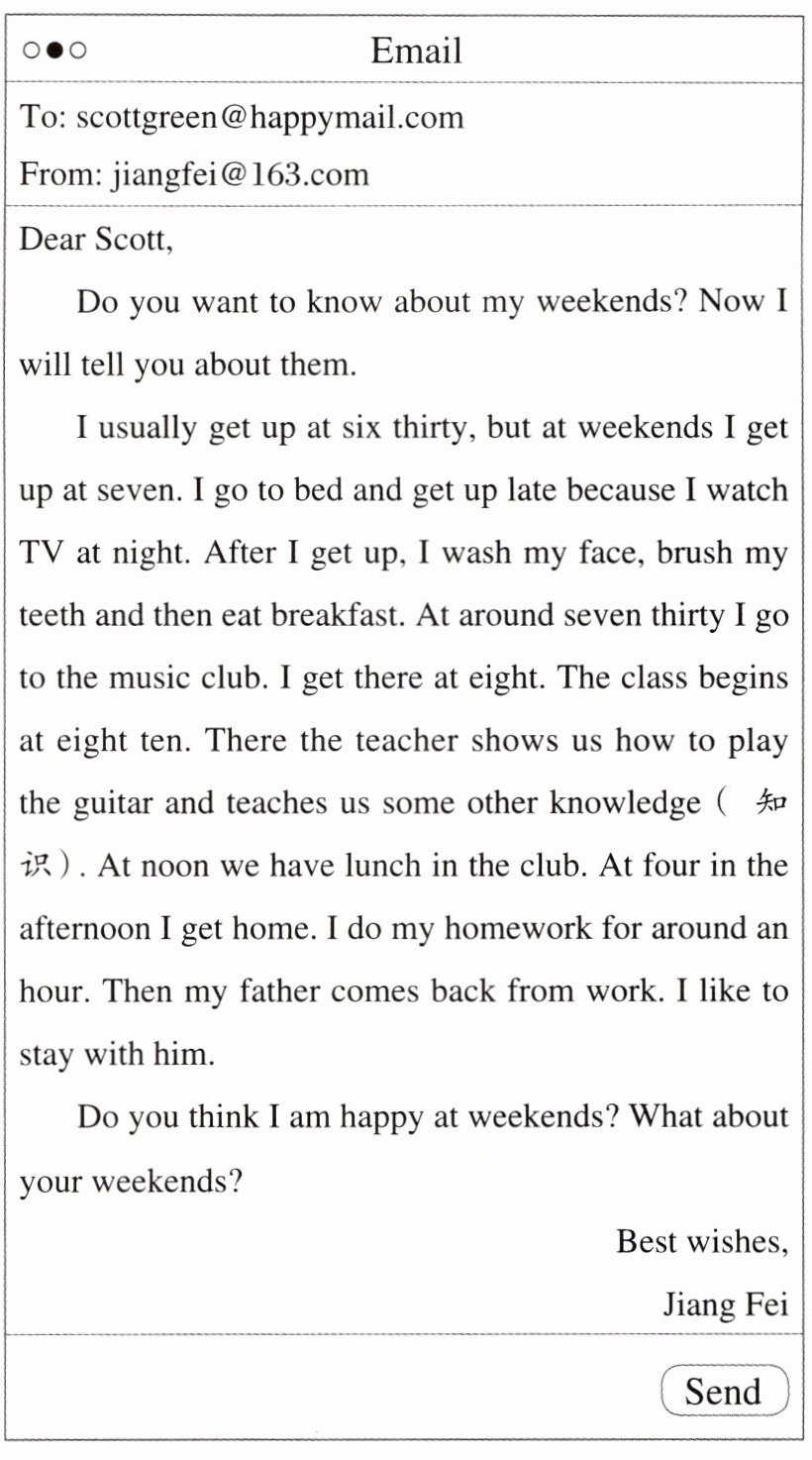 her shows us how to play the guitar and teaches us some other knowledge(知识). At noon we have lunch in the club. At four in the afternoon I get home. I do my homework for around an hour. Then my father comes back from work. I like to stay with him.
Do you think I am happy at weekends? What about your weekends?
Best wishes,
Jiang Fei
Send
13. When does Jiang Fei get up at weekends?(不超过5个词)
14. Where does Jiang Fei have lunch?(不超过5个词)
15. Does Jiang Fei have a happy weekend? Why?(不超过15个词)
To: scottgreen@happymail.com
From: jiangfei@163.com
Dear Scott,
Do you want to know about my weekends? Now I will tell you about them.
I usually get up at six thirty, but at weekends I get up at seven. I go to bed and get up late because I watch TV at night. After I get up, I wash my face, brush my teeth and then eat breakfast. At around seven thirty I go to the music club. I get there at eight. The class begins at eight ten. There the te
her shows us how to play the guitar and teaches us some other knowledge(知识). At noon we have lunch in the club. At four in the afternoon I get home. I do my homework for around an hour. Then my father comes back from work. I like to stay with him.Do you think I am happy at weekends? What about your weekends?
Best wishes,
Jiang Fei
Send
13. When does Jiang Fei get up at weekends?(不超过5个词)
At seven/7:00.
14. Where does Jiang Fei have lunch?(不超过5个词)
In the music club.
15. Does Jiang Fei have a happy weekend? Why?(不超过15个词)
Yes. Because he makes good use of his time.
(言之有理即可)
答案
13. At seven/7:00. 14. In the music club.
15. Yes. Because he makes good use of his time.(言之有理即可)
15. Yes. Because he makes good use of his time.(言之有理即可)
解析
【分析】
本题为任务型阅读,需从给定的邮件文本中定位对应问题的关键信息。第13题询问Jiang Fei周末的起床时间,需找到文中关于周末起床时间的描述;第14题询问午餐地点,需定位午餐相关的地点内容;第15题需判断是否有开心的周末并说明原因,结合文本合理作答即可。
【解析】
13. 定位邮件中句子“but at weekends I get up at seven.”,可知周末起床时间为七点,答案为At seven。
14. 定位邮件中句子“At noon we have lunch in the club.”,结合前文提到的“music club”,可知午餐地点是音乐俱乐部,答案为In the music club。
15. 结合邮件中Jiang Fei周末的活动(去音乐俱乐部、做作业、陪伴父亲),可知他有开心的周末,原因可写为Yes. Because he makes good use of his time.
【答案】
13. At seven
14. In the music club
15. Yes. Because he makes good use of his time.
【知识点】
任务型阅读、细节理解
【点评】
本题考查学生从邮件文本中提取关键信息的能力,题目难度较低,仔细阅读文本即可找到对应答案。
【难度系数】
0.8
本题为任务型阅读,需从给定的邮件文本中定位对应问题的关键信息。第13题询问Jiang Fei周末的起床时间,需找到文中关于周末起床时间的描述;第14题询问午餐地点,需定位午餐相关的地点内容;第15题需判断是否有开心的周末并说明原因,结合文本合理作答即可。
【解析】
13. 定位邮件中句子“but at weekends I get up at seven.”,可知周末起床时间为七点,答案为At seven。
14. 定位邮件中句子“At noon we have lunch in the club.”,结合前文提到的“music club”,可知午餐地点是音乐俱乐部,答案为In the music club。
15. 结合邮件中Jiang Fei周末的活动(去音乐俱乐部、做作业、陪伴父亲),可知他有开心的周末,原因可写为Yes. Because he makes good use of his time.
【答案】
13. At seven
14. In the music club
15. Yes. Because he makes good use of his time.
【知识点】
任务型阅读、细节理解
【点评】
本题考查学生从邮件文本中提取关键信息的能力,题目难度较低,仔细阅读文本即可找到对应答案。
【难度系数】
0.8
