

 登录
登录
五、用方框中所给词的适当形式补全对话。
picnic play out try have
(Beibei always stays inside. )
A: Hello, Beibei. Come
B: Er. I don't like
A: OK. Maybe(也许) we can go and
B: Sure. I like
(Then he
B: Oh, no. I can't get out. A: Er...
picnic play out try have
(Beibei always stays inside. )
A: Hello, Beibei. Come
out
and play basketball.B: Er. I don't like
playing
basketball.A: OK. Maybe(也许) we can go and
have
a picnic.B: Sure. I like
picnics
. I can't wait.(Then he
tries
to get out. )B: Oh, no. I can't get out. A: Er...
答案
out; playing; have; picnics; tries
解析
【分析】首先通读对话,理解语境是邀请Beibei出门参与活动,结合所给词汇和语法规则逐一分析每个空:第一空需用固定短语搭配;第二空涉及like的用法;第三空是固定短语搭配;第四空需考虑名词的适当形式;第五空要结合主语的人称和数确定动词形式。
【解析】1. 第一空:固定短语come out意为“出来”,符合语境,故填out;2. 第二空:like doing sth是固定用法,表长期爱好,play的动名词形式为playing,故填playing;3. 第三空:固定短语have a picnic意为“去野餐”,情态动词can后接动词原形,故填have;4. 第四空:like后接名词,picnic是可数名词,此处表泛指用复数形式picnics,故填picnics;5. 第五空:主语he是第三人称单数,一般现在时谓语动词用try的第三人称单数形式tries,故填tries。
【答案】out; playing; have; picnics; tries
【知识点】动词适当形式填空、固定搭配
【点评】本题考查基础词汇运用,涉及固定短语搭配和词形变化,是日常英语学习的基础题型,难度较低。
【难度系数】0.7
【解析】1. 第一空:固定短语come out意为“出来”,符合语境,故填out;2. 第二空:like doing sth是固定用法,表长期爱好,play的动名词形式为playing,故填playing;3. 第三空:固定短语have a picnic意为“去野餐”,情态动词can后接动词原形,故填have;4. 第四空:like后接名词,picnic是可数名词,此处表泛指用复数形式picnics,故填picnics;5. 第五空:主语he是第三人称单数,一般现在时谓语动词用try的第三人称单数形式tries,故填tries。
【答案】out; playing; have; picnics; tries
【知识点】动词适当形式填空、固定搭配
【点评】本题考查基础词汇运用,涉及固定短语搭配和词形变化,是日常英语学习的基础题型,难度较低。
【难度系数】0.7
六、新素材 阅读绘本,选择正确的答案。
On Sunday morning, a rabbit walks near the river. A wolf(狼) shouts, “Help! Help!” A big stone(石头)is on the wolf's back.
“Mr Rabbit, please move this stone away from my back.” The rabbit helps the wolf. Then the wolf jumps up and catches the rabbit. He wants to eat the rabbit.
The rabbit cries, “I help you. How can you kill(杀)me? It's unfair. Let's ask Mr Fox. He will say you're wrong.” “OK. He will say I can eat you.”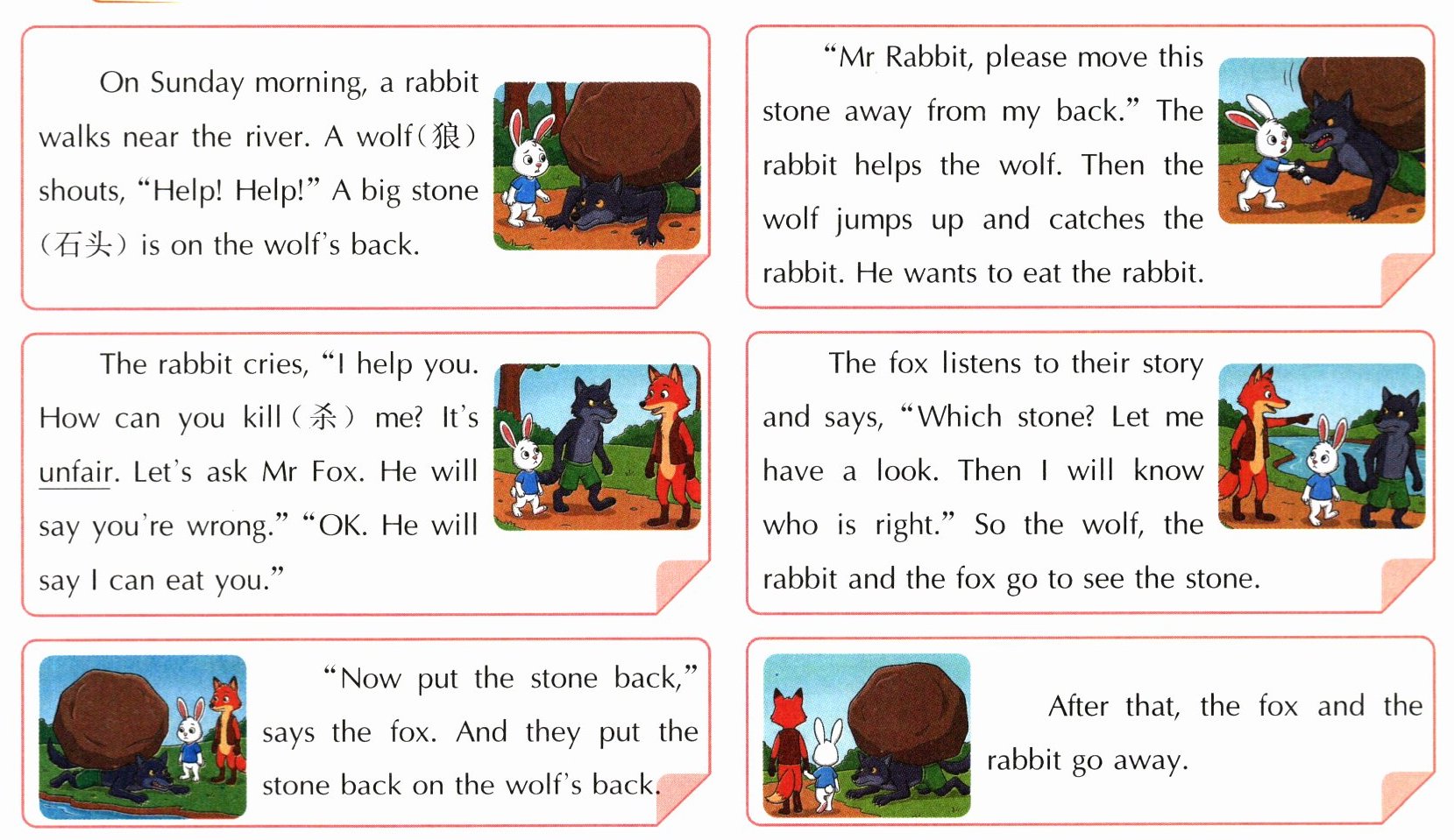
The fox listens to their story and says, “Which stone? Let me have a look. Then I will know who is right.” So the wolf, the rabbit and the fox go to see the stone.
“Now put the stone back,” says the fox. And they put the stone back on the wolf's back.
After that, the fox and the rabbit go away.
(
A. the fox's back B. the rabbit's back C. the wolf's back
(
A. On Sunday afternoon. B. On Monday morning. C. On Sunday morning.
(
A. likes him B. wants to make friends with him C. wants to eat him
(
A. 不公平的 B. 公平的 C. 生气的
(
A. Mr Fox. B. Mrs Fox. C. The wolf.
On Sunday morning, a rabbit walks near the river. A wolf(狼) shouts, “Help! Help!” A big stone(石头)is on the wolf's back.
“Mr Rabbit, please move this stone away from my back.” The rabbit helps the wolf. Then the wolf jumps up and catches the rabbit. He wants to eat the rabbit.
The rabbit cries, “I help you. How can you kill(杀)me? It's unfair. Let's ask Mr Fox. He will say you're wrong.” “OK. He will say I can eat you.”
The fox listens to their story and says, “Which stone? Let me have a look. Then I will know who is right.” So the wolf, the rabbit and the fox go to see the stone.
“Now put the stone back,” says the fox. And they put the stone back on the wolf's back.
After that, the fox and the rabbit go away.
(
C
)1. There's a big stone on C
.A. the fox's back B. the rabbit's back C. the wolf's back
(
C
)2. When does the rabbit help the wolf?A. On Sunday afternoon. B. On Monday morning. C. On Sunday morning.
(
C
)3. The wolf catches the rabbit because he C
.A. likes him B. wants to make friends with him C. wants to eat him
(
A
)4. The underlined word “unfair” means “A
” in Chinese.A. 不公平的 B. 公平的 C. 生气的
(
A
)5. Finally, who helps the rabbit?A. Mr Fox. B. Mrs Fox. C. The wolf.
答案
1. C 2. C 3. C 4. A 5. A
解析
【分析】
这是一篇英语阅读理解题,需结合原文内容逐一分析每个小题:
1. 第1题:定位原文确定大石头所在的位置;
2. 第2题:定位原文找到兔子帮助狼的时间;
3. 第3题:定位原文明确狼抓兔子的原因;
4. 第4题:结合上下文猜测划线单词的含义;
5. 第5题:定位原文找出最后帮助兔子的角色。
【解析】
1. 细节理解题:根据原文第一段最后一句“A big stone(石头)is on the wolf's back.”可知,大石头在狼的背上,故选C。
2. 细节理解题:根据原文第一段第一句“On Sunday morning, a rabbit walks near the river.”及第二段第一句“The rabbit helps the wolf.”可知,兔子帮助狼是在周日上午,故选C。
3. 细节理解题:根据原文第二段最后一句“He wants to eat the rabbit.”可知,狼抓兔子是因为想吃掉它,故选C。
4. 词义猜测题:兔子帮助了狼,狼却要吃掉兔子,兔子认为这一行为是不公平的,“unfair”意为“不公平的”,故选A。
5. 细节理解题:根据原文最后一段“After that, the fox and the rabbit go away.”可知,最后是狐狸帮助了兔子,故选A。
【答案】
1. C 2. C 3. C 4. A 5. A
【知识点】
英语阅读理解、细节理解、词义猜测
【点评】
本题为英语阅读基础题,主要考查学生对原文细节信息的查找能力和词义猜测能力,属于故事类阅读,内容易懂,适合练习基础阅读技巧。
【难度系数】
0.8
这是一篇英语阅读理解题,需结合原文内容逐一分析每个小题:
1. 第1题:定位原文确定大石头所在的位置;
2. 第2题:定位原文找到兔子帮助狼的时间;
3. 第3题:定位原文明确狼抓兔子的原因;
4. 第4题:结合上下文猜测划线单词的含义;
5. 第5题:定位原文找出最后帮助兔子的角色。
【解析】
1. 细节理解题:根据原文第一段最后一句“A big stone(石头)is on the wolf's back.”可知,大石头在狼的背上,故选C。
2. 细节理解题:根据原文第一段第一句“On Sunday morning, a rabbit walks near the river.”及第二段第一句“The rabbit helps the wolf.”可知,兔子帮助狼是在周日上午,故选C。
3. 细节理解题:根据原文第二段最后一句“He wants to eat the rabbit.”可知,狼抓兔子是因为想吃掉它,故选C。
4. 词义猜测题:兔子帮助了狼,狼却要吃掉兔子,兔子认为这一行为是不公平的,“unfair”意为“不公平的”,故选A。
5. 细节理解题:根据原文最后一段“After that, the fox and the rabbit go away.”可知,最后是狐狸帮助了兔子,故选A。
【答案】
1. C 2. C 3. C 4. A 5. A
【知识点】
英语阅读理解、细节理解、词义猜测
【点评】
本题为英语阅读基础题,主要考查学生对原文细节信息的查找能力和词义猜测能力,属于故事类阅读,内容易懂,适合练习基础阅读技巧。
【难度系数】
0.8
