

 登录
登录
四、任务型阅读(每小题 1.5 分,满分 15 分)
阅读下面短文,并根据所读内容在文章后的表格里填入最恰当的单词,每个空格只填一个单词。
(2025·镇江二模改编) Every year earthday.org sets the theme for Earth Day, which is on April 22. The theme of 2025 was called “Our Power, Our Planet”, championing renewable energy.
Renewable energy is energy that will never run out. Here is a guide to each energy source and how they can help us make electricity. Whether you are a student or a teacher, consider using our free guides!
What is solar energy?
Solar energy is energy from the sun. Solar energy is more than enough and clean, producing no greenhouse gases during operation. In 2023, solar energy made up 74% of renewable energy worldwide. It uses sunlight to create electricity or warm air and water. In the future, solar energy is expected to play an important role in meeting the world's energy needs.
What is wind energy?
Big machines called wind turbines (风力涡轮机) help make the wind's power. Most wind farms, where many turbines are seen, are on land, but some are built in the ocean too! The electricity a wind farm can make depends on two things: the speed of the wind and the number of the turbines on the farm. It's like having more friends to help you blow up balloons—more wind means more power! Wind turbine technology continues to improve, so wind energy will continue to grow and become an important part.
What is geothermal (地热的) energy?
Geothermal energy comes from the heat under the earth's surface. It can be used to make electricity to heat or cool buildings. However, geothermal energy can be found in certain areas where there is geothermal heat. The special place to find geothermal energy is called the Ring of Fire. It is known for having many earthquakes.
What is tidal (潮汐的) energy?
Tidal energy is like magic from the ocean! The water in the sea moves and then makes the special energy. Do you know that three billion people live close to the coastline? That's almost half of all the people in the world! It's smart to use tidal energy because it can help provide power to all those people while being friendly to our planet.
The energy landscape is changing rapidly. In the future, it is possible that renewable energy will master the energy market, offering clean power in the future!
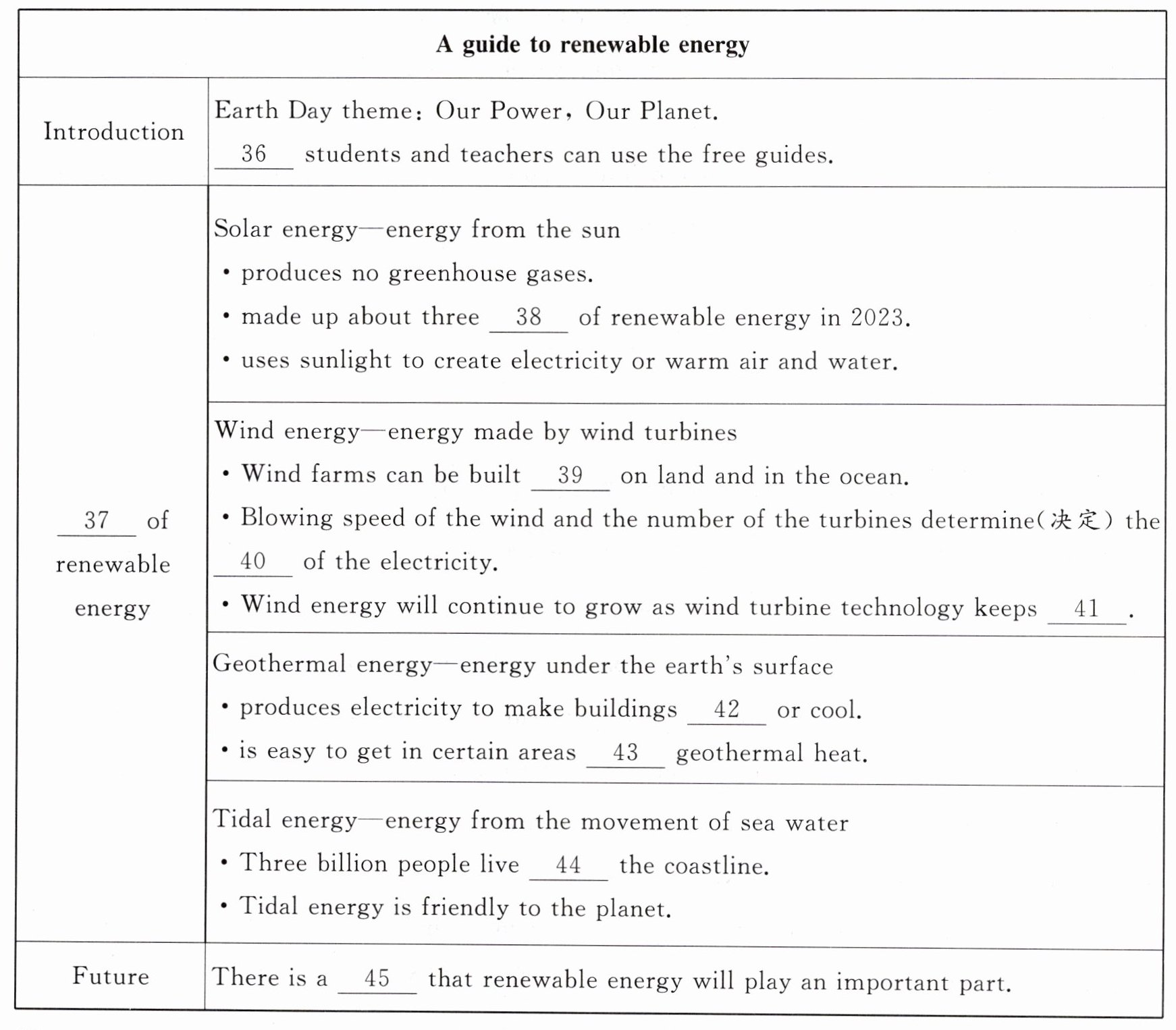
36.
阅读下面短文,并根据所读内容在文章后的表格里填入最恰当的单词,每个空格只填一个单词。
(2025·镇江二模改编) Every year earthday.org sets the theme for Earth Day, which is on April 22. The theme of 2025 was called “Our Power, Our Planet”, championing renewable energy.
Renewable energy is energy that will never run out. Here is a guide to each energy source and how they can help us make electricity. Whether you are a student or a teacher, consider using our free guides!
What is solar energy?
Solar energy is energy from the sun. Solar energy is more than enough and clean, producing no greenhouse gases during operation. In 2023, solar energy made up 74% of renewable energy worldwide. It uses sunlight to create electricity or warm air and water. In the future, solar energy is expected to play an important role in meeting the world's energy needs.
What is wind energy?
Big machines called wind turbines (风力涡轮机) help make the wind's power. Most wind farms, where many turbines are seen, are on land, but some are built in the ocean too! The electricity a wind farm can make depends on two things: the speed of the wind and the number of the turbines on the farm. It's like having more friends to help you blow up balloons—more wind means more power! Wind turbine technology continues to improve, so wind energy will continue to grow and become an important part.
What is geothermal (地热的) energy?
Geothermal energy comes from the heat under the earth's surface. It can be used to make electricity to heat or cool buildings. However, geothermal energy can be found in certain areas where there is geothermal heat. The special place to find geothermal energy is called the Ring of Fire. It is known for having many earthquakes.
What is tidal (潮汐的) energy?
Tidal energy is like magic from the ocean! The water in the sea moves and then makes the special energy. Do you know that three billion people live close to the coastline? That's almost half of all the people in the world! It's smart to use tidal energy because it can help provide power to all those people while being friendly to our planet.
The energy landscape is changing rapidly. In the future, it is possible that renewable energy will master the energy market, offering clean power in the future!
36.
Both
37. Kinds
38. quarters
39. both
40. production
41. improving
42. warm
43. with
44. near
45. possibility
答案
36. Both 37. Kinds/Types 38. quarters/fourths 39. both 40. production 41. improving 42. warm 43. with 44. near 45. possibility
解析
【分析】
这是一篇介绍可再生能源的任务型阅读题,解题思路如下:
1. 先通读全文,明确文章主旨是围绕2025年地球日主题“Our Power, Our Planet”,介绍太阳能、风能、地热能、潮汐能四种可再生能源的特点及未来前景。
2. 逐个分析表格空格,回到原文精准定位对应信息:
36题需找到原文中涉及学生和教师都能使用免费指南的表述,提炼“两者都”的对应表达;
37题是表格分类标题,下方列举不同可再生能源,需确定“种类”的对应词汇;
38题根据原文74%的占比,转换为分数表达;
39题找到风能农场分布的表述,提炼“既…又…”的结构;
40题需将原文中“发电量”的动词表达转换为名词形式;
41题注意“keep doing”的固定搭配,将原文动词转换为动名词;
42题找到地热能对建筑作用的表述,对应“heat”的同义形容词;
43题将原文的定语从句转换为介词短语作定语;
44题替换原文中“close to”的同义短语;
45题将原文的“It is possible that…”转换为“there is a possibility that…”的结构。
3. 填写时注意每个空格仅填一个单词,确保词性、形式正确。
【解析】
1. 36题:定位原文第二段“Whether you are a student or a teacher, consider using our free guides!”,“both...and...”表示“两者都”,首字母大写,故填Both。
2. 37题:表格下方分述了太阳能、风能等不同可再生能源,此处为分类标题,“Kinds/Types”表示“种类”,首字母大写,故填Kinds/Types。
3. 38题:定位太阳能部分“In 2023, solar energy made up 74% of renewable energy worldwide.”,74%接近四分之三,“three quarters/fourths”是四分之三的英文表达,故填quarters/fourths。
4. 39题:定位风能部分“Most wind farms, where many turbines are seen, are on land, but some are built in the ocean too!”,表示风能农场既在陆地也在海洋,“both”符合“both...and...”结构,故填both。
5. 40题:定位风能部分“The electricity a wind farm can make depends on two things: the speed of the wind and the number of the turbines on the farm.”,“the electricity a wind farm can make”即“发电量”,用名词“production”表示,故填production。
6. 41题:定位风能部分“Wind turbine technology continues to improve”,“keep doing sth.”是固定搭配,“improve”的动名词形式为“improving”,故填improving。
7. 42题:定位地热能部分“It can be used to make electricity to heat or cool buildings.”,“heat”对应形容词“warm”,表示“使建筑温暖”,故填warm。
8. 43题:定位地热能部分“However, geothermal energy can be found in certain areas where there is geothermal heat.”,此处将定语从句转换为“with+名词”的介词短语作后置定语,故填with。
9. 44题:定位潮汐能部分“Do you know that three billion people live close to the coastline?”,“close to”的同义短语为“near”,故填near。
10. 45题:定位最后一段“In the future, it is possible that renewable energy will master the energy market...”,“it is possible that...”可转换为“there is a possibility that...”,故填possibility。
【答案】
36. Both 37. Kinds/Types 38. quarters/fourths 39. both 40. production 41. improving 42. warm 43. with 44. near 45. possibility
【知识点】
1. 任务型阅读信息定位
2. 词汇/短语同义转换
3. 固定搭配运用
【点评】
本题考查学生对原文信息的精准定位能力、词汇形式转换及同义替换能力,需要学生在通读全文的基础上,细致匹配表格空格与原文内容,同时注意词性变化、固定搭配及句式转换。题目覆盖了分数表达、动名词用法、介词短语等知识点,对学生的语言综合运用能力有一定要求。
【难度系数】
0.6
这是一篇介绍可再生能源的任务型阅读题,解题思路如下:
1. 先通读全文,明确文章主旨是围绕2025年地球日主题“Our Power, Our Planet”,介绍太阳能、风能、地热能、潮汐能四种可再生能源的特点及未来前景。
2. 逐个分析表格空格,回到原文精准定位对应信息:
36题需找到原文中涉及学生和教师都能使用免费指南的表述,提炼“两者都”的对应表达;
37题是表格分类标题,下方列举不同可再生能源,需确定“种类”的对应词汇;
38题根据原文74%的占比,转换为分数表达;
39题找到风能农场分布的表述,提炼“既…又…”的结构;
40题需将原文中“发电量”的动词表达转换为名词形式;
41题注意“keep doing”的固定搭配,将原文动词转换为动名词;
42题找到地热能对建筑作用的表述,对应“heat”的同义形容词;
43题将原文的定语从句转换为介词短语作定语;
44题替换原文中“close to”的同义短语;
45题将原文的“It is possible that…”转换为“there is a possibility that…”的结构。
3. 填写时注意每个空格仅填一个单词,确保词性、形式正确。
【解析】
1. 36题:定位原文第二段“Whether you are a student or a teacher, consider using our free guides!”,“both...and...”表示“两者都”,首字母大写,故填Both。
2. 37题:表格下方分述了太阳能、风能等不同可再生能源,此处为分类标题,“Kinds/Types”表示“种类”,首字母大写,故填Kinds/Types。
3. 38题:定位太阳能部分“In 2023, solar energy made up 74% of renewable energy worldwide.”,74%接近四分之三,“three quarters/fourths”是四分之三的英文表达,故填quarters/fourths。
4. 39题:定位风能部分“Most wind farms, where many turbines are seen, are on land, but some are built in the ocean too!”,表示风能农场既在陆地也在海洋,“both”符合“both...and...”结构,故填both。
5. 40题:定位风能部分“The electricity a wind farm can make depends on two things: the speed of the wind and the number of the turbines on the farm.”,“the electricity a wind farm can make”即“发电量”,用名词“production”表示,故填production。
6. 41题:定位风能部分“Wind turbine technology continues to improve”,“keep doing sth.”是固定搭配,“improve”的动名词形式为“improving”,故填improving。
7. 42题:定位地热能部分“It can be used to make electricity to heat or cool buildings.”,“heat”对应形容词“warm”,表示“使建筑温暖”,故填warm。
8. 43题:定位地热能部分“However, geothermal energy can be found in certain areas where there is geothermal heat.”,此处将定语从句转换为“with+名词”的介词短语作后置定语,故填with。
9. 44题:定位潮汐能部分“Do you know that three billion people live close to the coastline?”,“close to”的同义短语为“near”,故填near。
10. 45题:定位最后一段“In the future, it is possible that renewable energy will master the energy market...”,“it is possible that...”可转换为“there is a possibility that...”,故填possibility。
【答案】
36. Both 37. Kinds/Types 38. quarters/fourths 39. both 40. production 41. improving 42. warm 43. with 44. near 45. possibility
【知识点】
1. 任务型阅读信息定位
2. 词汇/短语同义转换
3. 固定搭配运用
【点评】
本题考查学生对原文信息的精准定位能力、词汇形式转换及同义替换能力,需要学生在通读全文的基础上,细致匹配表格空格与原文内容,同时注意词性变化、固定搭配及句式转换。题目覆盖了分数表达、动名词用法、介词短语等知识点,对学生的语言综合运用能力有一定要求。
【难度系数】
0.6
