

 登录
登录
阅读下面短文,在文章后表格中的空格里填入最恰当的内容,第1—9小题每个空格只填1个单词,第10小题答案不超过6个单词。
新素养·思维品质 Some believe children's stories should always have happy endings where good wins and characters find happiness. However, many classic tales, like Charles Perrault's 1697 version of Little Red Riding Hood, end sadly, with the main character eaten by the wolf. Similarly, writer Michael Morpurgo has faced criticism for his books' sad endings, but he argues children can deal with sadness.
World Book Day, celebrated on 23 April, encourages reading for fun, and a book's ending often adds to that joy. In children's books, endings are usually happy, with characters overcoming problems, defeating bad guys, or finding love. Yet, some say happy endings can be too simple, not showing the complexity(复杂性) of real life. For example, if a book tells a life story, it might make sense for the character to die at the end, even if it's sad.
Happy endings bring joy and a way to escape, which is why many people read. They offer a break from the real world, which can be sad and hard to understand. A sad ending might ruin the mood and discourage new readers. Positive early reading experiences can inspire(激励) a lifelong love of books. Also, a happy ending doesn't mean a story is boring or without challenges—it can still be exciting and interesting.
On the other hand, happy endings often make reality seem simpler than it is. Stories with sad endings let children experience emotions like sadness in a safe way, helping them deal with similar feelings in real life. Moreover, happy endings can be less exciting because there's no sense of danger or surprise if you know everything will turn out fine.
In conclusion, while happy endings bring comfort and joy, sad endings can teach important lessons and add emotional depth. Both types of endings have their place in children's literature, helping young readers understand both the good and hard parts of life.
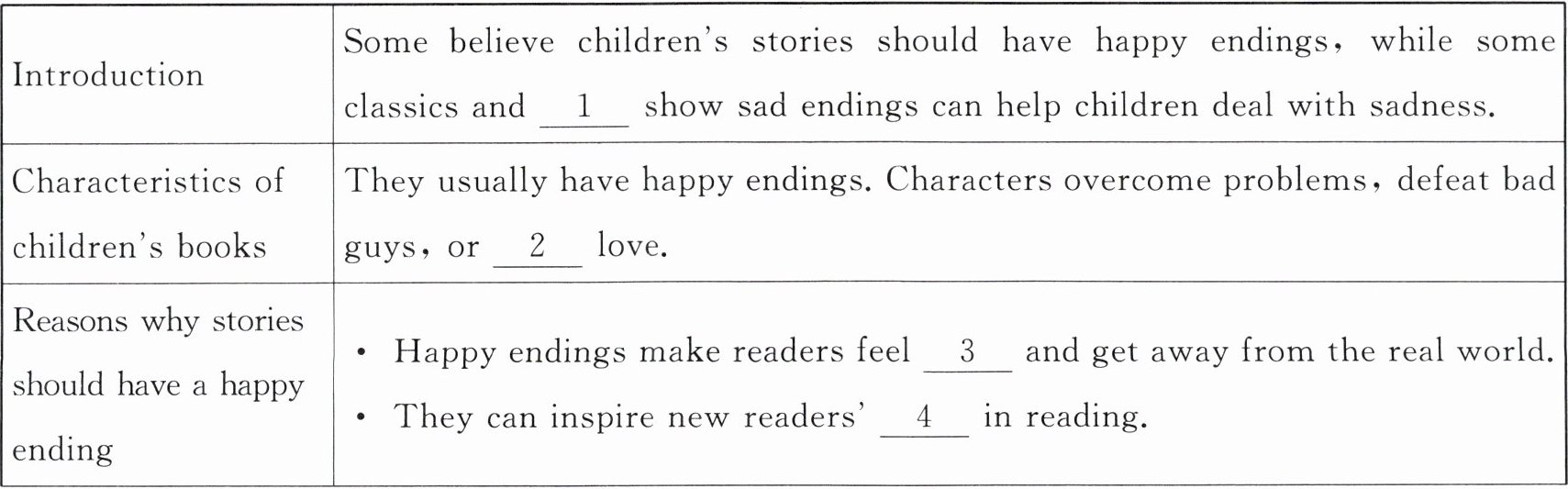
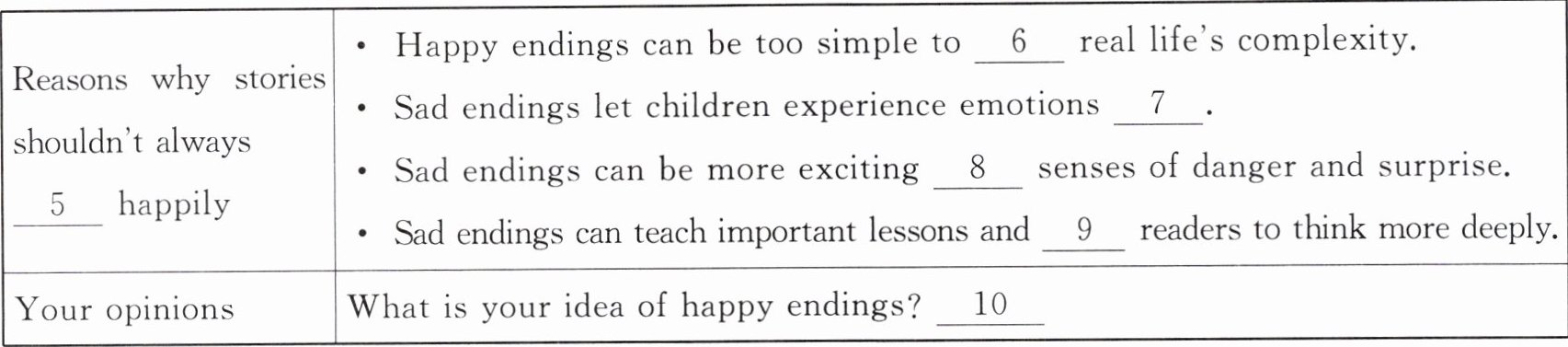
1.
2.
3.
4.
5.
6.
7.
8.
9.
10.
150
新素养·思维品质 Some believe children's stories should always have happy endings where good wins and characters find happiness. However, many classic tales, like Charles Perrault's 1697 version of Little Red Riding Hood, end sadly, with the main character eaten by the wolf. Similarly, writer Michael Morpurgo has faced criticism for his books' sad endings, but he argues children can deal with sadness.
World Book Day, celebrated on 23 April, encourages reading for fun, and a book's ending often adds to that joy. In children's books, endings are usually happy, with characters overcoming problems, defeating bad guys, or finding love. Yet, some say happy endings can be too simple, not showing the complexity(复杂性) of real life. For example, if a book tells a life story, it might make sense for the character to die at the end, even if it's sad.
Happy endings bring joy and a way to escape, which is why many people read. They offer a break from the real world, which can be sad and hard to understand. A sad ending might ruin the mood and discourage new readers. Positive early reading experiences can inspire(激励) a lifelong love of books. Also, a happy ending doesn't mean a story is boring or without challenges—it can still be exciting and interesting.
On the other hand, happy endings often make reality seem simpler than it is. Stories with sad endings let children experience emotions like sadness in a safe way, helping them deal with similar feelings in real life. Moreover, happy endings can be less exciting because there's no sense of danger or surprise if you know everything will turn out fine.
In conclusion, while happy endings bring comfort and joy, sad endings can teach important lessons and add emotional depth. Both types of endings have their place in children's literature, helping young readers understand both the good and hard parts of life.
1.
writers
2.
find
3.
joyful
4.
interest
5.
end
6.
show
7.
safely
8.
with
9.
encourage
10.
Happy endings bring comfort and joy.
150
答案
1. writers 根据第一段“Similarly, writer Michael Morpurgo has faced criticism for his books' sad endings, but he argues children can deal with sadness.”可知此处列举一位作家认为悲伤结局可以帮助孩子们处理悲伤;根据空前“some classics and”可知此处应用名词的复数形式。故填writers。
2. find 根据第二段“In children's books, endings are usually happy, with characters overcoming problems, defeating bad guys, or finding love.”可知儿童书籍结局通常是幸福的,角色克服问题、击败坏人或找到爱情。故填find。
3. joyful 根据第三段“Happy endings bring joy and a way to escape”可知快乐结局让读者感到快乐;感官动词“feel”后接形容词。故填joyful。
4. interest 根据第三段“Positive early reading experiences can inspire a lifelong love of books ... it can still be exciting and interesting.”可知快乐结局可以激发新读者的阅读兴趣。故填interest。
5. end 根据表格本行右侧的内容可知,此处介绍儿童故事为什么不应该总是快乐结局;情态动词 shouldn't 后接动词原形。故填end。
6. show 根据第二段“Yet, some say happy endings can be too simple, not showing the complexity of real life.”可知快乐结局可能太简单,无法展示生活的复杂性。故填show。
7. safely 根据第四段“Stories with sad endings let children experience emotions like sadness in a safe way”可知悲伤结局让孩子们以安全的方式体验情感;修饰空前动词“experience”,应用副词。故填safely。
8. with 根据第四段“Moreover, happy endings can be less exciting because there's no sense of danger or surprise if you know everything will turn out fine.”可知悲伤结局因为危险和惊喜的感觉而更令人兴奋;此处用 with 表示伴随。故填with。
9. encourage 根据最后一段“In conclusion, while happy endings bring comfort and joy, sad endings can teach important lessons and add emotional depth.”可知悲伤结局可以鼓励读者更深入地思考;encourage sb to do sth 表示“鼓励某人做某事”,情态动词 can 后接动词原形。故填encourage。
10. Happy endings bring comfort and joy.(答案不唯一,言之有理即可)
2. find 根据第二段“In children's books, endings are usually happy, with characters overcoming problems, defeating bad guys, or finding love.”可知儿童书籍结局通常是幸福的,角色克服问题、击败坏人或找到爱情。故填find。
3. joyful 根据第三段“Happy endings bring joy and a way to escape”可知快乐结局让读者感到快乐;感官动词“feel”后接形容词。故填joyful。
4. interest 根据第三段“Positive early reading experiences can inspire a lifelong love of books ... it can still be exciting and interesting.”可知快乐结局可以激发新读者的阅读兴趣。故填interest。
5. end 根据表格本行右侧的内容可知,此处介绍儿童故事为什么不应该总是快乐结局;情态动词 shouldn't 后接动词原形。故填end。
6. show 根据第二段“Yet, some say happy endings can be too simple, not showing the complexity of real life.”可知快乐结局可能太简单,无法展示生活的复杂性。故填show。
7. safely 根据第四段“Stories with sad endings let children experience emotions like sadness in a safe way”可知悲伤结局让孩子们以安全的方式体验情感;修饰空前动词“experience”,应用副词。故填safely。
8. with 根据第四段“Moreover, happy endings can be less exciting because there's no sense of danger or surprise if you know everything will turn out fine.”可知悲伤结局因为危险和惊喜的感觉而更令人兴奋;此处用 with 表示伴随。故填with。
9. encourage 根据最后一段“In conclusion, while happy endings bring comfort and joy, sad endings can teach important lessons and add emotional depth.”可知悲伤结局可以鼓励读者更深入地思考;encourage sb to do sth 表示“鼓励某人做某事”,情态动词 can 后接动词原形。故填encourage。
10. Happy endings bring comfort and joy.(答案不唯一,言之有理即可)
解析
【分析】
本题为关于儿童故事结局的阅读理解填空题,解题思路为:1. 通读全文把握核心观点(讨论儿童故事快乐结局与悲伤结局的利弊);2. 针对第1-9小题,先定位原文对应段落,再结合空格前后的语法要求(如名词单复数、动词形式、词性等),从原文提取符合的单词,确保每空1词;3. 第10小题结合最后一段观点,提炼不超过6个单词的内容。
【解析】
1. 定位第一段最后一句“Similarly, writer Michael Morpurgo has faced criticism for his books' sad endings, but he argues children can deal with sadness.”,空前“some classics and”需名词复数,故填writers;
2. 定位第二段“with characters overcoming problems, defeating bad guys, or finding love.”,对应or后动词原形,故填find;
3. 定位第三段“Happy endings bring joy and a way to escape”,感官动词feel后接形容词,joy的形容词为joyful,故填joyful;
4. 定位第三段“Positive early reading experiences can inspire a lifelong love of books ... it can still be exciting and interesting.”,此处指激发阅读兴趣,故填interest;
5. 结合表格本行内容,对应第二段“some say happy endings can be too simple”,情态动词shouldn't后接动词原形,故填end;
6. 定位第二段“not showing the complexity of real life”,情态动词can后接动词原形,故填show;
7. 定位第四段“in a safe way”,修饰动词experience用副词,safe的副词为safely,故填safely;
8. 定位第四段“no sense of danger or surprise if you know everything will turn out fine”,表伴随用介词with,故填with;
9. 定位最后一段“sad endings can teach important lessons and add emotional depth”,结合encourage sb to do sth结构,情态动词can后接动词原形,故填encourage;
10. 定位最后一段“while happy endings bring comfort and joy”,提炼符合要求的短语,故填Happy endings bring comfort and joy.
【答案】
1. writers 2. find 3. joyful 4. interest 5. end 6. show 7. safely 8. with 9. encourage 10. Happy endings bring comfort and joy.
【知识点】
阅读理解、词汇运用、词性辨析
【点评】
本题围绕儿童故事结局的话题展开,考察学生信息定位能力与语法运用能力,是典型的阅读填空题型,难度适中。
【难度系数】
0.6
本题为关于儿童故事结局的阅读理解填空题,解题思路为:1. 通读全文把握核心观点(讨论儿童故事快乐结局与悲伤结局的利弊);2. 针对第1-9小题,先定位原文对应段落,再结合空格前后的语法要求(如名词单复数、动词形式、词性等),从原文提取符合的单词,确保每空1词;3. 第10小题结合最后一段观点,提炼不超过6个单词的内容。
【解析】
1. 定位第一段最后一句“Similarly, writer Michael Morpurgo has faced criticism for his books' sad endings, but he argues children can deal with sadness.”,空前“some classics and”需名词复数,故填writers;
2. 定位第二段“with characters overcoming problems, defeating bad guys, or finding love.”,对应or后动词原形,故填find;
3. 定位第三段“Happy endings bring joy and a way to escape”,感官动词feel后接形容词,joy的形容词为joyful,故填joyful;
4. 定位第三段“Positive early reading experiences can inspire a lifelong love of books ... it can still be exciting and interesting.”,此处指激发阅读兴趣,故填interest;
5. 结合表格本行内容,对应第二段“some say happy endings can be too simple”,情态动词shouldn't后接动词原形,故填end;
6. 定位第二段“not showing the complexity of real life”,情态动词can后接动词原形,故填show;
7. 定位第四段“in a safe way”,修饰动词experience用副词,safe的副词为safely,故填safely;
8. 定位第四段“no sense of danger or surprise if you know everything will turn out fine”,表伴随用介词with,故填with;
9. 定位最后一段“sad endings can teach important lessons and add emotional depth”,结合encourage sb to do sth结构,情态动词can后接动词原形,故填encourage;
10. 定位最后一段“while happy endings bring comfort and joy”,提炼符合要求的短语,故填Happy endings bring comfort and joy.
【答案】
1. writers 2. find 3. joyful 4. interest 5. end 6. show 7. safely 8. with 9. encourage 10. Happy endings bring comfort and joy.
【知识点】
阅读理解、词汇运用、词性辨析
【点评】
本题围绕儿童故事结局的话题展开,考察学生信息定位能力与语法运用能力,是典型的阅读填空题型,难度适中。
【难度系数】
0.6
