

 登录
登录
1. 同学们,让我们先来复习一下一般过去时的用法吧!
I played basketball with my friends yesterday. 我昨天和我的朋友们打篮球了。
She was on holiday last week. 她上周在度假。
When I was a child, I often played football in the street.
当我是个孩子的时候,我经常在街上踢足球。
总结: 一般过去时表示① 某一特定时间发生的动作或状态,常和表示过去的② 状语连用,如yesterday, last week, last night等;也可以表示过去一段时间内经常反复发生的动作、行为,常与always, usually, often等③ 副词连用。
【即学即练】用所给词的适当形式填空。
Last weekend, I had a busy but happy time. On Saturday morning, I (1) (get) up early and went to the park with my family. We (2) (ride) our bikes there. It was a sunny day, and we (3) (see) many people flying kites. In the afternoon, I (4) (help) my mom cook dinner. We made noodles and fruit salad. They were delicious!
I played basketball with my friends yesterday. 我昨天和我的朋友们打篮球了。
She was on holiday last week. 她上周在度假。
When I was a child, I often played football in the street.
当我是个孩子的时候,我经常在街上踢足球。
总结: 一般过去时表示① 某一特定时间发生的动作或状态,常和表示过去的② 状语连用,如yesterday, last week, last night等;也可以表示过去一段时间内经常反复发生的动作、行为,常与always, usually, often等③ 副词连用。
【即学即练】用所给词的适当形式填空。
Last weekend, I had a busy but happy time. On Saturday morning, I (1) (get) up early and went to the park with my family. We (2) (ride) our bikes there. It was a sunny day, and we (3) (see) many people flying kites. In the afternoon, I (4) (help) my mom cook dinner. We made noodles and fruit salad. They were delicious!
答案
① 过去 ② 时间 ③ 频度
(1) got (2) rode (3) saw (4) helped
(1) got (2) rode (3) saw (4) helped
解析
【分析】
首先需明确一般过去时的核心用法:它用于描述过去特定时间发生的动作或状态,常搭配过去时间状语;也可表示过去反复发生的动作,搭配频度副词。解题时,总结部分需结合例句对应规则填写,即学即练部分需根据句中过去时间状语,将括号内动词变为过去式。
【解析】
1. 总结部分:
① 一般过去时表示过去某一特定时间发生的动作或状态,对应例句中yesterday、last week等过去时间;
② 常和表示过去的时间状语连用,如yesterday、last night等;
③ 也可表示过去经常反复的动作,与always、often等频度副词连用。
2. 即学即练部分:
所有句子均有明确过去时间状语(如Last weekend、On Saturday morning等),动词需用过去式:
(1) get的过去式为got;
(2) ride的过去式为rode;
(3) see的过去式为saw;
(4) help的过去式为helped。
【答案】
① 过去 ② 时间 ③ 频度;(1) got (2) rode (3) saw (4) helped
【知识点】
一般过去时的用法,动词过去式,频度副词
【点评】
本题先梳理一般过去时的核心规则,再通过填空练习巩固动词过去式的运用,是初中英语基础语法的典型考查题,帮助学生夯实时态知识点。
【难度系数】
0.3
首先需明确一般过去时的核心用法:它用于描述过去特定时间发生的动作或状态,常搭配过去时间状语;也可表示过去反复发生的动作,搭配频度副词。解题时,总结部分需结合例句对应规则填写,即学即练部分需根据句中过去时间状语,将括号内动词变为过去式。
【解析】
1. 总结部分:
① 一般过去时表示过去某一特定时间发生的动作或状态,对应例句中yesterday、last week等过去时间;
② 常和表示过去的时间状语连用,如yesterday、last night等;
③ 也可表示过去经常反复的动作,与always、often等频度副词连用。
2. 即学即练部分:
所有句子均有明确过去时间状语(如Last weekend、On Saturday morning等),动词需用过去式:
(1) get的过去式为got;
(2) ride的过去式为rode;
(3) see的过去式为saw;
(4) help的过去式为helped。
【答案】
① 过去 ② 时间 ③ 频度;(1) got (2) rode (3) saw (4) helped
【知识点】
一般过去时的用法,动词过去式,频度副词
【点评】
本题先梳理一般过去时的核心规则,再通过填空练习巩固动词过去式的运用,是初中英语基础语法的典型考查题,帮助学生夯实时态知识点。
【难度系数】
0.3
2. 你知道复合不定代词是什么吗?
首先,让我们先来了解什么是复合不定代词以及常见的复合不定代词有哪些:
由some, any, no, every分别与one, body, thing组合而成的不定代词叫作复合不定代词。
常见的复合不定代词有someone, somebody, something, anyone, anybody, anything, no one, nobody, nothing, everyone, everybody, everything。
接下来我们通过例子试着归纳它们的用法:
Someone is knocking at the door. 有人在敲门。
Everyone likes beautiful things. 每个人都喜欢美好的事物。
I want to tell you something important. 我想告诉你一些重要的事。
I need something to eat. 我需要吃点东西。(用于肯定句)
Is there anyone in the room? 房间里有人吗?(用于疑问句)
I don’t have anything to do. 我没有任何事可做。(用于否定句)
Would you like something to drink? 你想要些喝的东西吗?
总结:
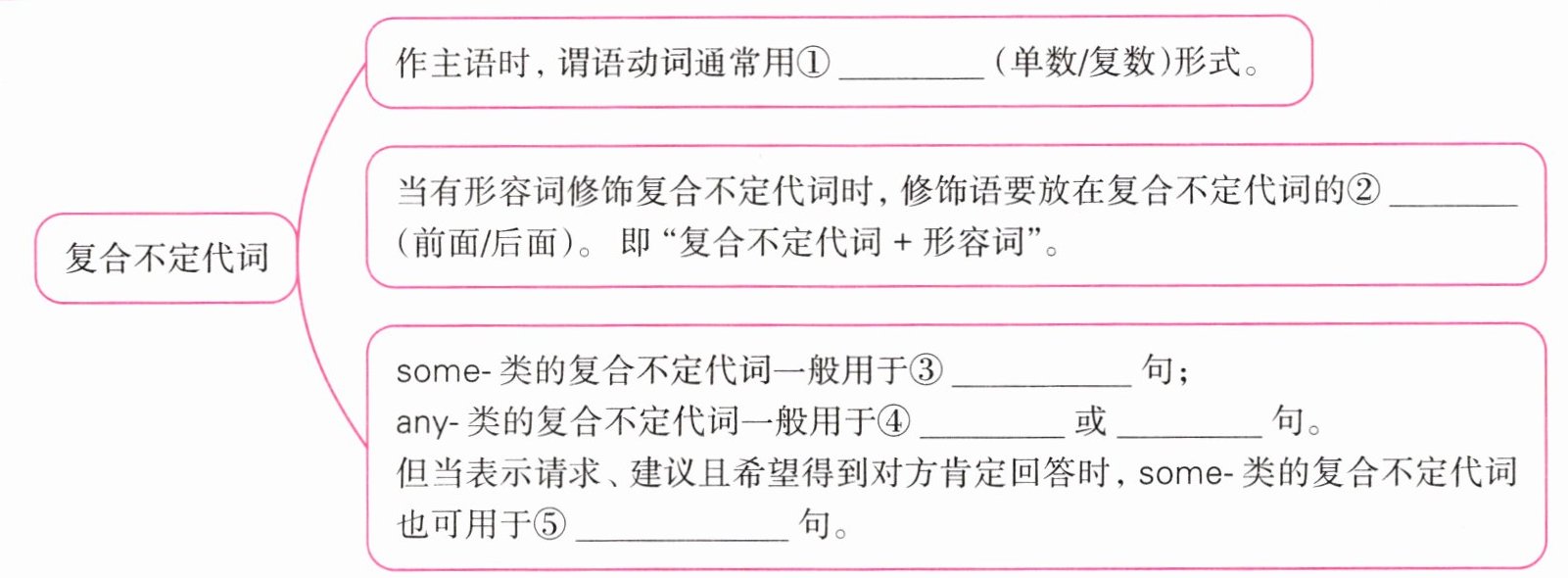
【即学即练】在下文空白处填入适当的复合不定代词。
Last summer, I went on a vacation to the countryside with my family. (1) thought it was really a great trip. When we arrived there, we didn’t know (2). But the friendly owner of the farmhouse welcomed us warmly at the gate. He showed us around the house and the farm. However, there was (3) special in the house. It was just an ordinary place. Then we went to the farm. I saw (4) interesting there. Some animals were running around freely. In the evening, we had a big dinner. The food was delicious. I ate (5) delicious and felt really full. After dinner, we sat outside and chatted happily. It was a wonderful vacation.
首先,让我们先来了解什么是复合不定代词以及常见的复合不定代词有哪些:
由some, any, no, every分别与one, body, thing组合而成的不定代词叫作复合不定代词。
常见的复合不定代词有someone, somebody, something, anyone, anybody, anything, no one, nobody, nothing, everyone, everybody, everything。
接下来我们通过例子试着归纳它们的用法:
Someone is knocking at the door. 有人在敲门。
Everyone likes beautiful things. 每个人都喜欢美好的事物。
I want to tell you something important. 我想告诉你一些重要的事。
I need something to eat. 我需要吃点东西。(用于肯定句)
Is there anyone in the room? 房间里有人吗?(用于疑问句)
I don’t have anything to do. 我没有任何事可做。(用于否定句)
Would you like something to drink? 你想要些喝的东西吗?
总结:
【即学即练】在下文空白处填入适当的复合不定代词。
Last summer, I went on a vacation to the countryside with my family. (1) thought it was really a great trip. When we arrived there, we didn’t know (2). But the friendly owner of the farmhouse welcomed us warmly at the gate. He showed us around the house and the farm. However, there was (3) special in the house. It was just an ordinary place. Then we went to the farm. I saw (4) interesting there. Some animals were running around freely. In the evening, we had a big dinner. The food was delicious. I ate (5) delicious and felt really full. After dinner, we sat outside and chatted happily. It was a wonderful vacation.
答案
总结部分:①单数 ②后面 ③肯定 ④疑问句;否定句 ⑤疑问句
即学即练:(1) Everyone/Everybody (2) anyone/anybody (3) nothing (4) something (5) everything
即学即练:(1) Everyone/Everybody (2) anyone/anybody (3) nothing (4) something (5) everything
解析
【分析】
本题考查复合不定代词的核心用法,需从主谓一致、修饰语位置、some/any类复合不定代词的句式用法三个维度掌握规则,再结合例句和语境推导答案。首先明确复合不定代词作主语时谓语用单数;形容词修饰复合不定代词需后置;some类多用于肯定句,any类多用于疑问句和否定句,表请求建议且希望肯定回答时some类可用于疑问句;最后结合即学即练的语境,匹配合适的复合不定代词。
【解析】
总结部分解析:
① 复合不定代词(如someone、everyone等)作主语时,谓语动词通常用单数形式,例句“Someone is knocking at the door”中is为单数谓语,故填单数。
② 形容词修饰复合不定代词时,修饰语需放在复合不定代词之后,如“something important”,故填后面。
③ some-类复合不定代词一般用于肯定句,例句“I need something to eat”为肯定句,故填肯定。
④ any-类复合不定代词一般用于疑问句(如“Is there anyone in the room?”)或否定句(如“I don’t have anything to do”),故填疑问句、否定句。
⑤ 当表示请求、建议且希望得到对方肯定回答时,some-类复合不定代词可用于疑问句,例句“Would you like something to drink?”符合,故填疑问句。
即学即练解析:
(1) 句意为“每个人都觉得这是很棒的旅行”,表示“每个人”,故填Everyone/Everybody。
(2) 句意为“我们不认识任何人”,否定句中用any-类,故填anyone/anybody。
(3) 句意为“房子里没有特别的东西”,表示“没有什么”,故填nothing。
(4) 句意为“我看到一些有趣的东西”,肯定句中用some-类,故填something。
(5) 句意为“我吃了所有美味的东西”,表示“一切”,故填everything。
【答案】
总结部分:①单数 ②后面 ③肯定 ④疑问句;否定句 ⑤疑问句
即学即练:(1) Everyone/Everybody (2) anyone/anybody (3) nothing (4) something (5) everything
【知识点】
复合不定代词用法;主谓一致;形容词后置
【点评】
本题围绕复合不定代词的基础用法展开,涵盖核心规则与实际运用,是初中英语代词部分的重点内容,需准确记忆规则并结合语境灵活运用。
【难度系数】
0.6
本题考查复合不定代词的核心用法,需从主谓一致、修饰语位置、some/any类复合不定代词的句式用法三个维度掌握规则,再结合例句和语境推导答案。首先明确复合不定代词作主语时谓语用单数;形容词修饰复合不定代词需后置;some类多用于肯定句,any类多用于疑问句和否定句,表请求建议且希望肯定回答时some类可用于疑问句;最后结合即学即练的语境,匹配合适的复合不定代词。
【解析】
总结部分解析:
① 复合不定代词(如someone、everyone等)作主语时,谓语动词通常用单数形式,例句“Someone is knocking at the door”中is为单数谓语,故填单数。
② 形容词修饰复合不定代词时,修饰语需放在复合不定代词之后,如“something important”,故填后面。
③ some-类复合不定代词一般用于肯定句,例句“I need something to eat”为肯定句,故填肯定。
④ any-类复合不定代词一般用于疑问句(如“Is there anyone in the room?”)或否定句(如“I don’t have anything to do”),故填疑问句、否定句。
⑤ 当表示请求、建议且希望得到对方肯定回答时,some-类复合不定代词可用于疑问句,例句“Would you like something to drink?”符合,故填疑问句。
即学即练解析:
(1) 句意为“每个人都觉得这是很棒的旅行”,表示“每个人”,故填Everyone/Everybody。
(2) 句意为“我们不认识任何人”,否定句中用any-类,故填anyone/anybody。
(3) 句意为“房子里没有特别的东西”,表示“没有什么”,故填nothing。
(4) 句意为“我看到一些有趣的东西”,肯定句中用some-类,故填something。
(5) 句意为“我吃了所有美味的东西”,表示“一切”,故填everything。
【答案】
总结部分:①单数 ②后面 ③肯定 ④疑问句;否定句 ⑤疑问句
即学即练:(1) Everyone/Everybody (2) anyone/anybody (3) nothing (4) something (5) everything
【知识点】
复合不定代词用法;主谓一致;形容词后置
【点评】
本题围绕复合不定代词的基础用法展开,涵盖核心规则与实际运用,是初中英语代词部分的重点内容,需准确记忆规则并结合语境灵活运用。
【难度系数】
0.6
