

 登录
登录
() 1. —Try this soup, and you like it.
—Wow! This is delicious.
A.must
B.will
C.shall
D.can
—Wow! This is delicious.
A.must
B.will
C.shall
D.can
答案
B
解析
本题考查"祈使句+and+陈述句"的固定结构,该结构中后续分句常用will引出顺承的预期结果,意为"将会"。A选项must表必须或肯定推测,不符合语境;C选项shall通常搭配第一人称主语,本句主语是you,用法不符;D选项can表能够,语义不通。此处表示尝过汤之后你就会喜欢它,用will符合规则和句意。
() 2. I a party next Saturday. I hope you can come.
you can come.
A.had
B.was having
C.have had
D.will have
you can come.
A.had
B.was having
C.have had
D.will have
答案
D
解析
句中时间状语"next Saturday"表示将来的时间,句子需使用一般将来时。选项A为一般过去时,B为过去进行时,C为现在完成时,均不符合时态要求,只有D选项的will have是一般将来时结构,匹配语境。
() 3. The weather report says it tomorrow.
A.will rain
B.rains
C.rained
D.is raining
A.will rain
B.rains
C.rained
D.is raining
答案
A
解析
本题考查一般将来时的用法,句中时间状语tomorrow表示动作发生在将来,谓语需用一般将来时“will+动词原形”的结构。选项B为一般现在时,C为一般过去时,D为现在进行时,均不符合语境,因此选A。
() 4. The winter holiday is coming. David and his sister it in Sanya.
A.spends
B.spend
C.is going to spend
D.are going to spend
A.spends
B.spend
C.is going to spend
D.are going to spend
答案
D
解析
由前句“寒假即将到来”可知,此处描述的是未来的计划,需用一般将来时,排除表一般现在时的A、B选项;主语David and his sister是复数,be going to结构中的be动词要用are,因此确定答案。
() 5. I ice skating this Sunday. Do you want to come?
A.go
B.went
C.was going
D.will go
A.go
B.went
C.was going
D.will go
答案
D
解析
句中时间状语this Sunday表示将来的时间,句子需用一般将来时。选项A是一般现在时,B是一般过去时,C是过去进行时,只有D的will go是一般将来时的正确结构,符合语境。
() 6. After the exam, you a wonderful holiday next month. Take it easy!
A.have
B.have had
C.had
D.will have
A.have
B.have had
C.had
D.will have
答案
D
解析
本题考查一般将来时的用法,句中时间标志词next month表示动作发生在将来,需使用一般将来时“will+动词原形”的结构,因此选will have。
() 7. —AI is developing fast. I'm wondering .
—I think it'll replace many jobs.
A.how will AI change our lives
B.how AI will change our lives
C.how did AI change our lives
D.how AI changed our lives
—I think it'll replace many jobs.
A.how will AI change our lives
B.how AI will change our lives
C.how did AI change our lives
D.how AI changed our lives
答案
B
解析
本题考查宾语从句的用法:1. 宾语从句必须使用陈述语序,据此可排除疑问语序的A、C选项;2. 答语用一般将来时描述AI未来的影响,可知空格处从句表达的是将来的动作,需用一般将来时,排除时态为一般过去时的D选项,最终确定答案为B。
Ⅱ.根据句意,用括号中所给词的适当形式
填空
1. I think we a more beautiful
world in the future. (have)
2. Emma fourteen years old next
month. (be)
3. They a new road in this part of
the city next year. (build)
4. His father to that factory next
week. He will work at home on the computer.
(not go)
5. There a talk on science in our
school tomorrow afternoon. (be)
填空
1. I think we a more beautiful
world in the future. (have)
2. Emma fourteen years old next
month. (be)
3. They a new road in this part of
the city next year. (build)
4. His father to that factory next
week. He will work at home on the computer.
(not go)
5. There a talk on science in our
school tomorrow afternoon. (be)
答案
1. will have
2. will be
3. will build
4. won't go(或will not go)
5. will be
2. will be
3. will build
4. won't go(或will not go)
5. will be
解析
这几道题均考查一般将来时的用法,题干中出现的in the future、next month、next year、next week、tomorrow afternoon都是表示将来的时间状语,一般将来时的基本结构为"will + 动词原形",否定形式为"will not/won't + 动词原形",there be句型的将来时结构为"there will be"。
1. 由时间状语in the future可知动作发生在将来,所以填will have;
2. 由时间状语next month可知描述的是未来的状态,所以填will be;
3. 由时间状语next year可知动作是未来要发生的,所以填will build;
4. 由时间状语next week和后句语境可知此处要表达将来的否定动作,所以填won't go / will not go;
5. 这是there be句型,时间状语tomorrow afternoon表将来,所以填will be。
1. 由时间状语in the future可知动作发生在将来,所以填will have;
2. 由时间状语next month可知描述的是未来的状态,所以填will be;
3. 由时间状语next year可知动作是未来要发生的,所以填will build;
4. 由时间状语next week和后句语境可知此处要表达将来的否定动作,所以填won't go / will not go;
5. 这是there be句型,时间状语tomorrow afternoon表将来,所以填will be。
续表
| 用法 | 人称 | 例句 |
| --- | --- | --- |
| 在陈述句中表示说话者的允诺、告诫、规定、命令等 | 主要用于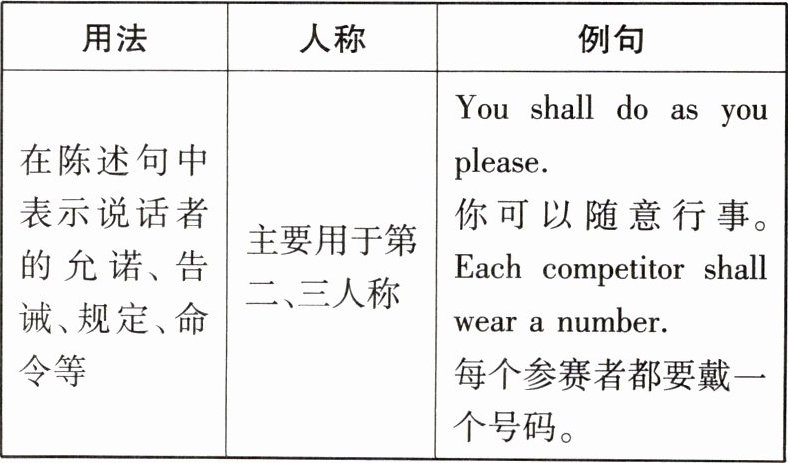 第二、三人称 | You shall do as you please. 你可以随意行事。Each competitor shall wear a number. 每个参赛者都要戴一个号码。 |
情境应用
1. I wonder where we shall a party
tonight. (have)
2. Shall take a bus? (us)
| 用法 | 人称 | 例句 |
| --- | --- | --- |
| 在陈述句中表示说话者的允诺、告诫、规定、命令等 | 主要用于
第二、三人称 | You shall do as you please. 你可以随意行事。Each competitor shall wear a number. 每个参赛者都要戴一个号码。 |情境应用
1. I wonder where we shall a party
tonight. (have)
2. Shall take a bus? (us)
答案
1. have 2. we
解析
1. 情态动词shall的后面必须接动词原形,括号所给的动词have直接使用原形即可,have a party是固定搭配,含义为“举办派对”。
2. 情态动词shall之后需要填入人称代词作句子的主语,括号给出的us是人称代词宾格,要转换为对应的主格形式we,Shall we...是八年级阶段常见的用于提出建议的固定句型。
2. 情态动词shall之后需要填入人称代词作句子的主语,括号给出的us是人称代词宾格,要转换为对应的主格形式we,Shall we...是八年级阶段常见的用于提出建议的固定句型。
