

 登录
登录
思维导图
Learning strategies
What does it take to explore space?
Why do we explore space?
How far can we go into space?
Make a poster about China’s space programme
Reading Plus
Vocabulary
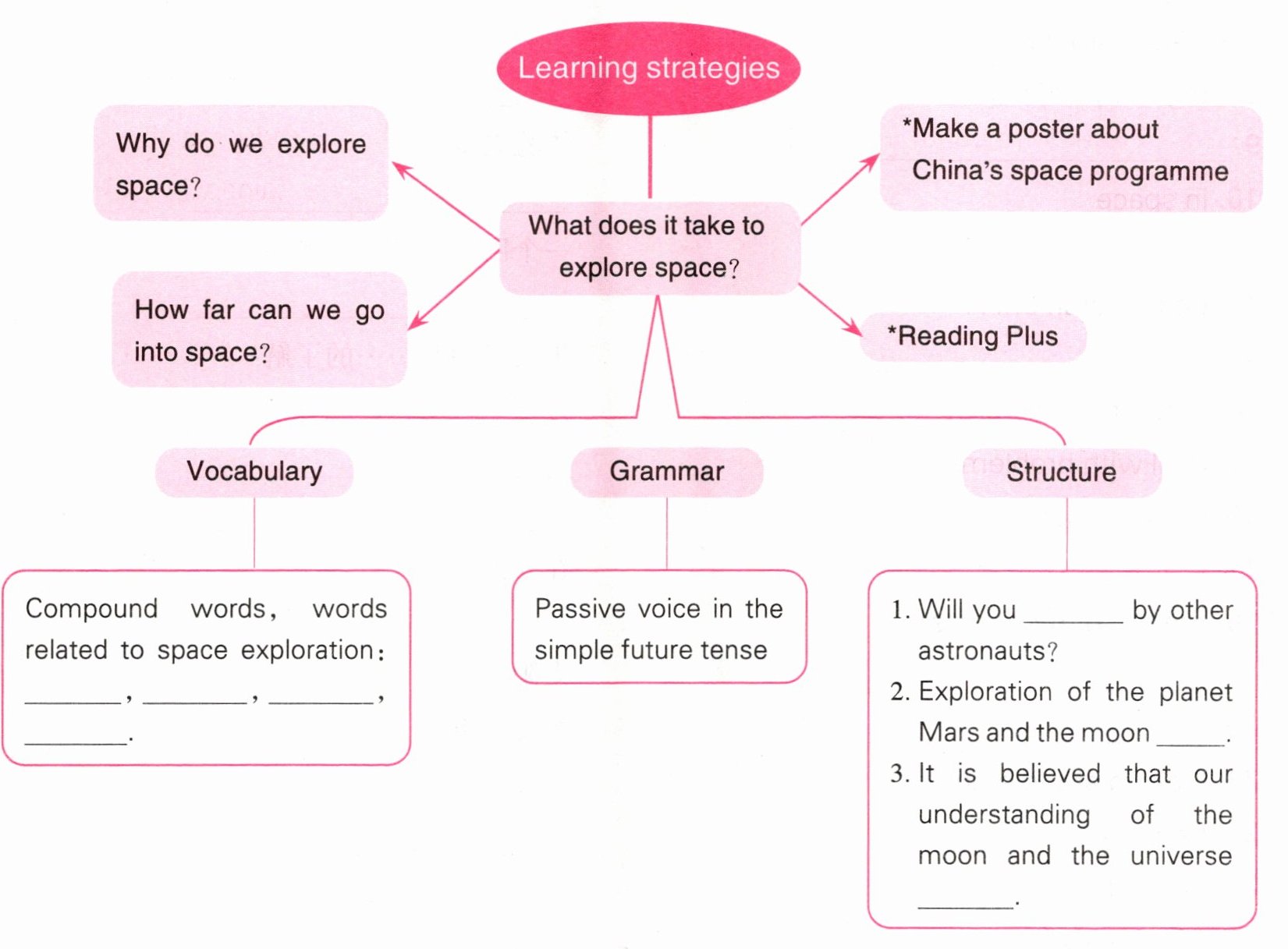
Structure
Compound words, words related to space exploration:
Passive voice in the simple future tense
1. Will you
2. Exploration of the planet Mars and the moon
3. It is believed that our understanding of the moon and the universe
Learning strategies
What does it take to explore space?
Why do we explore space?
How far can we go into space?
Make a poster about China’s space programme
Reading Plus
Vocabulary
Structure
Compound words, words related to space exploration:
manned
, launch
, movement
, exoplanet
.Passive voice in the simple future tense
1. Will you
be visited
by other astronauts?2. Exploration of the planet Mars and the moon
will be continued
.3. It is believed that our understanding of the moon and the universe
will be greatly improved
.答案
1. manned, launch, movement, exoplanet
2. be visited
3. will be continued
4. will be greatly improved
2. be visited
3. will be continued
4. will be greatly improved
解析
【分析】
本题分为两部分:一是填写与太空探索相关的词汇,二是运用一般将来时的被动语态完成句子。解题时,先回忆太空探索领域的常用词汇,结合语境匹配合适的词;再分析句子主语与动作的关系,判断使用被动语态,根据一般将来时被动语态的结构“will be + 过去分词”,结合句子主语和语境确定具体形式。
【解析】
1. 词汇部分:需填写与太空探索相关的词汇,manned(载人的)、launch(发射)、movement(太空运动相关)、exoplanet(系外行星)均符合太空探索主题的词汇要求。
2. 语法部分(一般将来时被动语态):
第1题:主语you是动作的承受者,句子为一般将来时被动疑问句,结构为“will + 主语 + be + 过去分词”,故填be visited。
第2题:主语是火星和月球的探索,是动作的承受者,需用一般将来时被动,故填will be continued。
第3题:主语是对月球和宇宙的理解,是动作的承受者,需用一般将来时被动,故填will be greatly improved。
【答案】
1. manned, launch, movement, exoplanet
2. be visited
3. will be continued
4. will be greatly improved
【知识点】
太空相关词汇、一般将来时被动语态
【点评】
本题结合思维导图学习策略,兼顾太空探索词汇积累与一般将来时被动语态的运用,是基础知识点的综合练习,适合巩固相关内容。
【难度系数】
0.5
本题分为两部分:一是填写与太空探索相关的词汇,二是运用一般将来时的被动语态完成句子。解题时,先回忆太空探索领域的常用词汇,结合语境匹配合适的词;再分析句子主语与动作的关系,判断使用被动语态,根据一般将来时被动语态的结构“will be + 过去分词”,结合句子主语和语境确定具体形式。
【解析】
1. 词汇部分:需填写与太空探索相关的词汇,manned(载人的)、launch(发射)、movement(太空运动相关)、exoplanet(系外行星)均符合太空探索主题的词汇要求。
2. 语法部分(一般将来时被动语态):
第1题:主语you是动作的承受者,句子为一般将来时被动疑问句,结构为“will + 主语 + be + 过去分词”,故填be visited。
第2题:主语是火星和月球的探索,是动作的承受者,需用一般将来时被动,故填will be continued。
第3题:主语是对月球和宇宙的理解,是动作的承受者,需用一般将来时被动,故填will be greatly improved。
【答案】
1. manned, launch, movement, exoplanet
2. be visited
3. will be continued
4. will be greatly improved
【知识点】
太空相关词汇、一般将来时被动语态
【点评】
本题结合思维导图学习策略,兼顾太空探索词汇积累与一般将来时被动语态的运用,是基础知识点的综合练习,适合巩固相关内容。
【难度系数】
0.5
