

 登录
登录
Ⅰ. Complete the passage with the proper form of the words and expressions in the box.
dry fever hit mirror interested
technology with the help of take pride in
Traditional stories and festivals 1.
Many students thought history was just 2.
As Chinese teenagers, we 8.
dry fever hit mirror interested
technology with the help of take pride in
Traditional stories and festivals 1.
mirror
our past and carry values that have been passed down for thousands of years.Many students thought history was just 2.
dry
, hard-to-remember facts. But now teachers often teach history in a lively way. New 3. technology
has brought new life to history. So students become 4. more interested
and can understand the culture behind it more easily. 5. With the help of
new technology, old pictures and traditional designs are a big 6. hit
on the internet. Creative products with its rich cultural background start a 7. fever
among people of all ages.As Chinese teenagers, we 8.
take pride in
our great history.答案
1. mirror 2. dry 3. technology 4. more interested 5. With the help of
6. hit 7. fever 8. take pride in
6. hit 7. fever 8. take pride in
解析
【分析】
本题为选词填空题,需先理解方框内词汇的词义、词性及用法,再结合上下文语境判断每个空缺处所需词汇的正确形式。首先通读全文把握大意:传统故事与节日反映过去,新技术让历史教学更生动,学生对历史更感兴趣,借助新技术传统文化在网上走红,青少年为祖国历史自豪。随后逐句分析语境,匹配对应词汇并调整形式(如比较级、固定短语等)。
【解析】
1. 主语为复数名词,需动词作谓语,mirror作动词意为“反映”,符合语境,填mirror;
2. 修饰名词facts需形容词,dry意为“枯燥的”,符合“难记的事实”的描述,填dry;
3. New修饰名词,technology意为“技术”,对应“新技术给历史带来新生”,填technology;
4. 结合语境学生“更感兴趣”,需形容词比较级,interested的比较级为more interested,填more interested;
5. 固定短语“With the help of”意为“借助”,句首大写,填With the help of;
6. a后需名词,hit作名词意为“热门事物”,对应“网上很火”,填hit;
7. a后需名词,fever意为“热潮”,对应“引发各年龄段的热潮”,填fever;
8. 固定短语“take pride in”意为“为…自豪”,主语为we,用原形,填take pride in。
【答案】
1. mirror 2. dry 3. technology 4. more interested 5. With the help of 6. hit 7. fever 8. take pride in
【知识点】
选词填空、固定搭配、形容词比较级
【点评】
本题考查词汇在语境中的灵活运用,需学生掌握方框内词汇的词义及固定短语,结合上下文逻辑判断合适的词形,难度适中,注重语境理解能力。
【难度系数】
0.5
本题为选词填空题,需先理解方框内词汇的词义、词性及用法,再结合上下文语境判断每个空缺处所需词汇的正确形式。首先通读全文把握大意:传统故事与节日反映过去,新技术让历史教学更生动,学生对历史更感兴趣,借助新技术传统文化在网上走红,青少年为祖国历史自豪。随后逐句分析语境,匹配对应词汇并调整形式(如比较级、固定短语等)。
【解析】
1. 主语为复数名词,需动词作谓语,mirror作动词意为“反映”,符合语境,填mirror;
2. 修饰名词facts需形容词,dry意为“枯燥的”,符合“难记的事实”的描述,填dry;
3. New修饰名词,technology意为“技术”,对应“新技术给历史带来新生”,填technology;
4. 结合语境学生“更感兴趣”,需形容词比较级,interested的比较级为more interested,填more interested;
5. 固定短语“With the help of”意为“借助”,句首大写,填With the help of;
6. a后需名词,hit作名词意为“热门事物”,对应“网上很火”,填hit;
7. a后需名词,fever意为“热潮”,对应“引发各年龄段的热潮”,填fever;
8. 固定短语“take pride in”意为“为…自豪”,主语为we,用原形,填take pride in。
【答案】
1. mirror 2. dry 3. technology 4. more interested 5. With the help of 6. hit 7. fever 8. take pride in
【知识点】
选词填空、固定搭配、形容词比较级
【点评】
本题考查词汇在语境中的灵活运用,需学生掌握方框内词汇的词义及固定短语,结合上下文逻辑判断合适的词形,难度适中,注重语境理解能力。
【难度系数】
0.5
Ⅱ. Read and complete the tasks.
Recently, a new documentary(纪录片) called Museums in the Textbook has made textbook knowledge more lively. Produced by China Media Group, it started to air on CCTV-10 on 25 February. Unlike traditional textbooks that only have words and pictures, it helps knowledge step off the page and into real life.
Each part of the documentary starts with a lesson from Chinese, history, music, or art textbooks. A special team, including teachers, museum experts and culture lovers, visits many famous museums. Their main job is to help students connect what they learn from textbooks with real cultural relics (文物) in museums.
Bu Yalin, the director of the documentary, said that textbooks mention many cultural relics, but it is impossible to find all of them in one museum. The team does not simply match textbook pictures with real objects. Instead, they study each lesson carefully and focus on something that interests students but is not fully explained in textbooks. Then they dig deep into these key ideas and
connect them to real relics. For example, one part of the documentary starts with the article A Happy Excursion (《逍遥游》) from a middle school Chinese textbook. It connects the magical fish kun and bird peng in the article with dinosaurs in the Natural History Museum of China. The team tries to find answers to questions like “Were there huge sea dinosaurs?” and “Could fish turn into birds?”. Finally, they find many special animals may come from ancient people’s imagination.
The programme provides a new way of thinking for young people. It tells them that textbooks are not boring—instead, they are like maps that guide people to explore the wonderful world around them.
A. Complete the notes. No more than 4 words for each blank.
A new documentary—Museums in the Textbook
| What it is | It helps knowledge 1.
| How it works | ☆ Each one starts with a lesson from different 2.
☆ A team visits many famous museums to help 3.
☆ The team 4.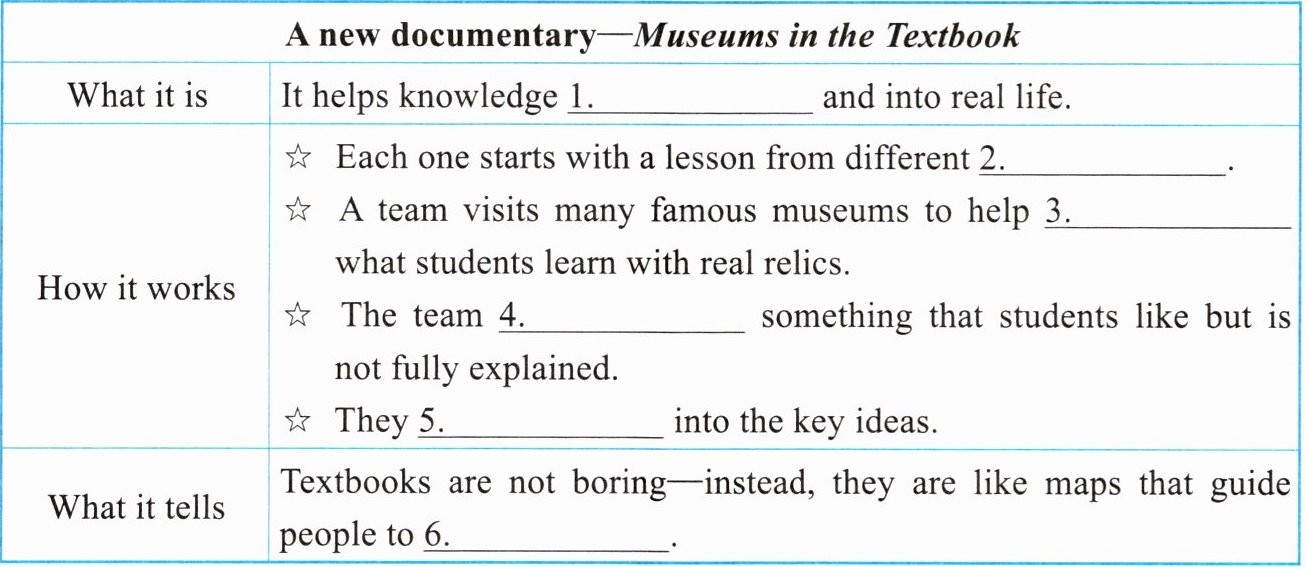 something that students like but is not fully explained.
☆ They 5.
| What it tells | Textbooks are not boring—instead, they are like maps that guide people to 6.
B. Answer the questions.
(
A. By giving an example.
B. By telling a funny story.
C. By introducing a famous person.
D. By comparing two different things.
(
A. To explain the history of cultural relics.
B. To tell readers how to make a documentary.
C. To encourage students to collect cultural relics.
D. To introduce a way to make textbook knowledge lively.
3. Will you watch the documentary Museums in the Textbook? Why or why not?
(No more than 15 words)
Recently, a new documentary(纪录片) called Museums in the Textbook has made textbook knowledge more lively. Produced by China Media Group, it started to air on CCTV-10 on 25 February. Unlike traditional textbooks that only have words and pictures, it helps knowledge step off the page and into real life.
Each part of the documentary starts with a lesson from Chinese, history, music, or art textbooks. A special team, including teachers, museum experts and culture lovers, visits many famous museums. Their main job is to help students connect what they learn from textbooks with real cultural relics (文物) in museums.
Bu Yalin, the director of the documentary, said that textbooks mention many cultural relics, but it is impossible to find all of them in one museum. The team does not simply match textbook pictures with real objects. Instead, they study each lesson carefully and focus on something that interests students but is not fully explained in textbooks. Then they dig deep into these key ideas and
connect them to real relics. For example, one part of the documentary starts with the article A Happy Excursion (《逍遥游》) from a middle school Chinese textbook. It connects the magical fish kun and bird peng in the article with dinosaurs in the Natural History Museum of China. The team tries to find answers to questions like “Were there huge sea dinosaurs?” and “Could fish turn into birds?”. Finally, they find many special animals may come from ancient people’s imagination.
The programme provides a new way of thinking for young people. It tells them that textbooks are not boring—instead, they are like maps that guide people to explore the wonderful world around them.
A. Complete the notes. No more than 4 words for each blank.
A new documentary—Museums in the Textbook
| What it is | It helps knowledge 1.
(to) step off the page
and into real life. || How it works | ☆ Each one starts with a lesson from different 2.
textbooks
.☆ A team visits many famous museums to help 3.
(to) connect
what students learn with real relics.☆ The team 4.
focuses on
something that students like but is not fully explained.☆ They 5.
dig deep
into the key ideas. || What it tells | Textbooks are not boring—instead, they are like maps that guide people to 6.
explore the world
. |B. Answer the questions.
(
A
)1. How does the writer explain the team’s work in Paragraph 3?A. By giving an example.
B. By telling a funny story.
C. By introducing a famous person.
D. By comparing two different things.
(
D
)2. What is the purpose of the passage?A. To explain the history of cultural relics.
B. To tell readers how to make a documentary.
C. To encourage students to collect cultural relics.
D. To introduce a way to make textbook knowledge lively.
3. Will you watch the documentary Museums in the Textbook? Why or why not?
(No more than 15 words)
Yes, I will. It can guide me to explore the past deeply.
/ No, I won’t. I prefer learning by reading books.
答案
A. 1. (to) step off the page 2. textbooks 3. (to) connect 4. focuses on
5. dig deep 6. explore the world
B. 1. A 2. D
3. Possible versions: Yes, I will. It can guide me to explore the past deeply. / No, I won’t. I prefer learning by reading books.
5. dig deep 6. explore the world
B. 1. A 2. D
3. Possible versions: Yes, I will. It can guide me to explore the past deeply. / No, I won’t. I prefer learning by reading books.
解析
【分析】
本题是关于纪录片《课本里的博物馆》的阅读理解题,分为信息填空、选择题和开放性问答。解题思路:先通读全文把握文章主旨,再针对A部分的填空,根据空格前后关键词在原文定位对应语句,提取匹配内容(注意字数限制);B部分选择题需回到原文找依据,开放性问答结合文章主旨合理作答(注意字数要求)。
【解析】
A. 1. 定位原文第一段最后一句“it helps knowledge step off the page and into real life”,故填(to) step off the page;
2. 定位原文第二段第一句“Each part of the documentary starts with a lesson from Chinese, history, music, or art textbooks”,故填textbooks;
3. 定位原文第二段最后一句“help students connect what they learn from textbooks with real cultural relics”,故填(to) connect;
4. 定位原文第三段“focus on something that interests students but is not fully explained in textbooks”,故填focuses on;
5. 定位原文第三段“Then they dig deep into these key ideas”,故填dig deep;
6. 定位原文最后一段“guide people to explore the wonderful world around them”,故填explore the world;
B. 1. 第三段以《逍遥游》为例说明团队工作,故选A;
2. 文章主要介绍让课本知识生动的纪录片,故选D;
3. 结合主旨,合理作答即可,如Yes, I will. It can make learning more interesting.
【答案】
A. 1. (to) step off the page 2. textbooks 3. (to) connect 4. focuses on 5. dig deep 6. explore the world
B. 1. A 2. D 3. Yes, I will. It can make learning more interesting.(答案不唯一,符合要求即可)
【知识点】
英语阅读理解、信息匹配、主旨大意
【点评】
本题围绕贴近学生学习的纪录片展开,考查细节查找、理解及主旨把握能力,题型常规,易上手。
【难度系数】
0.6
本题是关于纪录片《课本里的博物馆》的阅读理解题,分为信息填空、选择题和开放性问答。解题思路:先通读全文把握文章主旨,再针对A部分的填空,根据空格前后关键词在原文定位对应语句,提取匹配内容(注意字数限制);B部分选择题需回到原文找依据,开放性问答结合文章主旨合理作答(注意字数要求)。
【解析】
A. 1. 定位原文第一段最后一句“it helps knowledge step off the page and into real life”,故填(to) step off the page;
2. 定位原文第二段第一句“Each part of the documentary starts with a lesson from Chinese, history, music, or art textbooks”,故填textbooks;
3. 定位原文第二段最后一句“help students connect what they learn from textbooks with real cultural relics”,故填(to) connect;
4. 定位原文第三段“focus on something that interests students but is not fully explained in textbooks”,故填focuses on;
5. 定位原文第三段“Then they dig deep into these key ideas”,故填dig deep;
6. 定位原文最后一段“guide people to explore the wonderful world around them”,故填explore the world;
B. 1. 第三段以《逍遥游》为例说明团队工作,故选A;
2. 文章主要介绍让课本知识生动的纪录片,故选D;
3. 结合主旨,合理作答即可,如Yes, I will. It can make learning more interesting.
【答案】
A. 1. (to) step off the page 2. textbooks 3. (to) connect 4. focuses on 5. dig deep 6. explore the world
B. 1. A 2. D 3. Yes, I will. It can make learning more interesting.(答案不唯一,符合要求即可)
【知识点】
英语阅读理解、信息匹配、主旨大意
【点评】
本题围绕贴近学生学习的纪录片展开,考查细节查找、理解及主旨把握能力,题型常规,易上手。
【难度系数】
0.6
