

 登录
登录
情境4 冬至,太阳南行至极,这一天有何独特意义,中国人又是怎样庆祝的?一起来了解一下吧。
答案
答案略
解析
【分析】
这是一道中华传统文化类的开放性常识题,解题时可以分两大模块梳理思路:第一模块先梳理冬至的独特意义,先从天文属性切入,明确冬至的天文特征,再延伸到它在传统岁时文化中的特殊地位;第二模块梳理中国人围绕冬至的相关传统习俗,可从祭祀、饮食、特色民俗几个常见维度展开,结合日常积累的相关常识作答即可,只要内容符合史实、逻辑通顺都可得分。
【解析】
1. 冬至的独特意义:
天文层面:冬至是二十四节气中最早被测定的节气,当日太阳直射南回归线,北半球迎来全年白昼最短、黑夜最长的一天,此后太阳直射点北移,北半球白昼时长逐渐回升,对应传统认知中“冬至一阳生”的阴阳消长节点,是古人认知自然节律的重要标志性时间。
文化层面:冬至在古代有“冬至大如年”的极高地位,曾在部分历史时期作为岁首新年,是古代官方和民间都十分重视的核心岁时节点。
2. 冬至相关传统习俗:
民间流传有祭天祭祖的传统,不同地域衍生出了吃饺子、吃汤圆、喝羊肉汤等特色饮食习俗,冬至后还有数九、绘制九九消寒图等趣味民俗,承载了中国人驱寒祈福、阖家团圆的美好期许。
【答案】
答案略
【知识点】
二十四节气,冬至民俗,传统文化
【点评】
本题结合冬至的生活情境设问,属于常识积累类的开放性题目,没有硬性标准答案,答题时可以从天文特征、文化内涵、民俗活动多个角度展开,既能够巩固节气相关的常识,也能引导学生了解中华优秀传统民俗文化。
【难度系数】
0.8
这是一道中华传统文化类的开放性常识题,解题时可以分两大模块梳理思路:第一模块先梳理冬至的独特意义,先从天文属性切入,明确冬至的天文特征,再延伸到它在传统岁时文化中的特殊地位;第二模块梳理中国人围绕冬至的相关传统习俗,可从祭祀、饮食、特色民俗几个常见维度展开,结合日常积累的相关常识作答即可,只要内容符合史实、逻辑通顺都可得分。
【解析】
1. 冬至的独特意义:
天文层面:冬至是二十四节气中最早被测定的节气,当日太阳直射南回归线,北半球迎来全年白昼最短、黑夜最长的一天,此后太阳直射点北移,北半球白昼时长逐渐回升,对应传统认知中“冬至一阳生”的阴阳消长节点,是古人认知自然节律的重要标志性时间。
文化层面:冬至在古代有“冬至大如年”的极高地位,曾在部分历史时期作为岁首新年,是古代官方和民间都十分重视的核心岁时节点。
2. 冬至相关传统习俗:
民间流传有祭天祭祖的传统,不同地域衍生出了吃饺子、吃汤圆、喝羊肉汤等特色饮食习俗,冬至后还有数九、绘制九九消寒图等趣味民俗,承载了中国人驱寒祈福、阖家团圆的美好期许。
【答案】
答案略
【知识点】
二十四节气,冬至民俗,传统文化
【点评】
本题结合冬至的生活情境设问,属于常识积累类的开放性题目,没有硬性标准答案,答题时可以从天文特征、文化内涵、民俗活动多个角度展开,既能够巩固节气相关的常识,也能引导学生了解中华优秀传统民俗文化。
【难度系数】
0.8
任务1 语法填空
The Winter
$Solstice, also known as "Dongzhi" in Chinese, is the point at which the path of the sun in the sky is farthest south. At the Winter Solstice, the sun \underline{1 (travel)} the shortest path through the sky resulting in($导致) the day of the year with the least sunlight.
$Dongzhi means the \underline{2 (begin)} of the frozen weather in winter. It is one of the 24 Solar Terms in China. It has long been celebrated on the Winter Solstice when the night is the \underline{3 (long)}, and the day is the shortest in the northern hemisphere. It always comes on \underline{4} 21, 22, or 23.$
$Chinese people celebrate the Dongzhi Festival in many \underline{5 (way)}. The most popular ones are counting the Nines of Winter, making rice wine, \underline{6 (eat)} dumplings and so on. Dumplings have been the most traditional food in the north of China \underline{7} a long time, while some people in \underline{8 (south)} China make and eat \underline{9} meal of tangyuan.$
$Generally speaking, the Winter Solstice, once as important as the Spring Festival, is still \underline{10 (meaning)} for many Chinese people today.$
1.
2.
3.
4.
5.
6.
7.
8.
9.
10.
任务2 阅读表达
1. 新考法 开放式谈节气运动 What other traditional festivals do you know that are connected with solar terms?
2. 新考法 开放式谈看法 If you could create a new tradition for the Winter Solstice, what would it be?
The Winter
$Solstice, also known as "Dongzhi" in Chinese, is the point at which the path of the sun in the sky is farthest south. At the Winter Solstice, the sun \underline{1 (travel)} the shortest path through the sky resulting in($导致) the day of the year with the least sunlight.
$Dongzhi means the \underline{2 (begin)} of the frozen weather in winter. It is one of the 24 Solar Terms in China. It has long been celebrated on the Winter Solstice when the night is the \underline{3 (long)}, and the day is the shortest in the northern hemisphere. It always comes on \underline{4} 21, 22, or 23.$
$Chinese people celebrate the Dongzhi Festival in many \underline{5 (way)}. The most popular ones are counting the Nines of Winter, making rice wine, \underline{6 (eat)} dumplings and so on. Dumplings have been the most traditional food in the north of China \underline{7} a long time, while some people in \underline{8 (south)} China make and eat \underline{9} meal of tangyuan.$
$Generally speaking, the Winter Solstice, once as important as the Spring Festival, is still \underline{10 (meaning)} for many Chinese people today.$
1.
2.
3.
4.
5.
6.
7.
8.
9.
10.
任务2 阅读表达
1. 新考法 开放式谈节气运动 What other traditional festivals do you know that are connected with solar terms?
The Qingming Festival is connected with Solar Terms.
2. 新考法 开放式谈看法 If you could create a new tradition for the Winter Solstice, what would it be?
I'd start a winter-story-sharing activity.
答案
1. travels 2. beginning 3. longest 4. December 5. ways
6. eating 7. for 8. southern 9. a 10. meaningful
任务 2:1. The Qingming Festival is connected with Solar Terms.
2. I'd start a winter-story-sharing activity.(开放性试题,言之有理即可)
6. eating 7. for 8. southern 9. a 10. meaningful
任务 2:1. The Qingming Festival is connected with Solar Terms.
2. I'd start a winter-story-sharing activity.(开放性试题,言之有理即可)
解析
【分析】
首先通读全文,明确本文是介绍中国二十四节气中冬至的相关文化常识,完成语法填空时,先判断每个空格所在句子的时态、词性需求、固定搭配规则,结合上下文语义和生活常识逐一推导答案;完成阅读表达的开放题时,结合已有的中国传统节日常识和自身生活体验,写出符合逻辑、语法正确的内容即可。
具体思考路径:
1. 第一空:主语是the sun,描述客观自然规律用一般现在时,第三人称单数谓语需要变形;
2. 第二空:定冠词the后面需要接名词,把动词begin转为对应的名词形式;
3. 第三空:后文对应“白天是最短的”,并列结构说明冬至的夜晚是最长的,要用形容词最高级;
4. 第四空:结合常识冬至的日期在12月的21、22、23日,填入对应的月份名词;
5. 第五空:many后面要接可数名词的复数形式;
6. 第六空:和前面的counting、making并列,都是列举的冬至习俗,要用动名词形式保持结构一致;
7. 第七空:表示动作持续很长时间,用固定介词搭配for a long time;
8. 第八空:修饰名词China需要用形容词作定语,把名词south转为形容词形式;
9. 第九空:表达“一顿汤圆餐”,用不定冠词a修饰可数名词meal;
10. 第十空:be动词is后面需要接形容词作表语,把名词meaning转为对应的形容词。
开放题部分第一问回忆和节气重合的传统节日,比如清明节本身既是节气也是传统节日;第二问结合冬至冬日的特点设计合理的新传统即可。
【解析】
1. 此处描述客观自然规律,用一般现在时,主语the sun是第三人称单数,谓语动词travel变为travels;
2. 定冠词the后接名词,begin的名词形式是beginning,the beginning of表示“……的开端”;
3. 后文并列结构提到“the day is the shortest”,对应北半球冬至的夜晚是最长的,用形容词long的最高级longest;
4. 根据常识冬至的日期在每年12月的21、22或23日,填入December;
5. 形容词many后接可数名词复数,way的复数形式是ways;
6. 此处和counting the Nines of Winter、making rice wine并列,作表语列举习俗,要用动名词形式eating,保持并列结构一致;
7. for a long time是固定搭配,表示“很长一段时间”,用于描述动作持续的时长,填入介词for;
8. 修饰名词China需要形容词作定语,south的形容词形式是southern,southern China表示“中国南方”;
9. 此处表示“一顿汤圆餐”,meal是可数名词,发音以辅音音素开头,用不定冠词a;
10. be动词is后接形容词作表语,meaning的形容词形式是meaningful,表示“有意义的”。
阅读表达为开放性试题,语义通顺、符合常识和逻辑即可。
【答案】
语法填空:
1. travels
2. beginning
3. longest
4. December
5. ways
6. eating
7. for
8. southern
9. a
10. meaningful
任务2:
1. The Qingming Festival is connected with Solar Terms.(言之有理即可)
2. I'd start a winter-story-sharing activity.(言之有理即可)
【知识点】
一般现在时主谓一致
词性转换
固定介词搭配
【点评】
本题将英语语法考察和中国二十四节气的传统文化知识结合,既覆盖了初中阶段核心的词法、句法基础考点,又通过开放性设问引导学生结合文化常识和生活体验输出语言,渗透了文化自信的同时,也能锻炼学生的语言综合运用能力。
【难度系数】
0.7
首先通读全文,明确本文是介绍中国二十四节气中冬至的相关文化常识,完成语法填空时,先判断每个空格所在句子的时态、词性需求、固定搭配规则,结合上下文语义和生活常识逐一推导答案;完成阅读表达的开放题时,结合已有的中国传统节日常识和自身生活体验,写出符合逻辑、语法正确的内容即可。
具体思考路径:
1. 第一空:主语是the sun,描述客观自然规律用一般现在时,第三人称单数谓语需要变形;
2. 第二空:定冠词the后面需要接名词,把动词begin转为对应的名词形式;
3. 第三空:后文对应“白天是最短的”,并列结构说明冬至的夜晚是最长的,要用形容词最高级;
4. 第四空:结合常识冬至的日期在12月的21、22、23日,填入对应的月份名词;
5. 第五空:many后面要接可数名词的复数形式;
6. 第六空:和前面的counting、making并列,都是列举的冬至习俗,要用动名词形式保持结构一致;
7. 第七空:表示动作持续很长时间,用固定介词搭配for a long time;
8. 第八空:修饰名词China需要用形容词作定语,把名词south转为形容词形式;
9. 第九空:表达“一顿汤圆餐”,用不定冠词a修饰可数名词meal;
10. 第十空:be动词is后面需要接形容词作表语,把名词meaning转为对应的形容词。
开放题部分第一问回忆和节气重合的传统节日,比如清明节本身既是节气也是传统节日;第二问结合冬至冬日的特点设计合理的新传统即可。
【解析】
1. 此处描述客观自然规律,用一般现在时,主语the sun是第三人称单数,谓语动词travel变为travels;
2. 定冠词the后接名词,begin的名词形式是beginning,the beginning of表示“……的开端”;
3. 后文并列结构提到“the day is the shortest”,对应北半球冬至的夜晚是最长的,用形容词long的最高级longest;
4. 根据常识冬至的日期在每年12月的21、22或23日,填入December;
5. 形容词many后接可数名词复数,way的复数形式是ways;
6. 此处和counting the Nines of Winter、making rice wine并列,作表语列举习俗,要用动名词形式eating,保持并列结构一致;
7. for a long time是固定搭配,表示“很长一段时间”,用于描述动作持续的时长,填入介词for;
8. 修饰名词China需要形容词作定语,south的形容词形式是southern,southern China表示“中国南方”;
9. 此处表示“一顿汤圆餐”,meal是可数名词,发音以辅音音素开头,用不定冠词a;
10. be动词is后接形容词作表语,meaning的形容词形式是meaningful,表示“有意义的”。
阅读表达为开放性试题,语义通顺、符合常识和逻辑即可。
【答案】
语法填空:
1. travels
2. beginning
3. longest
4. December
5. ways
6. eating
7. for
8. southern
9. a
10. meaningful
任务2:
1. The Qingming Festival is connected with Solar Terms.(言之有理即可)
2. I'd start a winter-story-sharing activity.(言之有理即可)
【知识点】
一般现在时主谓一致
词性转换
固定介词搭配
【点评】
本题将英语语法考察和中国二十四节气的传统文化知识结合,既覆盖了初中阶段核心的词法、句法基础考点,又通过开放性设问引导学生结合文化常识和生活体验输出语言,渗透了文化自信的同时,也能锻炼学生的语言综合运用能力。
【难度系数】
0.7
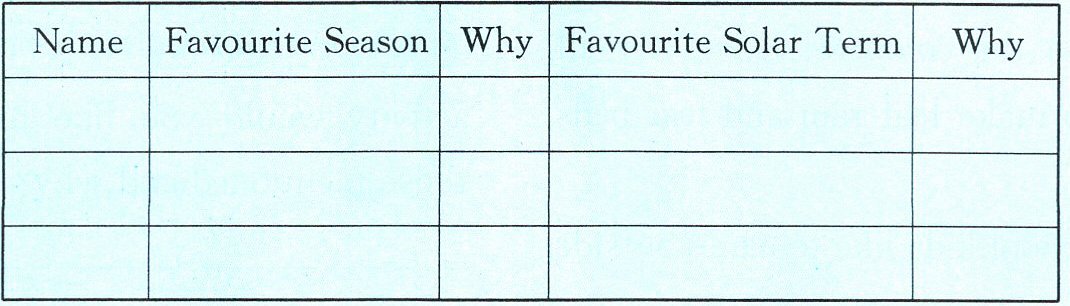
开展采访:根据情境1~4及其情境任务,请你对班里的同学们做一个小采访,了解同学们最喜欢的一个季节和节气以及原因,并邀请他们进行简单的介绍。请将采访内容填写在下面的表格中。
答案
| Name | Favourite Season | Why | Favourite Solar Term | Why |
| ---- | ---- | ---- | ---- | ---- |
| Tom | Summer | I like summer because I can swim in the pool and eat yummy ice cream. | The Summer Solstice | The day is the longest day of a year. I can play outside longer. |
续表
| Lily | Autumn | Autumn has beautiful falling leaves and cool weather. It's so comfortable. | The Autumn Equinox | The temperature is just right. And days and nights are equal. |
| ---- | ---- | ---- | ---- | ---- |
| Jack | Spring | In spring, flowers are in bloom everywhere. It's full of vitality. | The Vernal Equinox | I love the balanced days and nights. And nature wakes up. |
| ---- | ---- | ---- | ---- | ---- |
| Tom | Summer | I like summer because I can swim in the pool and eat yummy ice cream. | The Summer Solstice | The day is the longest day of a year. I can play outside longer. |
续表
| Lily | Autumn | Autumn has beautiful falling leaves and cool weather. It's so comfortable. | The Autumn Equinox | The temperature is just right. And days and nights are equal. |
| ---- | ---- | ---- | ---- | ---- |
| Jack | Spring | In spring, flowers are in bloom everywhere. It's full of vitality. | The Vernal Equinox | I love the balanced days and nights. And nature wakes up. |
解析
【分析】
这是一道开放性实践采访类填表题,解题思路非常清晰:1. 首先确定3位受访同班同学的姓名;2. 为每位同学选择符合日常认知的最喜欢的季节,结合学生的真实生活喜好写出对应的合理原因;3. 再从二十四节气中挑选和对应季节适配的节气,结合节气的特点写出符合逻辑的理由,保证所有内容通顺自然、符合常识即可。
【解析】
我们按照表格的列要求依次填写3位受访同学的相关信息:
1. 第一位受访同学Tom:
最喜欢的季节选Summer(夏天),理由贴合学生日常爱好:可以去泳池游泳、吃美味的冰淇淋;
最喜欢的节气选The Summer Solstice(夏至),理由符合夏至的特点:夏至是一年中白昼最长的一天,有更多时间可以在户外玩耍。
2. 第二位受访同学Lily:
最喜欢的季节选Autumn(秋天),理由贴合秋季特征:有美丽的落叶,天气凉爽,体感非常舒适;
最喜欢的节气选The Autumn Equinox(秋分),理由符合秋分的特点:气温适宜,昼夜时长相等,体感非常舒服。
3. 第三位受访同学Jack:
最喜欢的季节选Spring(春天),理由贴合春季特征:到处都开满鲜花,整个世界充满生机;
最喜欢的节气选The Vernal Equinox(春分),理由符合春分的特点:昼夜时长均衡,万物从蛰伏中苏醒,充满活力。
【答案】
| Name | Favourite Season | Why | Favourite Solar Term | Why |
| ---- | ---- | ---- | ---- | ---- |
| Tom | Summer | I like summer because I can swim in the pool and eat yummy ice cream. | The Summer Solstice | The day is the longest day of a year. I can play outside longer. |
| Lily | Autumn | Autumn has beautiful falling leaves and cool weather. It's so comfortable. | The Autumn Equinox | The temperature is just right. And days and nights are equal. |
| Jack | Spring | In spring, flowers are in bloom everywhere. It's full of vitality. | The Vernal Equinox | I love the balanced days and nights. And nature wakes up. |
【知识点】
季节英文表达、二十四节气英文、采访情景表达
【点评】
本题属于开放性实践作业,没有唯一标准答案,填写时只要内容符合季节、节气的相关常识,理由通顺符合学生的真实生活喜好就可以得分,题目既锻炼了学生的口语采访沟通能力,也巩固了和季节、传统节气相关的英语表达积累。
【难度系数】
0.7
这是一道开放性实践采访类填表题,解题思路非常清晰:1. 首先确定3位受访同班同学的姓名;2. 为每位同学选择符合日常认知的最喜欢的季节,结合学生的真实生活喜好写出对应的合理原因;3. 再从二十四节气中挑选和对应季节适配的节气,结合节气的特点写出符合逻辑的理由,保证所有内容通顺自然、符合常识即可。
【解析】
我们按照表格的列要求依次填写3位受访同学的相关信息:
1. 第一位受访同学Tom:
最喜欢的季节选Summer(夏天),理由贴合学生日常爱好:可以去泳池游泳、吃美味的冰淇淋;
最喜欢的节气选The Summer Solstice(夏至),理由符合夏至的特点:夏至是一年中白昼最长的一天,有更多时间可以在户外玩耍。
2. 第二位受访同学Lily:
最喜欢的季节选Autumn(秋天),理由贴合秋季特征:有美丽的落叶,天气凉爽,体感非常舒适;
最喜欢的节气选The Autumn Equinox(秋分),理由符合秋分的特点:气温适宜,昼夜时长相等,体感非常舒服。
3. 第三位受访同学Jack:
最喜欢的季节选Spring(春天),理由贴合春季特征:到处都开满鲜花,整个世界充满生机;
最喜欢的节气选The Vernal Equinox(春分),理由符合春分的特点:昼夜时长均衡,万物从蛰伏中苏醒,充满活力。
【答案】
| Name | Favourite Season | Why | Favourite Solar Term | Why |
| ---- | ---- | ---- | ---- | ---- |
| Tom | Summer | I like summer because I can swim in the pool and eat yummy ice cream. | The Summer Solstice | The day is the longest day of a year. I can play outside longer. |
| Lily | Autumn | Autumn has beautiful falling leaves and cool weather. It's so comfortable. | The Autumn Equinox | The temperature is just right. And days and nights are equal. |
| Jack | Spring | In spring, flowers are in bloom everywhere. It's full of vitality. | The Vernal Equinox | I love the balanced days and nights. And nature wakes up. |
【知识点】
季节英文表达、二十四节气英文、采访情景表达
【点评】
本题属于开放性实践作业,没有唯一标准答案,填写时只要内容符合季节、节气的相关常识,理由通顺符合学生的真实生活喜好就可以得分,题目既锻炼了学生的口语采访沟通能力,也巩固了和季节、传统节气相关的英语表达积累。
【难度系数】
0.7
