

 登录
登录
8. (2024 扬州宝应期末)如图 6-ZT-4 甲所示的人一边看手机一边开着电动车,结果发生了剐蹭。电动车紧急停车要经历如图乙所示的反应和制动两个过程,当电动车以 18 km/h 的速度匀速行驶时,他看一眼手机需要 2.5 s,在这段时间内相当于在无人驾驶状态下以原来的速度匀速行驶。该人发现情况紧急停车时,在反应时间内电动车行驶了 4 m,制动过程中所用时间为 3 s,电动车在这两个过程中行驶的总距离为 9.9 m。
(1)在看手机时间内,电动车行驶的路程有多少米?
(2)该电动车骑行人的反应时间为多少秒?
(3)该电动车从发现情况到紧急停车全程的平均速度。(结果保留一位小数)
(4)此现象提醒我们,骑电动车时不能看手机。请你从另一角度提一条避免剐蹭的建议:
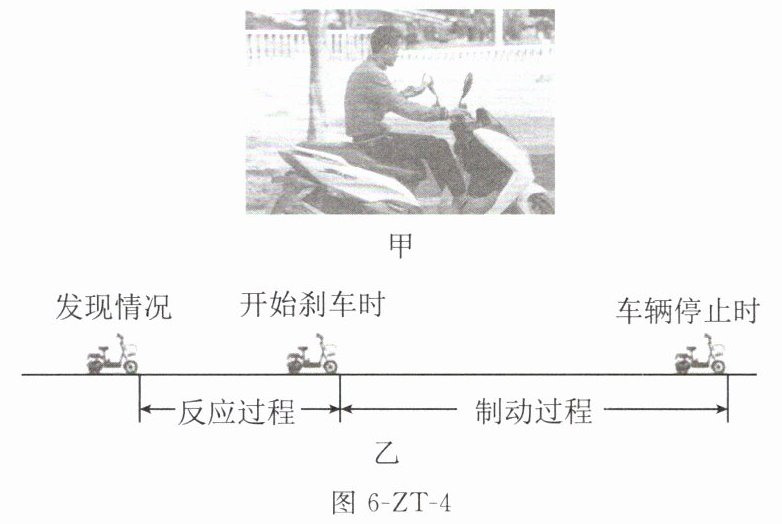
图 6-ZT-4
(1)在看手机时间内,电动车行驶的路程有多少米?
(2)该电动车骑行人的反应时间为多少秒?
(3)该电动车从发现情况到紧急停车全程的平均速度。(结果保留一位小数)
(4)此现象提醒我们,骑电动车时不能看手机。请你从另一角度提一条避免剐蹭的建议:
保持车距
。图 6-ZT-4
答案
(1)骑电动车的速度 $v=18\ \mathrm{km/h}=5\ \mathrm{m/s}$,由 $v=\frac{s}{t}$ 可知,在看手机时间内,电动车行驶的路程:
$s=vt=5\ \mathrm{m/s}×2.5\ \mathrm{s}=12.5\ \mathrm{m}$。
(2)由 $v=\frac{s}{t}$ 可知,该电动车骑行人的反应时间:
$t'=\frac{s'}{v}=\frac{4\ \mathrm{m}}{5\ \mathrm{m/s}}=0.8\ \mathrm{s}$。
(3)该电动车从发现情况到紧急停车全程的总路程 $s_{\mathrm{总}}=9.9\ \mathrm{m}$,所用的总时间为 $t_{\mathrm{总}}=0.8\ \mathrm{s}+3\ \mathrm{s}=3.8\ \mathrm{s}$,
全程的平均速度:
$v_1=\frac{s_{\mathrm{总}}}{t_{\mathrm{总}}}=\frac{9.9\ \mathrm{m}}{3.8\ \mathrm{s}}=2.6\ \mathrm{m/s}$。
(4)保持车距
$s=vt=5\ \mathrm{m/s}×2.5\ \mathrm{s}=12.5\ \mathrm{m}$。
(2)由 $v=\frac{s}{t}$ 可知,该电动车骑行人的反应时间:
$t'=\frac{s'}{v}=\frac{4\ \mathrm{m}}{5\ \mathrm{m/s}}=0.8\ \mathrm{s}$。
(3)该电动车从发现情况到紧急停车全程的总路程 $s_{\mathrm{总}}=9.9\ \mathrm{m}$,所用的总时间为 $t_{\mathrm{总}}=0.8\ \mathrm{s}+3\ \mathrm{s}=3.8\ \mathrm{s}$,
全程的平均速度:
$v_1=\frac{s_{\mathrm{总}}}{t_{\mathrm{总}}}=\frac{9.9\ \mathrm{m}}{3.8\ \mathrm{s}}=2.6\ \mathrm{m/s}$。
(4)保持车距
解析
【分析】
本题考查速度相关的计算,解题时需先统一单位,再利用速度公式$v=\frac{s}{t}$及其变形公式进行计算。(1)已知电动车速度和看手机的时间,直接用$s=vt$计算这段时间行驶的路程;(2)反应过程为匀速行驶,已知反应路程和速度,用$t=\frac{s}{v}$求反应时间;(3)全程平均速度等于总路程除以总时间,总时间为反应时间与制动时间之和;(4)结合安全驾驶常识提出合理建议。
【解析】
首先统一单位:电动车速度$v=18\ \mathrm{km/h}=18×\frac{1}{3.6}\ \mathrm{m/s}=5\ \mathrm{m/s}$。
(1) 看手机时间$t_1=2.5\ \mathrm{s}$,根据$s=vt$,电动车行驶的路程:
$s_1=vt_1=5\ \mathrm{m/s}×2.5\ \mathrm{s}=12.5\ \mathrm{m}$。
(2) 反应过程行驶的路程$s_2=4\ \mathrm{m}$,根据$t=\frac{s}{v}$,反应时间:
$t_2=\frac{s_2}{v}=\frac{4\ \mathrm{m}}{5\ \mathrm{m/s}}=0.8\ \mathrm{s}$。
(3) 全程总路程$s_{\mathrm{总}}=9.9\ \mathrm{m}$,总时间$t_{\mathrm{总}}=t_2 + t_{\mathrm{制动}}=0.8\ \mathrm{s}+3\ \mathrm{s}=3.8\ \mathrm{s}$,全程平均速度:
$v_{\mathrm{平均}}=\frac{s_{\mathrm{总}}}{t_{\mathrm{总}}}=\frac{9.9\ \mathrm{m}}{3.8\ \mathrm{s}}\approx2.6\ \mathrm{m/s}$。
(4) 避免剐蹭的建议:保持车距(或减速慢行、不超速等,合理即可)。
【答案】
(1)12.5 m;(2)0.8 s;(3)2.6 m/s;(4)保持车距
【知识点】
速度公式应用;平均速度计算;单位换算
【点评】
本题结合电动车驾驶的生活场景,将物理知识与安全驾驶常识结合,考查学生对速度公式的基本应用能力,难度适中,同时起到安全教育的作用。
【难度系数】
0.6
本题考查速度相关的计算,解题时需先统一单位,再利用速度公式$v=\frac{s}{t}$及其变形公式进行计算。(1)已知电动车速度和看手机的时间,直接用$s=vt$计算这段时间行驶的路程;(2)反应过程为匀速行驶,已知反应路程和速度,用$t=\frac{s}{v}$求反应时间;(3)全程平均速度等于总路程除以总时间,总时间为反应时间与制动时间之和;(4)结合安全驾驶常识提出合理建议。
【解析】
首先统一单位:电动车速度$v=18\ \mathrm{km/h}=18×\frac{1}{3.6}\ \mathrm{m/s}=5\ \mathrm{m/s}$。
(1) 看手机时间$t_1=2.5\ \mathrm{s}$,根据$s=vt$,电动车行驶的路程:
$s_1=vt_1=5\ \mathrm{m/s}×2.5\ \mathrm{s}=12.5\ \mathrm{m}$。
(2) 反应过程行驶的路程$s_2=4\ \mathrm{m}$,根据$t=\frac{s}{v}$,反应时间:
$t_2=\frac{s_2}{v}=\frac{4\ \mathrm{m}}{5\ \mathrm{m/s}}=0.8\ \mathrm{s}$。
(3) 全程总路程$s_{\mathrm{总}}=9.9\ \mathrm{m}$,总时间$t_{\mathrm{总}}=t_2 + t_{\mathrm{制动}}=0.8\ \mathrm{s}+3\ \mathrm{s}=3.8\ \mathrm{s}$,全程平均速度:
$v_{\mathrm{平均}}=\frac{s_{\mathrm{总}}}{t_{\mathrm{总}}}=\frac{9.9\ \mathrm{m}}{3.8\ \mathrm{s}}\approx2.6\ \mathrm{m/s}$。
(4) 避免剐蹭的建议:保持车距(或减速慢行、不超速等,合理即可)。
【答案】
(1)12.5 m;(2)0.8 s;(3)2.6 m/s;(4)保持车距
【知识点】
速度公式应用;平均速度计算;单位换算
【点评】
本题结合电动车驾驶的生活场景,将物理知识与安全驾驶常识结合,考查学生对速度公式的基本应用能力,难度适中,同时起到安全教育的作用。
【难度系数】
0.6
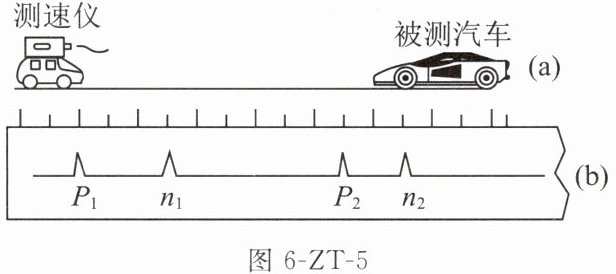
9.(2025常州天宁区校级月考)如图6-ZT-5(a)所示,停在公路旁的公安巡逻车利用超声波可以监测车速:巡逻车上的测速仪发出并接收超声波脉冲信号,根据发出和接收到的信号间的时间差就能测出车速。在图(b)中,$P_1$、$P_2$是测速仪先后发出的超声波信号,$n_1$、$n_2$分别是测速仪检测到的$P_1$、$P_2$经反射后的信号。设测速仪匀速扫描,$P_1$与$P_2$之间的时间间隔为1.8 s,超声波在空气中传播的速度为340 m/s。则:
(1)图(b)中每小格表示的时间是多少秒?
(2)测速仪第一次发出的信号到被测汽车收到时,汽车距测速仪的距离是多少?
(3)测速仪第二次发出的信号到被测汽车收到时,汽车距测速仪的距离是多少?
(4)汽车的速度是多少?
(1)图(b)中每小格表示的时间是多少秒?
(2)测速仪第一次发出的信号到被测汽车收到时,汽车距测速仪的距离是多少?
(3)测速仪第二次发出的信号到被测汽车收到时,汽车距测速仪的距离是多少?
(4)汽车的速度是多少?
答案
(1)$P_1$ 与 $P_2$ 之间的时间间隔为 1.8 s,由图可知,$P_1$ 与 $P_2$ 之间有 9 个小格,所以每小格表示的时间为 $t=\frac{1.8\ \mathrm{s}}{9}=0.2\ \mathrm{s}$。
(2)测速仪第一次发出信号到被测车收到时,经过的时间为
$t_1=\frac{1}{2}×(0.2\ \mathrm{s}×3)=0.3\ \mathrm{s}$,
测速仪第一次发出的信号到被测汽车收到时,汽车距测速仪的距离:
$s_1=vt_1=340\ \mathrm{m/s}×0.3\ \mathrm{s}=102\ \mathrm{m}$。
(3)测速仪第二次发出的信号到被测车收到时经过的时间为 $t_2=\frac{1}{2}×(0.2\ \mathrm{s}×2)=0.2\ \mathrm{s}$,
测速仪第二次发出的信号到被测汽车收到时,汽车距测速仪的距离:
$s_2=vt_2=340\ \mathrm{m/s}×0.2\ \mathrm{s}=68\ \mathrm{m}$。
(4)汽车两次接收信号的时间间隔为
$\Delta t=1.8\ \mathrm{s}-0.3\ \mathrm{s}+0.2\ \mathrm{s}=1.7\ \mathrm{s}$,
汽车两次接收到信号间行驶的距离为
$\Delta s=s_1-s_2=102\ \mathrm{m}-68\ \mathrm{m}=34\ \mathrm{m}$,
汽车的速度:
$v_{\mathrm{车}}=\frac{\Delta s}{\Delta t}=\frac{34\ \mathrm{m}}{1.7\ \mathrm{s}}=20\ \mathrm{m/s}$。
(2)测速仪第一次发出信号到被测车收到时,经过的时间为
$t_1=\frac{1}{2}×(0.2\ \mathrm{s}×3)=0.3\ \mathrm{s}$,
测速仪第一次发出的信号到被测汽车收到时,汽车距测速仪的距离:
$s_1=vt_1=340\ \mathrm{m/s}×0.3\ \mathrm{s}=102\ \mathrm{m}$。
(3)测速仪第二次发出的信号到被测车收到时经过的时间为 $t_2=\frac{1}{2}×(0.2\ \mathrm{s}×2)=0.2\ \mathrm{s}$,
测速仪第二次发出的信号到被测汽车收到时,汽车距测速仪的距离:
$s_2=vt_2=340\ \mathrm{m/s}×0.2\ \mathrm{s}=68\ \mathrm{m}$。
(4)汽车两次接收信号的时间间隔为
$\Delta t=1.8\ \mathrm{s}-0.3\ \mathrm{s}+0.2\ \mathrm{s}=1.7\ \mathrm{s}$,
汽车两次接收到信号间行驶的距离为
$\Delta s=s_1-s_2=102\ \mathrm{m}-68\ \mathrm{m}=34\ \mathrm{m}$,
汽车的速度:
$v_{\mathrm{车}}=\frac{\Delta s}{\Delta t}=\frac{34\ \mathrm{m}}{1.7\ \mathrm{s}}=20\ \mathrm{m/s}$。
解析
【分析】
要解决这道超声波测速问题,需明确核心逻辑:①测速仪匀速扫描,已知P₁与P₂的时间间隔,可通过它们的格数计算每小格的时间;②超声波从测速仪发出到汽车再反射回测速仪,总时间是往返时间,因此汽车接收到信号时,单程时间为总时间的一半,据此算出两次信号时汽车到测速仪的距离;③汽车移动的距离是两次距离的差,而两次接收信号的时间间隔需结合单程时间调整,最后用速度公式计算车速。
【解析】
(1) 已知P₁与P₂的时间间隔为1.8 s,由图(b)可知P₁与P₂之间有9个小格,因此每小格表示的时间:
$ t = \frac{1.8\ \mathrm{s}}{9} = 0.2\ \mathrm{s} $
(2) 测速仪第一次发出的信号到接收到反射信号(n₁)的时间间隔对应3个小格,总时间为 $ 0.2\ \mathrm{s} × 3 = 0.6\ \mathrm{s} $,信号单程到达汽车的时间:
$ t_1 = \frac{1}{2} × 0.6\ \mathrm{s} = 0.3\ \mathrm{s} $
此时汽车距测速仪的距离:
$ s_1 = v_{\mathrm{声}} t_1 = 340\ \mathrm{m/s} × 0.3\ \mathrm{s} = 102\ \mathrm{m} $
(3) 测速仪第二次发出的信号到接收到反射信号(n₂)的时间间隔对应2个小格,总时间为 $ 0.2\ \mathrm{s} × 2 = 0.4\ \mathrm{s} $,信号单程到达汽车的时间:
$ t_2 = \frac{1}{2} × 0.4\ \mathrm{s} = 0.2\ \mathrm{s} $
此时汽车距测速仪的距离:
$ s_2 = v_{\mathrm{声}} t_2 = 340\ \mathrm{m/s} × 0.2\ \mathrm{s} = 68\ \mathrm{m} $
(4) 汽车两次接收到信号的时间间隔:第一次接收信号在P₁发出后0.3 s,第二次接收信号在P₂发出后0.2 s,P₁与P₂间隔1.8 s,因此时间差:
$ \Delta t = 1.8\ \mathrm{s} - 0.3\ \mathrm{s} + 0.2\ \mathrm{s} = 1.7\ \mathrm{s} $
汽车行驶的距离:
$ \Delta s = s_1 - s_2 = 102\ \mathrm{m} - 68\ \mathrm{m} = 34\ \mathrm{m} $
汽车的速度:
$ v_{\mathrm{车}} = \frac{\Delta s}{\Delta t} = \frac{34\ \mathrm{m}}{1.7\ \mathrm{s}} = 20\ \mathrm{m/s} $
【答案】
(1) 0.2 s;(2) 102 m;(3) 68 m;(4) 20 m/s
【知识点】
速度计算、超声波测速、时间间隔
【点评】
本题是超声波测速的典型题,关键在于区分超声波的往返时间与单程时间,且需正确计算汽车两次接收信号的时间间隔,避免直接用P₁、P₂的间隔作为汽车运动时间,需理清时间的对应关系。
【难度系数】
0.5
要解决这道超声波测速问题,需明确核心逻辑:①测速仪匀速扫描,已知P₁与P₂的时间间隔,可通过它们的格数计算每小格的时间;②超声波从测速仪发出到汽车再反射回测速仪,总时间是往返时间,因此汽车接收到信号时,单程时间为总时间的一半,据此算出两次信号时汽车到测速仪的距离;③汽车移动的距离是两次距离的差,而两次接收信号的时间间隔需结合单程时间调整,最后用速度公式计算车速。
【解析】
(1) 已知P₁与P₂的时间间隔为1.8 s,由图(b)可知P₁与P₂之间有9个小格,因此每小格表示的时间:
$ t = \frac{1.8\ \mathrm{s}}{9} = 0.2\ \mathrm{s} $
(2) 测速仪第一次发出的信号到接收到反射信号(n₁)的时间间隔对应3个小格,总时间为 $ 0.2\ \mathrm{s} × 3 = 0.6\ \mathrm{s} $,信号单程到达汽车的时间:
$ t_1 = \frac{1}{2} × 0.6\ \mathrm{s} = 0.3\ \mathrm{s} $
此时汽车距测速仪的距离:
$ s_1 = v_{\mathrm{声}} t_1 = 340\ \mathrm{m/s} × 0.3\ \mathrm{s} = 102\ \mathrm{m} $
(3) 测速仪第二次发出的信号到接收到反射信号(n₂)的时间间隔对应2个小格,总时间为 $ 0.2\ \mathrm{s} × 2 = 0.4\ \mathrm{s} $,信号单程到达汽车的时间:
$ t_2 = \frac{1}{2} × 0.4\ \mathrm{s} = 0.2\ \mathrm{s} $
此时汽车距测速仪的距离:
$ s_2 = v_{\mathrm{声}} t_2 = 340\ \mathrm{m/s} × 0.2\ \mathrm{s} = 68\ \mathrm{m} $
(4) 汽车两次接收到信号的时间间隔:第一次接收信号在P₁发出后0.3 s,第二次接收信号在P₂发出后0.2 s,P₁与P₂间隔1.8 s,因此时间差:
$ \Delta t = 1.8\ \mathrm{s} - 0.3\ \mathrm{s} + 0.2\ \mathrm{s} = 1.7\ \mathrm{s} $
汽车行驶的距离:
$ \Delta s = s_1 - s_2 = 102\ \mathrm{m} - 68\ \mathrm{m} = 34\ \mathrm{m} $
汽车的速度:
$ v_{\mathrm{车}} = \frac{\Delta s}{\Delta t} = \frac{34\ \mathrm{m}}{1.7\ \mathrm{s}} = 20\ \mathrm{m/s} $
【答案】
(1) 0.2 s;(2) 102 m;(3) 68 m;(4) 20 m/s
【知识点】
速度计算、超声波测速、时间间隔
【点评】
本题是超声波测速的典型题,关键在于区分超声波的往返时间与单程时间,且需正确计算汽车两次接收信号的时间间隔,避免直接用P₁、P₂的间隔作为汽车运动时间,需理清时间的对应关系。
【难度系数】
0.5
