

 登录
登录
11. 2025·镇江 新考法·方程思想 如图,在等腰直角三角形ABC中,∠C=90°,AC=BC=8,D是AB的中点,M是边AC上的动点,作DN⊥DM,交BC于点N,延长MD到点P,使得$DP=\frac{1}{2}MD$.当△PNB面积最大时,AM的长等于
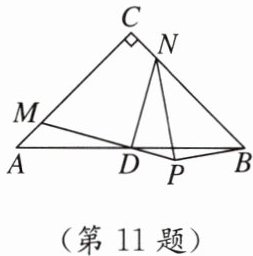
2
.答案
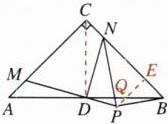
11. 2 【点拨】如图,连接 CD,取 BD 的中点 Q,连接 PQ 并延长交 BC 于点 E,$\because ∠ ACB=90°,AC=BC=8,D$ 是 AB 的中点,$\therefore AB=8\sqrt{2},∠ A=∠ CBA=45°,CD=\frac{1}{2}AB=AD=BD,∠ ACD=∠ BCD=45°,CD⊥ AB,\therefore ∠ ADM+∠ CDM=90°,BD=4\sqrt{2}$。$\because DM⊥ DN,\therefore ∠ CDN+∠ CDM=90°,\therefore ∠ CDN=∠ ADM$,又 $\because AD=CD,∠ A=∠ DCN=45°,\therefore △ ADM≌△ CDN,\therefore AM=CN$。$\because Q$ 为 BD 的中点,$\therefore DQ=\frac{1}{2}BD=\frac{1}{2}AD$。$\because DP=\frac{1}{2}MD,\therefore \frac{MD}{DP}=\frac{AD}{DQ}=2$。$\because ∠ ADM=∠ PDQ,\therefore △ ADM∽△ QDP,\therefore ∠ MAD=∠ PQD,\frac{AM}{PQ}=2,\therefore PQ// AM,AM=2PQ,\therefore ∠ PEB=∠ ACB=90°$,即 $PE⊥ BC$。$\because ∠ CBA=45°,\therefore △ BEQ$ 为等腰直角三角形,$\therefore$ 易知 $BE=EQ=\frac{\sqrt{2}}{2}BQ=\frac{\sqrt{2}}{4}BD=2$。设 $PQ=x$,则 $CN=AM=2x,PE=x+2,\therefore BN=BC-CN=8-2x$,$\therefore △ PNB$ 的面积 $=\frac{1}{2}BN· PE=\frac{1}{2}(8-2x)(x+2)=-x^2+2x+8=-(x-1)^2+9$。$\therefore$ 当 $x=1$ 时,$△ PNB$ 的面积最大,此时 $AM=2$。
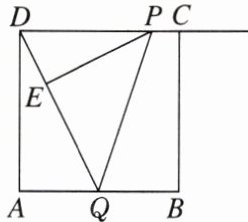
12. 新考法 分类讨论法 如图,在正方形ABCD中,点P为射线DC上的一个动点,点Q为AB的中点,连接PQ,DQ,过点P作PE⊥DQ于点E.
(1)请找出图中一对相似三角形,并证明;
(2)若AB=4,以点P,E,Q为顶点的三角形与△ADQ相似,试求出DP的长.
(1)请找出图中一对相似三角形,并证明;
(2)若AB=4,以点P,E,Q为顶点的三角形与△ADQ相似,试求出DP的长.
答案
12.【解】(1)$△ ADQ∽△ EPD$. 证明如下:
$\because PE⊥ DQ,\therefore ∠ DEP=90°.\therefore ∠ A=∠ DEP$。
$\because ∠ ADC=∠ ADQ+∠ EDP=90°,∠ EDP+∠ EPD=90°$,
$\therefore ∠ ADQ=∠ EPD$。
$\therefore △ ADQ∽△ EPD$。
(2)$\because AB=4,Q$ 为 AB 的中点,$\therefore AQ=2$。
$\because AD=AB=4$,
$\therefore DQ=\sqrt{AD^2+AQ^2}=\sqrt{4^2+2^2}=2\sqrt{5}$。
易知$∠ PEQ=∠ A=90°$,$\therefore$ 若以点 $P,E,Q$ 为顶点的三角形与$△ ADQ$相似,有两种情况:
①当$△ ADQ∽△ EPQ$时,$\frac{AD}{AQ}=\frac{EP}{EQ}=2$,设 $EQ=x$,则 $EP=2x,DE=2\sqrt{5}-x$。由(1)知$△ EPD∽△ ADQ$,$\therefore \frac{EP}{AD}=\frac{DE}{AQ},\therefore \frac{2x}{4}=\frac{2\sqrt{5}-x}{2},\therefore x=\sqrt{5}.\therefore EP=2\sqrt{5}$,$DE=\sqrt{5}.\therefore DP=\sqrt{DE^2+EP^2}=5$;
②当$△ ADQ∽△ EQP$时,$\frac{AD}{AQ}=\frac{EQ}{EP}=2$,设 $EQ=2a$,则 $EP=a$,同理可得$\frac{2\sqrt{5}-2a}{a}=\frac{2}{4}=\frac{1}{2},\therefore a=\frac{4\sqrt{5}}{5}$。经检验,$a=\frac{4\sqrt{5}}{5}$是原分式方程的解。$\therefore DE=\frac{2\sqrt{5}}{5},EP=\frac{4\sqrt{5}}{5}$。
$\therefore DP=\sqrt{DE^2+EP^2}=2$。综上所述,$DP$ 的长为 2 或 5。
$\because PE⊥ DQ,\therefore ∠ DEP=90°.\therefore ∠ A=∠ DEP$。
$\because ∠ ADC=∠ ADQ+∠ EDP=90°,∠ EDP+∠ EPD=90°$,
$\therefore ∠ ADQ=∠ EPD$。
$\therefore △ ADQ∽△ EPD$。
(2)$\because AB=4,Q$ 为 AB 的中点,$\therefore AQ=2$。
$\because AD=AB=4$,
$\therefore DQ=\sqrt{AD^2+AQ^2}=\sqrt{4^2+2^2}=2\sqrt{5}$。
易知$∠ PEQ=∠ A=90°$,$\therefore$ 若以点 $P,E,Q$ 为顶点的三角形与$△ ADQ$相似,有两种情况:
①当$△ ADQ∽△ EPQ$时,$\frac{AD}{AQ}=\frac{EP}{EQ}=2$,设 $EQ=x$,则 $EP=2x,DE=2\sqrt{5}-x$。由(1)知$△ EPD∽△ ADQ$,$\therefore \frac{EP}{AD}=\frac{DE}{AQ},\therefore \frac{2x}{4}=\frac{2\sqrt{5}-x}{2},\therefore x=\sqrt{5}.\therefore EP=2\sqrt{5}$,$DE=\sqrt{5}.\therefore DP=\sqrt{DE^2+EP^2}=5$;
②当$△ ADQ∽△ EQP$时,$\frac{AD}{AQ}=\frac{EQ}{EP}=2$,设 $EQ=2a$,则 $EP=a$,同理可得$\frac{2\sqrt{5}-2a}{a}=\frac{2}{4}=\frac{1}{2},\therefore a=\frac{4\sqrt{5}}{5}$。经检验,$a=\frac{4\sqrt{5}}{5}$是原分式方程的解。$\therefore DE=\frac{2\sqrt{5}}{5},EP=\frac{4\sqrt{5}}{5}$。
$\therefore DP=\sqrt{DE^2+EP^2}=2$。综上所述,$DP$ 的长为 2 或 5。
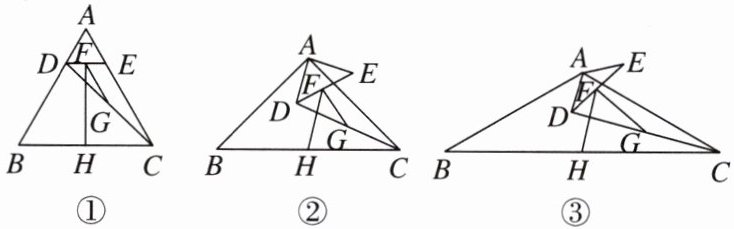
13. 新考法 等线段代换法 如图①,$△ ABC$和$△ ADE$是等边三角形,连接$DC$,点$F$,$G$,$H$分别是$DE$,$DC$和$BC$的中点,连接$FG$,$FH$.易证:$FH=\sqrt{3}FG$(不需证明).
(1)若$△ ABC$和$△ ADE$都是等腰直角三角形,且$∠ BAC=∠ DAE=90°$,如图②,其他条件不变,判断$FH$和$FG$之间的数量关系,写出你的猜想并利用图②进行证明;
(2)若$△ ABC$和$△ ADE$都是等腰三角形,且$∠ BAC=∠ DAE=120°$,如图③,其他条件不变,判断$FH$和$FG$之间的数量关系,写出你的猜想,并利用图③进行证明.
(1)若$△ ABC$和$△ ADE$都是等腰直角三角形,且$∠ BAC=∠ DAE=90°$,如图②,其他条件不变,判断$FH$和$FG$之间的数量关系,写出你的猜想并利用图②进行证明;
(2)若$△ ABC$和$△ ADE$都是等腰三角形,且$∠ BAC=∠ DAE=120°$,如图③,其他条件不变,判断$FH$和$FG$之间的数量关系,写出你的猜想,并利用图③进行证明.
答案
13.【解】(1)当$△ ABC$和$△ ADE$都是等腰直角三角形,且$∠ BAC=∠ DAE=90°$时,$FH=\sqrt{2}FG$。
证明:如图①,连接 $AH,CE,AF$。
$\because △ ABC$ 和 $△ ADE$ 都是等腰直角三角形,且$∠ BAC=∠ DAE=90°$,$F,H$ 分别是 $DE,BC$ 的中点,
$\therefore AH⊥ BC,AF⊥ DE,AH=CH=\frac{1}{2}BC,AF=EF=\frac{1}{2}DE$。
$\therefore$ 易得$\frac{AH}{AC}=\frac{AF}{AE}=\frac{\sqrt{2}}{2},∠ CAH=∠ EAF=45°$。
$\therefore$ 易得$∠ HAF=∠ EAC$。
$\therefore △ AHF∽△ ACE$。
$\therefore \frac{FH}{CE}=\frac{AH}{AC}=\frac{\sqrt{2}}{2}.\therefore CE=\sqrt{2}FH$。
$\because$ 点 $F,G$ 分别是 $DE,DC$ 的中点,
$\therefore CE=2FG$。
$\therefore FH=\sqrt{2}FG$。

(2)当$△ ABC$ 和 $△ ADE$ 都是等腰三角形,且$∠ BAC=∠ DAE=120°$时,$FH=FG$。
证明:如图②,连接 $AH,CE,AF$。
$\because △ ABC$ 和 $△ ADE$ 都是等腰三角形,点 $F,H$ 分别是$DE,BC$ 的中点,且$∠ BAC=∠ DAE=120°$,
$\therefore ∠ AED=∠ ADE=∠ ACB=∠ B=(180°-120°)÷2=30°$,
$AH⊥ BC,AF⊥ DE,∠ CAH=∠ EAF=\frac{1}{2}×120°=60°$。
$\therefore$ 易得$∠ HAF=∠ EAC,\frac{AH}{AC}=\frac{AF}{AE}=\frac{1}{2}$。
$\therefore △ AHF∽△ ACE$。
$\therefore \frac{HF}{CE}=\frac{AH}{AC}=\frac{1}{2}.\therefore CE=2FH$。
$\because$ 点 $F,G$ 分别是 $DE,DC$ 的中点,
$\therefore CE=2FG.\therefore FH=FG$。
