

 登录
登录
12. (★★)如图,在四边形ABCD中,AC为∠BAD的平分线,过点C作CF⊥AD于点F,且CB=CD.
(1)判断∠ABC与∠D之间的数量关系,并说明理由.
(2)若CF=6,AB=4,S△ACD=21,求DF的长.
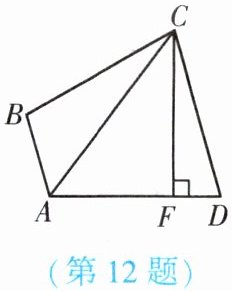
(1)判断∠ABC与∠D之间的数量关系,并说明理由.
(2)若CF=6,AB=4,S△ACD=21,求DF的长.
答案
(1)
解:$∠ ABC + ∠ D = 180°$,理由如下:
过点$C$作$CE ⊥ AB$,交$AB$的延长线于点$E$。
$\because AC$平分$∠ BAD$,$CF ⊥ AD$,$CE ⊥ AE$,
$\therefore CE = CF$,$∠ CEB = ∠ CFD = 90°$。
在$\mathrm{Rt}△ CEB$和$\mathrm{Rt}△ CFD$中,
$\begin{cases}CB = CD \\CE = CF\end{cases}$
$\therefore \mathrm{Rt}△ CEB ≌ \mathrm{Rt}△ CFD\ (\mathrm{HL})$,
$\therefore ∠ CBE = ∠ D$。
又$\because ∠ ABC + ∠ CBE = 180°$,
$\therefore ∠ ABC + ∠ D = 180°$。
---
(2)
解:$\because S_{△ ACD} = \frac{1}{2} · AD · CF = 21$,$CF=6$,
$\therefore \frac{1}{2} × AD × 6 = 21$,
解得$AD = 7$。
在$\mathrm{Rt}△ ACE$和$\mathrm{Rt}△ ACF$中,
$\begin{cases}AC = AC \\CE = CF\end{cases}$
$\therefore \mathrm{Rt}△ ACE ≌ \mathrm{Rt}△ ACF\ (\mathrm{HL})$,
$\therefore AE = AF$。
由(1)中$\mathrm{Rt}△ CEB ≌ \mathrm{Rt}△ CFD$,得$BE = DF$。
设$DF = x$,则$BE = x$,
$\therefore AE = AB + BE = 4 + x$,$AF = AD - DF = 7 - x$。
$\because AE = AF$,
$\therefore 4 + x = 7 - x$,
解得$x = \frac{3}{2}$。
$\therefore DF$的长为$\frac{3}{2}$。
解:$∠ ABC + ∠ D = 180°$,理由如下:
过点$C$作$CE ⊥ AB$,交$AB$的延长线于点$E$。
$\because AC$平分$∠ BAD$,$CF ⊥ AD$,$CE ⊥ AE$,
$\therefore CE = CF$,$∠ CEB = ∠ CFD = 90°$。
在$\mathrm{Rt}△ CEB$和$\mathrm{Rt}△ CFD$中,
$\begin{cases}CB = CD \\CE = CF\end{cases}$
$\therefore \mathrm{Rt}△ CEB ≌ \mathrm{Rt}△ CFD\ (\mathrm{HL})$,
$\therefore ∠ CBE = ∠ D$。
又$\because ∠ ABC + ∠ CBE = 180°$,
$\therefore ∠ ABC + ∠ D = 180°$。
---
(2)
解:$\because S_{△ ACD} = \frac{1}{2} · AD · CF = 21$,$CF=6$,
$\therefore \frac{1}{2} × AD × 6 = 21$,
解得$AD = 7$。
在$\mathrm{Rt}△ ACE$和$\mathrm{Rt}△ ACF$中,
$\begin{cases}AC = AC \\CE = CF\end{cases}$
$\therefore \mathrm{Rt}△ ACE ≌ \mathrm{Rt}△ ACF\ (\mathrm{HL})$,
$\therefore AE = AF$。
由(1)中$\mathrm{Rt}△ CEB ≌ \mathrm{Rt}△ CFD$,得$BE = DF$。
设$DF = x$,则$BE = x$,
$\therefore AE = AB + BE = 4 + x$,$AF = AD - DF = 7 - x$。
$\because AE = AF$,
$\therefore 4 + x = 7 - x$,
解得$x = \frac{3}{2}$。
$\therefore DF$的长为$\frac{3}{2}$。
解析
【分析】
(1) 要探究∠ABC与∠D的数量关系,已知AC是∠BAD的平分线,根据角平分线的性质:角平分线上的点到角两边的距离相等,可过点C作CE⊥AB交AB的延长线于点E,得到CE=CF,结合已知CB=CD,可证两个直角三角形全等,得到∠CBE=∠D,再结合邻补角互补(∠ABC+∠CBE=180°),即可推出两角的数量关系。
(2) 先利用三角形面积公式,结合已知△ACD的面积和CF的长度求出AD的长;再证明Rt△ACE≌Rt△ACF得到AE=AF,结合(1)中全等的结论可得BE=DF,设DF为x,用含x的式子分别表示AE和AF,根据AE=AF列方程求解即可得到DF的长度。
【解析】
(1) $\boldsymbol{∠ABC + ∠D = 180°}$,理由如下:
过点$C$作$CE ⊥ AB$,交$AB$的延长线于点$E$。
$\because AC$平分$∠ BAD$,$CF ⊥ AD$,$CE ⊥ AE$,
$\therefore CE = CF$,$∠ CEB = ∠ CFD = 90°$。
在$\mathrm{Rt}△ CEB$和$\mathrm{Rt}△ CFD$中,
$\begin{cases}CB = CD \\CE = CF\end{cases}$
$\therefore \mathrm{Rt}△ CEB ≌ \mathrm{Rt}△ CFD\ (\mathrm{HL})$,
$\therefore ∠ CBE = ∠ D$。
又$\because ∠ ABC + ∠ CBE = 180°$,
$\therefore ∠ ABC + ∠ D = 180°$。
(2) $\because S_{△ ACD} = \frac{1}{2} · AD · CF = 21$,$CF=6$,
$\therefore \frac{1}{2} × AD × 6 = 21$,
解得$AD = 7$。
在$\mathrm{Rt}△ ACE$和$\mathrm{Rt}△ ACF$中,
$\begin{cases}AC = AC \\CE = CF\end{cases}$
$\therefore \mathrm{Rt}△ ACE ≌ \mathrm{Rt}△ ACF\ (\mathrm{HL})$,
$\therefore AE = AF$。
由(1)中$\mathrm{Rt}△ CEB ≌ \mathrm{Rt}△ CFD$,得$BE = DF$。
设$DF = x$,则$BE = x$,
$\therefore AE = AB + BE = 4 + x$,$AF = AD - DF = 7 - x$。
$\because AE = AF$,
$\therefore 4 + x = 7 - x$,
解得$x = \frac{3}{2}$。
$\therefore DF$的长为$\frac{3}{2}$。
【答案】
(1) $\boldsymbol{∠ABC + ∠D = 180°}$
(2) $\boldsymbol{\frac{3}{2}}$
【知识点】
角平分线的性质;直角三角形全等的判定;全等三角形的性质
【点评】
本题属于几何综合基础题,核心考查角平分线性质与全等三角形的判定、性质的结合应用,构造辅助线得到全等三角形是解题的突破口,第二问结合方程思想求解线段长度,能较好地考查几何推理能力和知识综合运用能力。
【难度系数】
0.6
(1) 要探究∠ABC与∠D的数量关系,已知AC是∠BAD的平分线,根据角平分线的性质:角平分线上的点到角两边的距离相等,可过点C作CE⊥AB交AB的延长线于点E,得到CE=CF,结合已知CB=CD,可证两个直角三角形全等,得到∠CBE=∠D,再结合邻补角互补(∠ABC+∠CBE=180°),即可推出两角的数量关系。
(2) 先利用三角形面积公式,结合已知△ACD的面积和CF的长度求出AD的长;再证明Rt△ACE≌Rt△ACF得到AE=AF,结合(1)中全等的结论可得BE=DF,设DF为x,用含x的式子分别表示AE和AF,根据AE=AF列方程求解即可得到DF的长度。
【解析】
(1) $\boldsymbol{∠ABC + ∠D = 180°}$,理由如下:
过点$C$作$CE ⊥ AB$,交$AB$的延长线于点$E$。
$\because AC$平分$∠ BAD$,$CF ⊥ AD$,$CE ⊥ AE$,
$\therefore CE = CF$,$∠ CEB = ∠ CFD = 90°$。
在$\mathrm{Rt}△ CEB$和$\mathrm{Rt}△ CFD$中,
$\begin{cases}CB = CD \\CE = CF\end{cases}$
$\therefore \mathrm{Rt}△ CEB ≌ \mathrm{Rt}△ CFD\ (\mathrm{HL})$,
$\therefore ∠ CBE = ∠ D$。
又$\because ∠ ABC + ∠ CBE = 180°$,
$\therefore ∠ ABC + ∠ D = 180°$。
(2) $\because S_{△ ACD} = \frac{1}{2} · AD · CF = 21$,$CF=6$,
$\therefore \frac{1}{2} × AD × 6 = 21$,
解得$AD = 7$。
在$\mathrm{Rt}△ ACE$和$\mathrm{Rt}△ ACF$中,
$\begin{cases}AC = AC \\CE = CF\end{cases}$
$\therefore \mathrm{Rt}△ ACE ≌ \mathrm{Rt}△ ACF\ (\mathrm{HL})$,
$\therefore AE = AF$。
由(1)中$\mathrm{Rt}△ CEB ≌ \mathrm{Rt}△ CFD$,得$BE = DF$。
设$DF = x$,则$BE = x$,
$\therefore AE = AB + BE = 4 + x$,$AF = AD - DF = 7 - x$。
$\because AE = AF$,
$\therefore 4 + x = 7 - x$,
解得$x = \frac{3}{2}$。
$\therefore DF$的长为$\frac{3}{2}$。
【答案】
(1) $\boldsymbol{∠ABC + ∠D = 180°}$
(2) $\boldsymbol{\frac{3}{2}}$
【知识点】
角平分线的性质;直角三角形全等的判定;全等三角形的性质
【点评】
本题属于几何综合基础题,核心考查角平分线性质与全等三角形的判定、性质的结合应用,构造辅助线得到全等三角形是解题的突破口,第二问结合方程思想求解线段长度,能较好地考查几何推理能力和知识综合运用能力。
【难度系数】
0.6
13. (★★★)(1) 如图①, 在$△ ABC$中, $∠ BAC=90°$,$AB=AC$,点$D,E$分别在边$AC$,$AB$上.若$CE=BD$,则线段$AE$和线段$AD$之间的数量关系是.
(2) 如图②, 在$△ ABC$中, $∠ BAC>90°$,$AB=AC$,点$D,E$分别在边$AC$,$AB$上,且$CE=BD$,则线段$AE$和线段$AD$之间有什么数量关系?请说明理由.
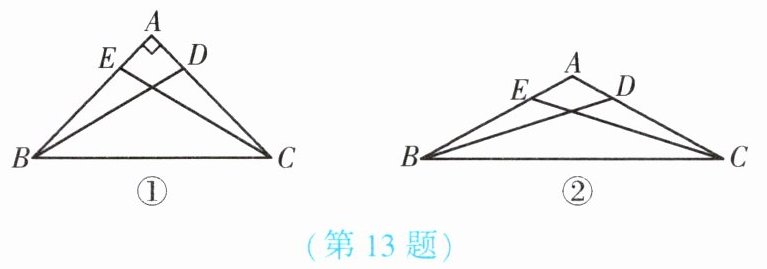
(2) 如图②, 在$△ ABC$中, $∠ BAC>90°$,$AB=AC$,点$D,E$分别在边$AC$,$AB$上,且$CE=BD$,则线段$AE$和线段$AD$之间有什么数量关系?请说明理由.
答案
(1) $\boldsymbol{AE=AD}$
(2) 解:$AE=AD$,理由如下:
过点$C$作$CM⊥ AE$,交$EA$的延长线于点$M$,
过点$B$作$BN⊥ AD$,交$DA$的延长线于点$N$。
$\therefore ∠ M = ∠ N = 90°$
$\because ∠ BAC > 90°$,
$\therefore ∠ CAM = 180° - ∠ BAC$,$∠ BAN = 180° - ∠ BAC$,
$\therefore ∠ CAM = ∠ BAN$
在$△ CAM$和$△ BAN$中,
$\{\begin{array}{l}∠ M = ∠ N \\∠ CAM = ∠ BAN \\AC = AB\end{array} $
$\therefore △ CAM ≌ △ BAN \ (\mathrm{AAS})$
$\therefore CM = BN$,$AM = AN$
在$\mathrm{Rt}△ CME$和$\mathrm{Rt}△ BND$中,
$\{\begin{array}{l}CE = BD \\CM = BN\end{array} $
$\therefore \mathrm{Rt}△ CME ≌ \mathrm{Rt}△ BND \ (\mathrm{HL})$
$\therefore EM = DN$
$\because EM = AE + AM$,$DN = AD + AN$
$\therefore AE + AM = AD + AN$
又$\because AM = AN$
$\therefore AE = AD$
(2) 解:$AE=AD$,理由如下:
过点$C$作$CM⊥ AE$,交$EA$的延长线于点$M$,
过点$B$作$BN⊥ AD$,交$DA$的延长线于点$N$。
$\therefore ∠ M = ∠ N = 90°$
$\because ∠ BAC > 90°$,
$\therefore ∠ CAM = 180° - ∠ BAC$,$∠ BAN = 180° - ∠ BAC$,
$\therefore ∠ CAM = ∠ BAN$
在$△ CAM$和$△ BAN$中,
$\{\begin{array}{l}∠ M = ∠ N \\∠ CAM = ∠ BAN \\AC = AB\end{array} $
$\therefore △ CAM ≌ △ BAN \ (\mathrm{AAS})$
$\therefore CM = BN$,$AM = AN$
在$\mathrm{Rt}△ CME$和$\mathrm{Rt}△ BND$中,
$\{\begin{array}{l}CE = BD \\CM = BN\end{array} $
$\therefore \mathrm{Rt}△ CME ≌ \mathrm{Rt}△ BND \ (\mathrm{HL})$
$\therefore EM = DN$
$\because EM = AE + AM$,$DN = AD + AN$
$\therefore AE + AM = AD + AN$
又$\because AM = AN$
$\therefore AE = AD$
解析
【分析】
(1) 第一问中,△ABC是等腰直角三角形,∠BAC=90°,AB=AC,AE、AD分别在Rt△AEC和Rt△ADB中,已知两组边CE=BD、AC=AB,可通过HL定理证明两个直角三角形全等,直接得出AE和AD的数量关系。
(2) 第二问中∠BAC为钝角,没有现成的直角三角形,需构造直角辅助解题:过B、C分别作AD、AE延长线的垂线,先证明△CAM和△BAN全等得到CM=BN、AM=AN,再通过HL证明Rt△CME和Rt△BND全等得到EM=DN,最后结合线段和差关系,减去相等的AM、AN即可推出AE和AD的数量关系。
【解析】
(1) 在$\mathrm{Rt}△AEC$和$\mathrm{Rt}△ADB$中:
$\{\begin{array}{l}AC=AB\\CE=BD\end{array} $
$\therefore \mathrm{Rt}△AEC≌\mathrm{Rt}△ADB\ (\mathrm{HL})$
$\therefore AE=AD$。
(2) $AE=AD$,理由如下:
过点$C$作$CM⊥ AE$,交$EA$的延长线于点$M$,
过点$B$作$BN⊥ AD$,交$DA$的延长线于点$N$。
$\therefore ∠ M = ∠ N = 90°$
$\because ∠ BAC > 90°$,
$\therefore ∠ CAM = 180° - ∠ BAC$,$∠ BAN = 180° - ∠ BAC$,
$\therefore ∠ CAM = ∠ BAN$
在$△ CAM$和$△ BAN$中,
$\{\begin{array}{l}∠ M = ∠ N \\∠ CAM = ∠ BAN \\AC = AB\end{array} $
$\therefore △ CAM ≌ △ BAN \ (\mathrm{AAS})$
$\therefore CM = BN$,$AM = AN$
在$\mathrm{Rt}△ CME$和$\mathrm{Rt}△ BND$中,
$\{\begin{array}{l}CE = BD \\CM = BN\end{array} $
$\therefore \mathrm{Rt}△ CME ≌ \mathrm{Rt}△ BND \ (\mathrm{HL})$
$\therefore EM = DN$
$\because EM = AE + AM$,$DN = AD + AN$
$\therefore AE + AM = AD + AN$
又$\because AM = AN$
$\therefore AE = AD$
【答案】
(1) $\boldsymbol{AE=AD}$
(2) $\boldsymbol{AE=AD}$
【知识点】
1. 全等三角形的判定与性质
2. 等腰三角形的性质
3. 直角三角形全等判定
【点评】
本题从等腰直角三角形拓展到一般等腰三角形,核心考查全等三角形的证明与应用,第一问是基础的HL判定应用,第二问需要通过作垂线构造直角三角形,将钝角条件下的证明转化为熟悉的直角三角形全等问题,既考查了基础定理的掌握情况,也考查了辅助线构造能力和转化思想。
【难度系数】
0.6
(1) 第一问中,△ABC是等腰直角三角形,∠BAC=90°,AB=AC,AE、AD分别在Rt△AEC和Rt△ADB中,已知两组边CE=BD、AC=AB,可通过HL定理证明两个直角三角形全等,直接得出AE和AD的数量关系。
(2) 第二问中∠BAC为钝角,没有现成的直角三角形,需构造直角辅助解题:过B、C分别作AD、AE延长线的垂线,先证明△CAM和△BAN全等得到CM=BN、AM=AN,再通过HL证明Rt△CME和Rt△BND全等得到EM=DN,最后结合线段和差关系,减去相等的AM、AN即可推出AE和AD的数量关系。
【解析】
(1) 在$\mathrm{Rt}△AEC$和$\mathrm{Rt}△ADB$中:
$\{\begin{array}{l}AC=AB\\CE=BD\end{array} $
$\therefore \mathrm{Rt}△AEC≌\mathrm{Rt}△ADB\ (\mathrm{HL})$
$\therefore AE=AD$。
(2) $AE=AD$,理由如下:
过点$C$作$CM⊥ AE$,交$EA$的延长线于点$M$,
过点$B$作$BN⊥ AD$,交$DA$的延长线于点$N$。
$\therefore ∠ M = ∠ N = 90°$
$\because ∠ BAC > 90°$,
$\therefore ∠ CAM = 180° - ∠ BAC$,$∠ BAN = 180° - ∠ BAC$,
$\therefore ∠ CAM = ∠ BAN$
在$△ CAM$和$△ BAN$中,
$\{\begin{array}{l}∠ M = ∠ N \\∠ CAM = ∠ BAN \\AC = AB\end{array} $
$\therefore △ CAM ≌ △ BAN \ (\mathrm{AAS})$
$\therefore CM = BN$,$AM = AN$
在$\mathrm{Rt}△ CME$和$\mathrm{Rt}△ BND$中,
$\{\begin{array}{l}CE = BD \\CM = BN\end{array} $
$\therefore \mathrm{Rt}△ CME ≌ \mathrm{Rt}△ BND \ (\mathrm{HL})$
$\therefore EM = DN$
$\because EM = AE + AM$,$DN = AD + AN$
$\therefore AE + AM = AD + AN$
又$\because AM = AN$
$\therefore AE = AD$
【答案】
(1) $\boldsymbol{AE=AD}$
(2) $\boldsymbol{AE=AD}$
【知识点】
1. 全等三角形的判定与性质
2. 等腰三角形的性质
3. 直角三角形全等判定
【点评】
本题从等腰直角三角形拓展到一般等腰三角形,核心考查全等三角形的证明与应用,第一问是基础的HL判定应用,第二问需要通过作垂线构造直角三角形,将钝角条件下的证明转化为熟悉的直角三角形全等问题,既考查了基础定理的掌握情况,也考查了辅助线构造能力和转化思想。
【难度系数】
0.6
