

 登录
登录
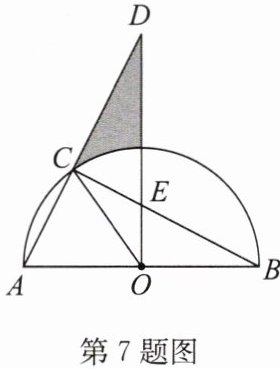
7.(2025·宜兴二模)如图,在半圆O中,直径AB的长为6,C是半圆上一点,过圆心O作AB的垂线交线段AC的延长线于点D,交弦BC于点E.
(1)求证:∠D=∠ABC;
(2)若OE=CE,求图中阴影部分的面积(结果保留根号和π).
(1)求证:∠D=∠ABC;
(2)若OE=CE,求图中阴影部分的面积(结果保留根号和π).
答案
7.(1)证明: $\because AB为直径, \therefore ∠ ACB=90°,$
$\therefore ∠ CAB + ∠ CBA=90°.$
$\because OD⊥ AB, \therefore ∠ DAO + ∠ D=90°, \therefore ∠ D=∠ ABC.$
(2)解: $\because OE=CE, \therefore ∠ EOC=∠ ECO.$
又$\because OB=OC, \therefore ∠ OBC=∠ OCB,$
$\therefore ∠ OBC=∠ OCB=∠ EOC.$
在$△ BOC$中, $∠ BOC + ∠ OBC + ∠ OCB = 3∠ EOC + 90°=180°, \therefore ∠ EOC=30°, \therefore ∠ AOC=60°.$
$\because OA=\frac{1}{2}AB=3, \therefore OC=OA=3, OD=3\sqrt{3}.$
在$△ OAC$中,OA边上的高为$\frac{3\sqrt{3}}{2},$
$\therefore S_{阴影}=\frac{1}{2}×3×3\sqrt{3}-\frac{30·π·3^2}{360}-\frac{1}{2}×3×\frac{3\sqrt{3}}{2}=\frac{9\sqrt{3}}{4}-\frac{3}{4}π.$
$\therefore ∠ CAB + ∠ CBA=90°.$
$\because OD⊥ AB, \therefore ∠ DAO + ∠ D=90°, \therefore ∠ D=∠ ABC.$
(2)解: $\because OE=CE, \therefore ∠ EOC=∠ ECO.$
又$\because OB=OC, \therefore ∠ OBC=∠ OCB,$
$\therefore ∠ OBC=∠ OCB=∠ EOC.$
在$△ BOC$中, $∠ BOC + ∠ OBC + ∠ OCB = 3∠ EOC + 90°=180°, \therefore ∠ EOC=30°, \therefore ∠ AOC=60°.$
$\because OA=\frac{1}{2}AB=3, \therefore OC=OA=3, OD=3\sqrt{3}.$
在$△ OAC$中,OA边上的高为$\frac{3\sqrt{3}}{2},$
$\therefore S_{阴影}=\frac{1}{2}×3×3\sqrt{3}-\frac{30·π·3^2}{360}-\frac{1}{2}×3×\frac{3\sqrt{3}}{2}=\frac{9\sqrt{3}}{4}-\frac{3}{4}π.$
解析
【分析】
(1) 要证明∠D=∠ABC,可利用直角三角形两锐角互余的性质推导:首先根据直径所对圆周角为直角,可得∠ACB=90°,即∠CAB+∠ABC=90°;再由OD⊥AB可得∠CAB+∠D=90°,根据同角的余角相等即可完成证明。
(2) 求阴影部分面积采用割补法:先利用等腰三角形等边对等角的性质,结合OE=CE、OB=OC推导角的数量关系,求出∠EOC=30°、∠AOC=60°;再分别计算Rt△AOD、等边△AOC、圆心角为30°的扇形OCE的面积,最后用$\boldsymbol{S_{阴影}=S_{△ AOD}-S_{△ AOC}-S_{扇形OCE}}$计算即可。
【解析】
(1) 证明:
∵ AB是半圆O的直径,
∴ ∠ACB=90°,
∴ ∠CAB + ∠ABC = 90°。
∵ OD⊥AB,
∴ ∠AOD=90°,
∴ ∠CAB + ∠D = 90°,
∴ ∠D=∠ABC。
(2) 解:
∵ OE=CE,
∴ ∠EOC=∠ECO。
又
∵ OB=OC(均为圆的半径),
∴ ∠OBC=∠OCB。
设∠EOC=α,则∠OBC=∠OCB=α,
∵ OD⊥AB,
∴ ∠BOC=∠BOD + ∠EOC=90°+α,
在△BOC中,内角和为180°,即:
$90°+α+α+α=180°$,
解得α=30°,即∠EOC=30°,
∴ ∠AOC=180°-∠BOC=180°-(90°+30°)=60°。
∵ AB=6,
∴ 圆的半径$OA=OC=3$,
在Rt△AOD中,∠A=60°,
∴ $OD=OA· \tan60°=3\sqrt{3}$,
$S_{△ AOD}=\frac{1}{2}× OA× OD=\frac{1}{2}×3×3\sqrt{3}=\frac{9\sqrt{3}}{2}$。
△AOC中OA=OC,∠AOC=60°,即△AOC为等边三角形,OA边上的高为$3×\sin60°=\frac{3\sqrt{3}}{2}$,
∴ $S_{△ AOC}=\frac{1}{2}×3×\frac{3\sqrt{3}}{2}=\frac{9\sqrt{3}}{4}$。
扇形OCE的圆心角为30°,
∴ $S_{扇形OCE}=\frac{30π×3^2}{360}=\frac{3π}{4}$。
∴ $S_{阴影}=S_{△ AOD}-S_{△ AOC}-S_{扇形OCE}=\frac{9\sqrt{3}}{2}-\frac{9\sqrt{3}}{4}-\frac{3π}{4}=\frac{9\sqrt{3}}{4}-\frac{3π}{4}$。
【答案】
(1) 证明见解析;
(2) $\boldsymbol{\frac{9\sqrt{3}}{4}-\frac{3π}{4}}$
【知识点】
圆周角定理、等腰三角形的性质、扇形面积计算
【点评】
本题是圆与三角形结合的典型综合题,既考查了圆和等腰三角形的基础性质,也考查了不规则图形面积的计算方法,解题关键是通过角的数量关系求出对应圆心角的度数,再结合割补法求解阴影面积。
【难度系数】
0.6
(1) 要证明∠D=∠ABC,可利用直角三角形两锐角互余的性质推导:首先根据直径所对圆周角为直角,可得∠ACB=90°,即∠CAB+∠ABC=90°;再由OD⊥AB可得∠CAB+∠D=90°,根据同角的余角相等即可完成证明。
(2) 求阴影部分面积采用割补法:先利用等腰三角形等边对等角的性质,结合OE=CE、OB=OC推导角的数量关系,求出∠EOC=30°、∠AOC=60°;再分别计算Rt△AOD、等边△AOC、圆心角为30°的扇形OCE的面积,最后用$\boldsymbol{S_{阴影}=S_{△ AOD}-S_{△ AOC}-S_{扇形OCE}}$计算即可。
【解析】
(1) 证明:
∵ AB是半圆O的直径,
∴ ∠ACB=90°,
∴ ∠CAB + ∠ABC = 90°。
∵ OD⊥AB,
∴ ∠AOD=90°,
∴ ∠CAB + ∠D = 90°,
∴ ∠D=∠ABC。
(2) 解:
∵ OE=CE,
∴ ∠EOC=∠ECO。
又
∵ OB=OC(均为圆的半径),
∴ ∠OBC=∠OCB。
设∠EOC=α,则∠OBC=∠OCB=α,
∵ OD⊥AB,
∴ ∠BOC=∠BOD + ∠EOC=90°+α,
在△BOC中,内角和为180°,即:
$90°+α+α+α=180°$,
解得α=30°,即∠EOC=30°,
∴ ∠AOC=180°-∠BOC=180°-(90°+30°)=60°。
∵ AB=6,
∴ 圆的半径$OA=OC=3$,
在Rt△AOD中,∠A=60°,
∴ $OD=OA· \tan60°=3\sqrt{3}$,
$S_{△ AOD}=\frac{1}{2}× OA× OD=\frac{1}{2}×3×3\sqrt{3}=\frac{9\sqrt{3}}{2}$。
△AOC中OA=OC,∠AOC=60°,即△AOC为等边三角形,OA边上的高为$3×\sin60°=\frac{3\sqrt{3}}{2}$,
∴ $S_{△ AOC}=\frac{1}{2}×3×\frac{3\sqrt{3}}{2}=\frac{9\sqrt{3}}{4}$。
扇形OCE的圆心角为30°,
∴ $S_{扇形OCE}=\frac{30π×3^2}{360}=\frac{3π}{4}$。
∴ $S_{阴影}=S_{△ AOD}-S_{△ AOC}-S_{扇形OCE}=\frac{9\sqrt{3}}{2}-\frac{9\sqrt{3}}{4}-\frac{3π}{4}=\frac{9\sqrt{3}}{4}-\frac{3π}{4}$。
【答案】
(1) 证明见解析;
(2) $\boldsymbol{\frac{9\sqrt{3}}{4}-\frac{3π}{4}}$
【知识点】
圆周角定理、等腰三角形的性质、扇形面积计算
【点评】
本题是圆与三角形结合的典型综合题,既考查了圆和等腰三角形的基础性质,也考查了不规则图形面积的计算方法,解题关键是通过角的数量关系求出对应圆心角的度数,再结合割补法求解阴影面积。
【难度系数】
0.6
8.如图,BC是半圆O的直径,P是半圆弧的中点,A是$\overset{\frown}{BP}$的中点,AD⊥BC于点D,连接AB,PB,AC.BP分别与AD,AC相交于点E,F.
(1)求证:AE=BE.
(2)判断BE与EF是否相等,并说明理由.
(3)小李通过操作发现CF=2AB.请问小李的发现是否正确?若正确,请说明理由;若不正确,请写出CF与AB的正确关系式.

(1)求证:AE=BE.
(2)判断BE与EF是否相等,并说明理由.
(3)小李通过操作发现CF=2AB.请问小李的发现是否正确?若正确,请说明理由;若不正确,请写出CF与AB的正确关系式.
答案
8.(1)证明: $\because BC是直径, \therefore ∠ BAC=90°.$
$\because AD⊥ BC于点D, \therefore ∠ ADB=90°,$
$\therefore ∠ ACB + ∠ ABC=90°, ∠ BAD + ∠ ABD=90°,$
$\therefore ∠ ACB=∠ BAD.$
$\because A是\overset{\frown}{BP}的中点, \therefore ∠ ACB=∠ ABP,$
$\therefore ∠ ABE=∠ BAE, \therefore AE=BE.$
(2)解:$BE=EF$.理由如下:
$\because BC是直径, \therefore ∠ BAC=90°,$
$\therefore ∠ BAE + ∠ EAF=90°, ∠ ABF + ∠ EFA=90°.$
$\because ∠ ABE=∠ BAE, \therefore ∠ EAF=∠ EFA, \therefore EF=AE.$
$\because AE=BE, \therefore BE=EF.$
(3)解:小李的发现是正确的.理由如下:
如答图,连接CP并延长,与BA的延长线交于点G.
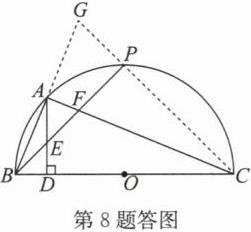
$\because P为半圆弧的中点,A是\overset{\frown}{BP}的中点,$
$\therefore ∠ PCF=∠ GBP, ∠ CPF=∠ BPG=90°, BP=PC.$
在$△ PCF$和$△ PBG$中,$\begin{cases} ∠ PCF=∠ PBG, \\ PC=PB, \\ ∠ CPF=∠ BPG, \end{cases}$
$\therefore △ PCF≌△ PBG(ASA), \therefore CF=BG.$
$\because BC为直径, \therefore ∠ BAC=90°.$
$\because A为\overset{\frown}{BP}的中点, \therefore ∠ GCA=∠ BCA.$
在$△ BAC$和$△ GAC$中,$\begin{cases} ∠ CAB=∠ CAG, \\ AC=AC, \\ ∠ BCA=∠ GCA, \end{cases}$
$\therefore △ BAC≌△ GAC(ASA), \therefore AB=AG=\frac{1}{2}BG.$
$\because CF=BG, \therefore CF=2AB.$
解析
【分析】
(1) 要证AE=BE,可通过证明两角相等得到等腰三角形。首先利用直径所对圆周角为直角及AD⊥BC的条件,由同角的余角相等推出∠BAD=∠ACB;再结合A是$\overset{\frown}{BP}$的中点,可得等弧所对的圆周角∠ACB=∠ABP,进而得到∠ABE=∠BAE,即可证得AE=BE。
(2) 判断BE与EF相等,可结合(1)的结论,转化为证明AE=EF。利用∠BAC=90°,可得∠BAE+∠EAF=∠ABF+∠AFE=90°,结合∠BAE=∠ABF,可推出∠EAF=∠EFA,得到EF=AE,进而得BE=EF。
(3) 验证CF=2AB是否成立,可构造辅助线转化线段关系:延长CP交BA的延长线于点G。先证明△PCF≌△PBG,得到CF=BG;再证明△BAC≌△GAC,得到AB=AG,即BG=2AB,即可推出CF=2AB,说明小李的发现正确。
【解析】
(1) 证明: $\because BC是直径, \therefore ∠ BAC=90°.$
$\because AD⊥ BC于点D, \therefore ∠ ADB=90°,$
$\therefore ∠ ACB + ∠ ABC=90°, ∠ BAD + ∠ ABD=90°,$
$\therefore ∠ ACB=∠ BAD.$
$\because A是\overset{\frown}{BP}的中点, \therefore ∠ ACB=∠ ABP,$
$\therefore ∠ ABE=∠ BAE, \therefore AE=BE.$
(2) 解:$BE=EF$.理由如下:
$\because BC是直径, \therefore ∠ BAC=90°,$
$\therefore ∠ BAE + ∠ EAF=90°, ∠ ABF + ∠ EFA=90°.$
$\because ∠ ABE=∠ BAE, \therefore ∠ EAF=∠ EFA, \therefore EF=AE.$
$\because AE=BE, \therefore BE=EF.$
(3) 解:小李的发现是正确的.理由如下:
如答图,连接CP并延长,与BA的延长线交于点G.
$\because P为半圆弧的中点,A是\overset{\frown}{BP}的中点,$
$\therefore ∠ PCF=∠ GBP, ∠ CPF=∠ BPG=90°, BP=PC.$
在$△ PCF$和$△ PBG$中,$\begin{cases} ∠ PCF=∠ PBG, \\ PC=PB, \\ ∠ CPF=∠ BPG, \end{cases}$
$\therefore △ PCF≌△ PBG(ASA), \therefore CF=BG.$
$\because BC为直径, \therefore ∠ BAC=90°.$
$\because A为\overset{\frown}{BP}的中点, \therefore ∠ GCA=∠ BCA.$
在$△ BAC$和$△ GAC$中,$\begin{cases} ∠ CAB=∠ CAG, \\ AC=AC, \\ ∠ BCA=∠ GCA, \end{cases}$
$\therefore △ BAC≌△ GAC(ASA), \therefore AB=AG=\frac{1}{2}BG.$
$\because CF=BG, \therefore CF=2AB.$
【答案】
(1) AE=BE,证明成立;
(2) BE=EF;
(3) 小李的发现正确,CF=2AB,辅助图如下:
【知识点】
圆周角定理;全等三角形的判定与性质;等腰三角形的判定
【点评】
本题是圆与三角形结合的综合题,考查了圆的基本性质、全等三角形的证明以及等腰三角形的判定,解题的关键是熟练运用直径所对圆周角为直角、等弧所对圆周角相等的性质,第三问通过构造辅助线将线段倍分问题转化为全等三角形对应边相等的问题,有助于锻炼几何综合思维能力。
【难度系数】
0.6
(1) 要证AE=BE,可通过证明两角相等得到等腰三角形。首先利用直径所对圆周角为直角及AD⊥BC的条件,由同角的余角相等推出∠BAD=∠ACB;再结合A是$\overset{\frown}{BP}$的中点,可得等弧所对的圆周角∠ACB=∠ABP,进而得到∠ABE=∠BAE,即可证得AE=BE。
(2) 判断BE与EF相等,可结合(1)的结论,转化为证明AE=EF。利用∠BAC=90°,可得∠BAE+∠EAF=∠ABF+∠AFE=90°,结合∠BAE=∠ABF,可推出∠EAF=∠EFA,得到EF=AE,进而得BE=EF。
(3) 验证CF=2AB是否成立,可构造辅助线转化线段关系:延长CP交BA的延长线于点G。先证明△PCF≌△PBG,得到CF=BG;再证明△BAC≌△GAC,得到AB=AG,即BG=2AB,即可推出CF=2AB,说明小李的发现正确。
【解析】
(1) 证明: $\because BC是直径, \therefore ∠ BAC=90°.$
$\because AD⊥ BC于点D, \therefore ∠ ADB=90°,$
$\therefore ∠ ACB + ∠ ABC=90°, ∠ BAD + ∠ ABD=90°,$
$\therefore ∠ ACB=∠ BAD.$
$\because A是\overset{\frown}{BP}的中点, \therefore ∠ ACB=∠ ABP,$
$\therefore ∠ ABE=∠ BAE, \therefore AE=BE.$
(2) 解:$BE=EF$.理由如下:
$\because BC是直径, \therefore ∠ BAC=90°,$
$\therefore ∠ BAE + ∠ EAF=90°, ∠ ABF + ∠ EFA=90°.$
$\because ∠ ABE=∠ BAE, \therefore ∠ EAF=∠ EFA, \therefore EF=AE.$
$\because AE=BE, \therefore BE=EF.$
(3) 解:小李的发现是正确的.理由如下:
如答图,连接CP并延长,与BA的延长线交于点G.
$\because P为半圆弧的中点,A是\overset{\frown}{BP}的中点,$
$\therefore ∠ PCF=∠ GBP, ∠ CPF=∠ BPG=90°, BP=PC.$
在$△ PCF$和$△ PBG$中,$\begin{cases} ∠ PCF=∠ PBG, \\ PC=PB, \\ ∠ CPF=∠ BPG, \end{cases}$
$\therefore △ PCF≌△ PBG(ASA), \therefore CF=BG.$
$\because BC为直径, \therefore ∠ BAC=90°.$
$\because A为\overset{\frown}{BP}的中点, \therefore ∠ GCA=∠ BCA.$
在$△ BAC$和$△ GAC$中,$\begin{cases} ∠ CAB=∠ CAG, \\ AC=AC, \\ ∠ BCA=∠ GCA, \end{cases}$
$\therefore △ BAC≌△ GAC(ASA), \therefore AB=AG=\frac{1}{2}BG.$
$\because CF=BG, \therefore CF=2AB.$
【答案】
(1) AE=BE,证明成立;
(2) BE=EF;
(3) 小李的发现正确,CF=2AB,辅助图如下:
【知识点】
圆周角定理;全等三角形的判定与性质;等腰三角形的判定
【点评】
本题是圆与三角形结合的综合题,考查了圆的基本性质、全等三角形的证明以及等腰三角形的判定,解题的关键是熟练运用直径所对圆周角为直角、等弧所对圆周角相等的性质,第三问通过构造辅助线将线段倍分问题转化为全等三角形对应边相等的问题,有助于锻炼几何综合思维能力。
【难度系数】
0.6
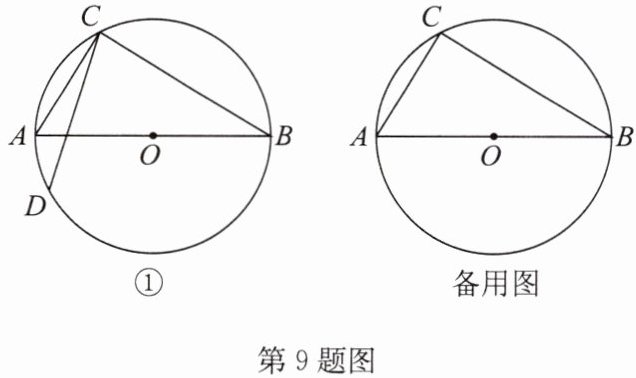
9.(2025·苏州工业园区月考)如图①,$\odot O$为$\mathrm{Rt}△ ABC$的外接圆,$AB$是直径,$BC=4\sqrt{3},AC=4$,$D$是$\odot O$上的动点,且点$C,D$分别位于$AB$的两侧.
(1)求$\odot O$的半径.
(2)当$CD=4\sqrt{2}$时,求$∠ ACD$的度数.
(3)连接$AD$,设$AD$的中点为$M$,在点$D$的运动过程中,线段$CM$是否存在最大值?若存在,求出$CM$的最大值.
(1)求$\odot O$的半径.
(2)当$CD=4\sqrt{2}$时,求$∠ ACD$的度数.
(3)连接$AD$,设$AD$的中点为$M$,在点$D$的运动过程中,线段$CM$是否存在最大值?若存在,求出$CM$的最大值.
答案
9.解:(1)$\because AB是直径, \therefore ∠ ACB=90°,$
$\therefore AB=\sqrt{AC^2+BC^2}=\sqrt{4^2+(4\sqrt{3})^2}=8,$
即$\odot O$的半径为4.
(2)如答图①,连接OC,OD.
$\because CD=4\sqrt{2}, OC=OD=4, \therefore CD^2=OC^2+OD^2,$
$\therefore ∠ COD=90°, \therefore ∠ OCD=45°.$
$\because AC=OC=OA, \therefore △ AOC是等边三角形,$
$\therefore ∠ ACO=60°, \therefore ∠ ACD=∠ ACO-∠ DCO=60°-45°=15°.$
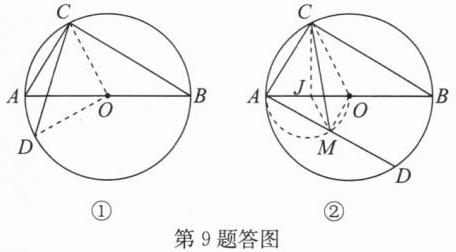
(3)存在.如答图②,连接OM,OC.
$\because AM=MD, \therefore OM⊥ AD, \therefore 点M的运动轨迹是以AO为直径的半圆J.连接CJ,JM.$
$\because △ AOC是等边三角形, AJ=OJ, \therefore CJ⊥ OA,$
$\therefore CJ=\sqrt{AC^2-AJ^2}=2\sqrt{3}.$
$\because CM≤ CJ+JM=2\sqrt{3}+2, \therefore CM的最大值为2\sqrt{3}+2.$
解析
【分析】
(1) 已知AB是Rt△ABC外接圆的直径,根据直径所对圆周角为直角可得∠ACB=90°,利用勾股定理计算AB长度后除以2即可得到圆的半径。
(2) 求∠ACD的度数时,先连接OC、OD,通过边长关系用勾股定理逆定理判断△OCD为等腰直角三角形,得到∠OCD=45°;再结合AC=OC=OA判断△AOC为等边三角形,得到∠ACO=60°,两角作差即可得到结果。
(3) 分析CM的最大值,先确定点M的运动轨迹:M是AD中点,由垂径定理得OM⊥AD,即∠AMO=90°,因此M的轨迹是以AO为直径的圆;再根据圆外一点到圆上点的最大距离等于该点到圆心的距离加圆的半径,计算对应线段长度相加即可。
【解析】
(1) $\because AB$是直径,$\therefore ∠ ACB=90°$,
由勾股定理得$AB=\sqrt{AC^2+BC^2}=\sqrt{4^2+(4\sqrt{3})^2}=8$,
$\therefore \odot O$的半径为$8÷2=4$。
(2) 如答图①,连接OC,OD。
$\because OC=OD=4$,$CD=4\sqrt{2}$,
$\therefore CD^2=(4\sqrt{2})^2=32$,$OC^2+OD^2=4^2+4^2=32$,即$CD^2=OC^2+OD^2$,
$\therefore ∠ COD=90°$,$△ OCD$是等腰直角三角形,$\therefore ∠ OCD=45°$,
$\because AC=OC=OA=4$,$\therefore △ AOC$是等边三角形,$\therefore ∠ ACO=60°$,
$\therefore ∠ ACD=∠ ACO - ∠ DCO=60° - 45°=15°$。
(3) 存在,求解如下:
如答图②,连接OM,OC。
$\because M$是AD的中点,O是圆心,$\therefore OM⊥ AD$(垂径定理),即$∠ AMO=90°$,
$\therefore$点M的运动轨迹是以AO为直径的半圆J,连接CJ,JM。
$\because △ AOC$是等边三角形,$AJ=OJ$,$\therefore CJ⊥ OA$,
在Rt$△ ACJ$中,$AJ=\frac{1}{2}AO=2$,$AC=4$,
$\therefore CJ=\sqrt{AC^2 - AJ^2}=\sqrt{4^2 - 2^2}=2\sqrt{3}$,
$\because JM$是半圆J的半径,$\therefore JM=\frac{1}{2}AO=2$,
根据两点之间线段最短,$CM≤ CJ + JM=2\sqrt{3}+2$,当且仅当C、J、M三点共线时取等号,
$\therefore CM$的最大值为$2\sqrt{3}+2$。
【答案】
(1) $\odot O$的半径为$\boldsymbol{4}$;
(2) $∠ ACD$的度数为$\boldsymbol{15°}$;
(3) 存在,CM的最大值为$\boldsymbol{2\sqrt{3}+2}$。
【知识点】
圆周角定理,勾股定理,垂径定理
【点评】
本题综合考查圆的基本性质、特殊三角形的判定与性质以及动点最值问题,前两问侧重基础定理的应用,第三问需要结合动点轨迹分析最值,能有效考查几何综合分析能力。
【难度系数】
0.65
(1) 已知AB是Rt△ABC外接圆的直径,根据直径所对圆周角为直角可得∠ACB=90°,利用勾股定理计算AB长度后除以2即可得到圆的半径。
(2) 求∠ACD的度数时,先连接OC、OD,通过边长关系用勾股定理逆定理判断△OCD为等腰直角三角形,得到∠OCD=45°;再结合AC=OC=OA判断△AOC为等边三角形,得到∠ACO=60°,两角作差即可得到结果。
(3) 分析CM的最大值,先确定点M的运动轨迹:M是AD中点,由垂径定理得OM⊥AD,即∠AMO=90°,因此M的轨迹是以AO为直径的圆;再根据圆外一点到圆上点的最大距离等于该点到圆心的距离加圆的半径,计算对应线段长度相加即可。
【解析】
(1) $\because AB$是直径,$\therefore ∠ ACB=90°$,
由勾股定理得$AB=\sqrt{AC^2+BC^2}=\sqrt{4^2+(4\sqrt{3})^2}=8$,
$\therefore \odot O$的半径为$8÷2=4$。
(2) 如答图①,连接OC,OD。
$\because OC=OD=4$,$CD=4\sqrt{2}$,
$\therefore CD^2=(4\sqrt{2})^2=32$,$OC^2+OD^2=4^2+4^2=32$,即$CD^2=OC^2+OD^2$,
$\therefore ∠ COD=90°$,$△ OCD$是等腰直角三角形,$\therefore ∠ OCD=45°$,
$\because AC=OC=OA=4$,$\therefore △ AOC$是等边三角形,$\therefore ∠ ACO=60°$,
$\therefore ∠ ACD=∠ ACO - ∠ DCO=60° - 45°=15°$。
(3) 存在,求解如下:
如答图②,连接OM,OC。
$\because M$是AD的中点,O是圆心,$\therefore OM⊥ AD$(垂径定理),即$∠ AMO=90°$,
$\therefore$点M的运动轨迹是以AO为直径的半圆J,连接CJ,JM。
$\because △ AOC$是等边三角形,$AJ=OJ$,$\therefore CJ⊥ OA$,
在Rt$△ ACJ$中,$AJ=\frac{1}{2}AO=2$,$AC=4$,
$\therefore CJ=\sqrt{AC^2 - AJ^2}=\sqrt{4^2 - 2^2}=2\sqrt{3}$,
$\because JM$是半圆J的半径,$\therefore JM=\frac{1}{2}AO=2$,
根据两点之间线段最短,$CM≤ CJ + JM=2\sqrt{3}+2$,当且仅当C、J、M三点共线时取等号,
$\therefore CM$的最大值为$2\sqrt{3}+2$。
【答案】
(1) $\odot O$的半径为$\boldsymbol{4}$;
(2) $∠ ACD$的度数为$\boldsymbol{15°}$;
(3) 存在,CM的最大值为$\boldsymbol{2\sqrt{3}+2}$。
【知识点】
圆周角定理,勾股定理,垂径定理
【点评】
本题综合考查圆的基本性质、特殊三角形的判定与性质以及动点最值问题,前两问侧重基础定理的应用,第三问需要结合动点轨迹分析最值,能有效考查几何综合分析能力。
【难度系数】
0.65
