

 登录
登录
一、写出序数词。
1. one—
2. two—
3. three—
4. four—
5. five—
6. eight—
7. nine—
8. twelve—
9. thirteen—
10. twenty—
11. twenty-one—
序数词的变化口诀详见“答案与解析”P6
1. one—
first
2. two—
second
3. three—
third
4. four—
fourth
5. five—
fifth
6. eight—
eighth
7. nine—
ninth
8. twelve—
twelfth
9. thirteen—
thirteenth
10. twenty—
twentieth
11. twenty-one—
twenty-first
序数词的变化口诀详见“答案与解析”P6
答案
1. first 2. second 3. third 4. fourth
5. fifth 6. eighth 7. ninth 8. twelfth
9. thirteenth 10. twentieth 11. twenty-first
方法归纳
序数词的变化口诀
基变序,有规律,一二三特殊记,词尾字母t、d、d。八减t,九减e,ve要用f替。
ty把y变成i,th前面有个e。若是碰到几十几,只变个位就可以。
5. fifth 6. eighth 7. ninth 8. twelfth
9. thirteenth 10. twentieth 11. twenty-first
方法归纳
序数词的变化口诀
基变序,有规律,一二三特殊记,词尾字母t、d、d。八减t,九减e,ve要用f替。
ty把y变成i,th前面有个e。若是碰到几十几,只变个位就可以。
解析
【分析】
本题考查基数词转换为序数词,需牢记基数词变序数词的规则:1、2、3为特殊变化;8减t,9减e,ve变f,ty变i加th;几十几的数只需变化个位的基数词为序数词。按照规则依次转换每个基数词即可。
【解析】
根据基数词变序数词的规则逐一转换:
1. one为特殊变化,对应序数词first;
2. two为特殊变化,对应second;
3. three为特殊变化,对应third;
4. four直接加th,对应fourth;
5. five的ve变f加th,对应fifth;
6. eight减t加h,对应eighth;
7. nine减e加th,对应ninth;
8. twelve的ve变f加th,对应twelfth;
9. thirteen直接加th,对应thirteenth;
10. twenty的ty变i加eth,对应twentieth;
11. twenty-one只需将个位one变为first,即twenty-first。
【答案】
1. first 2. second 3. third 4. fourth 5. fifth 6. eighth 7. ninth 8. twelfth 9. thirteenth 10. twentieth 11. twenty-first
【知识点】
基数词变序数词规则;英语序数词
【点评】
本题为英语基础题型,考察基数词转序数词的核心规则,涵盖特殊变化与一般变化,是英语数词知识点的基础应用,需准确记忆规则完成转换。
【难度系数】
0.8
本题考查基数词转换为序数词,需牢记基数词变序数词的规则:1、2、3为特殊变化;8减t,9减e,ve变f,ty变i加th;几十几的数只需变化个位的基数词为序数词。按照规则依次转换每个基数词即可。
【解析】
根据基数词变序数词的规则逐一转换:
1. one为特殊变化,对应序数词first;
2. two为特殊变化,对应second;
3. three为特殊变化,对应third;
4. four直接加th,对应fourth;
5. five的ve变f加th,对应fifth;
6. eight减t加h,对应eighth;
7. nine减e加th,对应ninth;
8. twelve的ve变f加th,对应twelfth;
9. thirteen直接加th,对应thirteenth;
10. twenty的ty变i加eth,对应twentieth;
11. twenty-one只需将个位one变为first,即twenty-first。
【答案】
1. first 2. second 3. third 4. fourth 5. fifth 6. eighth 7. ninth 8. twelfth 9. thirteenth 10. twentieth 11. twenty-first
【知识点】
基数词变序数词规则;英语序数词
【点评】
本题为英语基础题型,考察基数词转序数词的核心规则,涵盖特殊变化与一般变化,是英语数词知识点的基础应用,需准确记忆规则完成转换。
【难度系数】
0.8
二、完形填空。
The 15th day of the first lunar month is the Lantern Festival. It's important festival in China. People celebrate it in many ways. In the evening, there many beautiful lantern shows in parks and streets. Lanterns are often red red means happiness and good luck in China. People nice lanterns with paper and other things. Some are in the of rabbits, birds and boats. Some look like dragons and cartoon stars. There are colourful lanterns everywhere. In some cities, there is a big lantern show night. are the special food for this festival. Families always and have a good dinner. After that, people go out to . They sing and dance happily and have great fun.
(
(
(
(
(
(
(
(
(
(
The 15th day of the first lunar month is the Lantern Festival. It's important festival in China. People celebrate it in many ways. In the evening, there many beautiful lantern shows in parks and streets. Lanterns are often red red means happiness and good luck in China. People nice lanterns with paper and other things. Some are in the of rabbits, birds and boats. Some look like dragons and cartoon stars. There are colourful lanterns everywhere. In some cities, there is a big lantern show night. are the special food for this festival. Families always and have a good dinner. After that, people go out to . They sing and dance happily and have great fun.
(
A
)1. A. an B. a C. the(
C
)2. A. have B. has C. are(
A
)3. A. because B. and C. so(
B
)4. A. do B. make C. cut(
C
)5. A. colour B. size C. shape(
B
)6. A. a lot B. lots of C. much(
B
)7. A. on B. at C. in(
C
)8. A. Rice dumplings B. Dumplings C. Sweet dumplings(
C
)9. A. go in B. play games C. get together(
B
)10. A. climb mountains B. do fun things C. make lanterns答案
1. A 解析:important以元音音素开头,用an。 2. C 3. A 解析:后面解释为什么灯笼是红色的,此处用because。 4. B 解析:make lanterns做灯笼。 5. C 解析:in the shape of ...以……的形状。 6. B 7. B 解析:at night在晚上。 8. C 解析:元宵节吃汤圆,sweet dumplings汤圆。 9. C 10. B
解析
【分析】
先通读全文,明确文章围绕中国元宵节展开,再结合语法规则、固定搭配、词义辨析及节日常识逐一分析每个空:
1. 第1空:需判断冠词,important以元音音素开头,表泛指用an;
2. 第2空:考查there be句型,主语many beautiful lantern shows是复数,be动词用are;
3. 第3空:后文解释灯笼为红色的原因,需用表原因的连词because;
4. 第4空:固定搭配make lanterns意为“制作灯笼”,符合语境;
5. 第5空:in the shape of是固定短语,表“以……的形状”,对应后文兔子、鸟等造型;
6. 第6空:修饰可数名词复数lanterns,lots of可修饰可数/不可数名词,符合要求;
7. 第7空:固定搭配at night意为“在晚上”;
8. 第8空:元宵节的特色食物是汤圆,对应sweet dumplings;
9. 第9空:家人过节的常规动作是团聚,get together符合语境;
10. 第10空:后文提到唱歌跳舞,对应do fun things(做有趣的事)。
【解析】
1. 选A:important以元音音素开头,泛指“一个重要的节日”,用不定冠词an;
2. 选C:there be句型遵循就近原则,主语lantern shows是复数,be动词用are;
3. 选A:后文解释灯笼为红色的原因,用because引导原因状语从句;
4. 选B:make lanterns是固定短语,意为“制作灯笼”,符合语境;
5. 选C:in the shape of是固定搭配,表“以……的形状”,对应后文的各种造型;
6. 选B:lots of可修饰可数名词复数,符合修饰lanterns的要求;
7. 选B:at night是固定短语,意为“在晚上”;
8. 选C:元宵节的特色食物是汤圆,对应sweet dumplings;
9. 选C:get together意为“团聚”,符合家人过节的场景;
10. 选B:后文提到唱歌跳舞等活动,对应do fun things(做有趣的事)。
【答案】
1.A 2.C 3.A 4.B 5.C 6.B 7.B 8.C 9.C 10.B
【知识点】
冠词用法、there be句型、固定搭配
【点评】
本题围绕元宵节主题,考察基础语法、固定搭配及节日相关词汇,贴近生活,侧重基础知识的应用,适合巩固初中英语完形填空的解题能力。
【难度系数】
0.7
先通读全文,明确文章围绕中国元宵节展开,再结合语法规则、固定搭配、词义辨析及节日常识逐一分析每个空:
1. 第1空:需判断冠词,important以元音音素开头,表泛指用an;
2. 第2空:考查there be句型,主语many beautiful lantern shows是复数,be动词用are;
3. 第3空:后文解释灯笼为红色的原因,需用表原因的连词because;
4. 第4空:固定搭配make lanterns意为“制作灯笼”,符合语境;
5. 第5空:in the shape of是固定短语,表“以……的形状”,对应后文兔子、鸟等造型;
6. 第6空:修饰可数名词复数lanterns,lots of可修饰可数/不可数名词,符合要求;
7. 第7空:固定搭配at night意为“在晚上”;
8. 第8空:元宵节的特色食物是汤圆,对应sweet dumplings;
9. 第9空:家人过节的常规动作是团聚,get together符合语境;
10. 第10空:后文提到唱歌跳舞,对应do fun things(做有趣的事)。
【解析】
1. 选A:important以元音音素开头,泛指“一个重要的节日”,用不定冠词an;
2. 选C:there be句型遵循就近原则,主语lantern shows是复数,be动词用are;
3. 选A:后文解释灯笼为红色的原因,用because引导原因状语从句;
4. 选B:make lanterns是固定短语,意为“制作灯笼”,符合语境;
5. 选C:in the shape of是固定搭配,表“以……的形状”,对应后文的各种造型;
6. 选B:lots of可修饰可数名词复数,符合修饰lanterns的要求;
7. 选B:at night是固定短语,意为“在晚上”;
8. 选C:元宵节的特色食物是汤圆,对应sweet dumplings;
9. 选C:get together意为“团聚”,符合家人过节的场景;
10. 选B:后文提到唱歌跳舞等活动,对应do fun things(做有趣的事)。
【答案】
1.A 2.C 3.A 4.B 5.C 6.B 7.B 8.C 9.C 10.B
【知识点】
冠词用法、there be句型、固定搭配
【点评】
本题围绕元宵节主题,考察基础语法、固定搭配及节日相关词汇,贴近生活,侧重基础知识的应用,适合巩固初中英语完形填空的解题能力。
【难度系数】
0.7
三、新素材 阅读绘本,在横线上填入合适的单词,再按故事的发展排序。
A. [图] Long ago, a mother crow and her babies lived in a big tree. The babies were too young. They stayed in the nest and made small noises.
B.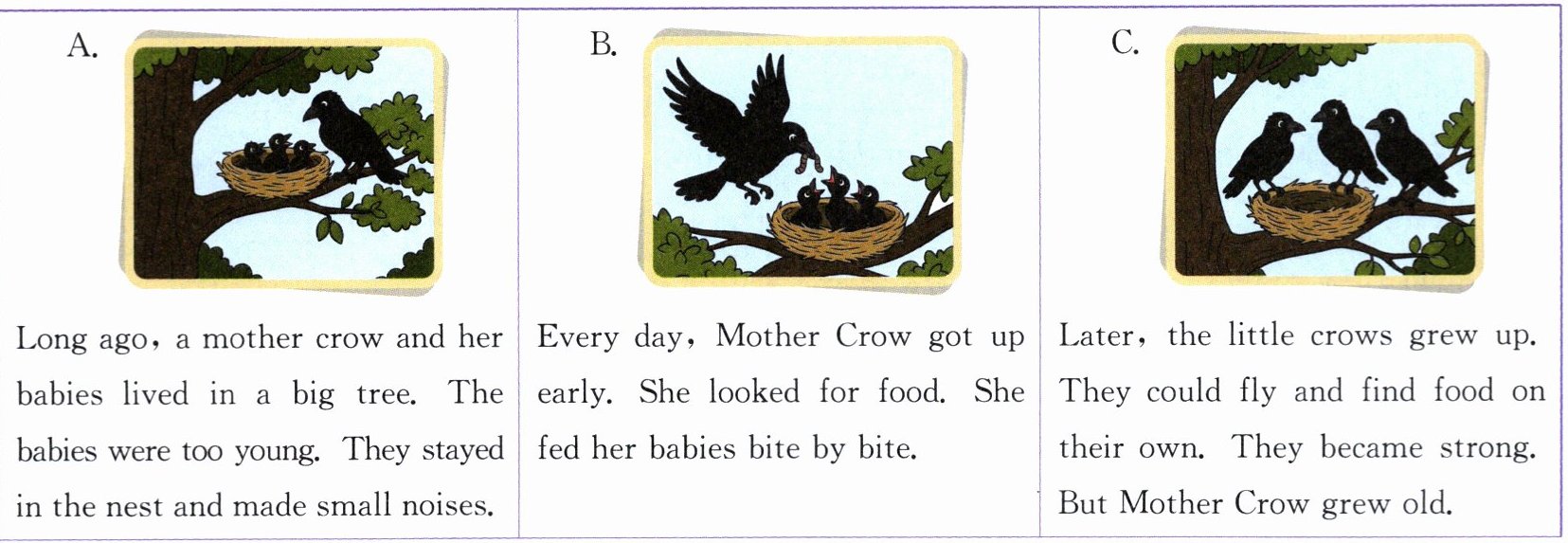 Every day, Mother Crow got up early. She looked for food. She fed her babies bite by bite.
C. [图] Later, the little crows grew up. They could fly and find food on their own. They became strong. But Mother Crow grew old.
D. [图] She couldn't fly or look for food. The little crows remembered their mother's love. So they took turns to find food. They brought it home.
E.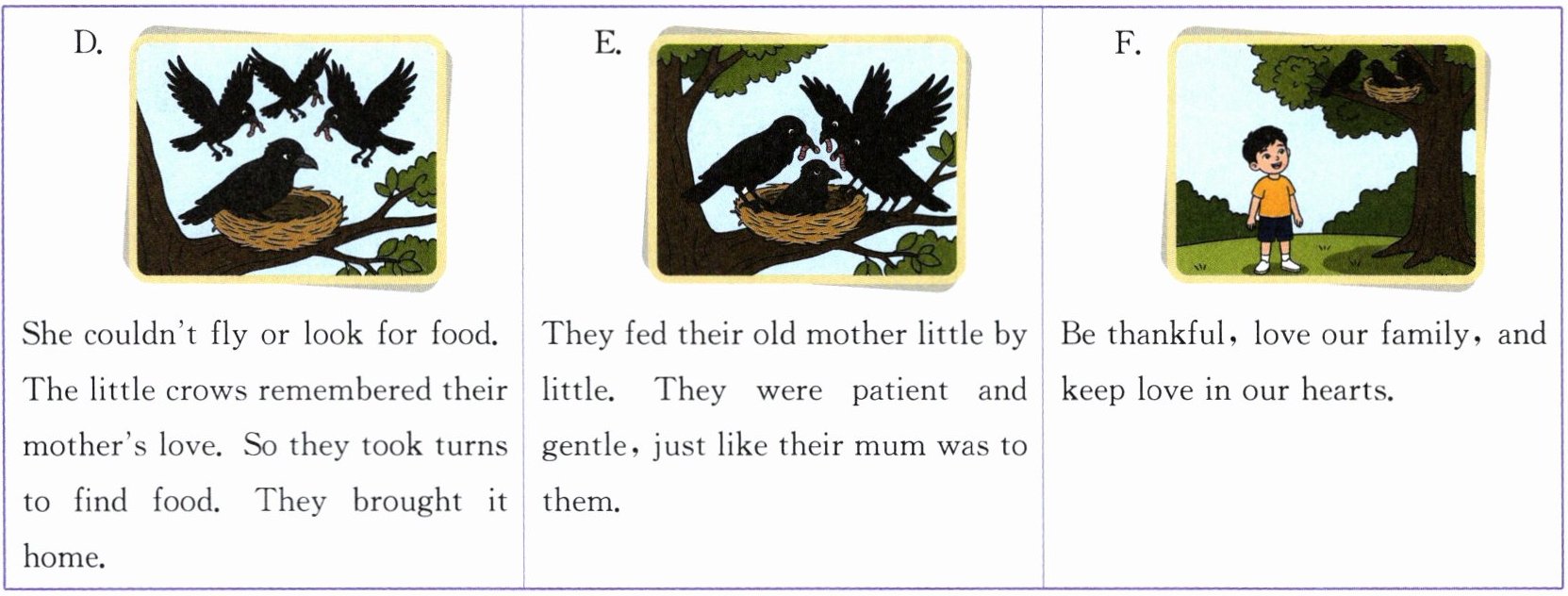 They fed their old mother little by little. They were patient and gentle, just like their mum was to them.
F. [图] Be thankful, love our family, and keep love in our hearts.
(
(
(
(
(
A. [图] Long ago, a mother crow and her babies lived in a big tree. The babies were too young. They stayed in the nest and made small noises.
B.
Every day, Mother Crow got up early. She looked for food. She fed her babies bite by bite.C. [图] Later, the little crows grew up. They could fly and find food on their own. They became strong. But Mother Crow grew old.
D. [图] She couldn't fly or look for food. The little crows remembered their mother's love. So they took turns to find food. They brought it home.
E.
They fed their old mother little by little. They were patient and gentle, just like their mum was to them.F. [图] Be thankful, love our family, and keep love in our hearts.
(
5
) The little crows 1. fed
their old mother little by little.(
1
) A mother crow and her babies 2. lived
in a big tree.(
3
) The little crows 3. grew
up, but Mother Crow became old.(
2
) Mother Crow looked for food and fed her 4. babies
.(
4
) Mother Crow could not look for food, so her babies 5. found
food for her.答案
1. fed 2. lived 3. grew 4. babies
5. found 5 1 3 2 4
5. found 5 1 3 2 4
解析
【分析】首先,需结合绘本故事语境确定空格处的合适单词(故事为过去时态,需用动词过去式);再梳理故事发展的先后逻辑,将句子按顺序排列。第一步,分析每个句子的空格:1. 句意为小乌鸦一点一点喂老妈妈,需填“喂”的过去式;2. 句意为乌鸦妈妈和宝宝住在大树里,需填“居住”的过去式;3. 句意为小乌鸦长大,需填“成长”的过去式;4. 句意为妈妈喂她的宝宝,需填对应名词;5. 句意为宝宝找食物,需填“找到”的过去式。第二步,梳理故事顺序:先讲乌鸦母子居住在大树,再讲妈妈找食喂宝宝,接着宝宝长大妈妈变老,然后妈妈不能找食宝宝找食,最后宝宝喂妈妈,据此排列句子序号。
【解析】1. 根据“小乌鸦一点一点______老妈妈”的语境,用feed的过去式fed;2. 根据“乌鸦妈妈和宝宝______在大树里”的语境,用live的过去式lived;3. 根据“小乌鸦______大了”的语境,用grow的过去式grew;4. 根据“妈妈找食物喂她的______”的语境,填babies;5. 根据“宝宝______食物给她”的语境,用find的过去式found。排序时,故事发展逻辑为:母子居住→妈妈喂宝宝→宝宝长大妈妈变老→妈妈不能找食宝宝找食→宝宝喂妈妈,对应括号序号为5、1、3、2、4。
【答案】1. fed 2. lived 3. grew 4. babies
5. found 5 1 3 2 4
【知识点】动词过去式、英语阅读理解、故事排序
【点评】本题结合绘本素材,既考查英语词汇的语境运用(动词过去式),又考查对故事发展逻辑的梳理,贴合小学英语的学习内容,难度适中。
【难度系数】0.6
【解析】1. 根据“小乌鸦一点一点______老妈妈”的语境,用feed的过去式fed;2. 根据“乌鸦妈妈和宝宝______在大树里”的语境,用live的过去式lived;3. 根据“小乌鸦______大了”的语境,用grow的过去式grew;4. 根据“妈妈找食物喂她的______”的语境,填babies;5. 根据“宝宝______食物给她”的语境,用find的过去式found。排序时,故事发展逻辑为:母子居住→妈妈喂宝宝→宝宝长大妈妈变老→妈妈不能找食宝宝找食→宝宝喂妈妈,对应括号序号为5、1、3、2、4。
【答案】1. fed 2. lived 3. grew 4. babies
5. found 5 1 3 2 4
【知识点】动词过去式、英语阅读理解、故事排序
【点评】本题结合绘本素材,既考查英语词汇的语境运用(动词过去式),又考查对故事发展逻辑的梳理,贴合小学英语的学习内容,难度适中。
【难度系数】0.6
