

 登录
登录
一、完形填空
First day
German (德国的) children usually begin school at six. $\underline{\quad1\quad}$ the first day of school, parents or friends $\underline{\quad2\quad}$ the child a big colorful gift (礼物). It usually has candy, a pencil box and a fountain pen (水笔) in it. Most German children learn to write with a fountain pen.
School schedule
The school day $\underline{\quad3\quad}$ at about 8 a.m. Around 10 there is a short break. The school day is over around 2 p.m. Students go home for a hot meal (一顿饭) at lunch. $\underline{\quad4\quad}$ is also the biggest meal of the day. Pupils get out of school early in Germany, $\underline{\quad5\quad}$ they do a lot of homework. In some states in Germany, kids also have school on Saturdays!
Choice of classes
German classes are like the ones in China, but some of the $\underline{\quad6\quad}$ are different. Children study math, science, literature, music and art, history and geography. They also have gym classes. In grade 3, they start foreign (外国的) $\underline{\quad7\quad}$ study. All students learn English, but in grades 5 and 7 they can take up $\underline{\quad8\quad}$ languages. They can learn French (法语), Latin, Spanish or Russian.
After-school $\underline{\quad9\quad}$
After school and homework, teens usually meet their friends and go out to the movies, cafés, shops or discos. On the weekend, they $\underline{\quad10\quad}$ time with their families.
( ) 1. A. At B. On C. In D. Before
( ) 2. A. give B. make C. design D. introduce
( ) 3. A. goes B. ends C. leaves D. starts
( ) 4. A. It B. He C. They D. We
( ) 5. A. and B. but C. also D. or
( ) 6. A. homework B. housework C. exercises D. subjects
( ) 7. A. sports B. language C. painting D. science
( ) 8. A. both B. some C. other D. all
( ) 9. A. events B. classes C. clubs D. activities
( ) 10. A. take B. chat C. spend D. hope
First day
German (德国的) children usually begin school at six. $\underline{\quad1\quad}$ the first day of school, parents or friends $\underline{\quad2\quad}$ the child a big colorful gift (礼物). It usually has candy, a pencil box and a fountain pen (水笔) in it. Most German children learn to write with a fountain pen.
School schedule
The school day $\underline{\quad3\quad}$ at about 8 a.m. Around 10 there is a short break. The school day is over around 2 p.m. Students go home for a hot meal (一顿饭) at lunch. $\underline{\quad4\quad}$ is also the biggest meal of the day. Pupils get out of school early in Germany, $\underline{\quad5\quad}$ they do a lot of homework. In some states in Germany, kids also have school on Saturdays!
Choice of classes
German classes are like the ones in China, but some of the $\underline{\quad6\quad}$ are different. Children study math, science, literature, music and art, history and geography. They also have gym classes. In grade 3, they start foreign (外国的) $\underline{\quad7\quad}$ study. All students learn English, but in grades 5 and 7 they can take up $\underline{\quad8\quad}$ languages. They can learn French (法语), Latin, Spanish or Russian.
After-school $\underline{\quad9\quad}$
After school and homework, teens usually meet their friends and go out to the movies, cafés, shops or discos. On the weekend, they $\underline{\quad10\quad}$ time with their families.
( ) 1. A. At B. On C. In D. Before
( ) 2. A. give B. make C. design D. introduce
( ) 3. A. goes B. ends C. leaves D. starts
( ) 4. A. It B. He C. They D. We
( ) 5. A. and B. but C. also D. or
( ) 6. A. homework B. housework C. exercises D. subjects
( ) 7. A. sports B. language C. painting D. science
( ) 8. A. both B. some C. other D. all
( ) 9. A. events B. classes C. clubs D. activities
( ) 10. A. take B. chat C. spend D. hope
答案
B
; A
; D
; A
; B
; D
; B
; C
; D
; C
; A
; D
; A
; B
; D
; B
; C
; D
; C
二、阅读理解
A
Our English teacher Ms Chen wrote the sentence (句子) on the blackboard and said, “Please write this down.”
We started to write. I wrote down the first word and stopped.
“That’s not right. But is it OK to point out the mistake (错误)? Is that polite, in the first lesson?” Questions jumped into my mind (脑海).
“Why aren’t you writing, Wang Han?”
I looked up at Ms Chen. My eyes met hers. My mouth felt dry (干的).
But then I thought about the meaning (意思) of the sentence. I put up my hand.
“Ms Chen, there’s a mistake,” I said. “That sentence is from Confucius, not from Mencius.
“Well done, Wang Han. In fact, this is my first lesson for all of you. You are now in junior high school. Learning will be more difficult. It’s important to think more in your learning. As Confucius said: It is no use learning without thinking. Please always remember this.”
That’s really an important (重要的) lesson!
( ) 1. What lesson is it according to (根据) the text?
A. Ms Chen’s first lesson in English.
B. Ms Chen’s first Chinese lesson.
C. Wang Han’s first lesson about Chinese language.
D. Wang Han’s first English lesson in Grade 7.
( ) 2. Why did Wang Han stop writing?
A. Because he found something wrong.
B. Because he found the sentence special.
C. Because he found many questions coming into his mind.
D. Because he was thinking of the meaning of the sentence.
( ) 3. Why did Wang Han’s mouth feel dry?
A. Because he found a mistake.
B. Because he stopped writing.
C. Because he didn’t feel well.
D. Because he looked into Ms Chen’s eyes.
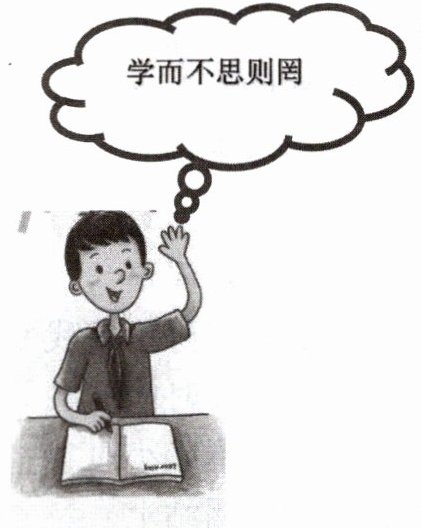
( ) 4. What does the sentence on the blackboard mean in Chinese?
A. 温故而知新
B. 学而不思则罔
C. 思而不学则殆
D. 三人行,必有我师
( ) 5. What lesson does the writer learn in the text?
A. Learning is very difficult.
B. Questioning the teaching is important.
C. Thinking more when learning.
D. Finding mistakes is very important.
A
Our English teacher Ms Chen wrote the sentence (句子) on the blackboard and said, “Please write this down.”
We started to write. I wrote down the first word and stopped.
“That’s not right. But is it OK to point out the mistake (错误)? Is that polite, in the first lesson?” Questions jumped into my mind (脑海).
“Why aren’t you writing, Wang Han?”
I looked up at Ms Chen. My eyes met hers. My mouth felt dry (干的).
But then I thought about the meaning (意思) of the sentence. I put up my hand.
“Ms Chen, there’s a mistake,” I said. “That sentence is from Confucius, not from Mencius.
“Well done, Wang Han. In fact, this is my first lesson for all of you. You are now in junior high school. Learning will be more difficult. It’s important to think more in your learning. As Confucius said: It is no use learning without thinking. Please always remember this.”
That’s really an important (重要的) lesson!
( ) 1. What lesson is it according to (根据) the text?
A. Ms Chen’s first lesson in English.
B. Ms Chen’s first Chinese lesson.
C. Wang Han’s first lesson about Chinese language.
D. Wang Han’s first English lesson in Grade 7.
( ) 2. Why did Wang Han stop writing?
A. Because he found something wrong.
B. Because he found the sentence special.
C. Because he found many questions coming into his mind.
D. Because he was thinking of the meaning of the sentence.
( ) 3. Why did Wang Han’s mouth feel dry?
A. Because he found a mistake.
B. Because he stopped writing.
C. Because he didn’t feel well.
D. Because he looked into Ms Chen’s eyes.
( ) 4. What does the sentence on the blackboard mean in Chinese?
A. 温故而知新
B. 学而不思则罔
C. 思而不学则殆
D. 三人行,必有我师
( ) 5. What lesson does the writer learn in the text?
A. Learning is very difficult.
B. Questioning the teaching is important.
C. Thinking more when learning.
D. Finding mistakes is very important.
答案
D
; A
; D
; B
; C
; A
; D
; B
; C
