

 登录
登录
Ⅰ. 阅读理解
A
Nowadays, with the development of science and technology, people in China can do many things online. Many people even travel online because they are too busy and have no time to travel. But there are many people choosing offline tours(线下旅游). I did a survey among 500 women and 500 men from 1 November to 2 November. Here are the results.
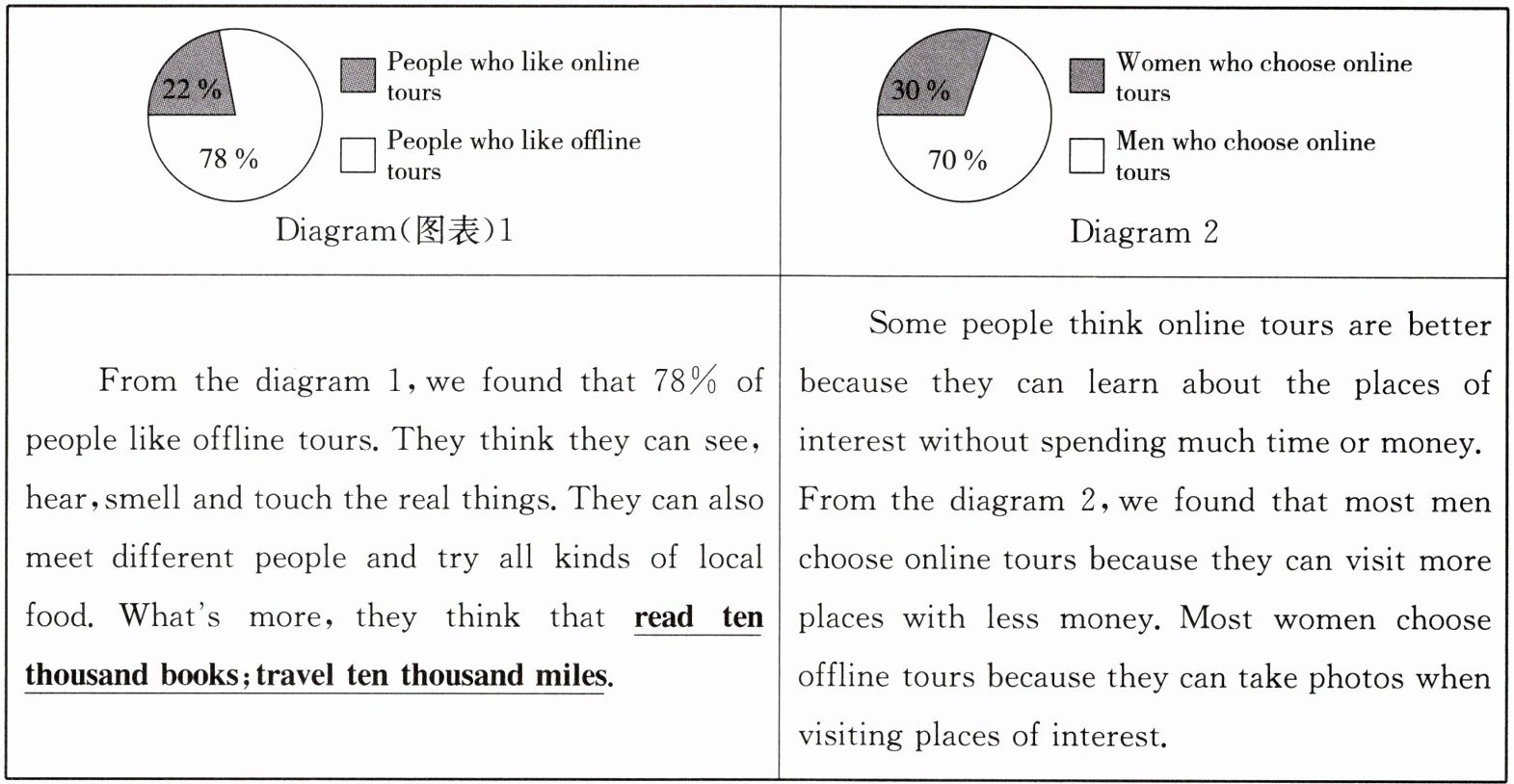
From the diagram 1, we found that 78% of people like offline tours. They think they can see, hear, smell and touch the real things. They can also meet different people and try all kinds of local food. What's more, they think that read ten thousand books; travel ten thousand miles.
Some people think online tours are better because they can learn about the places of interest without spending much time or money. From the diagram 2, we found that most men choose online tours because they can visit more places with less money. Most women choose offline tours because they can take photos when visiting places of interest.
If you want to travel, which will you choose, online tours or offline tours?
(
A. 110.
B. 220.
C. 390.
D. 780.
(
A. 千里之行,始于足下。
B. 旅行是最好的老师。
C. 读万卷书,行万里路。
D. 行百里者半九十。
(
A. A storybook.
B. A science report.
C. A medical website.
D. A travel magazine.
A
Nowadays, with the development of science and technology, people in China can do many things online. Many people even travel online because they are too busy and have no time to travel. But there are many people choosing offline tours(线下旅游). I did a survey among 500 women and 500 men from 1 November to 2 November. Here are the results.
From the diagram 1, we found that 78% of people like offline tours. They think they can see, hear, smell and touch the real things. They can also meet different people and try all kinds of local food. What's more, they think that read ten thousand books; travel ten thousand miles.
Some people think online tours are better because they can learn about the places of interest without spending much time or money. From the diagram 2, we found that most men choose online tours because they can visit more places with less money. Most women choose offline tours because they can take photos when visiting places of interest.
If you want to travel, which will you choose, online tours or offline tours?
(
B
)1.【数字计算题】How many people choose online tours according to the text?A. 110.
B. 220.
C. 390.
D. 780.
(
C
)2.【句义猜测题】What does the underlined sentence mean in Chinese?A. 千里之行,始于足下。
B. 旅行是最好的老师。
C. 读万卷书,行万里路。
D. 行百里者半九十。
(
D
)3.【文本出处题】Where is this text most probably from?A. A storybook.
B. A science report.
C. A medical website.
D. A travel magazine.
答案
1. B 2. C 3. D
解析
【分析】
本题包含三类英语阅读理解题型:第1题是数字计算题,需先确定调查总人数,再结合图表占比计算结果;第2题是句义猜测题,需结合英文谚语的字面意思和中文对应谚语判断;第3题是文本出处题,需根据文章核心内容判断适用场景。
【解析】
1. 数字计算题:首先,调查总人数为500名女性+500名男性=1000人;图表1显示选择在线旅游的人数占比为22%,因此选择在线旅游的人数为1000×22%=220,对应选项B。
2. 句义猜测题:划线句“read ten thousand books; travel ten thousand miles”字面含义为读一万卷书,行一万里路,对应的中文谚语是“读万卷书,行万里路”,对应选项C。
3. 文本出处题:文章围绕在线旅游与线下旅游的调查结果展开,核心内容与旅游相关,最可能出自旅游杂志,对应选项D。
【答案】
1.B 2.C 3.D
【知识点】
英语阅读理解、数字计算、谚语理解
【点评】
本题涵盖数字计算、句义猜测、文本出处三类常见阅读题型,要求学生精准提取原文及图表信息,结合常识解答,整体难度适中。
【难度系数】
0.5
本题包含三类英语阅读理解题型:第1题是数字计算题,需先确定调查总人数,再结合图表占比计算结果;第2题是句义猜测题,需结合英文谚语的字面意思和中文对应谚语判断;第3题是文本出处题,需根据文章核心内容判断适用场景。
【解析】
1. 数字计算题:首先,调查总人数为500名女性+500名男性=1000人;图表1显示选择在线旅游的人数占比为22%,因此选择在线旅游的人数为1000×22%=220,对应选项B。
2. 句义猜测题:划线句“read ten thousand books; travel ten thousand miles”字面含义为读一万卷书,行一万里路,对应的中文谚语是“读万卷书,行万里路”,对应选项C。
3. 文本出处题:文章围绕在线旅游与线下旅游的调查结果展开,核心内容与旅游相关,最可能出自旅游杂志,对应选项D。
【答案】
1.B 2.C 3.D
【知识点】
英语阅读理解、数字计算、谚语理解
【点评】
本题涵盖数字计算、句义猜测、文本出处三类常见阅读题型,要求学生精准提取原文及图表信息,结合常识解答,整体难度适中。
【难度系数】
0.5
