

 登录
登录
四、任务型阅读
阅读下面短文,在文章后图表中的空格里填入一个最恰当的单词,每个空格只填1个单词。
体裁: 议论文
主题: 学校生活
难度: ★★★★★
建议用时: 9 min
正确率: /10
Some people say growing food is good for the mind and body.
What you need to know
• Food growing has been taught in schools for more than 100 years in the UK.
• At most schools, food growing is an extracurricular(课外的) activity. This means it's usually an after-class club instead of a lesson like English or maths.
• The number of school students in the UK growing their own food has grown since 2023, according to a recent survey.
Some people say that growing food is a skill that every child should learn, while others think it's not necessary. What do you think? Should children learn to grow food?
Yes—it teaches children so much.
Growing food is a fun way to learn about lots of things besides books. Students get to know where food actually comes from and it's a way to learn more about soil, insects, and the weather. Also, if children grow food, studies show that it helps them to be healthier. Planting, watering, and moving around outside is a great way to keep fit, just like PE. Besides, watching a small seed grow into food makes students feel like they achieve(实现;完成) something besides the stressful numbers on the test papers.
No—it's not a necessary skill.
Not all schools have enough space to grow food. Buying seeds and gardening tools also cost money. It's difficult for some schools to find the right place and spend enough money. Besides, looking after a patch(菜地) properly takes time and effort—perhaps more than students can give. Schools would have to get help from staff or volunteers to manage the weeding, watering, and so on. Anyway, most students will buy their food from shops in the future. Growing food is a lovely hobby but it's not a necessary(必要的) life skill.
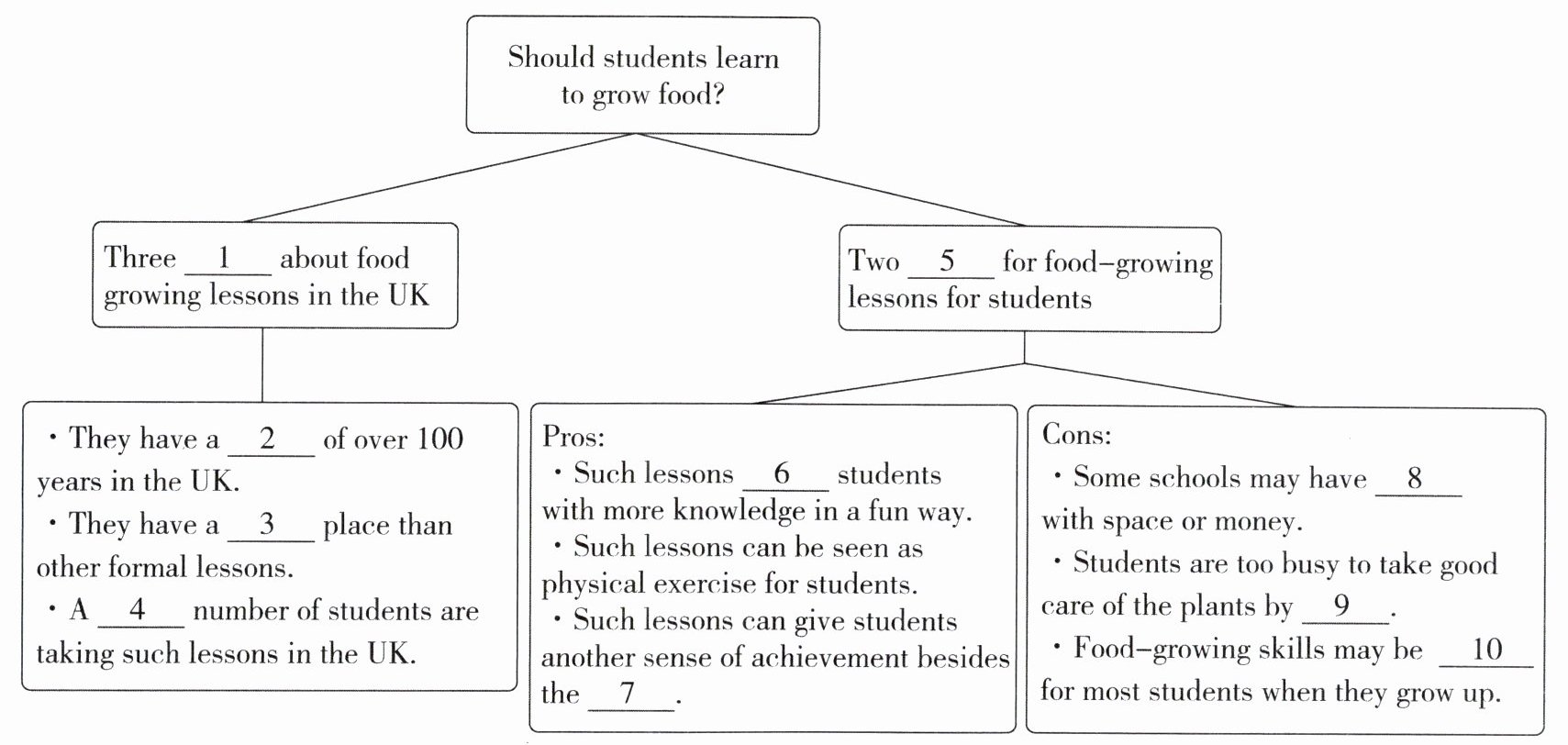
1.
2.
3.
4.
5.
6.
7.
8.
9.
10.
阅读下面短文,在文章后图表中的空格里填入一个最恰当的单词,每个空格只填1个单词。
体裁: 议论文
主题: 学校生活
难度: ★★★★★
建议用时: 9 min
正确率: /10
Some people say growing food is good for the mind and body.
What you need to know
• Food growing has been taught in schools for more than 100 years in the UK.
• At most schools, food growing is an extracurricular(课外的) activity. This means it's usually an after-class club instead of a lesson like English or maths.
• The number of school students in the UK growing their own food has grown since 2023, according to a recent survey.
Some people say that growing food is a skill that every child should learn, while others think it's not necessary. What do you think? Should children learn to grow food?
Yes—it teaches children so much.
Growing food is a fun way to learn about lots of things besides books. Students get to know where food actually comes from and it's a way to learn more about soil, insects, and the weather. Also, if children grow food, studies show that it helps them to be healthier. Planting, watering, and moving around outside is a great way to keep fit, just like PE. Besides, watching a small seed grow into food makes students feel like they achieve(实现;完成) something besides the stressful numbers on the test papers.
No—it's not a necessary skill.
Not all schools have enough space to grow food. Buying seeds and gardening tools also cost money. It's difficult for some schools to find the right place and spend enough money. Besides, looking after a patch(菜地) properly takes time and effort—perhaps more than students can give. Schools would have to get help from staff or volunteers to manage the weeding, watering, and so on. Anyway, most students will buy their food from shops in the future. Growing food is a lovely hobby but it's not a necessary(必要的) life skill.
1.
facts
2.
history
3.
lower
4.
growing
5.
ideas
6.
provide
7.
scores
8.
difficulty
9.
themselves
10.
unnecessary
答案
四、【语篇解读】本文是一篇议论文。文章主要论述了学生是否应该学习种植食物,并介绍了英国学校教授种植食物。
1. facts 根据“What you need to know”和思维导图下方的内容可知,此处介绍有关英国学校种植食物课程的三个事实。故填 facts。
2. history 根据“Food growing has been taught in schools for more than 100 years in the UK.”可知英国学校教授种植食物已有 100 多年的历史。故填 history。
3. lower 根据“This means it's usually an after-class club instead of a lesson like English or maths.”可知种植食物课程是课外活动,与英语或数学这样的主课相比,地位较低;根据空后“than”可知此处应用形容词的比较级。故填 lower。
4. growing/rising 根据“The number of school students in the UK growing their own food has grown since 2023”可知参与种植食物的学生人数增长了;此处应用动名词形式修饰空后名词“number”。故填 growing/rising。
5. ideas 根据思维导图下方的内容可知,此处介绍有关学生是否应该学习种植食物的两个观点。故填 ideas。
6. provide 根据“Growing food is a fun way to learn about lots of things besides books.”和“it's a way to learn more about soil, insects, and the weather”可知种植食物课程给学生提供更多知识;provide sb. with sth.表示“为某人提供某物”。故填 provide。
7. scores/grades 根据“watching a small seed grow into food makes students feel like they achieve something besides the stressful numbers on the test papers”可知种植食物让学生在试卷上的分数之外,拥有另外的成就感。故填 scores/grades。
8. difficulty/difficulties/trouble/problems 根据“It's difficult for some schools to find the right place and spend enough money.”可知一些学校很难找到合适的地方并花足够的钱,即在空间或资金上有困难。故填 difficulty/difficulties/trouble/problems。
9. themselves 根据“perhaps more than students can give. Schools would have to get help from staff or volunteers to manage the weeding, watering, and so on.” 可知照顾菜地所需的时间和精力比学生能付出的更多,需要学校工作人员或志愿者的帮助,由此可知学生不能自己照顾种植的食物。故填 themselves。
10. unnecessary/useless/meaningless 根据“Growing food is a lovely hobby but it's not a necessary life skill.”可知种植食物不是学生未来必要的生活技能,即对大多数学生来说可能是不必要的。故填 unnecessary/useless/meaningless。
1. facts 根据“What you need to know”和思维导图下方的内容可知,此处介绍有关英国学校种植食物课程的三个事实。故填 facts。
2. history 根据“Food growing has been taught in schools for more than 100 years in the UK.”可知英国学校教授种植食物已有 100 多年的历史。故填 history。
3. lower 根据“This means it's usually an after-class club instead of a lesson like English or maths.”可知种植食物课程是课外活动,与英语或数学这样的主课相比,地位较低;根据空后“than”可知此处应用形容词的比较级。故填 lower。
4. growing/rising 根据“The number of school students in the UK growing their own food has grown since 2023”可知参与种植食物的学生人数增长了;此处应用动名词形式修饰空后名词“number”。故填 growing/rising。
5. ideas 根据思维导图下方的内容可知,此处介绍有关学生是否应该学习种植食物的两个观点。故填 ideas。
6. provide 根据“Growing food is a fun way to learn about lots of things besides books.”和“it's a way to learn more about soil, insects, and the weather”可知种植食物课程给学生提供更多知识;provide sb. with sth.表示“为某人提供某物”。故填 provide。
7. scores/grades 根据“watching a small seed grow into food makes students feel like they achieve something besides the stressful numbers on the test papers”可知种植食物让学生在试卷上的分数之外,拥有另外的成就感。故填 scores/grades。
8. difficulty/difficulties/trouble/problems 根据“It's difficult for some schools to find the right place and spend enough money.”可知一些学校很难找到合适的地方并花足够的钱,即在空间或资金上有困难。故填 difficulty/difficulties/trouble/problems。
9. themselves 根据“perhaps more than students can give. Schools would have to get help from staff or volunteers to manage the weeding, watering, and so on.” 可知照顾菜地所需的时间和精力比学生能付出的更多,需要学校工作人员或志愿者的帮助,由此可知学生不能自己照顾种植的食物。故填 themselves。
10. unnecessary/useless/meaningless 根据“Growing food is a lovely hobby but it's not a necessary life skill.”可知种植食物不是学生未来必要的生活技能,即对大多数学生来说可能是不必要的。故填 unnecessary/useless/meaningless。
解析
【分析】
本题为任务型阅读,需结合短文内容与思维导图结构,定位每个空格对应的原文信息,再根据语法规则(如比较级、名词形式、固定搭配等)确定恰当词汇。解题思路:先通读短文,明确文章围绕“学生是否应学习种植食物”展开,分为英国种植课程的相关事实、支持与反对的观点两部分;再对应思维导图的每个空格,找到原文中匹配的细节,结合词性、语境选择合适单词。
【解析】
1. 思维导图左侧介绍英国种植食物课程的三个相关内容,对应短文“What you need to know”部分的三个事实,故填facts。
2. 原文提到“Food growing has been taught in schools for more than 100 years in the UK”,对应“100多年的历史”,故填history。
3. 原文说明种植课程是课外活动,而非英语、数学这类主课,结合空后“than”需用比较级,故填lower。
4. 原文提到“the number...has grown since 2023”,修饰名词“number”需用动名词,故填growing/rising。
5. 思维导图右侧是关于是否应开设种植课程的两种看法,对应短文的Yes和No部分,故填ideas。
6. 原文提到种植课程能教学生很多知识,结合固定搭配“provide sb. with sth.”,故填provide。
7. 原文提到种植带来的成就感是试卷上的分数之外的,对应“考试分数”,故填scores/grades。
8. 原文指出部分学校空间或资金不足,对应“困难”,故填difficulty/difficulties/trouble/problems。
9. 原文提到照顾菜地需要额外帮助,学生无法自己完成,故填themselves。
10. 原文说明种植不是未来必要的生活技能,对应“不必要的”,故填unnecessary/useless/meaningless。
【答案】
1. facts 2. history 3. lower 4. growing/rising 5. ideas 6. provide 7. scores/grades 8. difficulty/difficulties/trouble/problems 9. themselves 10. unnecessary/useless/meaningless
【知识点】
任务型阅读、词汇运用、信息匹配
【点评】
本题围绕学校生活话题,以议论文形式考查学生提取信息并转换为恰当词汇的能力,需准确理解原文细节,结合语法规则完成填空,是常见的任务型阅读题型。
【难度系数】
0.4
本题为任务型阅读,需结合短文内容与思维导图结构,定位每个空格对应的原文信息,再根据语法规则(如比较级、名词形式、固定搭配等)确定恰当词汇。解题思路:先通读短文,明确文章围绕“学生是否应学习种植食物”展开,分为英国种植课程的相关事实、支持与反对的观点两部分;再对应思维导图的每个空格,找到原文中匹配的细节,结合词性、语境选择合适单词。
【解析】
1. 思维导图左侧介绍英国种植食物课程的三个相关内容,对应短文“What you need to know”部分的三个事实,故填facts。
2. 原文提到“Food growing has been taught in schools for more than 100 years in the UK”,对应“100多年的历史”,故填history。
3. 原文说明种植课程是课外活动,而非英语、数学这类主课,结合空后“than”需用比较级,故填lower。
4. 原文提到“the number...has grown since 2023”,修饰名词“number”需用动名词,故填growing/rising。
5. 思维导图右侧是关于是否应开设种植课程的两种看法,对应短文的Yes和No部分,故填ideas。
6. 原文提到种植课程能教学生很多知识,结合固定搭配“provide sb. with sth.”,故填provide。
7. 原文提到种植带来的成就感是试卷上的分数之外的,对应“考试分数”,故填scores/grades。
8. 原文指出部分学校空间或资金不足,对应“困难”,故填difficulty/difficulties/trouble/problems。
9. 原文提到照顾菜地需要额外帮助,学生无法自己完成,故填themselves。
10. 原文说明种植不是未来必要的生活技能,对应“不必要的”,故填unnecessary/useless/meaningless。
【答案】
1. facts 2. history 3. lower 4. growing/rising 5. ideas 6. provide 7. scores/grades 8. difficulty/difficulties/trouble/problems 9. themselves 10. unnecessary/useless/meaningless
【知识点】
任务型阅读、词汇运用、信息匹配
【点评】
本题围绕学校生活话题,以议论文形式考查学生提取信息并转换为恰当词汇的能力,需准确理解原文细节,结合语法规则完成填空,是常见的任务型阅读题型。
【难度系数】
0.4
