

 登录
登录
(
A.increase
B.reduce
C.cause
D.create
B
)1. A balanced diet can the risk of many health problems.A.increase
B.reduce
C.cause
D.create
答案
1.B
解析
【分析】首先理解句子含义:均衡饮食能______很多健康问题的风险。接着辨析四个选项的动词词义:A选项increase意为“增加”;B选项reduce意为“减少”;C选项cause意为“导致”;D选项create意为“创造”。结合生活常识,均衡饮食对健康有益,应是降低健康问题的风险,据此筛选符合语境的动词。
【解析】根据句子语境“均衡饮食”与“健康问题的风险”,结合常识可知,均衡饮食会减少健康问题的风险。逐一分析选项:A选项“增加”不符合均衡饮食的积极作用;C选项“导致”、D选项“创造”均不符合语境,只有B选项“减少”符合要求,故选B。
【答案】B
【知识点】动词词义辨析、语境理解
【点评】本题考查动词词义辨析,结合生活常识和句子语境即可选出正确答案,属于基础题型。
【难度系数】0.7
【解析】根据句子语境“均衡饮食”与“健康问题的风险”,结合常识可知,均衡饮食会减少健康问题的风险。逐一分析选项:A选项“增加”不符合均衡饮食的积极作用;C选项“导致”、D选项“创造”均不符合语境,只有B选项“减少”符合要求,故选B。
【答案】B
【知识点】动词词义辨析、语境理解
【点评】本题考查动词词义辨析,结合生活常识和句子语境即可选出正确答案,属于基础题型。
【难度系数】0.7
(
A.take notes
B.make mistakes
C.take action
D.make money
C
)2. We need to to save animals in danger.A.take notes
B.make mistakes
C.take action
D.make money
答案
2.C
解析
【分析】先明确句子语境:我们需要______来拯救濒危动物。接着分析各选项短语的含义:A.take notes意为“做笔记”;B.make mistakes意为“犯错”;C.take action意为“采取行动”;D.make money意为“赚钱”。结合“拯救濒危动物”的需求,只有“采取行动”符合逻辑,因此确定解题方向为结合语境辨析短语含义。
【解析】原句意为“我们需要______来拯救濒危动物”。逐一分析选项:A项“take notes”(做笔记)与拯救动物无关;B项“make mistakes”(犯错)语义不通;C项“take action”(采取行动)符合拯救濒危动物需要付诸行动的语境;D项“make money”(赚钱)不符合句意。综上,正确选项为C。
【答案】C
【知识点】动词短语辨析;语境理解
【点评】本题考查常用动词短语的含义及语境运用,属于基础题型,需学生准确掌握短语意思并结合句意判断。
【难度系数】0.6
【解析】原句意为“我们需要______来拯救濒危动物”。逐一分析选项:A项“take notes”(做笔记)与拯救动物无关;B项“make mistakes”(犯错)语义不通;C项“take action”(采取行动)符合拯救濒危动物需要付诸行动的语境;D项“make money”(赚钱)不符合句意。综上,正确选项为C。
【答案】C
【知识点】动词短语辨析;语境理解
【点评】本题考查常用动词短语的含义及语境运用,属于基础题型,需学生准确掌握短语意思并结合句意判断。
【难度系数】0.6
(
—By bike. It's good for my health and it doesn't the air.
A.break
B.hurt
C.produce
D.pollute
D
)3. —How do you like to go to school?—By bike. It's good for my health and it doesn't the air.
A.break
B.hurt
C.produce
D.pollute
答案
3.D
解析
【分析】先理解对话语境:问句询问上学方式,答语说明骑自行车的好处是对健康有益且不会影响空气。接着分析各选项动词的含义,结合语境筛选出符合逻辑的词汇。
【解析】对话翻译:——你喜欢怎么去上学?——骑自行车。它对我的健康有好处,而且不会______空气。A.break意为“打破”;B.hurt意为“伤害”;C.produce意为“生产”;D.pollute意为“污染”。结合常识,骑自行车不会污染空气,符合语境,故选D。
【答案】D
【知识点】动词词义辨析
【点评】本题考查日常语境下的动词词义运用,属于基础题,需学生掌握常见动词含义并结合语境作答。
【难度系数】0.7
【解析】对话翻译:——你喜欢怎么去上学?——骑自行车。它对我的健康有好处,而且不会______空气。A.break意为“打破”;B.hurt意为“伤害”;C.produce意为“生产”;D.pollute意为“污染”。结合常识,骑自行车不会污染空气,符合语境,故选D。
【答案】D
【知识点】动词词义辨析
【点评】本题考查日常语境下的动词词义运用,属于基础题,需学生掌握常见动词含义并结合语境作答。
【难度系数】0.7
二、新素材·垃圾焚烧厂为何“吃不饱”?
阅读理解
Have you ever imagined that a waste-burning factory does not have enough rubbish to burn? In some cities, this is becoming true.
In the past, people made too much waste. Cities built waste-to-energy factories to burn rubbish and make electricity. But now, some factories get less daily household waste. They are becoming “hungry”. This is actually good news for us.
Why does this happen? Because waste recycling works well today. People sort(分类)rubbish carefully. Kitchen waste becomes fertilizer(肥料), and plastic, paper, glass and metal can be used again. There is less leftover rubbish to burn. Besides, people learn to cut down waste and reuse things in daily life.
Even so, waste-to-energy factories are still useful. Here is how they work:
80 英语 九年级 上册 外研版
Rubbish goes into a very hot oven (over 850°C). Then natural waste reacts with O₃, breaks down and gives off heat, CO₂ and H₂O.
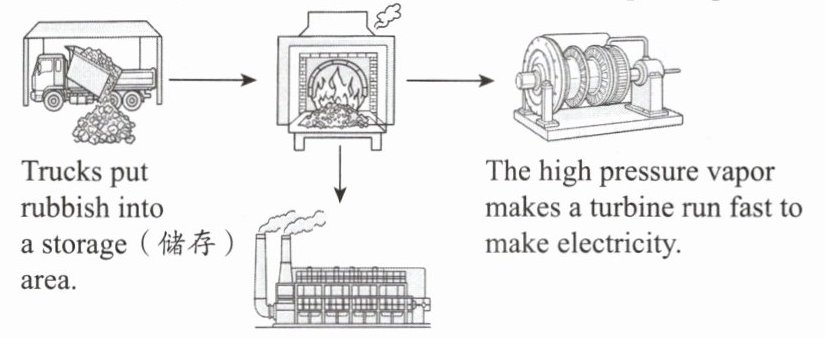
Before smoke goes into the air, cleaners make it clean. About 90% of the waste at the beginning is gone. The ash left can be used for building houses, and the metal inside can be recycled again.
Right recycling is the best way to protect our home. The future will be a greener world with no useless waste. The word “recycle” means to treat things that have already been used so that they can be used again.
(
A. It can be burned for electricity.
B. It can be made into fertilizer.
C. It can be stored in factories.
D. It can be used to clean water.
(
A. by using numbers
B. by telling stories
C. by showing a picture
D. by comparing different factories
(
A. Burning waste is the best way to deal with rubbish.
B. Good waste sorting can bring environmental benefits.
C. Waste-to-energy factories should be shut down.
D. People should not sort their rubbish any more.
阅读理解
Have you ever imagined that a waste-burning factory does not have enough rubbish to burn? In some cities, this is becoming true.
In the past, people made too much waste. Cities built waste-to-energy factories to burn rubbish and make electricity. But now, some factories get less daily household waste. They are becoming “hungry”. This is actually good news for us.
Why does this happen? Because waste recycling works well today. People sort(分类)rubbish carefully. Kitchen waste becomes fertilizer(肥料), and plastic, paper, glass and metal can be used again. There is less leftover rubbish to burn. Besides, people learn to cut down waste and reuse things in daily life.
Even so, waste-to-energy factories are still useful. Here is how they work:
80 英语 九年级 上册 外研版
Rubbish goes into a very hot oven (over 850°C). Then natural waste reacts with O₃, breaks down and gives off heat, CO₂ and H₂O.
Before smoke goes into the air, cleaners make it clean. About 90% of the waste at the beginning is gone. The ash left can be used for building houses, and the metal inside can be recycled again.
Right recycling is the best way to protect our home. The future will be a greener world with no useless waste. The word “recycle” means to treat things that have already been used so that they can be used again.
(
B
)4. What can people do with kitchen waste according to the passage?A. It can be burned for electricity.
B. It can be made into fertilizer.
C. It can be stored in factories.
D. It can be used to clean water.
(
C
)5. The writer explains how waste-to-energy factories work .A. by using numbers
B. by telling stories
C. by showing a picture
D. by comparing different factories
(
B
)6. Which statement would the writer most likely agree with?A. Burning waste is the best way to deal with rubbish.
B. Good waste sorting can bring environmental benefits.
C. Waste-to-energy factories should be shut down.
D. People should not sort their rubbish any more.
答案
4.B 5.C 6.B
解析
【分析】
本题为环保主题的阅读理解题,包含3道小题,分别考查细节理解、信息呈现方式、推理判断能力。解题思路:第4题需定位原文中厨房垃圾处理的相关语句,匹配对应选项;第5题需关注文中的插图,判断作者解释垃圾焚烧厂工作的方式;第6题需结合全文主旨,分析作者的核心观点。
【解析】
4. 细节理解题。根据文章第三段“Kitchen waste becomes fertilizer(肥料)”可知,厨房垃圾可被制成肥料,对应选项B。A选项(焚烧发电)是其他垃圾的处理方式,C选项(储存)、D选项(净化水)文中未提及,故排除。
5. 细节理解题。文中配有“插图1”展示垃圾焚烧厂的工作流程,作者通过展示图片的方式解释其工作原理,对应选项C。A选项(用数字)、B选项(讲故事)、D选项(对比工厂)均不符合,故排除。
6. 推理判断题。文章提到垃圾分类工作有效,减少了待焚烧的垃圾,且指出“Right recycling is the best way to protect our home”,说明作者认为良好的垃圾分类能带来环境效益,对应选项B。A选项(焚烧是最好方式)与原文不符,C选项(关闭焚烧厂)、D选项(不用分类)均与文章观点相悖,故排除。
【答案】
4.B 5.C 6.B
【知识点】
阅读理解细节理解、阅读理解推理判断、环保主题阅读
【点评】
本题以垃圾焚烧厂的现状为素材,结合环保主题考查九年级学生的阅读理解能力,题目设置贴合学生认知水平,注重对细节查找、信息解读和观点推理的考查,引导学生关注环保与资源回收。
【难度系数】
0.6
本题为环保主题的阅读理解题,包含3道小题,分别考查细节理解、信息呈现方式、推理判断能力。解题思路:第4题需定位原文中厨房垃圾处理的相关语句,匹配对应选项;第5题需关注文中的插图,判断作者解释垃圾焚烧厂工作的方式;第6题需结合全文主旨,分析作者的核心观点。
【解析】
4. 细节理解题。根据文章第三段“Kitchen waste becomes fertilizer(肥料)”可知,厨房垃圾可被制成肥料,对应选项B。A选项(焚烧发电)是其他垃圾的处理方式,C选项(储存)、D选项(净化水)文中未提及,故排除。
5. 细节理解题。文中配有“插图1”展示垃圾焚烧厂的工作流程,作者通过展示图片的方式解释其工作原理,对应选项C。A选项(用数字)、B选项(讲故事)、D选项(对比工厂)均不符合,故排除。
6. 推理判断题。文章提到垃圾分类工作有效,减少了待焚烧的垃圾,且指出“Right recycling is the best way to protect our home”,说明作者认为良好的垃圾分类能带来环境效益,对应选项B。A选项(焚烧是最好方式)与原文不符,C选项(关闭焚烧厂)、D选项(不用分类)均与文章观点相悖,故排除。
【答案】
4.B 5.C 6.B
【知识点】
阅读理解细节理解、阅读理解推理判断、环保主题阅读
【点评】
本题以垃圾焚烧厂的现状为素材,结合环保主题考查九年级学生的阅读理解能力,题目设置贴合学生认知水平,注重对细节查找、信息解读和观点推理的考查,引导学生关注环保与资源回收。
【难度系数】
0.6
