

 登录
登录
五、任务型阅读。
阅读短文,从短文后A至F六个选项中选出五个可以填入空白处的最佳选项。
Storytelling
Storytelling has caught the human imagination for thousands of years. People everywhere have told stories to amuse, to teach, to remember, and just to pass the time. People started telling stories long before writing was invented. 1 But people all over the world still tell one another stories out loud. A person who can tell a good story nearly always finds listeners.
Before people developed writing, storytelling was the most important way to pass along information. Anything a culture wanted to protect—its beliefs, its history, and its traditions—had to be told out loud. Each generation would tell the culture's stories to the next. 2 Knowledge passed on in this method is called the spoken tradition. Even cultures that know how to write still pass along some information in this way.
3 In other cultures only special storytellers were trusted to do this important job. A culture's best storytellers had good memories. They could also make the stories very interesting, so people would listen and remember them. Sometimes people would sing the stories or tell them in the form of poems. 4
However, stories told aloud change over time as different people tell them. A storyteller might change a story in order to make it better. Or a teller may simply not remember all the details of a story. Unlike written stories, the spoken tradition is not created by any one person. 5 Sometimes the stories are collected and written down long after they have been created.
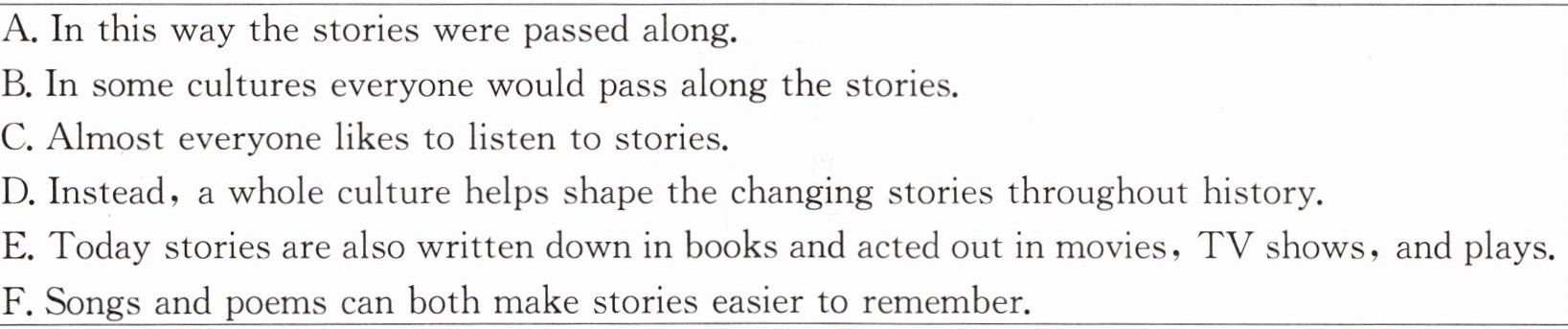
1.
2.
3.
4.
5.
阅读短文,从短文后A至F六个选项中选出五个可以填入空白处的最佳选项。
Storytelling
Storytelling has caught the human imagination for thousands of years. People everywhere have told stories to amuse, to teach, to remember, and just to pass the time. People started telling stories long before writing was invented. 1 But people all over the world still tell one another stories out loud. A person who can tell a good story nearly always finds listeners.
Before people developed writing, storytelling was the most important way to pass along information. Anything a culture wanted to protect—its beliefs, its history, and its traditions—had to be told out loud. Each generation would tell the culture's stories to the next. 2 Knowledge passed on in this method is called the spoken tradition. Even cultures that know how to write still pass along some information in this way.
3 In other cultures only special storytellers were trusted to do this important job. A culture's best storytellers had good memories. They could also make the stories very interesting, so people would listen and remember them. Sometimes people would sing the stories or tell them in the form of poems. 4
However, stories told aloud change over time as different people tell them. A storyteller might change a story in order to make it better. Or a teller may simply not remember all the details of a story. Unlike written stories, the spoken tradition is not created by any one person. 5 Sometimes the stories are collected and written down long after they have been created.
1.
E
2.
A
3.
B
4.
F
5.
D
答案
五、1. E 2. A 3. B 4. F 5. D
解析
【分析】
本题为任务型阅读的七选五题型,需结合上下文语境、逻辑关系及词汇对应来选择合适选项。解题思路如下:
1. 第1空:前文提到“文字发明前人们就开始讲故事”,后文转折说明“全世界的人仍会大声讲故事”,需选体现“现在故事传播形式”的选项,对应E。
2. 第2空:前文提到“每一代把文化故事传给下一代”,需选总结“故事传递方式”的选项,对应A(In this way指代口头传递的方式)。
3. 第3空:后文出现“In other cultures”,需选对应“In some cultures”的选项,对应B,形成结构上的并列对比。
4. 第4空:前文提到“人们用唱歌或诗歌形式讲故事”,需选说明这种形式作用的选项,对应F(说明歌曲和诗歌让故事更容易记忆)。
5. 第5空:前文提到“口头传统不是某个人创造的”,后文说“故事被收集写下来”,需选体现“整个文化对故事的塑造”的选项,对应D,形成转折逻辑。
【解析】
1. 第1空:前文讲述文字发明前的故事传播,后文转折说明现在的故事形式,E选项“Today stories are also written down in books and acted out in movies, TV shows, and plays.” 符合时间对比的逻辑,故选E。
2. 第2空:前文提到每一代传递故事,A选项“In this way the stories were passed along.” 中的“In this way”指代前文的口头传递方式,承接上文,故选A。
3. 第3空:后文有“In other cultures”,B选项“In some cultures everyone would pass along the stories.” 与后文形成“some...other...”的并列结构,符合语境,故选B。
4. 第4空:前文提到用唱歌或诗歌形式讲故事,F选项“Songs and poems can both make stories easier to remember.” 说明这种形式的作用,承接上文,故选F。
5. 第5空:前文说口头传统不是个人创造的,D选项“Instead, a whole culture helps shape the changing stories throughout history.” 转折说明是整个文化塑造故事,符合逻辑,故选D。
【答案】
1. E 2. A 3. B 4. F 5. D
【知识点】
任务型阅读、上下文逻辑衔接、语篇理解
【点评】
本题考查任务型阅读中七选五的解题能力,需准确把握上下文的逻辑关系(如时间对比、并列结构、指代关系、转折关系等),结合语境匹配选项,难度适中,注重对语篇连贯性的理解。
【难度系数】
0.6
本题为任务型阅读的七选五题型,需结合上下文语境、逻辑关系及词汇对应来选择合适选项。解题思路如下:
1. 第1空:前文提到“文字发明前人们就开始讲故事”,后文转折说明“全世界的人仍会大声讲故事”,需选体现“现在故事传播形式”的选项,对应E。
2. 第2空:前文提到“每一代把文化故事传给下一代”,需选总结“故事传递方式”的选项,对应A(In this way指代口头传递的方式)。
3. 第3空:后文出现“In other cultures”,需选对应“In some cultures”的选项,对应B,形成结构上的并列对比。
4. 第4空:前文提到“人们用唱歌或诗歌形式讲故事”,需选说明这种形式作用的选项,对应F(说明歌曲和诗歌让故事更容易记忆)。
5. 第5空:前文提到“口头传统不是某个人创造的”,后文说“故事被收集写下来”,需选体现“整个文化对故事的塑造”的选项,对应D,形成转折逻辑。
【解析】
1. 第1空:前文讲述文字发明前的故事传播,后文转折说明现在的故事形式,E选项“Today stories are also written down in books and acted out in movies, TV shows, and plays.” 符合时间对比的逻辑,故选E。
2. 第2空:前文提到每一代传递故事,A选项“In this way the stories were passed along.” 中的“In this way”指代前文的口头传递方式,承接上文,故选A。
3. 第3空:后文有“In other cultures”,B选项“In some cultures everyone would pass along the stories.” 与后文形成“some...other...”的并列结构,符合语境,故选B。
4. 第4空:前文提到用唱歌或诗歌形式讲故事,F选项“Songs and poems can both make stories easier to remember.” 说明这种形式的作用,承接上文,故选F。
5. 第5空:前文说口头传统不是个人创造的,D选项“Instead, a whole culture helps shape the changing stories throughout history.” 转折说明是整个文化塑造故事,符合逻辑,故选D。
【答案】
1. E 2. A 3. B 4. F 5. D
【知识点】
任务型阅读、上下文逻辑衔接、语篇理解
【点评】
本题考查任务型阅读中七选五的解题能力,需准确把握上下文的逻辑关系(如时间对比、并列结构、指代关系、转折关系等),结合语境匹配选项,难度适中,注重对语篇连贯性的理解。
【难度系数】
0.6
