

 登录
登录
Ⅱ.读写结合。
阅读下面语篇,根据语篇内容,填写表格中所缺的信息,并回答第7小题。
In our communities, young people are making a difference through simple acts of kindness. Their stories show that helping others doesn't always require grand gestures.
The Crayon Collector
Leah, a five-year-old from the United States, spent much time in hospital because of illness. She found the hospital lacked crayons for young patients, as crayons could only be used once for health reasons. Wanting to help, Leah set out to collect 500 boxes. With family help, she organized crayon collecting activities. Her story spread, and she eventually gathered over 2,600 boxes, bringing color and joy to waiting rooms.
The Plastic Exchanger
Tony, a 13-year-old Canadian, worried about plastic pollution harming ocean life. At the age of 6, he started the "Plastic Money Shop" where people traded single-use plastics for useful items like rice or school supplies. The collected plastic is recycled into furniture and building materials. "My goal is to remove single-use plastic from our planet." Tony explains.
The Reading Guide
In a small village with limited books, 14-year-old Maria created a"reading corner" in her community center. She collected donated books and organized weekly reading sessions for younger children. Maria patiently helps them with difficult words and discusses stories together. "Reading opens new worlds," she says. Her efforts have inspired many children to discover the joy of books.
These young helpers prove that anyone can contribute to building a kinder world.
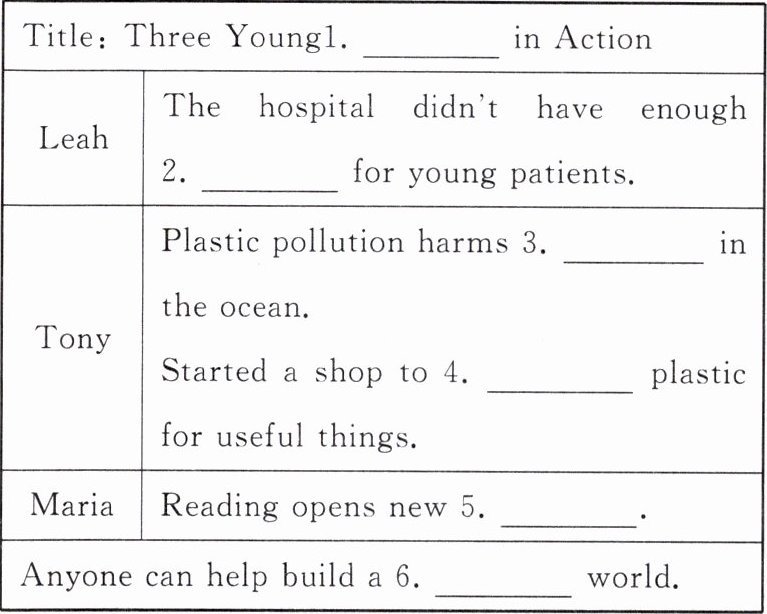
7. Besides the ways mentioned in the passage, what else can you do to help people in your daily life?
阅读下面语篇,根据语篇内容,填写表格中所缺的信息,并回答第7小题。
In our communities, young people are making a difference through simple acts of kindness. Their stories show that helping others doesn't always require grand gestures.
The Crayon Collector
Leah, a five-year-old from the United States, spent much time in hospital because of illness. She found the hospital lacked crayons for young patients, as crayons could only be used once for health reasons. Wanting to help, Leah set out to collect 500 boxes. With family help, she organized crayon collecting activities. Her story spread, and she eventually gathered over 2,600 boxes, bringing color and joy to waiting rooms.
The Plastic Exchanger
Tony, a 13-year-old Canadian, worried about plastic pollution harming ocean life. At the age of 6, he started the "Plastic Money Shop" where people traded single-use plastics for useful items like rice or school supplies. The collected plastic is recycled into furniture and building materials. "My goal is to remove single-use plastic from our planet." Tony explains.
The Reading Guide
In a small village with limited books, 14-year-old Maria created a"reading corner" in her community center. She collected donated books and organized weekly reading sessions for younger children. Maria patiently helps them with difficult words and discusses stories together. "Reading opens new worlds," she says. Her efforts have inspired many children to discover the joy of books.
These young helpers prove that anyone can contribute to building a kinder world.
7. Besides the ways mentioned in the passage, what else can you do to help people in your daily life?
I can help classmates with homework,
visit elderly neighbors, and clean up
classroom after school.
答案
Ⅱ.读写结合。
1. Helpers 2. crayons 3. life
4. exchange/trade 5. worlds 6. kinder
7. I can help classmates with homework,
visit elderly neighbors, and clean up
classroom after school.
1. Helpers 2. crayons 3. life
4. exchange/trade 5. worlds 6. kinder
7. I can help classmates with homework,
visit elderly neighbors, and clean up
classroom after school.
解析
【分析】
这是英语阅读信息提取类题型,解题思路非常清晰:首先通读全文了解三位年轻人行善的核心故事,之后逐个对应表格的空缺,回到原文精准定位对应语句,优先匹配原文出现的原词完成前6个填空,最后第7小题结合日常生活场景,写出符合逻辑、切实可行的助人行为即可,大部分空都能直接找到原文依据,不需要复杂推导。
【解析】
1. 定位全文最后一段"These young helpers prove that anyone can contribute to building a kinder world.",结合标题含义“三位行动中的年轻助人者”,填入Helpers,注意首字母大写。
2. 定位Leah部分的原文"She found the hospital lacked crayons for young patients",lacked和题干中didn't have enough含义完全对应,直接填入crayons。
3. 定位Tony部分的原文"worried about plastic pollution harming ocean life",对应题干“塑料污染危害海洋生物”,填入life。
4. 定位Tony部分的原文"people traded single-use plastics for useful items",同时文章小标题是The Plastic Exchanger,可知他开店的目的是用塑料交换有用的物品,exchange/trade都符合语义要求。
5. 定位Maria部分的直接引语"Reading opens new worlds," she says. 提取原词填入worlds。
6. 定位全文最后一句"These young helpers prove that anyone can contribute to building a kinder world." 提取原词填入kinder。
7. 本题为开放性作答,只要写出日常生活中合理的助人行为、表述通顺即可得分。
【答案】
1. Helpers
2. crayons
3. life
4. exchange/trade
5. worlds
6. kinder
7. I can help classmates with homework, visit elderly neighbors, and clean up classroom after school.(表述合理即可)
【知识点】
阅读信息提取,原文定位,情景表达
【点评】
本题难度较低,前6道填空几乎都可以直接在原文找到对应原句,重点考察学生快速定位文本信息的能力,最后一道开放题引导学生将文本内容和现实生活结合,鼓励学生主动践行善意,兼具知识性和德育引导性。
【难度系数】
0.8
这是英语阅读信息提取类题型,解题思路非常清晰:首先通读全文了解三位年轻人行善的核心故事,之后逐个对应表格的空缺,回到原文精准定位对应语句,优先匹配原文出现的原词完成前6个填空,最后第7小题结合日常生活场景,写出符合逻辑、切实可行的助人行为即可,大部分空都能直接找到原文依据,不需要复杂推导。
【解析】
1. 定位全文最后一段"These young helpers prove that anyone can contribute to building a kinder world.",结合标题含义“三位行动中的年轻助人者”,填入Helpers,注意首字母大写。
2. 定位Leah部分的原文"She found the hospital lacked crayons for young patients",lacked和题干中didn't have enough含义完全对应,直接填入crayons。
3. 定位Tony部分的原文"worried about plastic pollution harming ocean life",对应题干“塑料污染危害海洋生物”,填入life。
4. 定位Tony部分的原文"people traded single-use plastics for useful items",同时文章小标题是The Plastic Exchanger,可知他开店的目的是用塑料交换有用的物品,exchange/trade都符合语义要求。
5. 定位Maria部分的直接引语"Reading opens new worlds," she says. 提取原词填入worlds。
6. 定位全文最后一句"These young helpers prove that anyone can contribute to building a kinder world." 提取原词填入kinder。
7. 本题为开放性作答,只要写出日常生活中合理的助人行为、表述通顺即可得分。
【答案】
1. Helpers
2. crayons
3. life
4. exchange/trade
5. worlds
6. kinder
7. I can help classmates with homework, visit elderly neighbors, and clean up classroom after school.(表述合理即可)
【知识点】
阅读信息提取,原文定位,情景表达
【点评】
本题难度较低,前6道填空几乎都可以直接在原文找到对应原句,重点考察学生快速定位文本信息的能力,最后一道开放题引导学生将文本内容和现实生活结合,鼓励学生主动践行善意,兼具知识性和德育引导性。
【难度系数】
0.8
