

 登录
登录
3. 若观测点高度为$ h $(单位:$\mathrm{km}$),观测者视线能达到的最远距离为$ d $(单位:$\mathrm{km}$),则$ d \approx \sqrt{2hR} $,其中$ R $是地球半径,约等于$ 6400 \ \mathrm{km} $,利用近似公式判断(1)(2)中的说法是否正确:
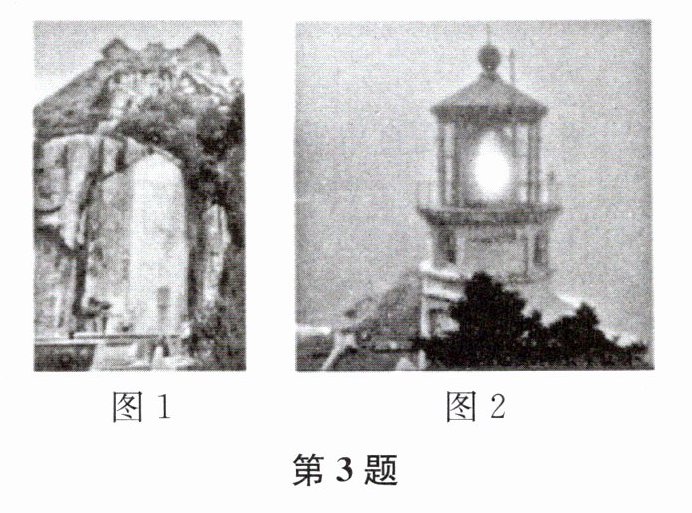
(1)如图1,天气晴朗的一天,小明站在泰山上海拔为$ 1532.7 \ \mathrm{m} $的某处,若该处到海边的最小距离约为$ 230 \ \mathrm{km} $,则小明可以看到大海.
(2)如图2,曾被誉为世界七大奇迹之一、建于公元前3世纪毁于地震的亚历山大灯塔,用青铜反光镜反射阳光或灯火,反光镜高于海平面$ 125 \ \mathrm{m} $,它反射的光能照到离灯塔$ 35 \ \mathrm{km} $的海面上.
(1)如图1,天气晴朗的一天,小明站在泰山上海拔为$ 1532.7 \ \mathrm{m} $的某处,若该处到海边的最小距离约为$ 230 \ \mathrm{km} $,则小明可以看到大海.
(2)如图2,曾被誉为世界七大奇迹之一、建于公元前3世纪毁于地震的亚历山大灯塔,用青铜反光镜反射阳光或灯火,反光镜高于海平面$ 125 \ \mathrm{m} $,它反射的光能照到离灯塔$ 35 \ \mathrm{km} $的海面上.
答案
(1) $\because d \approx \sqrt{2hR}$,$1\ 532.7\ \mathrm{m}=1.532\ 7\ \mathrm{km}$,$\therefore d^2 \approx 2×1.5327×6\ 400\approx19\ 619$,$230^2=52\ 900$. $\because 19\ 619<52\ 900$,$\therefore d<230\ \mathrm{km}$,$\therefore$ 小明在该处看不到大海,故不正确.
(2) $125\ \mathrm{m}=0.125\ \mathrm{km}$,$\because d \approx \sqrt{2hR}=\sqrt{2×0.125×6\ 400}=40\ \mathrm{km}>35\ \mathrm{km}$,$\therefore$ 它反射的光能照到离灯塔 $35\ \mathrm{km}$ 的海面上,故正确.
(2) $125\ \mathrm{m}=0.125\ \mathrm{km}$,$\because d \approx \sqrt{2hR}=\sqrt{2×0.125×6\ 400}=40\ \mathrm{km}>35\ \mathrm{km}$,$\therefore$ 它反射的光能照到离灯塔 $35\ \mathrm{km}$ 的海面上,故正确.
