

 登录
登录
10. 如图,线段$DE$与$AF$分别为$△ ABC$的中位线与中线,连接$DF,EF$.
(1)求证:$AF$与$DE$互相平分;
(2)当线段$AF$与$BC$满足怎样的数量关系时,四边形$ADFE$为矩形? 请说明理由.
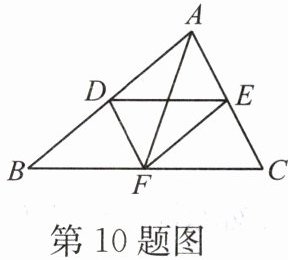
(1)求证:$AF$与$DE$互相平分;
(2)当线段$AF$与$BC$满足怎样的数量关系时,四边形$ADFE$为矩形? 请说明理由.
答案
10. (1)证明:$\because DE$是$△ ABC$的中位线,
$\therefore$点$D$是$AB$的中点,
$\therefore AD=\frac{1}{2}AB$.
$\because EF$是$△ ABC$的中位线,
$\therefore EF// AB$,$EF=\frac{1}{2}AB$,
$\therefore EF=AD$,
$\therefore$四边形$ADFE$是平行四边形,
$\therefore AF$与$DE$互相平分.
(2)解:当$AF=\frac{1}{2}BC$时,四边形$ADFE$为矩形.
理由:$\because$线段$DE$为$△ ABC$的中位线,
$\therefore DE=\frac{1}{2}BC$.
$\because AF=\frac{1}{2}BC$,
$\therefore AF=DE$.
由(1)得四边形$ADFE$是平行四边形,
$\therefore$四边形$ADFE$为矩形.
$\therefore$点$D$是$AB$的中点,
$\therefore AD=\frac{1}{2}AB$.
$\because EF$是$△ ABC$的中位线,
$\therefore EF// AB$,$EF=\frac{1}{2}AB$,
$\therefore EF=AD$,
$\therefore$四边形$ADFE$是平行四边形,
$\therefore AF$与$DE$互相平分.
(2)解:当$AF=\frac{1}{2}BC$时,四边形$ADFE$为矩形.
理由:$\because$线段$DE$为$△ ABC$的中位线,
$\therefore DE=\frac{1}{2}BC$.
$\because AF=\frac{1}{2}BC$,
$\therefore AF=DE$.
由(1)得四边形$ADFE$是平行四边形,
$\therefore$四边形$ADFE$为矩形.
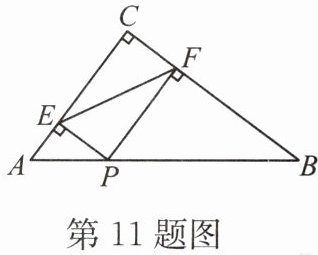
11. 如图,在$△ ABC$中,$∠ C=90°,AC=6,BC=8$,点$P$为斜边$AB$上一动点,过$P$作$PE⊥ AC$于点$E$,作$PF⊥ BC$于点$F$,连接$EF$,则$EF$的最小值为
$\frac{24}{5}$
.答案
11. $\frac{24}{5}$
12. 如图,在$△ ABC$中,$O$是$AC$边上的一个动点,过$O$作直线$MN// BC$,$MN$交$∠ ACB$的平分线于点$E$,交$△ ABC$的外角$∠ ACD$的平分线于点$F$,连接$AE,AF$.
(1)求证:$OE=OF$;
(2)若$CE=12,CF=5$,求$OC$的长;
(3)当点$O$在$AC$边的什么位置时,四边形$AECF$是矩形? 请说明理由.
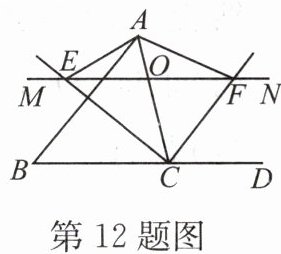
(1)求证:$OE=OF$;
(2)若$CE=12,CF=5$,求$OC$的长;
(3)当点$O$在$AC$边的什么位置时,四边形$AECF$是矩形? 请说明理由.
答案
12. (1)证明:$\because CE$平分$∠ ACB$,$CF$平分$∠ ACD$,
$\therefore ∠ ACE=∠ BCE$,$∠ ACF=∠ DCF$.
$\because MN// BC$,
$\therefore ∠ FEC=∠ BCE$,$∠ EFC=∠ DCF$.
$\therefore ∠ FEC=∠ ACE$,$∠ EFC=∠ ACF$.
$\therefore OE=OC$,$OF=OC$.
$\therefore OE=OF$.
(2)解:$\because CE$平分$∠ ACB$,$CF$平分$∠ ACD$,
$\therefore ∠ ACE=\frac{1}{2}∠ ACB$,$∠ ACF=\frac{1}{2}∠ ACD$.
$\therefore ∠ ACE+∠ ACF=\frac{1}{2}∠ ACB+\frac{1}{2}∠ ACD=\frac{1}{2}(∠ ACB+∠ ACD)=\frac{1}{2}×180°=90°$,即$∠ ECF=90°$.
在$\mathrm{Rt}△ ECF$中,$\because CE=12$,$CF=5$,
$\therefore EF=\sqrt{CE^{2}+CF^{2}}=13$.
由(1),知$OE=OF=OC$,
$\therefore OC=\frac{1}{2}EF=6.5$.
(3)解:当$O$在$AC$边的中点处时,四边形$AECF$是矩形.理由如下:
当$O$为$AC$的中点时,$OA=OC$.
$\because OE=OF$,
$\therefore$四边形$AECF$是平行四边形.
又$\because ∠ ECF=90°$,
$\therefore$四边形$AECF$是矩形.
$\therefore ∠ ACE=∠ BCE$,$∠ ACF=∠ DCF$.
$\because MN// BC$,
$\therefore ∠ FEC=∠ BCE$,$∠ EFC=∠ DCF$.
$\therefore ∠ FEC=∠ ACE$,$∠ EFC=∠ ACF$.
$\therefore OE=OC$,$OF=OC$.
$\therefore OE=OF$.
(2)解:$\because CE$平分$∠ ACB$,$CF$平分$∠ ACD$,
$\therefore ∠ ACE=\frac{1}{2}∠ ACB$,$∠ ACF=\frac{1}{2}∠ ACD$.
$\therefore ∠ ACE+∠ ACF=\frac{1}{2}∠ ACB+\frac{1}{2}∠ ACD=\frac{1}{2}(∠ ACB+∠ ACD)=\frac{1}{2}×180°=90°$,即$∠ ECF=90°$.
在$\mathrm{Rt}△ ECF$中,$\because CE=12$,$CF=5$,
$\therefore EF=\sqrt{CE^{2}+CF^{2}}=13$.
由(1),知$OE=OF=OC$,
$\therefore OC=\frac{1}{2}EF=6.5$.
(3)解:当$O$在$AC$边的中点处时,四边形$AECF$是矩形.理由如下:
当$O$为$AC$的中点时,$OA=OC$.
$\because OE=OF$,
$\therefore$四边形$AECF$是平行四边形.
又$\because ∠ ECF=90°$,
$\therefore$四边形$AECF$是矩形.
