

 登录
登录
22. (10分)如图,在正方形ABCD中,E为CD边上的一点,F为BC延长线上的一点,且$ CE = CF $.
(1)求证:$ △ BCE ≌ △ DCF $.
(2)若$ ∠ FDC = 30° $,求$ ∠ BEF $的度数.
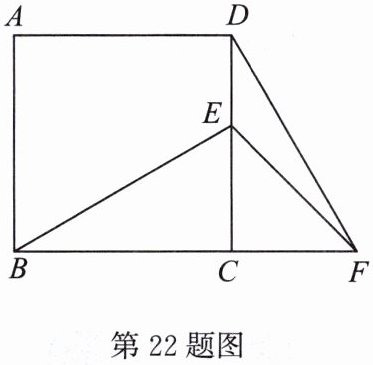
(1)求证:$ △ BCE ≌ △ DCF $.
(2)若$ ∠ FDC = 30° $,求$ ∠ BEF $的度数.
答案
22. (1)证明:$\because$四边形$ABCD$是正方形,
$\therefore BC=DC$,$∠ BCD=90°$.
$\because F$为$BC$延长线上的一点,
$\therefore ∠ DCF=90°$.
在$△ BCE$和$△ DCF$中,$BC=DC$,$∠ BCD=∠ DCF=90°$,$CE=CF$,
$\therefore △ BCE≌△ DCF(SAS)$.
(2)解:$\because △ BCE≌△ DCF$,
$\therefore ∠ EBC=∠ FDC=30°$,
$\therefore ∠ BEC=60°$.$\because ∠ DCF=90°$,$CE=CF$,
$\therefore ∠ FEC=45°$,$\therefore ∠ BEF=∠ BEC+∠ FEC=60°+45°=105°$.
$\therefore BC=DC$,$∠ BCD=90°$.
$\because F$为$BC$延长线上的一点,
$\therefore ∠ DCF=90°$.
在$△ BCE$和$△ DCF$中,$BC=DC$,$∠ BCD=∠ DCF=90°$,$CE=CF$,
$\therefore △ BCE≌△ DCF(SAS)$.
(2)解:$\because △ BCE≌△ DCF$,
$\therefore ∠ EBC=∠ FDC=30°$,
$\therefore ∠ BEC=60°$.$\because ∠ DCF=90°$,$CE=CF$,
$\therefore ∠ FEC=45°$,$\therefore ∠ BEF=∠ BEC+∠ FEC=60°+45°=105°$.
23. (12分)如图①,在$ □ ABCD $中,点O是对角线AC的中点,EF过点O且与AD,BC分别相交于点E,F,GH过点O且与AB,CD分别相交于点G,H,连接EG,FG,FH,EH.
(1)求证:四边形EGFH是平行四边形.
(2)如图②,若$ EF // AB $,$ GH // BC $,在不添加任何辅助线的情况下,请直接写出图②中与四边形AGHD面积相等的所有平行四边形(四边形AGHD除外).
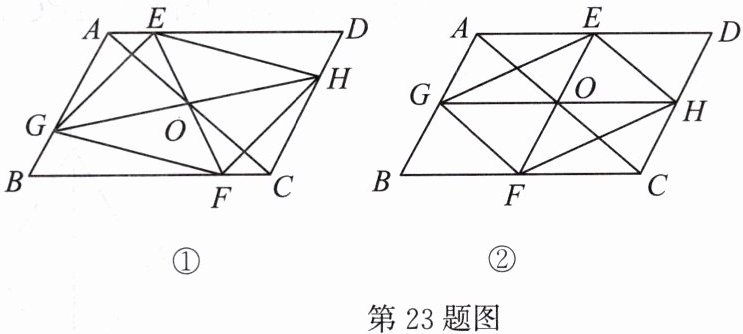
(1)求证:四边形EGFH是平行四边形.
(2)如图②,若$ EF // AB $,$ GH // BC $,在不添加任何辅助线的情况下,请直接写出图②中与四边形AGHD面积相等的所有平行四边形(四边形AGHD除外).
答案
23. (1)证明:$\because$四边形$ABCD$是平行四边形,
$\therefore OA=OC$,$AD// BC$,
$\therefore ∠ EAO=∠ FCO$.
又$\because ∠ AOE=∠ COF$,$\therefore △ OAE≌△ OCF(ASA)$,$\therefore OE=OF$.同理可证$OG=OH$.
$\therefore$四边形$EGFH$是平行四边形.
(2)解:与四边形$AGHD$面积相等的所有平行四边形有$□ GBCH$,$□ ABFE$,$□ EFCD$,$□ EGFH$.
$\therefore OA=OC$,$AD// BC$,
$\therefore ∠ EAO=∠ FCO$.
又$\because ∠ AOE=∠ COF$,$\therefore △ OAE≌△ OCF(ASA)$,$\therefore OE=OF$.同理可证$OG=OH$.
$\therefore$四边形$EGFH$是平行四边形.
(2)解:与四边形$AGHD$面积相等的所有平行四边形有$□ GBCH$,$□ ABFE$,$□ EFCD$,$□ EGFH$.
24. (12分)在数学课堂上,老师出了一道题:化简$ \sqrt{(1 - \sqrt{2})^2} $.同学们马上举手发言,小明站起来说:"老师,这道题太简单了,因为平方与开平方互为逆运算,所以$ \sqrt{(1 - \sqrt{2})^2} = 1 - \sqrt{2} $."而老师却说小明错了,为什么呢?这是因为如果$ \sqrt{a^2} = a $成立,那么必须具备条件$ a ≥ 0 $,而$ 1 - \sqrt{2} < 0 $.正确的思路是先判断正负,然后开方.$ \sqrt{(1 - \sqrt{2})^2} = \sqrt{2} - 1 $,你看明白了吗? 请你做一做下面的习题:
(1)化简:$ \sqrt{(\sqrt{2} - \sqrt{3})^2} = $
(2)化简:$ \sqrt{(1 - \sqrt{2})^2} + \sqrt{(\sqrt{2} - \sqrt{3})^2} + \sqrt{(\sqrt{3} - \sqrt{4})^2} + ··· + \sqrt{(\sqrt{2021} - \sqrt{2022})^2} $.
(3)已知a,b,c是三角形的三边长,化简:$ \sqrt{(a + b - c)^2} + \sqrt{(b - c - a)^2} $.
(1)化简:$ \sqrt{(\sqrt{2} - \sqrt{3})^2} = $
$\sqrt{3}-\sqrt{2}$
.(2)化简:$ \sqrt{(1 - \sqrt{2})^2} + \sqrt{(\sqrt{2} - \sqrt{3})^2} + \sqrt{(\sqrt{3} - \sqrt{4})^2} + ··· + \sqrt{(\sqrt{2021} - \sqrt{2022})^2} $.
(3)已知a,b,c是三角形的三边长,化简:$ \sqrt{(a + b - c)^2} + \sqrt{(b - c - a)^2} $.
答案
24. 解:(1)$\sqrt{3}-\sqrt{2}$
(2)原式$=\sqrt{2}-1+\sqrt{3}-\sqrt{2}+\sqrt{4}-\sqrt{3}+···+\sqrt{2022}-\sqrt{2021}=\sqrt{2022}-1$.
(3)原式$=a+b-c+(a+c-b)=a+b-c+a+c-b=2a$.
(2)原式$=\sqrt{2}-1+\sqrt{3}-\sqrt{2}+\sqrt{4}-\sqrt{3}+···+\sqrt{2022}-\sqrt{2021}=\sqrt{2022}-1$.
(3)原式$=a+b-c+(a+c-b)=a+b-c+a+c-b=2a$.
