

 登录
登录
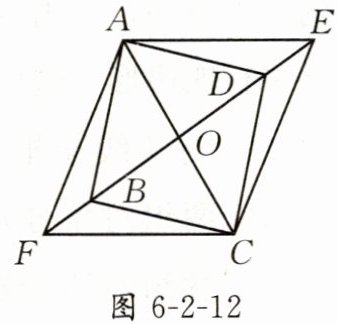
5. 如图6-2-12,在 $ \Box ABCD $中,对角线AC,BD相交于点O, $ OA=5 $ cm,E,F为直线BD上的两个动点(点E,F始终在 $ \Box ABCD $外),且 $ DE=\frac{1}{2} OD $ , $ BF=\frac{1}{2} OB $ ,连接AE,CE,CF,AF。
(1) 求证:四边形 AFCE为平行四边形。
(2) 若 $ D E=\frac{1}{3} O D $ , $ B F=\frac{1}{3} O B $ ,上述结论还成立吗?若 $ D E=\frac{1}{n} O D $ , $ B F=\frac{1}{n} O B $呢?
(3) 若 CA 平分 $ ∠ B C D $ $ ∠ A E C=6 0° $ ,求四边形 AECF的周长。
(1) 求证:四边形 AFCE为平行四边形。
(2) 若 $ D E=\frac{1}{3} O D $ , $ B F=\frac{1}{3} O B $ ,上述结论还成立吗?若 $ D E=\frac{1}{n} O D $ , $ B F=\frac{1}{n} O B $呢?
(3) 若 CA 平分 $ ∠ B C D $ $ ∠ A E C=6 0° $ ,求四边形 AECF的周长。
答案
5. (1)证明:$\because$四边形$ABCD$是平行四边形,
$\therefore OA=OC$,$OB=OD$。
$\because DE=\frac{1}{2}OD$,$BF=\frac{1}{2}OB$,
$\therefore DE=BF$。$\therefore OE=OF$。
$\therefore$四边形$AFCE$为平行四边形。
(2)解:$\because DE=\frac{1}{3}OD$,$BF=\frac{1}{3}OB$,
$\therefore DE=BF$。$\therefore OE=OF$。
$\therefore$四边形$AFCE$为平行四边形。
$\therefore$上述结论成立。
同理,若$DE=\frac{1}{n}OD$,$BF=\frac{1}{n}OB$,则四边形$AFCE$为平行四边形。
(3)解:$\because$四边形$ABCD$是平行四边形,
$\therefore AD// BC$,$OA=OC$。$\therefore ∠ DAC=∠ BCA$。
$\because CA$平分$∠ BCD$,
$\therefore ∠ BCA=∠ DCA$。$\therefore ∠ DCA=∠ DAC$。
$\therefore AD=CD$。
$\because OA=OC$,$\therefore OE⊥ AC$。
$\therefore OE$垂直平分$AC$。$\therefore AE=CE$。
$\because ∠ AEC=60°$,$\therefore △ ACE$是等边三角形。
$\therefore AE=CE=AC=2OA=10\ \mathrm{cm}$,
$\therefore C_{\mathrm{四边形}AECF}=2(AE + CE)=2×(10 + 10)=40(\mathrm{cm})$。
$\therefore OA=OC$,$OB=OD$。
$\because DE=\frac{1}{2}OD$,$BF=\frac{1}{2}OB$,
$\therefore DE=BF$。$\therefore OE=OF$。
$\therefore$四边形$AFCE$为平行四边形。
(2)解:$\because DE=\frac{1}{3}OD$,$BF=\frac{1}{3}OB$,
$\therefore DE=BF$。$\therefore OE=OF$。
$\therefore$四边形$AFCE$为平行四边形。
$\therefore$上述结论成立。
同理,若$DE=\frac{1}{n}OD$,$BF=\frac{1}{n}OB$,则四边形$AFCE$为平行四边形。
(3)解:$\because$四边形$ABCD$是平行四边形,
$\therefore AD// BC$,$OA=OC$。$\therefore ∠ DAC=∠ BCA$。
$\because CA$平分$∠ BCD$,
$\therefore ∠ BCA=∠ DCA$。$\therefore ∠ DCA=∠ DAC$。
$\therefore AD=CD$。
$\because OA=OC$,$\therefore OE⊥ AC$。
$\therefore OE$垂直平分$AC$。$\therefore AE=CE$。
$\because ∠ AEC=60°$,$\therefore △ ACE$是等边三角形。
$\therefore AE=CE=AC=2OA=10\ \mathrm{cm}$,
$\therefore C_{\mathrm{四边形}AECF}=2(AE + CE)=2×(10 + 10)=40(\mathrm{cm})$。
1. 如图6-2-13,在 $ \Box A B C D $中,将 $ △ A B E $和 $ △ C D F $分别沿着BE, DF折叠得到 $ △ G B E $和 $ △ H D F $,点G,H恰好落在对角线BD上,且 $ \frac{S_{△ E G H}}{S_{△ E B G}}=\frac{1}{3} $,连接 EH。若 EH $ \bot $ BD,则 $ \frac{A B}{B C}= $ ___。 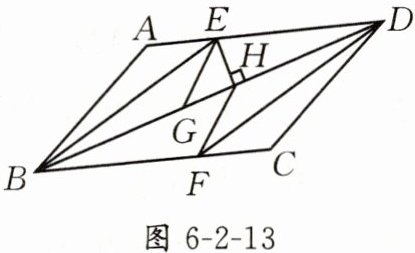
答案
1. $\frac{3\sqrt{5}}{10}$
2. 在 Rt $ △ A B C $中, $ ∠ A C B=9 0° $ $ ∠ A=3 0° $ $ A B=2 0 $ D是线段
AB上的动点,DE//BC交AC于点E,DF $ \bot $ AB分别交射线BC,射线AC于点F,G连接EF。
(1) 如图6-2-14 $ \textcircled{1} $ ,连接CD,若点G恰好平分DF,判断四边形DEFC的形状并证明;
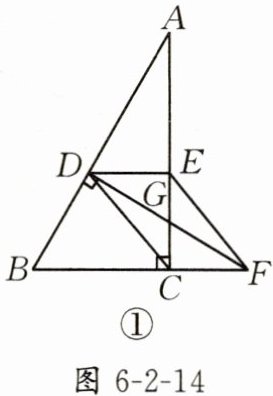
(2) 如图6-2-14 $ \textcircled{2} $ ,设 AD的长为 x , $ △ DEF $的面积为 y,求出 y关于 x的函数表达式;
(3) 当 EF=DB时,求 AD的长。
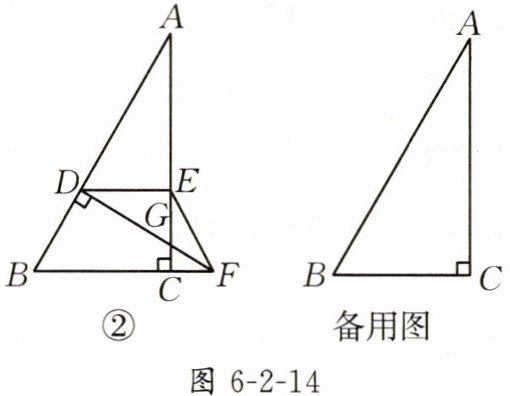
AB上的动点,DE//BC交AC于点E,DF $ \bot $ AB分别交射线BC,射线AC于点F,G连接EF。
(1) 如图6-2-14 $ \textcircled{1} $ ,连接CD,若点G恰好平分DF,判断四边形DEFC的形状并证明;
(2) 如图6-2-14 $ \textcircled{2} $ ,设 AD的长为 x , $ △ DEF $的面积为 y,求出 y关于 x的函数表达式;
(3) 当 EF=DB时,求 AD的长。
答案
2. 解:(1)四边形$DEFC$是平行四边形。
证明:$\because$点$G$恰好平分$DF$,
$\therefore DG=FG$。
$\because DE// BC$,
$\therefore ∠ CFG=∠ EDG$。
在$△ CFG$和$△ EDG$中,
$\because ∠ CFG=∠ EDG$,$FG=DG$,$∠ CGF=∠ EGD$,
$\therefore △ CFG≌△ EDG(\mathrm{ASA})$。$\therefore EG=CG$。
$\therefore$四边形$DEFC$是平行四边形。
(2)$\because ∠ ACB=90°$,$DE// BC$,
$\therefore ∠ AED=∠ ACB=90°$。
$\because ∠ A=30°$,
$\therefore BC=\frac{1}{2}AB=\frac{1}{2}×20=10$,$DE=\frac{1}{2}AD=\frac{1}{2}x$。
在$\mathrm{Rt}△ ABC$中,由勾股定理,得$AC=\sqrt{AB^{2}-BC^{2}}=\sqrt{20^{2}-10^{2}}=10\sqrt{3}$。
在$\mathrm{Rt}△ ADE$中,由勾股定理,得$AE=\sqrt{AD^{2}-DE^{2}}=\sqrt{x^{2}-(\frac{1}{2}x)^{2}}=\frac{\sqrt{3}}{2}x$。
$\therefore CE=AC - AE=10\sqrt{3}-\frac{\sqrt{3}}{2}x$。
$\therefore y=S_{△ DEF}=\frac{1}{2}DE· CE=\frac{1}{2}×\frac{1}{2}x×(10\sqrt{3}-\frac{\sqrt{3}}{2}x)=-\frac{\sqrt{3}}{8}x^{2}+\frac{5\sqrt{3}}{2}x(0<x<20)$。
(3)①当点$F$在线段$BC$的延长线上时,$EF=DB$,梯形$DBFE$为等腰梯形,如答图6 - 2 - 4①所示。
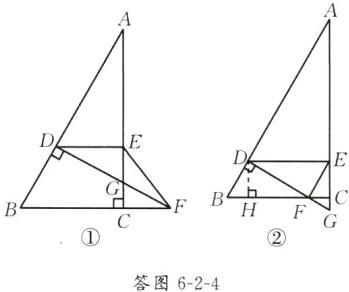
$\because ∠ ACB=90°$,$∠ A=30°$,
$\therefore ∠ B=90°-∠ A=60°$。$\therefore ∠ BFE=∠ B=60°$。
$\because DF⊥ AB$,
$\therefore ∠ BDF=90°$。$\therefore ∠ BFD=90°-∠ B=30°$。
$\therefore ∠ DFE=∠ BFE-∠ BFD=60°-30°=30°$。
$\because DE// BC$,
$\therefore ∠ EDF=∠ BFD=30°$。
$\therefore ∠ EDF=∠ DFE=30°$。
$\therefore DE=EF$。$\therefore DE=DB$。
由(2)可知,当$AD=x$时,$DE=\frac{1}{2}x$,$BD=20 - x$,
$\therefore \frac{1}{2}x=20 - x$,解得$x=\frac{40}{3}$,
$\therefore AD$的长为$\frac{40}{3}$。
②当点$F$在线段$BC$上时,过点$D$作$DH⊥ BC$于点$H$,如答图6 - 2 - 4②所示。
$\because DE// BC$,$DH⊥ BC$,$AC⊥ BC$,
$\therefore DH=CE$。
$\because EF=DB$,
$\therefore \mathrm{Rt}△ BDH≌\mathrm{Rt}△ FEC(\mathrm{HL})$。
$\therefore ∠ B=∠ EFC$。$\therefore BD// EF$。
$\therefore$四边形$BDEF$为平行四边形。
由(2)知$BF=DE=\frac{1}{2}x$。
$\because DF⊥ AB$,
$\therefore ∠ BDF=90°$。
$\therefore ∠ BFD=90°-∠ B=30°$。
$\therefore BD=\frac{1}{2}BF=\frac{1}{2}×\frac{1}{2}x=\frac{1}{4}x$。
$\therefore \frac{1}{4}x=20 - x$,解得$x=16$。
$\therefore AD$的长为$16$。
综上所述,$AD$的长为$\frac{40}{3}$或$16$。
